Tag: Stanley Kubrick

2001: A Space Odyssey (1968)

2001: A Space Odyssey (1968)

Kubrick’s enigmatic masterpiece will open your mind in the same way as its mysterious monoliths

Director: Stanley Kubrick

Cast: Keir Dullea (Dr. Dave Bowman), Gary Lockwood (Dr. Frank Poole), William Sylvester (Dr. Floyd Heywod), Douglas Rain (HAL 900), Daniel Richter (Moon-Watcher), Leonard Rossiter (Dr. Andrei Smyslov), Margaret Tyzack (Elena), Robert Beatty (Dr. Ralph Halvorsen), Sean Sullivan (Dr. Bill Michaels)

When I first sat down to watch 2001: A Space Odyssey I was a teenager. It quickly became clear I had no idea what I was getting into. Somewhere in my mind I pictured an experience a bit like Star Wars. What I wasn’t ready for was the enigma wrapped in a mystery Kubrick actually made. Watching it was rather like a teenager chugging back a fine red wine as their first drink: I spat it out and reached for a can of Fosters. Appreciation for that sort of stuff has to grow with age. Today, for all Kubrick can be self-important, this is visionary, individualistic, ground-breaking film-making. A truly unique piece of film artistry and a masterclass in sound and vision, presenting something unanswerably different. No wonder its impact has stretched through film, like the monolith’s on mankind.

2001 could arguably be about everything and nothing. It was developed by Kubrick and Arthur C Clarke, working in tandem to produce both script and Clarke’s novel. But Kubrick flew in a radically different direction. While he and Clarke populated the novel treatment with greater context, Kubrick felt (as the film reached its conclusion) that explanations weakened the film. Its power lay in maintain the mystery. Kubrick cut a voiceover, trimmed out characters, sliced out dialogue and removed all references to aliens behind events: he left the film itself as a mysterious artifact, the viewer could touch it and experience their own unique odyssey into the unknown.

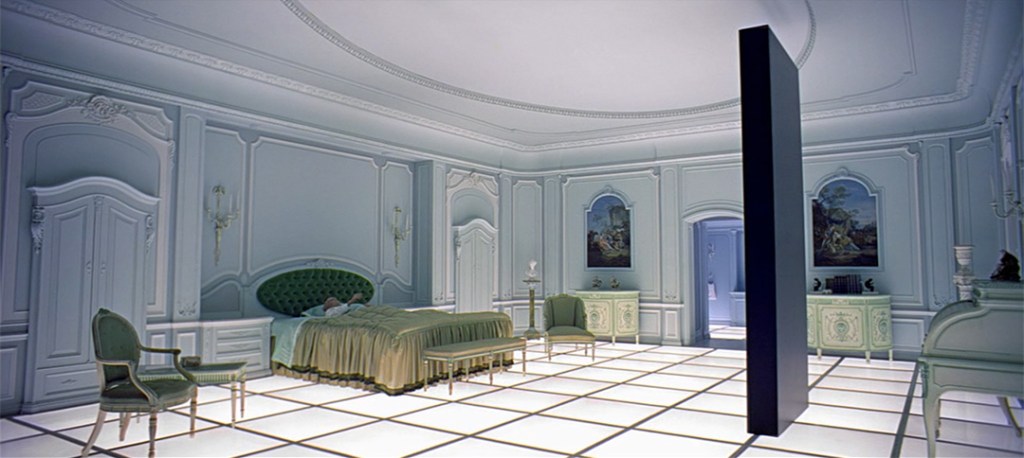
Split into four chapters, we are taken from the dawn of our civilisation to (perhaps) the dawn of our next civilisation. A prologue shows the arrival of a mysterious monolith on prehistoric Earth, where a group of ape-like humanoids encounter it and learn to use tools (namely to hunt and kill). Millions of years later, mankind’s early colonisation of space discovers another mysterious monolith, buried millions of years earlier. A mission is sent to Jupiter years to find out more about its origins. On that mission, all the crew bar Dr Dave Bowman (Kier Dullea) are killed when on-board computer HAL seems to malfunction. Bowman is left alone to encounter a monolith circling Jupiter which takes him into the infinite, a whole lifetime lived in minutes in a dream-like French drawing room, before his rebirth into a giant space baby.

What’s extraordinary about all this, is that Kubrick does nothing to place any of this into an understandable context. 2001 is a sort of Last Year at Marienbad in Space, a journey into a series of questions with no answers – but yet somehow never feels unsatisfying. It’s also fascinating as a work that feels profoundly philosophical, but with very little actual philosophy or insight in it. Instead, what the film supplies is a sort of raw, elemental power that makes you tremble to your very bones. You can feel it worming inside you, its unfathomable imagery, haunting audioscape and sometimes impenetrable logic making it even more engrossing.

It’s often been said the only character in 2001 Kubrick related to was HAL, the emotionless but sinister computer. In fact, I’d say the character Kubrick most relates to is the Monolith. For, essentially, what is it but a film director: a master manipulator holding all the cards, knowing all the answers and choosing what to share with us? We understand nothing in a film without the director’s guiding hand. Like the Monolith, 2001 has such overwhelming awe and majesty that people are drawn to it while barely understanding it. That’s a Godlike power I feel Kubrick relates to.

2001 is a master-class of the director’s art. The visionary beauty of its imagery is breath-taking. From its sweepingly empty vistas of the barren rocks of pre-historic Earth to the serene majesty of space, this is a film filled with indelible images. There is a true power in the geometrical perfect, bottomlessly black Monoliths that make them something you instantly can’t look away from. And don’t forget that 2001 has one of the two greatest jump cuts in history (the other, of course, being in Lawrence of Arabia), as an ape celebrates victory by flinging a bone into the air that cuts suddenly into a similarly shaped space craft as it falls.

Kubrick’s imagery of planets in mysterious line-ups, or the sun emerging over the top of the Moon have helped define how we think of space. His vision of mankind’s future, full of pristine surfaces, corridors that curve and rotate to create gravity has a power behind the simplicity of its design. So mind-bending is Kubrick’s vision of entering the Monolith – a kaleidoscope of colours hurtling towards the camera – that only the knowledge of his control freak self would let you believe that he (unlike many of the film’s viewers) never once dropped acid.

But the real genius Kubrick used was to match the stately, patient beauty of his images – and you can’t deny that 2001 is a film that frequently takes its time – with striking, perfectly selected classical music. You can argue what Kubrick does here is piggy-back emotional and spiritual effect from the work of others. But his choice of musical score is unfailingly, undeniably perfect: there is no chance Alex North’s rejected score could have had the same power. The deep rumblings of Richard Strauss’ Also sprach Zarathustra so perfectly captures the endlessly, unknowable power of space, time and the Monolith itself that it’s now become a landmark piece. The scenes of the ships in space are given a balletic beauty by being perfectly cut to Johan Strauss’ The Blue Danube. Could the Monolith have had both the power and unsettling sense of the unknowable without the sound of Ligeti’s Reqiuem? There is not a single decision to combine sound and visuals in 2001 that isn’t perfect.

And it only adds to the mysterious power of a film that can be deeply unsettling. If there is a transparent philosophical idea in 2001, it’s that mankind uses tools for conquest; the Monolith at first inspires a progression from the empty posturing of rival ape-tribes, into head-smashing violence. And, millions of years later, mankind is still two tribes (East and West), with weapons that could blow each other out of existence. But, whether that was the aim of the Monolith we never know. Just as we never really know what’s going on with Bowman’s fast track life through his neoclassical hotel (though I find something terrifying at Bowman encountering increasingly older versions of himself in silent trepidation).
Is 2001 optimistic or pessimistic about the future? I think Kubrick is aiming for letting us make up our in mind – after all this is our own private communion with his monolith. It matches his own natural inclination for distance. The humans in 2001 are almost impossibly stoic: space travel is no more exciting to them than a plane trip to a frequent flyer (the curved space station is basically an airport, which the character’s treat with the same time-killing blaseness as we do at a terminal). Messages from family members are twice watched by different figures with impassiveness. HAL’s control of the ship is so total, you wonder what the crew is for. Has the Monolith-inspired technology stunted mankind – now we are so dependent on machine that we just cogs in their workings, has progress stalled? 2001 could really be about mankind’s rebirth for a new life.

The HAL sequence – a precursor in many ways to The Shining in its unsettlingly invasive atmosphere – sticks in the mind as it has easily the most dialogue, plot and overt drama. HAL is a brilliant creation – Douglas Rain’s emotionless voice subtly shifting from strangely sweet to terrifyingly relentless to surprisingly sympathetic when he meets his end – and the sheer terror of these technological marvels turning against us (a space probe that shifts into a sort of monster, followed by a jump cut to HAL’s glowing red eye is just breathtakingly brilliant).

But if 2001 is short of narrative drive, surely that was Kubrick’s point? To keep 2001 as a mysterious encounter with no real answers. It opens and closes with two thirty-minute sequences devoid of any dialogue (the last word we here is “mystery”) and gives us such a blast of the senses that it feels more like being flung into a void of unanswerable questions. I was certainly not ready for that when I first watched it. But now, I just have to bow before Kubrick’s mastery. This inspired so many, its power is felt in thousands of works of art since. And it does this because it balances awe, wonder and mystery in a masterful way few other films can. You learn nothing in 2001. It has no real message, argument, or philosophical points, But yet it leaves you utterly satisfied, bursting at the seams with the power of your own imagination. That’s masterful film-making.

Dr Strangelove; or How I Learned to Stop Worrying and Love the Bomb (1964)

Peter Sellers tries to stop the end of the world in the terrific satire Dr Strangelove

Director: Stanley Kubrick

Cast: Peter Sellers (Group Captain Lionel Mandrake/President Merkin Muffley/Dr Strangelove), George C. Scott (General Buck Turgidson), Sterling Hayden (Brigadier General Jack D Ripper), Keenan Wynn (Colonel Bat Guano), Slim Pickens (Major “King” Kong), Peter Bull (Russian Ambassador), Jack Creley (Mr Staines), James Earl Jones (Lt Lothar Zogg), Tracy Reed (Miss Foreign Affairs)

“Gentlemen you can’t fight in here. This is the War Room!” Kubrick’s hugely influential satire helped shape our perceptions of the Cold War and its mantra of mutually assured direction. Showing no mercy to its targets, it mixes Goonish schoolboy humour with moments of genuine tension and rising horror. Sure it features some of the faults of its director –self-importance, cold distance and much of the wit is due to Sellers and the performers rather than the not-particularly-witty-Kubrick – but there is no doubt it remains a seminal classic.

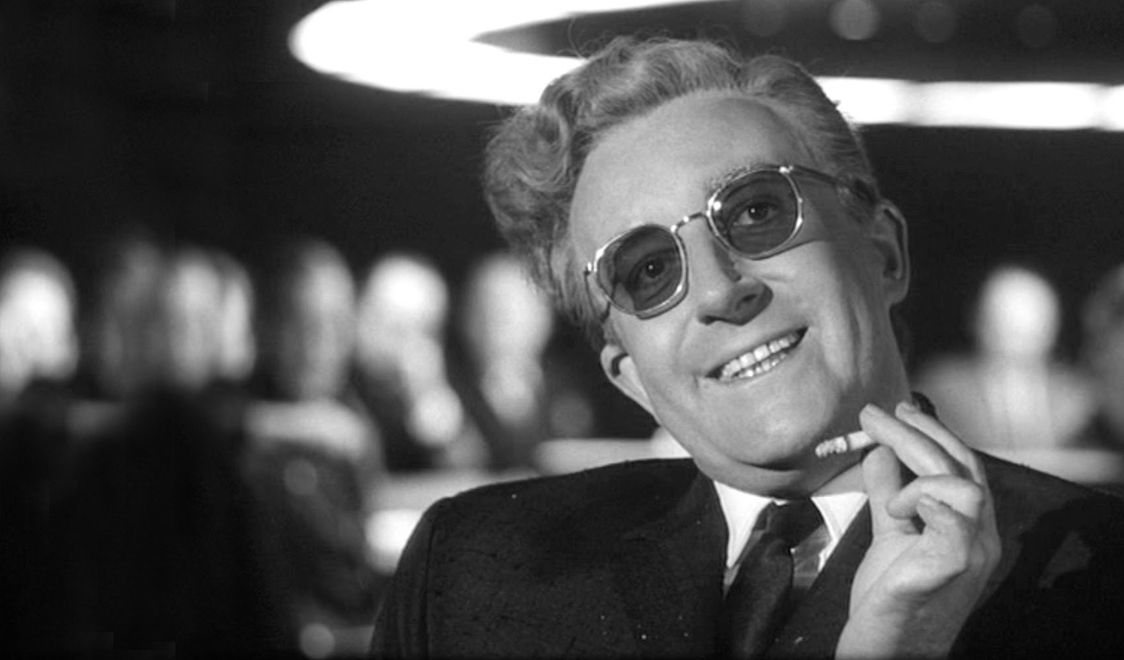
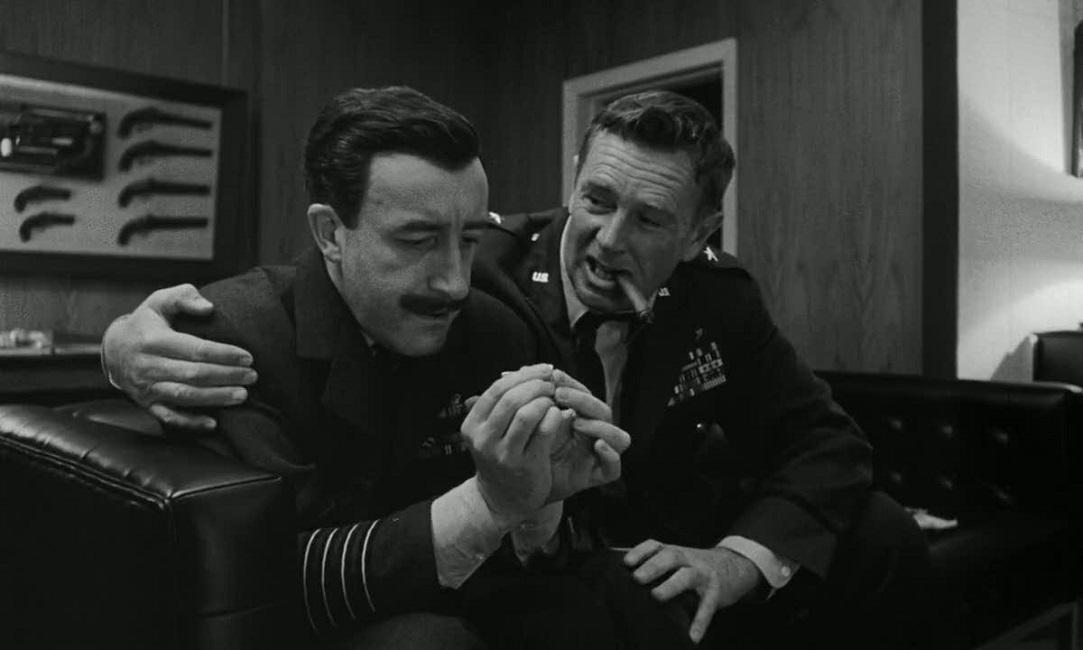
General Jack D Ripper (Sterling Hayden – excellent) orders his planes to drop their nuclear bombs on the USSR. Ripper is launching a pre-emptive strike to protect the American way of life from the Commies and, most importantly, to protect our precious bodily fluids. Yup he’s crazy, something his second-in-command RAF Group Captain Lionel Mandrake (Peter Sellers) quickly realises, but can’t do anything about. US President Merkin Muffley (Sellers again) reacts with horror at the prospect of all-out-war, negotiating with the Soviets to co-operate in shooting down the planes, while some of his advisors such as trigger-happy General Buck Turgidson (George C Scott, hilariously OTT) argue perhaps there is some merit in striking first. And sinister former-Nazi scientific consultant Dr Strangelove (Sellers one more time) spells out the impact of nuclear war.

Kubrick quickly came to the conclusion that if you were going to make a film about nuclear war, it almost couldn’t be anything buta comedy: after all the idea of two sides building a huge arsenal of weapons capable of destroying the world was so crazy, you wouldn’t believe it if you were told it. Dr Strangelove therefore ends up taking place in a world that’s one third grounded and two-thirds heightened reality. There is a great deal of college-style humour in the film (you can see it in those characters names which reference everything from the Whitechapel killer to female genitalia and excrement), but it works because its (mostly) played dead-straight.

Part of the film’s appeal was the number of sacred cows it slays. All the things that, at the time, America was meant to respect were ridiculed. The military, politicians, the Presidency, America’s moral authority, the ingenuity of American science and engineering. It’s all shown to be ineffectual, misguided, underpinned by fascist-tinged insanity, myopically obsessed with big bangs over humanity or plain ridiculous. Every single authority figure in the film is deconstructed over its course as some combination of childish, empathy-free or useless. You can’t come out of this film and every again have an unquestioning assurance our leaders know what they are doing.

This works, because it’s placed in a film that in many ways has the plot of a far more serious film (its very similar of course to Fail Safe). Chunks of it are played completely straight, or with just the merest touch of the surreal. In particular the sequences set on the bomber, commanded by Major Kong (played at short notice by Slim Pickens after injury prevented Sellers taking on that role as well) have that true sense of Kubrickian detail in their careful staging of all the procedures a bomber crew would follow (even if it still allows some fun to be poked at the expense of the survival kit, the contents of which would give a fella “a pretty good weekend in Vegas”).

Those bomber scenes sometimes outstay their welcome in their cold technicality (it’s odd to say that a film as short of this sometimes feels a little overlong), but that’s largely because in a film that is clearly demanding us to shake our heads at the madness, it struggles to get us invested in a more conventional heroic story (especially as success there is starting a nuclear conflagration).

Perhaps that’s because of the coldness in Kubrick’s style – emotion doesn’t often find its way into his greatest works, and he was often reliant on working with the right people (get a McDowell in it or a  Nicholson and things can click, get an O’Neal and you can get a different story). Humour isn’t his strong suit, but fortunately he worked with Sellers at his finest hours. Sellers takes on three roles, all of them a sharp contrast, and he’s masterful in all of them. There were fewer more gifted improvisational performers than Sellers, and each of his parts benefits hugely from the dynamism (of various sorts) he gives them. It’s also interesting that two of them are actually the “one sane man” (Muffley and Mandrake) while Strangelove is a pantomime monster of insanity (introduced late in the film, he’s the final indicator that our fates are in the hands of complete lunatics).

For Mandrake, Sellers parodied the stiff-upper lip upper class, with Mandrake a stuffed-shirt, attempting to wheedle recall codes out with Ripper with a clumsy bonhomie. Muffley is played almost dead-straight as a weak man out of his depth. But he does have a phone call monologue with the Russian premier (largely improvised with Sellers) that is one of the funniest things you’ll ever see. There’s no restraint in Strangelove, a wheel-chair bound grotesque with a phantom (hardcore fascist) hand, constantly suppressing involuntary Hitler salutes and trying to hide his mounting excitement at the prospect of worldwide annihilation (“Mein Fuhrer! I can valk!”).

Kubrick’s directorial approach – wisely – seems to have been to acknowledge that Sellers was providing so much of the madness and dark comedy the concept demands, that he could be more restrained. Interestingly, for being his most famous film, it often feels like one of his least personal ones. It stands outside much of the Kubrick cannon – it’s short, its often brisk, technically it’s unflashy and often unobtrusive – and it plays on the director’s weakest vein, comedy.

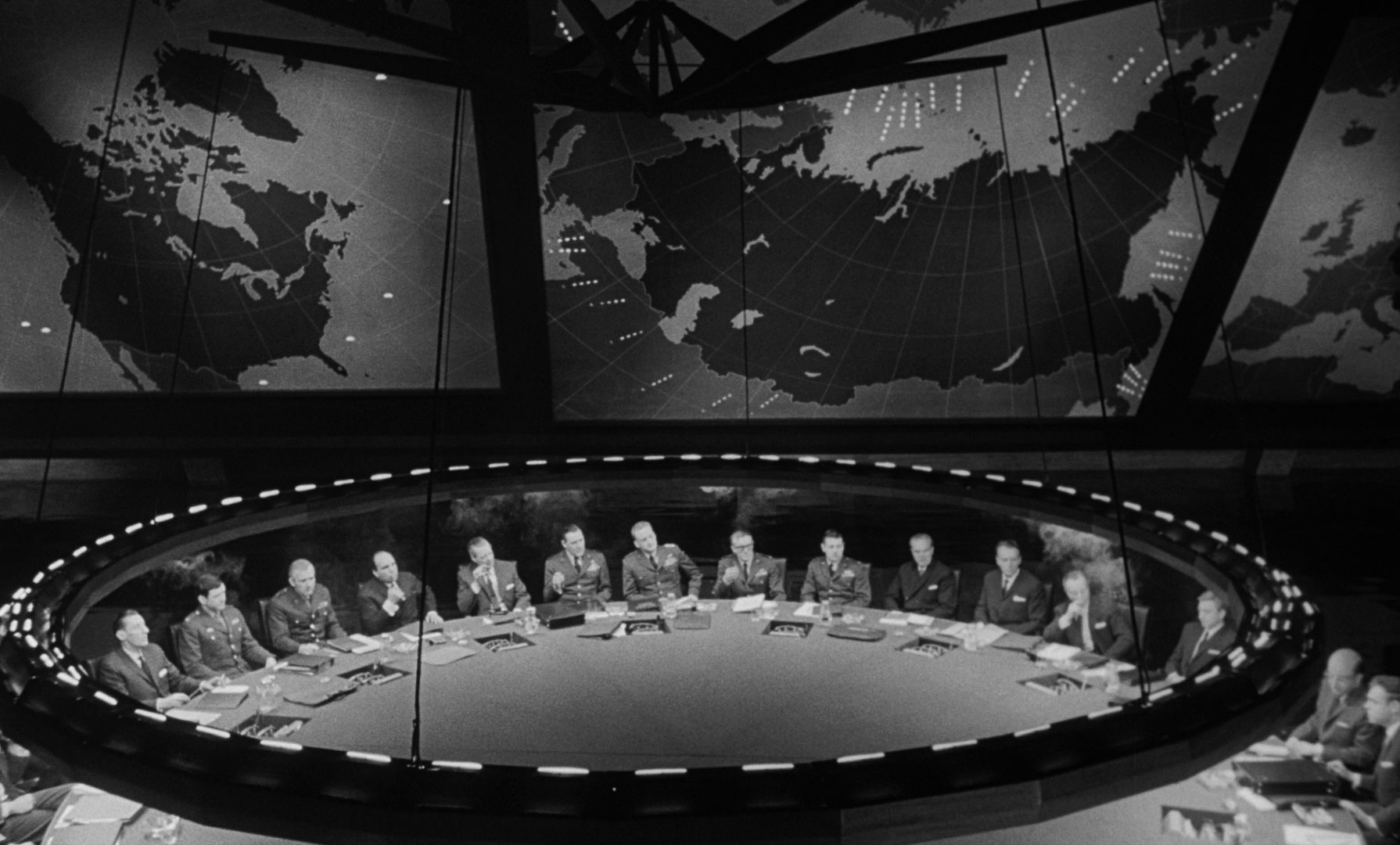
But it’s got his mastery of detail – partly also due to its faultless set design by Ken Adam. The reconstruction of the bomber interior is overwhelmingly convincing (the Air Force was amazed at how accurate it was). Ripper’s low-ceilinged office is a visual metaphor for the character’s insular insanity. Most influential of-all, the Bond villain-ish War Room, with its vast circular table and huge screens was so perfectly conceived, it cemented the idea for generations of what war planning rooms should look like (Reagan even asked where it was when he took office). The film may be darkly surreal, but its surroundings give it an authority that is essential for its success.

Authority is what the film needed to work. Perhaps that’s the greatest contribution of Kubrick, to create a structure of convincing reality, allowing the surreal and insane actions to work. From Ripper’s clear fixation on his own impotence (“I do not avoid women but I do deny them my essence”) – to Turgidson’s increasingly bombastic militarism (“I don’t say we won’t get our hair mussed, but I do say no more than 10 to 20 million killed. Tops.”), they all work because they contrast with a setting soaked in reality and detail. It also adds the important depth that gives the film impact: sure it wouldn’t happen like this, but something like this could happen.

Dr Strangelove’s humour has at times dated – there’s something undeniably schoolboyish about its tone. Stretches showing the detail of the bomber’s operation go on way too long. The film itself also takes a while to get going, and like many Kubrick films it has an air of being pleased with itself. But in Sellers it has a comic genius at the height of his game and its impact in changing the way we think about the world can’t be denied. Still a classic.

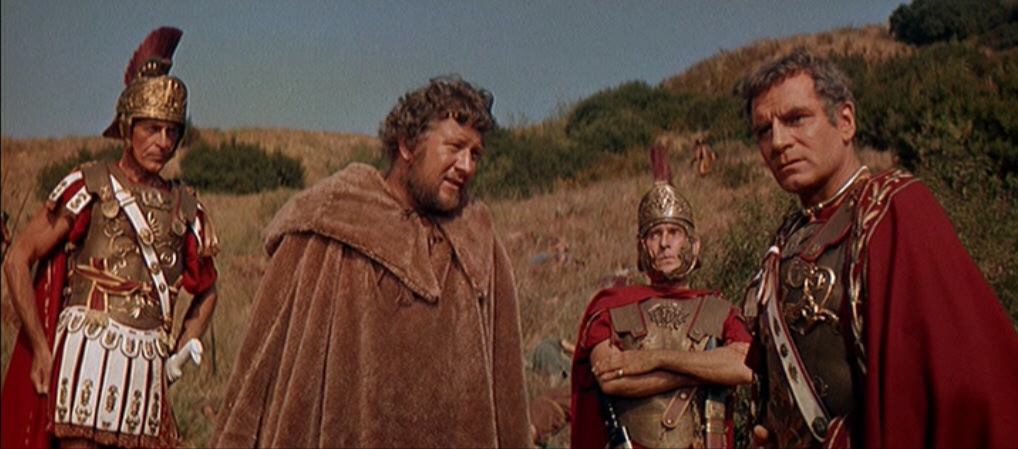
Spartacus (1960)

Kirk Douglas leads the campaign for freedom in Spartacus

Director: Stanley Kubrick

Cast: Kirk Douglas (Spartacus), Laurence Olivier (Crassus), Jean Simmons (Varinia), Charles Laughton (Gracchus), Peter Ustinov (Batiatus), Tony Curtis (Antoninus), John Gavin (Julius Caesar), John Dall (Marcus Glabrus), Nina Foch (Helena Glabrus), John Ireland (Crixus), Herbert Lom (Tigranes Levantus), Charles McGraw (Marcellus), Joanna Barnes (Claudia Marius), Woody Strode (Draba), Paul Lambert (Gannicus)

You can’t talk about Spartacus without saying it can you? Did the team working on the film realise that, for all the big names, spectacles and sweeping that the film’s definitive contribution to popular culture would be the sound of a hundred men all claiming to be the slave leader? But it’s the moment you think of more than any other when the film comes up – and there’s not many films that can claim to have contributed such an instantly recognisable moment to our cultural heritage. It’s not the film’s only merit though: this is grand, entertaining, old-school Hollywood epic-film making.

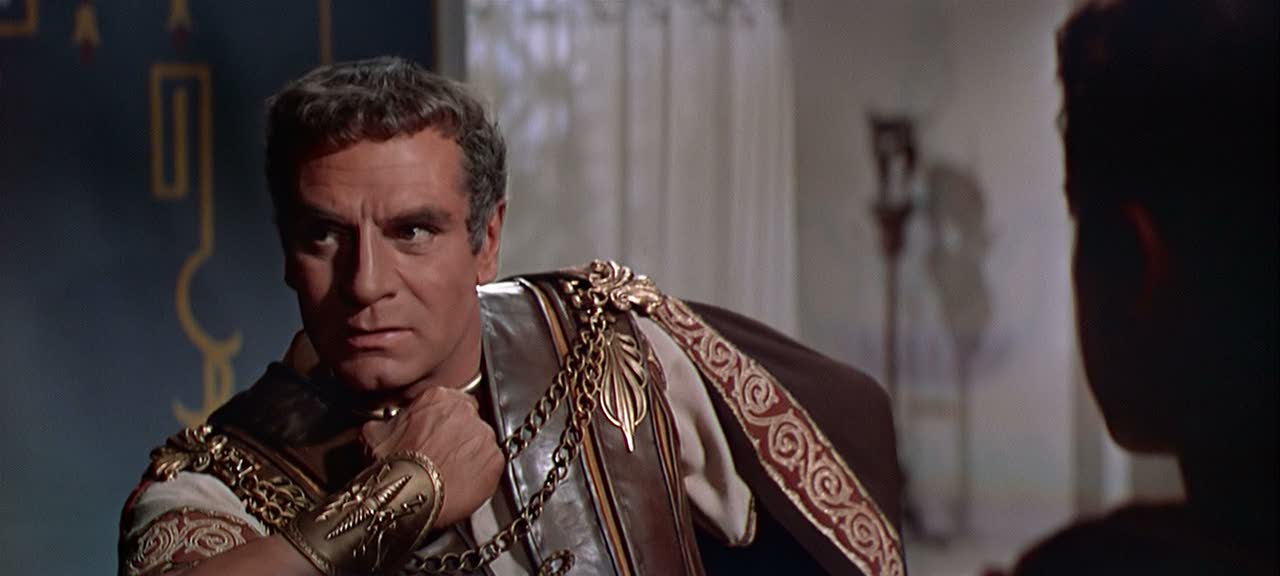
In the last decades of the Roman Republic, Spartacus (Kirk Douglas) is a young man born a slave, purchased by gladiator trainer Batiatus (Peter Ustinov) to learn how to thrill the crowds and kill his opponents. There he falls in love with slave-girl Varinia (Jean Simmons) and clashes with the regime of the training school. Revolt however stirs when rich nobleman Crassus (Laurence Olivier) arrives at the school and demands a fight to the death of his entertainment – as well as purchasing Varinia. In the aftermath, Spartacus leads a revolt – which grows into a huge army that soons puts all of Rome at risk. But a risk is also an opportunity: certainly it is for Crassus, who sees this as his chance to bring the Republic under his control.

Spartacus is a grand piece of film-making, shot on a huge scale, a labour of love for Kirk Douglas as producer. Upset at being denied the lead role in Ben-Hur, Douglas decided to make his own Roman epic – and to make something even grander than that Oscar-winning epic. Everything was thrown at the screen: grand locations, huge sets, star actors and a sweeping epic score. Alex North’s classically tinged score – with it’s distinctive employment of Roman instruments and echoing of both the intimidating splendour of Rome and the bucolic happiness of the liberated slaves – is proper old-school Hollywood score-making, that helps set the scene for the film’s epic sweep.

And Spartacus is epic – and epic entertainment. While it’s possibly a little too long, it knows when to spice up events with a battle, love scene or bit of political skulduggery. There are multiple story lines going on in this film, and interestingly they don’t all intersect. It’s easy to see Spartacus – and his struggle for freedom – as the real story of the film. But for most of the Roman characters, this is an embarrassment or sub-plot. There is a whole other story happening around the struggle to preserve Roman Republicanism – with Crassus as the face of oppression and his opponent Gracchus the slightly soiled but still vaguely democratic face of the old system. Both plots only rarely come together, and while that of Spartacus captures the heart strings, a lot of the film’s narrative drive is in the Roman conspiracies.

Perhaps this is because in the entire rebellion only Spartacus and Varinia qualify as really having personalities. And those personalities are basically flawless. Spartacus is almost saint-like in his nobility, a guy who never does anything wrong and whose only mistake is trusting others in a shifting world. Douglas does a great job of performing a character who is practically a living legend – and he completely convinces as the sort of leader his people would follow to the end. His relationship with Jean Simmons is also touchingly sweet and innocent – the film is very good at capturing the sense of how stunted the emotional lives of slaves have been, and the powerful joy they can find in the freedom of simple intimacies so many of us take for granted.

But the slaves themselves are frequently (whisper it) rather dull. Many of them might as well be sitting around the camp fires singing Kumbaya. Bar a brief moment at the start, no suggestion of taking vengeance raises its head. The liberated slaves sing, clap hands and gaze with joy. Children play and people frolic in the fields. Tony Curtis – good value as Crassus’ ex-bodyman, a learned man and entertainer of children – stages a magic show, with patter that could have come straight out of a Brooklyn street. Other than him, none of the slaves register as personalities. A tint of darkness, or moments of fury or even dangerous rage against their oppressors would have made a world of difference. But this is a simple film, where the slaves are building a utopia.

That’s probably why the film is more interested in the politics of the Romans. It’s certainly where the big name actors end up. Olivier is at his prowling, imperialist best – a heartless slice of ambition determined to bend events to his will. Against him, Charles Laughton with an impish cheek, a slightly corrupted air, as the man-of-the-people. These two conduct their own political battle of cut-and-thrust that Spartacus barely realises is happening. This manoeuvring is the real dramatic heart of the film, powered by these actors strengths (John Gavin and John Dall as their lieutenants look and sound very plodding against the playful archness of Olivier and Laughton).

That’s partly the point of Dalton Trumbo’s script (Douglas famously broke the Hollywood Blacklist by crediting Trumbo for his work on the film). While Rome plays politics, real people are fighting and dying for liberty – and will eventually find themselves crucified with nothing left but their pride and sense of freedom. It’s that feeling that probably lies behind the enduring love for this film.

It is perhaps Kubrick’s most universally beloved film. Interestingly though, it’s also the one Kubrick was least proud of. It’s true the film lacks much of his personal touch. While directed with flair and skill, parts of it could really have been made by any number of directors (not something you could say, for example, about The Shining or Barry Lyndon). Kubrick often quietly, albeit gently, disowned the film (he said he never knew what to say when people asked him about it). It’s the only Kubrick film where he was a “gun for hire”, subservient to the vision of the producer. His interest you feel is in the smaller moments – moments such as Woody Strode’s excellent cameo as a Gladiator (many of the strongest moments with the slaves in the tyranny of the Gladiator school, where life is meaningless and cheap). Really, it’s Douglas’ film – it’s similarities to The Vikings for example is striking – and while a poor advert for auteurism, it’s still a great advert for entertainment.

Kubrick’s greater interest in human failings and shades of grey perhaps explains why the Romans emerge as the more interesting characters. Spartacus’ lack of flaws were an intense frustration to him. Perhaps that’s why Peter Ustinov (who won an Oscar) is the films stand-out character. As gladiator owner Batiatus, Ustinov is devious, playful, amoral, ambitious, without principle, dryly witty but somehow still has touches of decency. The most colourful character in the piece is also the one most coated with shades of grey.

*It’s an advert for what makes Spartacus lastingly engaging and interesting whenever you watch it – even if the cry of “I’m Spartacus!” and the decency and honour of the slaves is always going to be what stirs the emotions and tugs the heartstrings. Douglas set out to make one of the greatest “sword and sandal” epics. He succeeded.

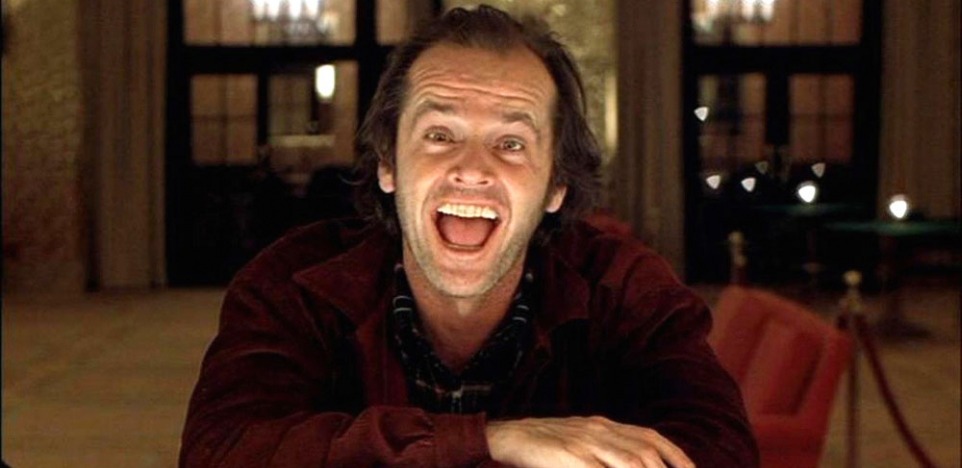
The Shining (1980)

Jack Nicholson loses his mind in The Shining

Director: Stanley Kubrick

Cast: Jack Nicholson (Jack Torrance), Shelley Duvall (Wendy Torrance), Danny Lloyd (Danny Torrance), Scatman Crothers (Dick Hallorann), Barry Nelson (Stuart Ullman), Philip Stone (Delbert Grady), Joe Turkel (Lloyd), Anne Jackson (Doctor), Tony Burton (Larry Durkin)

I’ve often had mixed feelings towards Kubrick’s films. He’s impossible not to admire and there is no doubt many of his films are landmarks in cinema. But I’ve also often found him a brilliant technician, a striking intellectual but an emotionally cold and distant director, who seizes the brain and sense but doesn’t always engage the heart. It’s perhaps unsurprising that a director who has such control over the tools of cinema should be able to use it to create one of the greatest horror films of all time. Because what else is horror but the expert use of technique to unsettle and scare the audience? It’s like the genre Kubrick was destined to try – and succeed at.

The Shining was itself partly born out of Kubrick’s disappointment at the reception given to Barry Lyndon, his cinematically rich, but emotionally unengaging (to many) Thackeray adaptation. It garlanded awards, but praise that was more respectful than fulsome – while audiences had largely stayed away. Kubrick may be an artist – but he still wanted people to see his work. He decided to direct a film based on a poplar horror novel – after all people have been seeing slasher and fright pics for decades, so why not get a piece of that action? Stephen King’s novel was one of the few that engaged him (allegedly the famously highbrow Kubrick spent months reading part way into various horror novels before flinging them across his office in contempt). Sure Kubrick – much to King’s annoyance – junked many of the author’s themes in favour of his own. But in doing so he created a terrifying and deeply unsettling experience that stands as his most effective late work.

In the abandoned, and snow isolated, Overlook Hotel during off-season, writer Jack Torrance (Jack Nicholson) is hired as caretaker to keep the building running. Accompanied by his wife Wendy (Shelley Duvall) and young son Danny (Danny Lloyd), Torrance hopes to use the isolation time to come up with a draft of his new novel. However, dark forces are at work at the hotel. Ten years ago the caretaker butchered his whole family there, and the deaths have left a psychic legacy on the building. This is picked up on by the ESP-powered Danny, but also begins to play on the psyche of Jack who slowly begins to become ever more short-tempered, twitchy and unhinged as time goes on.

The Shining is one of the most frightening and unsettling films I’ve ever seen. And I attribute that completely to Kubrick’s mastery of the language of cinema. Every single frame, every single note on the soundtrack, has been perfectly shaped to inspire dread in the heart of the viewer. There are no cheap tricks, no jump scares, no obvious cinematic parlour games. Instead this is Kubrick using his technical artistry. What else can you say when one of the most disturbing things in the film is the changing sound of Danny’s tricycle as he cycles round the hotel (in a single, low angle, tracking shot), going from near silence as he cycles over carpet to bursts of sound as he cycles over wooden floor? When the score overwhelms with discordant sound and high notes as Danny simply stares at a door? 

But Kubrick’s genius is everywhere. He understands how the human brain is unsettled by symmetry. Watch the film again and see how so much of it is perfectly framed, how still the camera often is, how images – such as shots of corridors or rooms – are set in such a way to make the image look symmetrical. Something is off in our minds about seeing a building that looks so precise. It transfers as well when the actors are caught in the middle of the frame, with the set either side of them looking identical. Our mind keeps telling us it’s wrong. It feeds into our own doubts and fears. It disturbs us completely. Stillness and quiet mix with bursts of colour. For every elevator door opening to deposit a tidal wave of blood, there is the quiet intimacy of Philip Stone (absolutely chilling) as a ghostly representation of a past janitor, urging Jack to “correct” his wife and child.

That fear of symmetry extends as well to Kubrick’s use of two girl twins as ghosts of the former caretaker’s murdered children (and their stillness and softness of voice is equally terrifying). The ghosts throughout this film that urge Jack on in his murderous rampage are almost uniformly softly spoken, calm and polite – qualities that carry more and more menace. Even when the horrors begin to erupt, Kubrick keeps the camera movement and editing slow, gentle and frequently employs tracking shots (naturally leading to the invention of a new type of Steadicam). Where jump cuts are used they are to give us flashes of Danny’s ESP visions of the hotel (sudden cuts to the murdered girls or other horrors), enough to jolt us and working all the more in the rest of the film’s measured pace and gothic chills.

Kubrick also brilliantly makes use of the psychological impact of isolation. Out in the middle of nowhere, it’s clear time quickly loses meaning. The film is punctured throughout with title cards that seem increasingly random, either naming days (with no indication of how much time has passed between them) or time jumps that seem unconnected with the previous scene. It’s quick to see how much the Torrance’s perception of time has been lost in never-changing surroundings. The impact of constant isolation on a fragile psyche is perhaps something we are even more acutely aware of in 2020, and it’s clear that it has a catastrophic effect on Jack, who becomes ever more susceptible to his bad angels.

Those bad angels are partly where Kubrick begins to deviate from King. Not surprisingly, with Kubrick’s often nihilistic view of humanity, he introduces the idea that Jack has a history of violent temper and even striking Danny. This is very different from King’s idea of a good man and father being bent out of all recognition by the hotel’s evil into a would-be murderer. It’s possibly the main objection King had against the film’s changing of the novel. That and Kubrick’s clear disinterest in “shining” – the name given to the ESP qualities some of the characters display. For Kubrick, what was more important was the unsettling impact environments can have on people’s psyches – amplified in this case by terrifyingly bloodthirsty ghosts. For King the corruption of the good from evil among us was crucial. Both are fascinating ideas – but you can see why the book’s author would not be pleased to see his concepts sidelined.

Part of this may also have stemmed from the casting of Nicholson. Probably the greatest American actor of the 1970s (his hits during that decade are astonishing), this was the first chapter in a new era. Now Nicholson became JACK, part actor but part personality, so larger-than-life that you only had to say his first name for everyone to know who he was. Sure, Nicholson is (like in A Few Good Men) a ticking time bomb, but the performance works. It’s the film where Nicholson embraced for the first time the demonic grin and leer of cruelty he would use so well. But seeing him attack the film’s gothic qualities, while still having a touch of humanity for its quiet moments, works a treat. Could any other actor in the world have pulled off “Here’s Johnny!” and still have us absorbed in the character and the film? It’s pantomime, but brilliance.

More controversial is Shelley Duvall’s weepy, slightly pathetic wife. Much of Duvall’s wetness in the role is surely connected to the reportedly miserable time she had on set. To draw the “right” reactions from her, Kubrick essentially bullied her on set, putting her through hell. Sometimes hundreds of takes were done of even the most trivial scenes to get them right (this film perhaps cemented Kubrick’s reputation for ludicrous perfectionism), a regime that reduced Duvall to a state of near psychological collapse. While this was perfect for her performance, it was hardly conducive to her well-being. And was in itself perhaps another sign of the lack of heart in Kubrick, a director concerned only in the end with effect not emotional truth.

So it’s a black mark against the film. But The Shining is still a masterpiece, perhaps one of Kubrick’s greatest films. The film was so dependent on its technical wizardry, detailed perfection and preciseness that its impact becomes almost unbearable. It focuses on all Kubrick’s strengths and almost none of his weaknesses – indeed his basic dislike of people becomes crucial to its effect rather than running counter to an audience’s need to invest. Tense, unsettling, troubling and in the end deeply scary, while never feeling cheap or exploitative. It’s a landmark in both its genre and its director’s career.

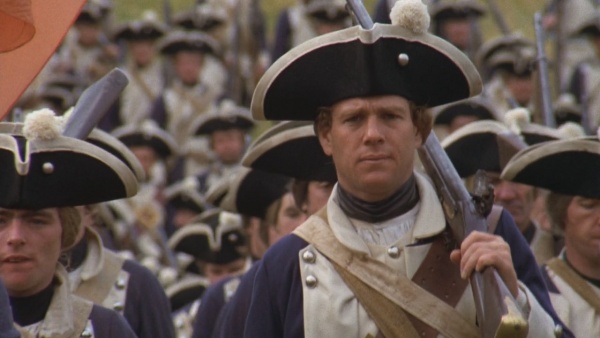
Barry Lyndon (1975)

Ryan O’Neal is Barry Lyndon in Kubrick’s brilliantly distant epic

Director: Stanley Kubrick

Cast: Ryan O’Neal (Redmond Barry), Marisa Berenson (Lady Lyndon), Michael Hordern (Narrator), Patrick Magee (Chevalier du Balibari), Hardy Krüger (Captain Potzdorf), Marie Kean (Belle Barry), Gay Hamilton (Nora Brady), Godfrey Quigley (Captain Grogan), Murray Melvin (Reverend Samuel Runt), Steven Berkoff (Lord Ludd), Frank Middlemass (Sir Charles Reginald Lyndon), Leon Vitali (Lord Bullingdon), Leonard Rossiter (Captain John Quin), André Morell (Lord Wendover), Anthony Sharp (Lord Hallam), Philip Stone (Graham), Arthur O’Sullivan (Captain Feeney)

Kubrick has been criticised as a director more interested in style and the technical tricks of cinema than emotion, and there is perhaps no argument for the prosecution than Barry Lyndon. It now seems to the cineaste’s choice du jour as the greatest Kubrick film (probably partly because it is less well-known). Barry Lyndon however is like an exercise in all Kubrick’s strengths and weaknesses, a film that you can admire at great length while simultaneously caring very little about anything that happens in it.

Based on a William Makepeace Thackeray (although it feels in spirit only), Barry Lyndon tells the story of Irish chancer Redmond Barry (Ryan O’Neal) in the mid eighteenth century. Fleeing Ireland after (he believes) killing an English officer in a duel, Barry goes from the British arm to the Prussian army, to card-sharping the courts of Europe to marrying into the aristocracy, as husband to Lady Lyndon (Marisa Berenson). But, however hard he tries, it’s difficult for an Irish chancer to be accepted by the British aristocracy, particularly when he suffers from the vocal hatred of his wife’s son Lord Bullingdon (Leon Vitali). 

Kubrick spent several years carrying out research for an epic biopic of Napoleon (he had Ian Holm lined up for the lead role – Holm read multiple biographies and spent months working on a script with Kubrick). The flop of Waterloo (with a deliciously hammy Rod Steiger as Napoleon) killed off the chances of that film making it to the screen. Never-the-less Kubrick now had a vast archive of research for the period – and how easy it was to shift the focus of this research back a few decades. Thackeray’s novel was his chance to put all this to use – and allow Kubrick to indulge what had become a passion for the style of the era.

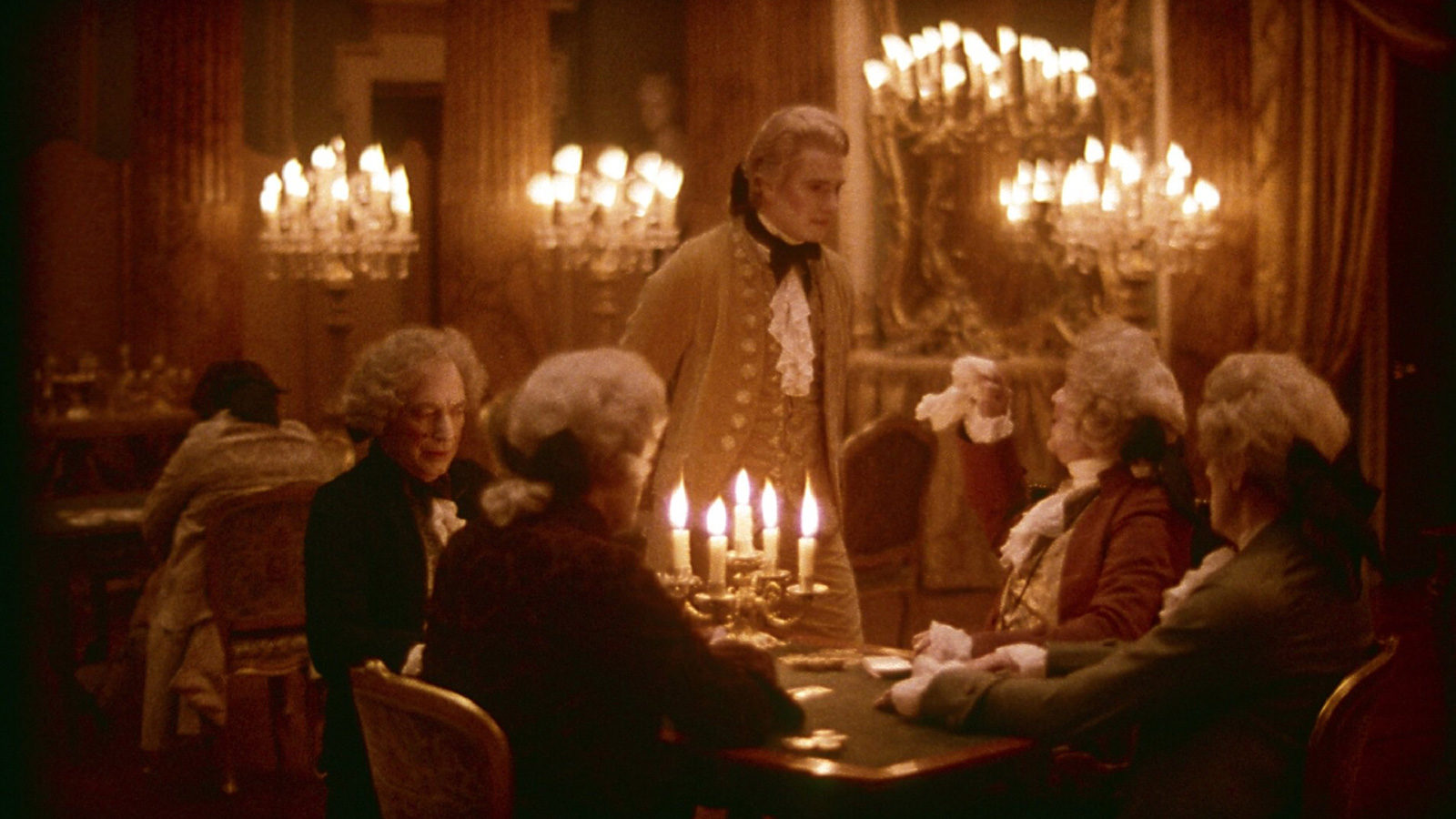
Barry Lyndon won four Oscars – and all in the areas where the film deserves unqualified praise. This is a stunningly beautiful piece of work, surely a contender for one of the most strikingly gorgeous films ever made. Ken Adam’s set design utilises a superb range of locations across the UK, dressed to breath-taking effect. The costumes, completely accurate to the period, are exquisitely detailed (Milan Canonero and Ulla-Britt Söderland) and lusciously mounted. Leonard Rosenman’s score is a wonderful riff on a range of masterpieces from classical music, including Handel, Bach, Schubert and Mozart.

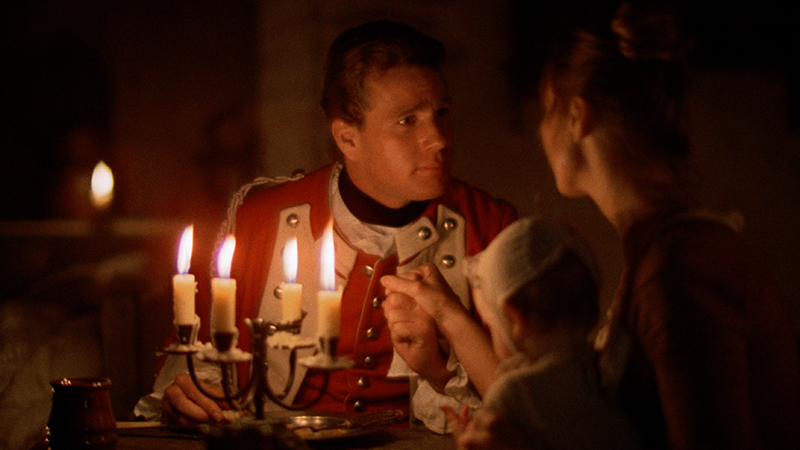
Most strikingly Kubrick decided to film as much as possible with natural lighting only, rather than the vast array of lighting bought in for most films. This was part of Kubrick’s intention to avoid any sense of the studio to his film – everything was to be shot on location and to help immerse the viewer in the detail of the period. Shots were framed to imitate artists of the period, in particular Hogarth. Evening scenes were shot lit only by candle-light, leading to truly stunning images, simply superbly lit. John Alcott’s photograhy utilised (and I’m serious here) NASA designed cameras used for the moon landings to capture images in such low light. Visually, Barry Lyndon may be one of the most perfect films ever made. It’s wonderful – and any doubts that Kubrick is not a true master of cinema should be dismissed.

But Kubrick’s problem, as always? He’s a technocrat artist who lacks some soul. So much time and energy has been expelled on the visuals and the design – the film took almost a year to shoot – that, while you are constantly almost hypnotised by its sublime imagery, it slowly occurs to you that you couldn’t care less about most of the events that happen in it. For all the film’s great length and beauty, it’s a cold and distant film. Kubrick turns Thackeray’s rogueish comic tale – a picaresque dance – into a chillingly sterile meditation on fate, with Barry transformed from a rogue and chancer into a lifeless, passive figure to whom things happen rather than ever attempting to instigate them. 

Is this Kubrick’s idea of humanity? Perhaps it suits the director who was the great master of intricate design and traps, that he would be tempted to turn this story into one where humans are just another piece of set dressing moved around and manipulated by an unseen force (fate, or rather a director?). The distancing effect is further by super-imposing an all-knowing narrator over the events, who frequently pre-empts what will happen and stresses the powerlessness of men. (On a side note, the book is narrated by Barry as were early screenplay drafts – perhaps the idea of O’Neal’s flat voice narrating so much of the action horrified Kubrick. It’s a definite improvement to get Michael Hordern’s tones talking to us for three hours.)

Perhaps though, the failure to capture any sense of Thackeray’s satirical wit, is a sharp reveal of Kubrick’s own inability to appreciate comedy – without the guiding hand of a Peter Sellers to support him. The problem is exacerbated by Ryan O’Neal in the lead role. Kubrick was ordered to hire one of the top ten box office draws of 1972 in the lead role – alas only O’Neal and Redford were the correct age and sex, and Redford (first choice) could never see himself as an Irishman masquerading as an Englishman. So O’Neal got the job – and the film is a damning indictment of his lack of charisma, flat and dry delivery and inability to bring life and energy to the proceedings (although O’Neal has blamed the editing partly for this, as well as the extended shoot). The film helped put an end to O’Neal’s career as a star (already on the wane) – and he is the film’s greatest weakness, in a role that needed more of the impish charm of Malcolm McDowell (although the lead actor from any of Kubrick’s films would have been superior). O’Neal’s presence turns Barry into a character we care nothing for, in a story already coldly distant.

O’Neal is also not helped by Kubrick’s utilising again his great love of striking British character actors – every role is filled with a recognisable face from 1970s British film and TV, each bringing colour and vibrancy to their (often brief) scenes. From Leonard Rossiter – weasily as you’d expect – as the captain Barry thinks he kills, through Patrick Magee’s ambivalently sinister Chevalier, Marie Kean’s loving mother, Murray Melvin’s obsequious priest, Godfrey Quigley’s matey army officer there is not a weak turn elsewhere in the movie. Leon Vitali brings real depth and energy into the film late on as Barry’s son-in-law and hated rival. Even Marisa Berenson – reduced to a dozen lines at most – makes an emotional impression as a woman trapped into serving the needs of the men in her life.

All these actors however are revolving in a movie that gets stuck and overwhelmed in its own grandeur and beauty. There are many wonderful sequences – with the film bookended by two duelling sequences that explore the strange rules and conventions with this society with a vicious black humour. Kubrick’s points about the oppressive insularity of the establishment – and the amount of forgiveness it has for its own, compared to the instant judgement of the outsider – are generally well-made, but are at times so laced with the director’s own cynical views of humanity in general (an increasingly clear trait in his later work) that they carry little impact. Despite this the film is never less than strangely captivating, even if its very easy to let it drift past you rather than invest in it.

But above all, while the film is stunning and the direction of Kubrick near faultless, the film itself gets so close to a great painting that it becomes something you hang on the wall to admire, but not to invest in. Kubrick couldn’t match his genius with the sort of emotion or wit that the story needed (much as it’s vastly superior to Tom Jones, that film gets closer to the spirit of authors like Thackeray than this ever does). Instead, he creates a coldly sterile world, like a perfect experiment in form and style that totally forgets such trivial elements as character and story. For all the film is full of character and events, you’ll find you care very little about them – and that the brilliance of Kubrick is only a partial consolation for that loss.

Paths of Glory (1957)

Kirk Douglas leads men into pointless battle in Kubrick’s Paths of Glory

Director: Stanley Kubrick

Cast: Kirk Douglas (Colonel Dax), Ralph Meeker (Cpl Philippe Paris), Adolphe Menjou (Major General Georges Broulard), George Macready (Brigadier General Paul Mireau), Wayne Morris (Lt Roget), Richard Anderson (Major Saint-Auban), Joe Turkel (Pvt Pierre Arnaud), Timothy Carey (Pvt  Maurice Ferol), Emile Meyer (Father Duprée), Bert Freed (Sgt Boulanger), Susanne Christian (German singer)

Kubrick’s fourth film is one that often gets overlooked when running over his CV – and it’s had less cultural impact than, say, A Clockwork Orange, 2001 or The Shining – but out of all of his films (except maybe The Shining) it’s the one I’ve come back to the most often, and is certainly his first stone-cold classic. This Word War One tragedy simmers with anti-war sentiment, and it’s so beautifully made and assembled you can see its influence in films right up to 1917.

In 1916 the war is bogged down into trench warfare. Command wants results, an action they can point to, so General Broulard (Adolphe Menjou) is sent by the General Staff to instruct General Mireau (George Macready) to launch an attack on a well defended German position called “the Anthill”. Mireau says any attack would be suicide – until the prospect of his promotion being directly linked to it is mentioned, at which point he becomes the attack’s most passionate advocate. Mireau passes the order onto regiment commander Colonel Dax (Kirk Douglas), who protests that the attack is pointless, but is ordered to lead it or be relieved of his command. The attack is a costly farce, and the humiliated Mireau (with Broulard’s tacit agreement) demands a blood sacrifice – one man from each company will be placed on trial for cowardice and shot as an example for the whole French army. Dax deplores this injustice – but with the administrative meat-grinder as deadly as the one on the front, what hope does he have?

Kubrick believed passionately in the project but also needed a commercial hit in order to bolster his career. So he recruited Kirk Douglas to get the funding – Douglas took a third of the film’s budget as his salary, so it wasn’t all charity – and he rewrote the ending of the book to allow Dax to come up with a last minute solution to get the soldiers off. Douglas, to his credit, was having none of that and demanded a rewrite that restored the book’s original bleak ending. 

So it’s largely thanks to Douglas we get the shape of the film that we end up with – but it’s clear that it’s Kubrick’s genius that makes it the film it is. Actor and director were a perfect combination here, so much so that Douglas got Kubrick on board to direct Spartacus (an unhappy experience for them both). But Paths of Glory was where both actor and director were working in perfect partnership, both pushing the other to give of their very best. Dax is the perfect Douglas role – decent, intelligent, well-spoken, passionate, a natural leader, but the film undermines all this with his ineffectiveness. Each of his crusades goes wrong, and he fails at every goal he sets himself. Douglas brilliantly captures both sides of this in his generously low-key but committed performance.

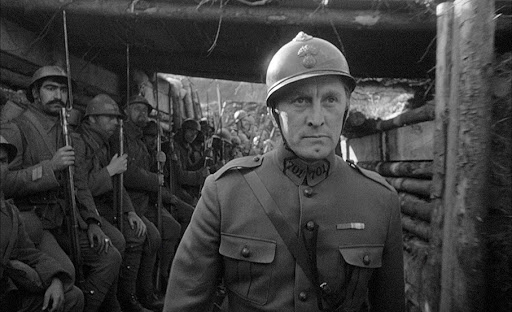
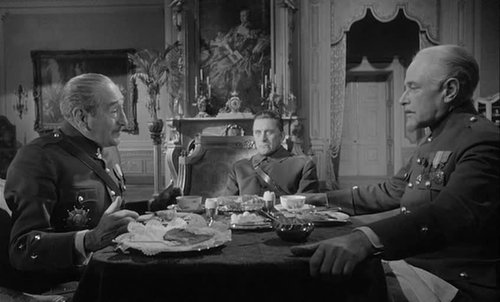
He has a great framework of a film around him from Kubrick. The director uses several longs shots, extended takes and tracking shots to throw us into the world. The opening sequences at the military HQ, taking in the palatial setting of Mireau’s campaign office, have a stately construction and technical formality which then contrasts superbly with the lower angle, tracking shot-laden, POV sequences set in the trenches. Kubrick’s camera glides through these trenches, low angles seeming to make them tower over the viewer, the mud and filth only worse in the body-strewn no-man’s land that stands between the French and the Germans.

It culminates in the attack sequence, one of the greatest battle sequences ever placed on film. Following the doomed advance at a methodical pace, matching the speed of the soldiers, the camera tracks over no man’s land as explosions rend the ground and bodies are thrown to the mud under a hail of bullets. At the front is Dax, vainly blowing on his whistle and encouraging the men forward, while all around him devastation and slaughter win out. Any thought that this wasn’t a pointless enterprise from start to finish is completely dispelled, and our sympathies are completely with Dax and the soldiers, whose lives are superfluous to the ambitions of the generals.

Both generals cut appalling figures for different reasons. Mireau, played with a trumpeting, vain bombast by Macready, is a “blood and guts” soldier who never places his own blood and guts anywhere near the line. Proudly bragging about the skills of his soldiers, then furiously denouncing their cowardice, one telling shot has him in the trenches staring through binoculars at the German positions, oblivious to the wounded men filing past him. Later he orders the shelling of these very trenches in fury at their failure to advance far enough. Broulard is hardly better, Menjou’s “hail well met” bluster hiding a chilling lack of empathy.

The Germans are never seen, because the real enemies here are war itself (and we are kidding ourselves if the same thing wasn’t happening on the other side) and the authorities who push us into it. The film is almost like some sort of black satire, with the generals confidently telling their soldiers they are right behind them, before retreating several miles to the rear to watch the battle unfold. Dax is middle-management, caught between trying his best to deliver orders he knows are impossible, and protecting men he knows are doomed, and failing at both tasks.

The system demands blood sacrifices from the lowest possible rungs, so the hierarchy can reassure themselves they are not blamed (Dax’s offer to take all the blame is promptly rejected by Broulard – no question of any of the officers being at fault!), so the men are chosen by their company commanders. One is chosen by lottery (he of course is a decorated war hero, but that cuts no ice), one because he’s an “undesirable” and the third because he has witnessed his own commanding officer’s cowardice. None of them deserve it, but their guilt is “proved” in a kangaroo court that lasts less than 15 minutes, and in which Dax is barely allowed to put a defence case.

Kubrick’s film becomes a surprisingly fast (it’s less than 90 minutes) but inexorable march towards those three stakes in the ground and the firing squad. Questions of justice and courage are completely pointless – any brave acts in the film are pointless, two of the victims are cited for their courage and the most cowardly character in the film, Wayne Morris’ snivelling Lt Rouget, ends up commanding the firing squad – and the message we are left with is that the institution of war and man are the real villains here.

War has no heroes, only survivors. Victories are important to the generals only in the sense of being tools to jockey for position, and the common soldier is an expendable puppet who can be killed on a whim to fill any political reason. It’s a harsh and chilling view of the military – and leaves very little hope – but it’s superbly made and controlled by Kubrick, in a film surprisingly with more heart in it than any film he ever made before or since. It’s a film that leaks with sorrow and disgust at the victims of the military machine, a film with emotion as well as a technical marvel. It might be Kubrick’s most complete film.

A Clockwork Orange (1971)

Malcolm McDowell burns up the screen in Kubrick’s masterful but cold A Clockwork Orange

Director: Stanley Kubrick

Cast: Malcolm McDowell (Alex DeLarge), Patrick Magee (Mr Frank Alexander), Michael Bates (Chief Guard Barnes), Warren Clarke (Dim), Adrienne Corri (Mrs Mary Alexander), Carl Duering (Dr Brodky), Paul Farrell (Tramp), Clive Francis (Joe the Lodger), Michael Gover (Prison Governor), Miriam Karlin (Catlady), James Marcus (Georgie), Aubrey Morris (PR Deltoid), Godfrey Quigley (Prison Chaplain), Sheila Raynor (Mum), Madge Ryan (Dr Branom), Anthony Sharp (Minister), Philip Stone (Dad)

For decades, A Clockwork Orange was unseen in Britain. After a number of copycat crimes led to a backlash, Kubrick – who had complete control over the rights of the film in the UK, his adopted country – essentially refused to let the film be shown anywhere in the country during his lifetime. This gave Clockwork Orange a sort of mystique for UK audiences that it has only slowly worn off, the air of the banned product, impossible to see other than through a dodgy knock-off or by travelling to another country. Released from the vaults this century, the film still carries a chilling pull, even if it’s a compelling but still muddled piece of intellectualism.

Adapted faithfully from Anthony Burgess’ novel, the film follows the life of violent young man Alex DeLarge (Malcolm McDowell), leader of a gang of street thugs who delight in evenings of “ultra violence”, with a bit of “the old in-out” thrown in for good measure. Which, in the invented Ingsoc style dialogue Burgess came up with, basically means Alex is essentially a psychotic rapist, albeit one with a huge degree of anti-authoritarian charm and cheek. Alex’s crimes eventually catch up with him however, whereupon he is imprisoned and volunteers for what he assumes is an easy option: an experimental psychiatric aversion treatment, designed to make him incapable of taking parts in acts of violence and sex. Released back into the world, Alex finds it and himself unchanged – the only difference being that violence makes him feel sick, which is poor defence as he encounters all his victims yet again, all bent on revenge.

Did something about the film scare Kubrick? Was part of his later mixed feelings about the film based around the fact the film is seduced by Alex, that it indulges his awfulness and utter lack of morality and makes points comparing the authoritarian government with the murderer they are trying to deal with. Yes, Kubrick makes clear that Alex feels nothing but pleasure about his awful acts, and the distorted fish-eyed lens he uses to capture much of this really hammers home the awfulness of his actions. But it’s also a film that takes a giddy delight in Alex’s charm and larger-than-life persona, and makes it easier for us to find him an attractive figure.

Of course part of this is through the way Kubrick seizes upon a once-in-a-lifetime performance from Malcolm McDowell, who roars through the film with such giddy power, such perverse force of nature electricity that he never captured it again. McDowell’s impish delight is what powers the film, and Kubrick’s clear admiration for the actor’s improvisation, his pushing of boundaries (the film’s most famous sequence, Alex singing Singin’ in the Rain while assaulting and – off camera – raping a woman, was McDowell’s own improvisation). McDowell’s performance is a magnet, his sneering contempt for authority and his sexy confidence and cultured intelligence makes Alex a character far more attractive than he should be.

And quite possibly to Kubrick as well. The film’s moral force loses some of its direction from the novel, by its skill in presenting in such a bravura way Alex’s horrors and because McDowell charges through the film. Kubrick was always the ultimate technician of film, so it’s not a surprise that A Clockwork Orange is a triumph of style and design; perhaps that is at the heart of its enduring power and impact. Kubrick’s design pushes the film a few degrees into the future from 1971, with a grimy, rundown look at Britain mixed with primary colours and garish 70s design. The look of Alex and Droogs is inspired, the sort of cos-play triumph that was way ahead of its time.

The film wants to make points about morality and free will, but these ideas get lost in the mastery of the film-making and the technical triumph of Kubrick (and John Alcott’s) camerawork. The film makes extensive use of fish-eyed, wide angle lenses that distort the world around Alex, hammering home the ultra-realism of the film. At several points Kubrick uses slow pan outs that go from tight shots to reveal more and more of the world of the film, granting an epic status to this squalid world (and increasing the status of Alex all the more). It’s sublimely made, but this is part of the problem.

The main problem is that Kubrick as a director is all technocrat genius, and no heart at all. He loses himself in what he can do, and forgets what he should do. It’s a film where it’s easy to sympathise with the anti-hero, as no voice is really given to the victims. Kubrick seems able to overlook the horror of the events, in his admiration for the actor and the technique. It muddies as well the questions of morality around the mind-altering control of the state – and these ideas are less thought-provoking than Kubrick might have thought anyway. It wants us to ask if a repressive state that prevents someone from committing violent acts – but does nothing to change their basic personality or desire to change, only forces them to do so – can really take the moral high ground? The film argues not – and the Kubrick’s general misanthropy is focused as much on how violence from one naturally begets violence in others – but this is pretty basic stuff.

Perhaps if Kubrick had invested more time in the reality of moments, to off-set the ultra-realism of Alex’s violence and the epic grandeur of McDowell, the film might have been able to explore this further. We see all of Alex’s victims respond with anger and fury and violence when given their chance for revenge in the second half of the film, but we don’t get a sense of the internal journey that takes them there. What we get is the look of horror (and later the near panicked reaction when he realises he has given shelter to his wife’s rapist) from Patrick Magee’s Mr Alexander, but that’s it. Otherwise, the focus places the victims on the outside of the drama and zooms in on the perpetrator and the government trying to control him.

It makes for a misbalanced film, which fails to make the points you wish it could make. Kubrick’s film is an electric piece of filmmaking, dynamic and skilled behind the camera, but the film lacks the heart it needs to counterbalance its coldness and slightly smug satire. It grips and envelops you when watching it – not least due to McDowell’s genius in the lead role – but it’s not a film that works as well as it should. You admire it and then realise its lack of soul.