Tag: Stephen Fry

Gosford Park (2001)

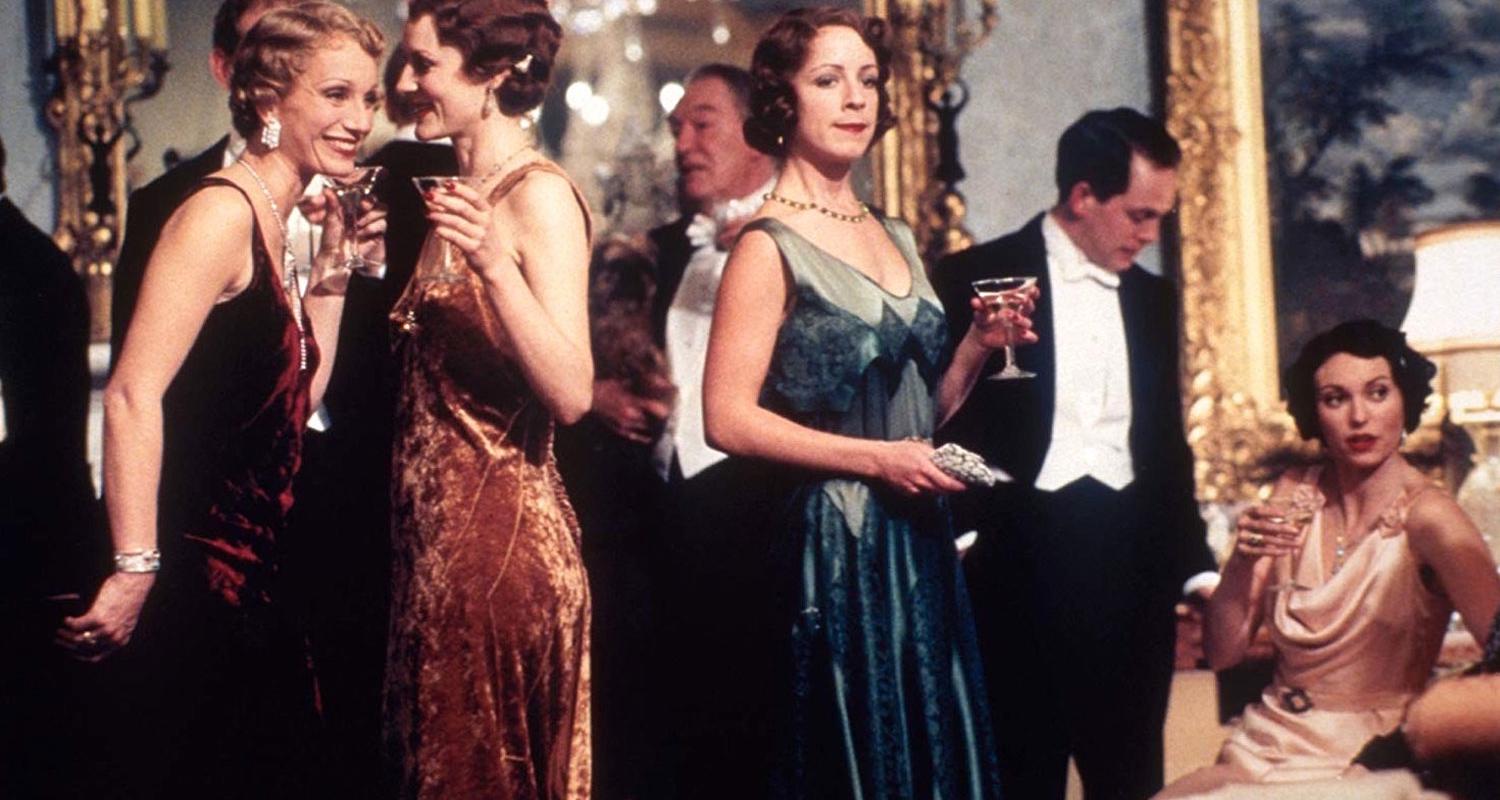
Cruelty, snobbery and viciousness – just another night at Gosford Park

Director: Robert Altman

Cast: Eileen Atkins (Mrs Croft), Bob Balaban (Morris Weissman), Alan Bates (Mr Jennings), Charles Dance (Lord Stockbridge), Stephen Fry (Inspector Thompson), Michael Gambon (Sir William McCordle), Richard E. Grant (George), Derek Jacobi (Probert), Kelly Macdonald (Mary Maceachran), Helen Mirren (Mrs Wilson), Jeremy Northam (Ivor Novello), Clive Owen (Robert Parks), Ryan Phillippe (Henry Denton), Kristin Scott-Thomas (Lady Sylvia McCordle), Maggie Smith (Constance, Countess of Trentham), Emily Watson (Elsie), Claudie Blakely (Mabel Nesbitt), Tom Hollander (Lt Commander Anthony Meredith), Geraldine Somerville (Lady Stockbridge), Jeremy Swift (Arthur), Sophie Thompson (Dorothy), James Wilby (Freddie Nesbitt)
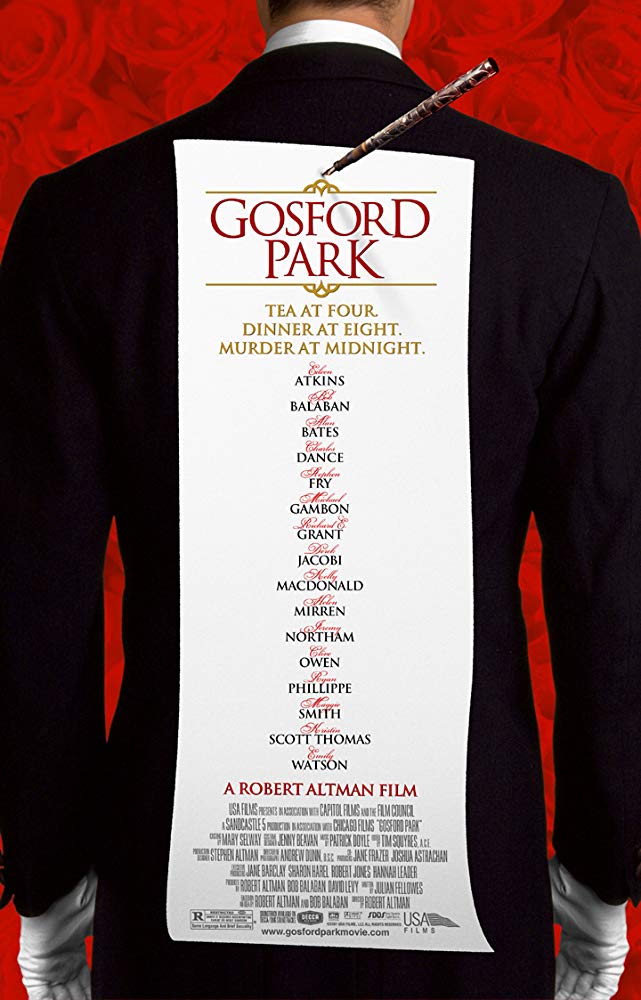
We’ve always fancied ourselves that when Brits make films in America – think John Schlesinger’s brilliant analysis of New York hustlers in Midnight Cowboy – they turn the sharp analytical eye of the outsider on American society. But do we like it when America turns the same critical eye on us? Gosford Park is a film surely no Brit could have made, so acutely vicious and condemning of the class system of this country, without the hectoring that left-wing British filmmakers so often bring to the same material, it’s just about perfect in exposing the hypocrisy and cruelty that undermines our class system. You’ll never look at an episode of Downton Abbey the same way again.

In November 1932, Sir William McCordle (Michael Gambon) hosts a shooting party at his country house. McCordle is almost universally despised by his relatives and peers – most especially his wife Lady Sylvia (Kristin Scott-Thomas) – but tolerated as his vast fortune from his factories basically funds the lives of nearly everyone at the house party. While the upper classes gather upstairs, downstairs the servants of the house led by butler Jennings (Alan Bates) and housekeeper Mrs Wilson (Helen Mirren) order the house to meet the often selfish and thoughtless demands of the rich. The house is rocked midway through the weekend, when a murder occurs overnight. With motives aplenty, perhaps the new maid Mary (Kelly Macdonald) of the imperious Countess Trentham (Maggie Smith) has the best chance of finding the truth.

First and foremost, it’s probably a good idea to say that this is in no way a murder-mystery. Robert Altman, I think, could barely care less about whodunit. While the film has elements that gently spoof elements of its Agatha Christie-ish settings, Altman’s interest has always been the personal relationships between people and the societies they move in. So this is a film really about the atmosphere of the house and most importantly how these people treat each other. Altman despised snobbery, and in a world that is fuelled by that very vice, he goes to town in showing just how awful and stifling so many elements of the class system really were.
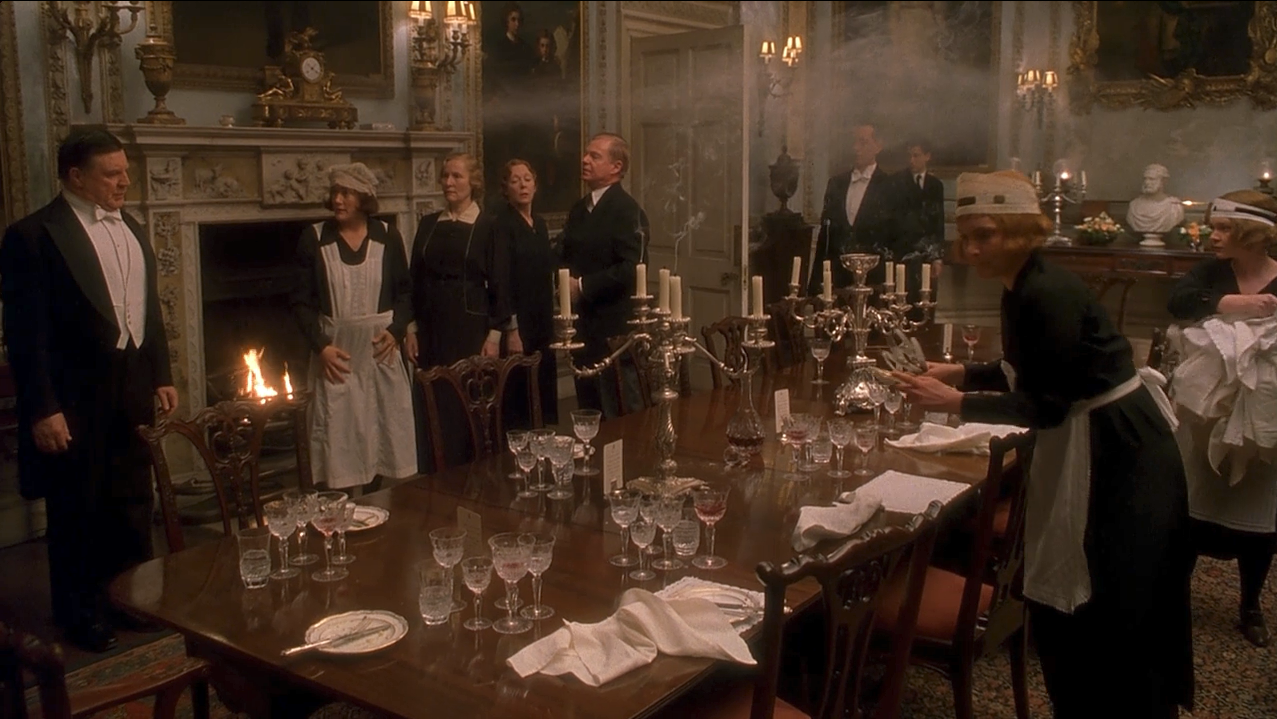
“He thinks he’s God Almighty. They all do.” So speaks Clive Owen’s Robert Parks, valet, of his employer the patrician Lord Stockbridge (Charles Dance, excellent). You’ve got the attitude right there: the rich see themselves as a different species to those pushing plates around and cleaning clothes below stairs. The idea of there being anything in common is laughable. Slight moments of casual conversation between servant and master in the film are governed by strict laws and carry a quiet tension. 

It’s so acute in its analysis of the selfishness, snobbery, cruelty and arrogance of the British class system that each time I watch it I’m less and less convinced that Downton Abbey (the cuddliest version of this world you could imagine) creator Julian Fellowes had much to do with it. This film is so far from the “we are all in this together” Edwardian paternalism of that series, you can’t believe the same man wrote both. All the heritage charm of Downton is drained from Gosford, leaving only the cold reality of what a world is like where a small number of people employ the rest.

Upstairs the hierarchy is absurdly multi-layered. Everyone is aware of their position, with those at the top of the tree barely able to look those at the bottom in the eye, let alone talk to them. The rudeness is striking. Maggie Smith (who is brilliant, her character totally devoid of the essential kindness of her role in Downton Abbey has) is so imperiously offensive, such an arch-snob, she can only put the thinnest veil over her contempt when she deigns to speak to her inferiors. Her niece, played with an ice-cold distance by Kristin Scott-Thomas, embodies aloofness, selfishness and casual cruelty.

Ivor Novello (Jeremy Northam, superb) – the one real person in the film, and a film star – is treated like a jumped up minstrel player, with characters falling over themselves to make snide comments about his career. His guest Morris Weissman (an excellent Bob Balaban), a Hollywood film producer, is treated with similar contempt – when reluctant to divulge details of the film he is in England researching (a Charlie Chan film) for fears he will spoil his plot, the Countess bluntly informs him “oh, none of us will see it”. Later, as Novello plays the piano (essentially singing for his supper) only the servants are pleased – most of the upper classes endure it under sufferance (“Don’t encourage him” the Countess says when there is a smattering of applause). You can see why, after only a few hours in the house, Weissman whispers to Novello: “How do you put up with these people?”

The servants themselves are bits of furniture, or barely acknowledged at all. Altman doesn’t shoot a single scene without a servant present, but this often hammers home their irrelevance to the upper classes (it’s made even more effective by seeing actors like Bates, Jacobi, Grant, Macdonald, Owen and Watson essentially being treated as extras). There are no bonds between upstairs and downstairs at all. Any upset witnessed on either side is responded to with silence. When Emily Watson’s Elsie (a brilliant performance of arch awareness of her place) momentarily forgets herself and speaks out at the dinner table, it’s treated like she has crapped on the floor – needless to say her career is finished.

The servants however echo the pointless rituals and ingrained hierarchy of their masters below stairs. For ease (!) the house servants insist the visiting servants are only addressed by the names of their employers not their own names. At their dinner table, their seating reflects the hierarchy of their employers. Many of the servants are more grounded and “normal” than the upstairs types, but they are as complicit in this system continuing as anyone else. They simply can’t imagine a life without it, and accept without question their place at the bottom rung of the house. 

Ryan Phillippe, later revealed as an actor masquerading as a servant (for research), immediately shows how hard it is to move between the two social circles. The servants despise him as a traitor who may leak secrets about their views of the employers. The guests see him as a jumped up intruder, even more vulgar than Novello and Weissman. His later humiliation is one of the few moments that see both sides of the social divide united (it’s fitting that it is an act of cruelty that reinforces the social rules that brings people together). 

The focus is so overwhelmingly on the class system – with Altman’s brilliant camera work (the camera is never still) giving us the sense of being a fly-on-the-wall in this house – that you forget it’s a murder mystery. Here the film is also really clever, archly exposing the harsh realities of the attitudes held by your standard group of Christie characters. Dance’s Lord Stockbridge in a Christie story would be a “perfect brick” but here we’ve seen he’s a shrewd but judgemental old bastard. The film throws in a clumsy Christie-style incompetent police detective, played by Stephen Fry. This is possibly the film’s only real misstep as Fry’s performance touches on a farcical tone that seems completely out of step with the rest of the film. But the Christie parody is generally wonderful, exploding the cosy English world the public perception believes is behind Christie (even if the author herself was often darker than people remember!).

It’s a hilarious film – Maggie Smith in particular is memorable, from cutting down her fellow guests, to judgementally tutting at shop-bought (not homemade) marmalade – but it’s also a film that creeps up on you with real emotional impact. Kelly Macdonald is very good as the most “everyday” character, who takes on the role of detective and has superb chemistry with Clive Owen’s dashing valet. But the film builds towards a heart-rending conclusion – a conclusion that, with its reveal about the darker side of Gambon’s blustering Sir William, feels more relevant every day – that shows the secret tragedies and dark underbelly of these worlds, with a particularly affecting scene between Atkins and Mirren (Mirren in particular is such a peripheral figure for so much of the film, that her final act revelations and emotional response carries even more force).  It’s heart rending.

Gosford Park is a film continually misremembered as either a cosy costume drama or a murder mystery. It’s neither. It’s a brilliant analysis of the British class system and a superb indictment of the impact and damage it has had on people and the country. Hilarious, brilliantly directed by Altman with a superb cast – it’s a masterpiece, perhaps one of the finest films in Altman’s catalogue.

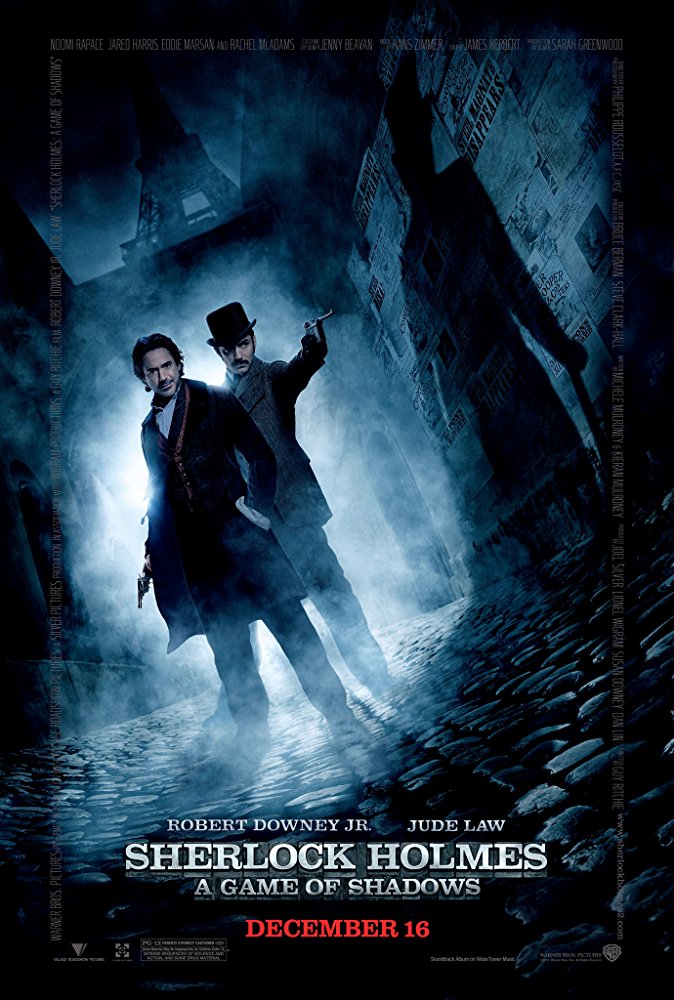
Sherlock Holmes: A Game of Shadows (2011)

Our heroes are on the run in Sherlock Holmes: A Game of Shadows

Director: Guy Richie

Cast: Robert Downey Jnr (Sherlock Holmes), Jude Law (Dr John Watson), Jared Harris (Professor James Moriarty), Noomi Rapace (Madame Simza Heron), Stephen Fry (Mycroft Holmes), Kelly Reilly (Mary Morstan), Rachel McAdams (Irene Adler), Eddie Marsan (Inspector Lestrade), Paul Anderson (Sebastian Moran), Geraldine James (Mrs Hudson), Thierry Neuvic (Claude Ravache)

Sequels are tricky beasts. You need to work out what people liked about the first film and double down on it, while also expanding the story in new and exciting ways. When I first saw Sherlock Holmes: A Game of Shadows in the cinema, I was very sceptical about whether this film managed that. But actually, viewing it a second time around (and almost seven years later), I enjoyed it a lot more than I remembered.

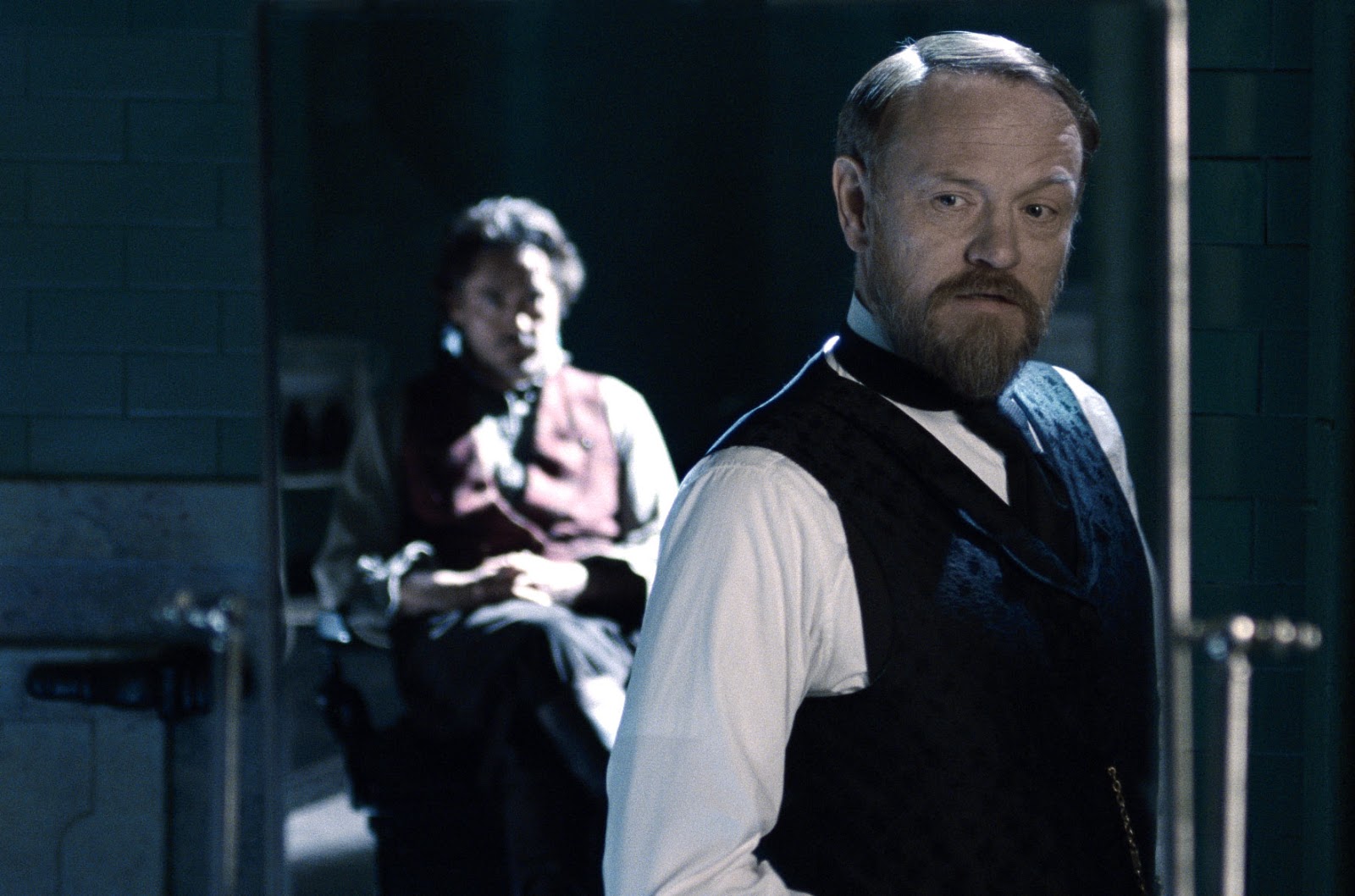
As Watson (Jude Law) prepares for his wedding to Mary Morstan (Kelly Reilly), Sherlock Holmes (Robert Downey Jnr) is consumed into an investigation targeting the “Napoleon of Crime” Professor James Moriarty (Jared Harris). A series of bombings across Europe is being blamed on anarchists – but is it in fact a scheme launched by Moriarty’s military-industrial complex to instigate a world war (from which he can make a profit)? Well what do you think?

Sherlock Holmes: A Game of Shadows doubles down most strongly on the relationship between Holmes and Watson. Recognising that the things from the first film everyone loved was the brotherly banter between these two, the sequel places it front and centre. While the first film felt the need to introduce a traditional love interest for Holmes, this film kills off Irene Adler in the first few minutes (despite this, poor Rachel McAdams has better material here than most of the first film). Instead the true “romantic” relationship of the film is Holmes and Watson, as they banter, bicker and make huge sacrifices to protect each other. 

It’s helped again by Downey Jnr and Law’s excellent performances and their strong chemistry. Saying this, the first half hour of the film thinks it’s funnier than it is, with its intermixing of Watson’s stag night with a series of Downey fights. There is a little too much brashness to it early on, without sufficient grounding in the warmth between the two characters. But once we hit the real action 40 minutes into the film, the balance between comedy, affection and peril is pretty effectively met.

And Ritchie directs some very fine action sequences here. There is an extraordinary sequence of a chase through the forest, which uses an exquisite mixture of hand held cameras, Steadicam, slow motion and half a dozen other tricks to deliver a series of striking and immersive shots. Yes it’s overblown and in-your-face but it works perfectly. The film is crammed with brash, powerful action scenes like this that really strike you between the eyes. 

It also still keeps in touch with the original novels in a nice way. Some of the best dialogue scenes are those between Holmes and Jared Harris’ muscular but serpentine Moriarty (Harris is very good, a far stronger villain than the first film). These scenes use dialogue from the original stories extremely effectively. Meanwhile, its build towards its version of the Reichenbach fall is actually very clever, one that twists on the movie’s “calling card” of Holmes predicting every move of a fight before it begins by having Moriarty pull the same trick (which is in itself a neat scene).

Where the film does fall short amidst all this action and explosions and jokes (some good, some bad) is that we don’t get much in the way of investigation or deduction. There is a bit of sleight-of-hand and a touch of pocket picking, but most of the “deductions” are based on highlighting with the camera or dialogue objects that might as well be labelled “Important Plot Device”. Holmes doesn’t so much as investigate here as charge head first from one combat sequence or dangerous situation to another. There isn’t a lot of patience in his method here – and not a lot of patience in the film itself. But then this film is largely based on The Final Problem, probably one of the least “detective” of the stories in the cannon.

But Game of Shadows is very good fun, has some neat action sequences, is well shot and is more or less entertaining, even if some of the comedy suggests it’s a little too pleased with itself. Sure it loses some of the smaller-scale delights of both the books and original film in its rush to make sure you are wowed. But I enjoyed it a lot more the second time round, since I’d watched the original film more recently and was tuned up into what it was trying to do.

The Man Who Knew Infinity (2015)


Dev Patel is mathematical genius Srinivasas Ramanujan, struggling against prejudice in The Man Who Knew Infinity

Director: Matthew Brown

Cast: Dev Patel (Srinivasas Ramanujan), Jeremy Irons (GH Hardy), Devika Bhise (Janaki), Toby Jones (John Edensor Littlewood), Stephen Fry (Sir Francis Spring), Jeremy Northam (Bertrand Russell), Kevin McNally (Percy MacMahon), Richard Johnson (Vice Master Henry Jackson), Anthony Calf (Howard), Padraic Delaney (Beglan), Shazad Latif (Chandra Mahalanobis)

The British Empire. It’s a difficult slice of British history, and it undoubtedly contributed to contemporary attitudes of superiority that affected British people and their institutions. It’s these attitudes that form the central themes of The Man Who Knew Infinity, an effective story of a struggle against the odds. 

In the early 1900s, Srinivasas Ramanujan (Dev Patel) works in Madras as a junior accountant – but his superiors quickly realise his mathematical abilities far outstrip his mundane tasks, and encourage him to write to mathematics professors to bring his theoretical work to their attention. Ramanujan starts a correspondence with GH Hardy (Jeremy Irons) of Trinity College, Cambridge, who invites him to England to explore his potential. Once there, Ramanujan quickly proves his genius but, despite Hardy’s support, he struggles to be accepted by the fellows and students of the college, who only see an upstart from the colonies.

The Man Who Knew Infinity is a conventionally structured biography – struggles personal and professional, success followed by setback and a final triumph combined with a bittersweet ending. It’s structurally nothing different from things you’ve seen before, but it’s told with calm, quiet, engrossing dedication, with unflashy direction, a solidly written script and some truly excellent acting. No wheel is reinvented, but it revolves with a highly enjoyable and heartfelt tenderness.

It’s a film that manages to present mathematics without using spurious real-world clunky metaphors, and gets a lovely feel for the hard work and theoretical study that go into mathematical theory. It also brilliantly communicates what the maths is about. I’m no theoretical mathematician (football stats are my limit) but even I could follow (just) why Ramanujan’s insights were so important and what they meant to the field of theoretical mathematics. The film has a real feel, not only for rhythms of academic work, but also the politics of academia (which needless to say are labyrinthine).

But the film’s main point is the resentment and outright racism Ramanujan must overcome. Played by Dev Patel with a quiet decency and modesty that only rarely bubbles over into bitterness, Ramanujan is constantly hit with everything from misunderstanding to contempt. His every achievement is met by questioning and doubt. His proofs must be demonstrated time and time again. To win the support and respect of his peers, he must constantly revise and revise his work, while the slightest slip is held up as proof his fraudulence or luck. 

If you do want to criticise the presentation of this, you could say that much of the campaigning and struggle for acceptance is championed by the establishment figure of Hardy – it’s he who does most to convert others, and who presents Ramanujan’s key theories to the Royal Society at the end. Stressing Ramanujan’s politeness and humbleness does have the downside of making him a slight passenger at times in his own movie.

But then it’s not just his movie, because this is a story of a deep, near romantic, bond that forms between the gentle Ramanujan and the shy and sensitive Hardy. Hardy, the film implies, was a man uncomfortable with emotional closeness, but he feels a huge bond with Ramanujan, having overcome similar class-based prejudice. The two men have a natural understanding, and support each other, finding themselves in perfect sync in their opinions on mathematics and their outlooks on life. In the nature of the British, nothing is ever said – but it’s clear that both men feel an intense personal connection that, quite possibly in Hardy’s case, mixes with a suppressed romantic yearning.


This relationship largely works so well because Jeremy Irons is quite simply fantastic as Hardy. Cast so often as superior types, here he gets to flex other parts of his arsenal as someone shy, timid, and sensitive. Hardy is so uncomfortable with personal friendships, he can rarely bring himself to look directly at other people. Irons sits on the edges of frames, or hunches and shrinks, his eyes permanently cast down. Saying that, he brings out the inner steel and determination in Hardy, his devotion as an advocate for Ramanujan. Irons is so shyly withdrawn, that the moments he allows emotional openness with Ramanujan, and most movingly with fellow mathematician Littlewood (played with a kindly good nature by Toby Jones), are wonderfully affecting. This might be one of Irons’ finest performances in his career.

The Man Who Knew Infinity is in many ways a conventional film, but performances like Irons’ lift it into something a little bit special. It’s a well-meaning and heartfelt film that embraces some fascinating concepts and also presents a story of triumph against adversity that feels genuinely moving and engaging. Filmically and narratively it’s very much by-numbers at times – but it hits those numbers so well, you’ll certainly have no complaints.

Wilde (1997)


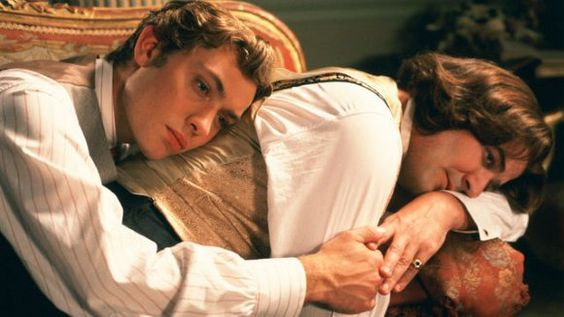
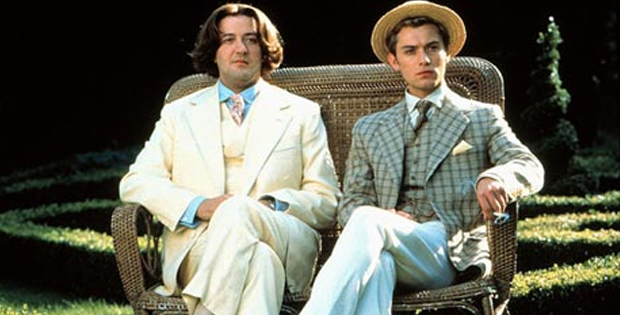
Jude Law and Stephen Fry in a disastrous love affair in sensitive biopic Wilde

Director: Brian Gilbert

Cast: Stephen Fry (Oscar Wilde), Jude Law (Lord Alfred “Bosie” Douglas), Jennifer Ehle (Constance Lloyd Wilde), Vanessa Redgrave (Jane Francesca Agnes “Speranza” Wilde), Gemma Jones (Sibyl Douglas), Judy Parfitt (Lady Mount-Temple), Michael Sheen (Robbie Ross), Zoë Wanamaker (Ada Leverson), Tom Wilkinson (Marquess of Queensbury), Ioan Gruffudd (John Gray)

Could there be a more perfect piece of casting than Stephen Fry as Oscar Wilde? Not only is Fry the spitting image of the famed Irishman, but Fry’s own mercurial talent, his enormous outpouring of novels, articles and screenplays, his skill as a raconteur and his general ubiquitous presence as a personality make him a pretty good modern equivalent of Oscar Wilde. A lifelong admirer of Wilde – and an increasingly vocal proponent of gay rights and mental health awareness – Wilde’s life plugs into many of Fry’s own outlooks on the world. So yeah, perfect casting!

Opening in 1882 with Wilde’s tour of America (he effortlessly charms a group of clichéd “yee-haw!” silver miners – who literally fire their guns into the air in delight at his bon-mots in the film’s crudest touch), the film covers Wilde’s growing career, but focuses on his personal relationships. Unaware of his homosexuality, he marries Constance (Jennifer Ehle), but discovers his true nature with her friend Robbie Ross (Michael Sheen). However, this leads to his destructive, obsessive love for alternately petulant and caring Lord Alfred Douglas (Jude Law), his beloved “Bosie”. When he is accused publically of sodomy by Bosie’s father, the Marquess of Queensbury (a raging Tom Wilkinson, chewing the scenery), Wilde takes the matter to court – a disastrous decision that destroys his life.

Brian Gilbert’s film is a sensitive and lovingly crafted slice of period drama, that movingly demonstrates the hypocrisy of Victorian values. Wilde is celebrated by the public, despite the open secret of his and Bosie’s relationship, while rent boys (including a one-line appearance from Orlando Bloom!) and discrete gay relationships are common place. Wilde is a gentle, naïve man for whom emotional closeness is more important than physical love. He charms a society only too aware of his nature. However, the instant he causes a stink, his reputation is ruined and his life collapses. What the film does so well is give us a sense of the inner vulnerability, doubt and desire for affection at the heart of a man who, perhaps more than any other, lived his life as a public exhibition.

Halliwell’s Film Guide claimed the film attempted to reposition Wilde as a family man, a grossly unfair view of the film’s stance. As if a man who discovers he is gay could not love his children, or that he could no longer care for his wife. Similarly, accusations that the film shows Wilde’s homosexuality as the roots of his downfall are similarly misguided – Robbie Ross is unaffected by legal troubles and he’s openly gay. No, the film is making a far more conventional (in a way) point – Wilde was brought low because he fell hopelessly in love with the wrong guy.

Jude Law’s big break was in this film – and watching it again is a reminder of what a firebrand, dynamic actor he can be. He makes Bosie half monster, half emotionally vulnerable child. He alternates (sometimes within the same scene) between affection, devotion, kindness and wildly petulant rage. He’s overwhelmingly selfish and self-obsessed – even as Wilde’s life collapses, he can only whine that he is furious his father is winning – but then remorseful and guilt-stricken when the consequences of his actions become clear (but not enough to not do it again). Law juggles all these contradictions with astonishing skill – it’s an assured, magnetic performance of brilliance. We can see why Wilde adores him, while at the same time wanting to wring his neck.

It’s also clear why all the other characters around Wilde find him so appalling. Ross (and Sheen is similarly superb as Wilde’s tragically “friend-zoned” devoted admirer) can’t bear the appalling influence Bosie has, but knows he’s powerless to do anything about it. In one great scene, Bosie haughtily says he knows Ross always hated him, before cruelly saying it’s because Wilde loved Bosie, but Ross was only “one of his boys” – the look of pain on Sheen’s face is brilliantly moving. Wilde himself seems almost sadly (if inevitably) drawn into Bosie’s tastes for casual sex and rough trade – often playing voyeur at these events, while sadly accepting Bosie doesn’t find him physically attractive. Wilde’s basically the victim of an abusive relationship – and the film does a brilliant job of demonstrating why a man otherwise so blessed with intelligence can’t see it.

Julian Mitchell’s excellent screenplay (based on Richard Ellman’s award-winning biography) uses Wilde’s The Selfish Giant as a framing device – subtly comparing Wilde and Bosie respectively to the giant and the child. It also brilliantly constructs a sense of Wilde’s quick wit and staggering intelligence, and provides a host of sparkling cameos for some fine character actors. The production design and photography are spot-on, and while Gilbert may be slightly workmanlike in his filming, he certainly lets the story tell itself.

The focus on Wilde’s family life is also reassuringly different – it’s brilliant to see Wilde’s obvious adoration for his children, and plenty of indication that he was actually (much of the time) a very good husband and father. Mitchell’s script softens Constance’s reaction to Wilde’s conviction (she wasn’t as forgiving and forward-thinking in her views as she seems to be here) but it does mean that we are allowed to see the full story of Wilde’s life, rather than having him defined by his sexuality. Jennifer Ehle also does a marvellous job with very little material, and her quiet dignity and support for her husband (despite her anger at his obsession with Bosie) is very affecting.

But at the centre of all this is that perfect casting of Stephen Fry. In all the rest of his career, Fry will never be better than he is here. His Wilde is intellectual, mildly arrogant, but also naïve, gentle and almost unworldly. His voice is perfect for the aphorisms, and he is really striking physically. Above all though, he brings a deep, emotional empathy to the part – you feel how personal this is for Fry the actor, and you feel how closely he identifies with a man who discovered his sexuality late. His besotted, blind love for Bosie is as affecting as it is frustrating. His vulnerability in Reading gaol is deeply moving. It’s a quite marvellous performance, anchoring a movie that is gentle, kindly, caring and sensitive in exploring the inner life of a very public man.

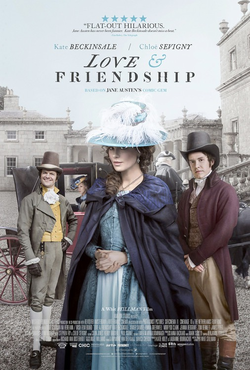
Love and Friendship (2016)


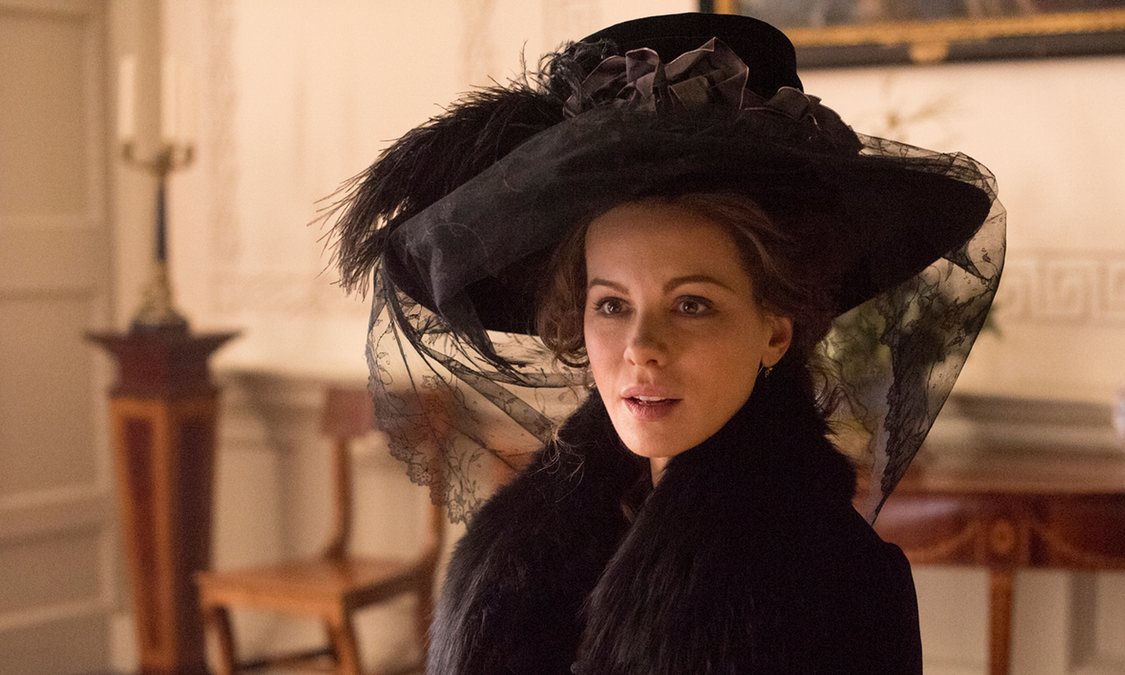
Kate Beckinsale in a true star turn in Whit Stillman’s brilliant Love and Friendship

Director: Whit Stillman

Cast: Kate Beckinsale (Lady Susan Vernon), Chloë Sevigny (Alicia Johnson), Xavier Samuel (Reginald DeCourcy), Emma Greenwell (Catherine Vernon), Morfydd Clark (Frederica Vernon), James Fleet (Sir Reginald DeCourcy), Jemma Redgrave (Lady DeCourcy), Tom Bennett (Sir James Martin), Justin Edwards (Charles Vernon), Stephen Fry (Mr Johnson)

Films based on Jane Austen are hardly a new thing. There have been dozens of productions on film and television of Austen’s biggest hitters (P&P, S&S, Emma…). What a delight therefore to get an Austen adaptation that takes a very different approach and with material much less familiar. Stillman has even renamed the source material (Lady Susan) with the title from another piece of Austen ephemera, making it playfully fit into the famous X & Y titles.

Lady Susan Vernon (Kate Beckinsale) is notorious throughout society as its most outrageous flirt.  After a failed affair with Lord Manwaring, she retreats to the country home of her late husband’s brother Charles (Justin Edwards). There she soon ensnares Charles’ brother-in-law Reginald DeCourcy (Xavier Samuel) into an understanding, while simultaneously promoting the marriage of her reluctant daughter Frederica (Morfydd Clark) to the wealthy bumbler Sir James Martin (Tom Bennett). Naturally there is outrage left and right.

Watching this film the first question that springs to mind is what has Kate Beckinsale been doing her whole career? Clearly on the basis of this been wasting her talents in umpteen Underworld movies. This film plays to all her strengths: her sophistication, elegance, the intelligence and sharpness she can convey in dialogue, mixed in with a distant quality she has. She’s absolutely on top of her game her as the aloof, completely selfish and manipulative Lady Susan, and bitingly funny. Her A-list status translates perfectly into a cast of largely unknowns: just as she would in real life, she seems to glide amongst the other characters in the film like some demi-god descended from the stars.

Beckinsale is one of the brightest stars in this terrifically dry and witty adaption by Whit Stillman of a little known Jane Austen work (I confess I’d never heard of it before!). The film has a frosty tongue and a sharply observant eye, and delights in the absurdities and eccentricities of the Austen upper middle classes as much as it does the ruthless bitchiness and selfish back-biting of the marriage game. It’s the perfect film to remind everyone that there is so much more to Austen than the lazily inaccurate perception of love and romantic clinches in the rain. Stillman really brings to the forefront her accurate understanding of people, and her sharp satirical eye.

The film fairly canters along – sometimes with such haste that the intricacies of who is related to who and how are a little lost, despite some witty freeze-frames that introduce each character like calling cards – and it’s often blisteringly funny. It has a brilliant mixture of verbal put-downs and catty asides (often delivered with a cool sharpness). The film is not afraid to mix this with some near slapstick absurdity, particularly from an exceptional Tom Bennett whose over-eager, nervously talkative, endearingly naïve Sir James threatens to steal the whole movie. His introductory monologue on the confusion between “Churchill” and “Church Hill” is a show-stopping laugh riot. It all serves to create a wonderfully arch and funny dive into Austenland.

There is a fantastic self-awareness around the whole film which Stillman manages to wear very lightly. It’s a very faithful immersion in Austen’s style and humour, but also leans on the wall of gentle humour at the conventions of lesser costume dramas. It’s a hugely difficult line to walk, but the film never staggers or slackens. It stays tight, taut and the story grows with a warmth and reality while Stillman continues to almost tease the source material.

The final resolution of events manages to feel both surprising and strangely inevitable. It’s a perfect summation for a film that is simply marvellous, brilliantly performed and frequently laugh-out-loud funny. Lady Susan is in many ways deplorable, but Stillman avoids all temptation to try and redeem her or to make her into some sort of genuine heroine (“Facts are horrid things” she observes after another accurate condemnation). Stillman expands the implications of Austen’s text to more than hint at secrets behind her final marriage.

Love and Friendship is a terrific film, the best Austen adaptation on screen since Emma Thompson’s virtuoso Sense and Sensibility. It also has the best work of her entire career from Kate Beckinsale, giving the kind of performance which makes you re-evaluate all your impressions of her. Every single moment of the film has a rich emotional depth mixed with hilarity. It’s not just a wonderful costume drama, it’s a wonderful film.

The Hobbit: The Desolation of Smaug (2013)


Martin Freeman does some good work in one of the rare moments where the film actually does a scene from the original book

Director: Peter Jackson

Cast: Martin Freeman (Bilbo Baggins), Ian McKellen (Gandalf), Richard Armitage (Thorin Oakenshield), Benedict Cumberbatch (Smaug/Necromancer), Evangeline Lilly (Tauriel), Luke Evans (Bard), Lee Pace (Thranduil), Stephen Fry (Master of Lake Town), Orlando Bloom (Legolas), Graham McTavish (Dwalin), Ken Stott (Balin), Aidan Turner (Kili), James Nesbitt (Bofur)

The Hobbit films are an interesting opportunity to watch a team try to recapture lightening in a bottle. The Lord of the Rings films were not just a hit – they were a cultural phenomenon and changed the lives of nearly everyone involved in their production. For many of the actors it will be the first line of their obituary. The Hobbit followed the same shooting plan (two years in New Zealand, three films shot back to back) but somehow it didn’t manage to recapture the same magic. It still made squillions of dollars of course, but it’s not as loved as the first trilogy.

Of course the main problem with this is that the three films were (let’s be honest) a rather bloated inflation of a pretty short kids’ book into almost 8 hours of film making. The Desolation of Smaug is one of the biggest victims of this aggressive padding, as action sequences are crammed into to fill up the running time, at the cost of those moments of character development that made the first trilogy such a rewarding investment (and even made the first film an enjoyable experience for all its faults).

This film is all too aware that it is a “big film” and a guaranteed box-office smash, so gives us the action it thinks the punters want. Strangely it all feels more like a contractual obligation (“Peter we need more Tolkien. Three more to be exact. Do what you have to do!”) – what it probably needed (as did the whole trilogy) is a new pair of eyes on it, a fresh take, rather than Jackson having to go back to the well. To be fair Jackson acknowledged this, and tried to hire Guillarmo Del Toro to direct the trilogy (still credited as creative consultant).

The action sequences in this film bizarrely expand moments from the book with overblown padding – they are invariably the duller parts of the film. In that I’ll include the ludicrous semi-comic barrel escape of the dwarves (turned from floating down the river to a chase orgy of Dwarves-Elves-Orc conflict) and the overextended attempt to dispose of Smaug in the Lonely Mountain (again marked by unbelievable acts of athleticism and derring-do which seem so out of step I wonder if we are meant to take them seriously). Add in the huge amount of action given to Jackson-favourite Legolas and we have an awful lot of dull, over-choreographed action padding out a very slim story (no more than 6 chapters of the original book). What the makers seem to feel are the film’s tentpole highlights are in fact the sags in the fabric.

It’s a shame because the moments where the film does hew more closely to the story of the book are easily the best bits. The confrontation between Bilbo and Smaug is the film’s real highlight (helped by Benedict Cumberbatch’s superb vocal work as the self-satisfied fire breather), and (with some tweaks) it’s pretty much straight out of the book. The material in Laketown is faithful enough to the tone of the book, while adding depth to its story and the life of the town so that you invest in its fate (Luke Evans does a good job with surprisingly little as Bard). The inclusion of Beorn the shapeshifter I could have done without (one for the fans) and stupid as the spider attack is, at least it was in the original book. But the more the film starts to focus away from the dwarf plotline and onto elf politics or the terribly vague rise of Sauron story, the less it holds your attention.

Bless him, by 2013 Jackson was probably the only person on the planet excited by seeing Orlando Bloom in a film. The acrobatic elf has all the depth and interest of a cartoon character, while his now heavily over choreographed fight scenes seem to be taking place in a different universe from the first trilogy. In fact, all the scenes involving the elves are deathly dull and add very little to the plot, little more than limp attempts to tie in the LOTR story more fully into The Hobbit. This focus on Legolas also steals screen time from the dwarves, making many of them little more than extras in their own story.

The problem with ramming so much action and extra plot in to link the films into LOTR is that we don’t get the time with the characters we need in order to feel the necessary concern for them. The main problem here is that there are too many characters. There are three people who can claim to be the lead in this film (Bilbo, Gandalf and Thorin). Behind them there are at least 10 prominent supporting characters and behind them at least another 12 small but important characters. That’s 25 characters the film needs to be juggle – in other words about 6.5 minutes each if you divide it equally. Jackson does a decent job with juggling these it has to be said – but it’s still way too many. I challenge any non-Tolkien fan to successfully identify pictures of all 13 dwarves without prompts.

It’s a shame as there are some very good performances in this. Martin Freeman continues to be perfect for the lead role, decent, brave and resourceful (but with small flashes of “ring addiction”); Ian McKellen of course just is Gandalf; controversial as her extended storyline is, I rather liked Evangeline Lilly’s performance; Ken Stott does a lot with limited screen time as Balin. Richard Armitage demonstrates his star charisma again as Thorin, a complex part he invests with a Shakespearean gravitas: in this film Thorin is at times kindly, stubborn, generous, selfish, patient, temperamental, a warm friend, a deeply suspicious comrade – Armitage holds all these threads together brilliantly. Honestly the guy is an absolute star.

Overall, I enjoyed Desolation much more than I remember doing in the cinema. Perhaps it helps that I’ve seen all three films, and understand more where this film is going. It’s still an overblown, overstuffed piece of work that doesn’t have the sense of soul that LOTR has. It mistakes high octane action for human interest and struggles to make all the characters in the film make an impression. A braver adaptation would have reduced the number of dwarves – but I can just imagine the riot from the book fans… What this film really is, of course, is 4-5 really good scenes, surrounded by padding to boost the running time – but those scenes (Smaug and Bilbo, Thorin confronting the people of Laketown, the few quiet talking bits) are very well done, and they just about make the film work. On repeated viewings you’ll find yourself drifting out to make a cuppa during the barrel chase. But you’ll certainly be in your seat when Bilbo first enters the Lonely Mountain’s treasure store. And its miles better than what was to come.