Tag: Stephen Tobolowsky

Basic Instinct (1992)

Basic Instinct (1992)

A sensationalist hit, this Trashy Hitchcock-pastiches looks very pleased with its own naughtiness today

Director: Paul Verhoeven

Cast: Michael Douglas (Detective Nick Curran), Sharon Stone (Catherine Tramell), George Dzundza (Detective Gus Moran), Jeanne Tripplehorn (Dr Beth Garner), Dorothy Malone (Hazel Dobkins), Denis Arndt (Lt Philip Walker), Leilani Sarelle (Roxy Hardy), Bruce A Young (Detective Sam Andrews), Chelcie Ross (Captain Talcott), Wayne Knight (Assistant DA John Correli), Stephen Tobolowsky (Dr Lamott)
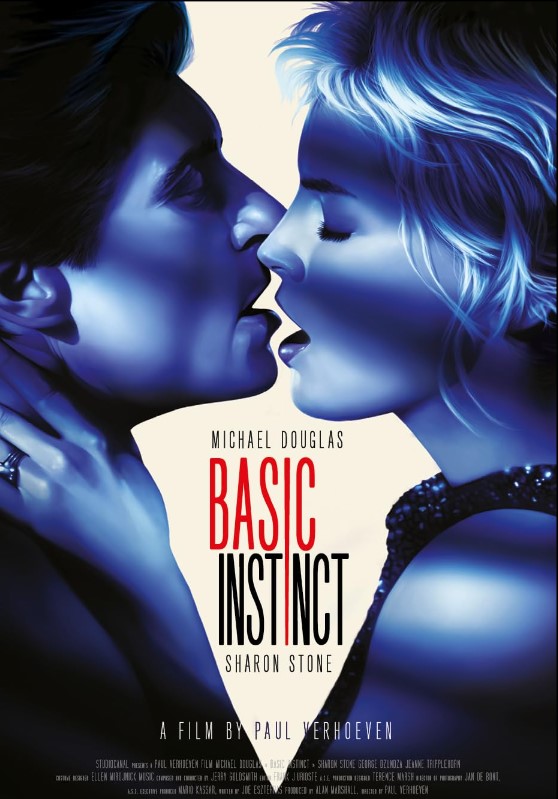
If there is one thing Basic Instinct proves for sure, it’s that Paul Verhoeven is a very naughty boy. A sensational smash hit in 1992, largely because of the instant iconic status of that scene (you know which one), Basic Instinct remixes Hitchcock (especially Vertigo and Psycho) with lashings of explicit sex and violence, a touch of The Silence of the Lambs and a dollop of Fatal Attraction. It’s a deeply silly, dirty film that was a sort of Fifty Shades of its day: vanilla porn for those who feel too self-conscious to actually go and watch a real one.

Catherine Trammell (Sharon Stone) is number one suspect for the murder of her boyfriend (or rather as she describes him “the guy I was fucking”) for two reasons: one she published a novel a few weeks earlier where she explicitly described the crime in detail and two she’s an obvious Hannibal Lector-ish genius psychopath. Doesn’t stop weak-willed detective Nick Curran (Michael Douglas) from becoming obsessed with her, sucked into a wild sexual affair. But is Catherine a misunderstood unlucky victim, or the genius manipulator her old college rival Dr Beth Garner (Jeanne Tripplehorn) – also Nick’s on-and-off girlfriend and psychiatrist – says she is?

Basic Instinct was the most expensive script ever sold, earning Joe Eszterhas $3million for what he claimed was fourteen days’ work. And you can see why – it’s got everything audiences could need for an addictive, trashy bit of fun. A femme fatale who is also a genius psychopath! A handsome macho cop! Brutal murders! A puzzle interesting enough to keep ticking over but obvious enough that you don’t need to think about it too much! And of course, lots and lots and lots of sex! And then even more sex! No wonder people saw dollar bills – at the very worst they had a chance at a so-bad-its-good box office smash.

But the good stuff. Basic Instinct’s comic-book Hitchcock pastiche actually works rather well, helped enormously by a marvellous Oscar-nominated score by Jerry Goldsmith, which brilliantly channels Bernard Herrmann’s luscious Vertigo strings. It’s no exaggeration to say Goldsmith’s score dramatically improves the film, from adding tension to a drawn-out elevator trip to adding a film noir lyricism to Catherine and Nick’s rather forced sexualised banter. Verhoeven also really knows his business: the film’s famous interrogation scene works as well as it does through his skilful editing between wide angles, close-ups and POV shots, aided by the striking uplighting from cinematographer Jan de Bont.

That scene – and the film – also works because of Sharon Stone. Taking on a role turned down by almost every single woman in Hollywood, Stone seizes hold of a part she knew was a once in a lifetime opportunity. Nick may be the lead – and Douglas, in the middle of his run of weak modern American men bewitched by strong women, may have been the high-paid star ($14 million to Stone’s $550k) – but both knew this was Catherine’s movie. Stone plays the role with a playful, sensual confidence and arrogant defiance, knowing full well she can seduce anyone. Despite the clunky dialogue, she makes Catherine sexy, smart and just about vulnerable enough to make some viewers doubt whether she’s the killer or not. (I mean she blatantly is, the film doesn’t really try and pretend otherwise. Most of the fun is seeing how shamelessly she can parade it and still get away with it.)

Away from that though, Basic Instinct is a terribly silly film, a well-made pandering to our lowest desires. Opening with an extremely graphic post-coitus stabbing frenzy (with blood spray everywhere and a nose skewered by an ice pick) – it then teases us three times that it will repeat this again after nearly every explosive session of rumpy-pumpy. Ah yes, the rumpy-pumpy. Basic Instinct slows at the half-way mark for an almost five-minute extended multi-angled, orgasm packed bit of horizontal jogging that Nick then rather pathetically spends most of the rest film bragging about being “the fuck of the century”.

But then Nick is a pathetic figure. Somehow keeping hold of his badge, despite gunning down two tourists while high on cocaine, he’s got such an addictive personality he makes Lloyd Bridges’ (“I picked the wrong week to quit sniffing glue!”) air traffic controller in Airplane look like a model of restraint. After internal affairs-mandated therapy (how’s that for a slap on the wrist) – hilariously compromised by Jeanne Tripplehorn’s Dr Garner crossing all ethical lines by repeatedly shagging him – Nick has proudly quit drugs, drink, smoking, and shooting before asking questions. Needless to say, under Catherine’s influence, he embraces all of these again, all while still managing to be the sort of middle-aged loser who wears a pullover to nightclub.

Eszterhas’ script mixes awful “tough” dialogue (“Looks like he got off before he got offed” Nick’s partner jokes over a victim) with clumsy psychological insight (my favourite is Tobolowsky’s consultant who confidently states two options: Trammel either did or didn’t do it – inevitably this childishly empty insight is met with the manly ‘tecs muttering “In English Doc!”) and blunt statements of the obvious (“She’s brilliant! And Evil!” screams poor Tripplehorn). The flirty banter is largely sold by Sharon Stone’s confidence, since the lines (“I’m not wearing underwear”) are hardly Double Indemnity. The film’s mystery is so irrelevant to its appeal (and, in many ways, plot), it merrily gets bogged down in several off-screen murders of characters we’ve never met.

Today Basic Instinct feels like a bizarre museum piece. George Dzundza’s sidekick cop is intended as comic-relief but comes across like a little ball of toxic masculinity. An early sex scene between Nick and Beth is pretty much impossible to watch today without thinking “yeah that’s rape”. The film uses bisexuality (though we only, of course, get girl-on-girl – Douglas made it clear he ain’t gonna kiss no man) as raw titillation, an entre for the soft porn of Douglas and Stone noisily going at it for about 10% of the film’s run time. Even the famous scene is uncomfortable to watch, since Stone has since made it clear she didn’t consent to that shot.

Basic Instinct is a deeply silly piece of trash. But then that was its appeal back then – no one felt they were actually watching Hitchcock when they sat down to this rip-off of the master (in fact Basic Instinct makes you feel it’s probably a relief the production code meant Hitchcock couldn’t give into his Verhoevenish instincts). Today most like to think of it as a sort of well played card trick. However, it’s hard not to feel a bit for Sharon Stone to whom it became a millstone (which she eventually exploited for a terrible belated sequel for which she pocketed $13.5million), despite being the person possibly most responsible for its success. So maybe Nick won in the end after all.

Mississippi Burning (1988)

Mississippi Burning (1988)

Earnest drama about racism, whose narrative perhaps focuses on less important issues and people

Director: Alan Parker

Cast: Gene Hackman (Agent Rupert Anderson), Willem Dafoe (Special Agent Alan Ward), Frances McDormand (Mrs Pell), Brad Dourif (Deputy Sheriff Clinton Pell), R. Lee Ermey (Mayor Tilman), Gailard Sartain (Sheriff Ray Stuckey), Stephen Tobolowsky (Clayton Townley), Michael Rooker (Frank Bailey), Pruitt Taylor Vince (Lester Cowans), Kevin Dunn (Agent Bird), Badja Djola (Agent Monk)

In June 1964 three civil rights workers – two white New Yorkers Andrew Goorman and Michael Schwerner and a black Mississippian James Chaney – were arrested, released and then murdered by Neshoba County law officials working alongside KKK white supremacists. An FBI investigation (codenamed Mississippi Burning) revealed the crime, arrested the criminals and managed to convict several (but not all) of them on the federal charge of violating civil rights (convinced the state charge of murder would lead to acquittal from racist juries). Mississippi Burning fictionalises this true-life atrocity into a hard-hitting thriller, mixed with the conventions of crime drama.

It’s directed by Alan Parker in the style of Midnight Express, pulling no punches in chucking the vileness of the KKK up on screen. During the course of Mississippi Burning we see Black people chased, beaten, flung out of moving cars onto the street, lynched and a praying child kicked in the face by a KKK thug. Rightly, the murderers are a vile parade of bullies, cowards and knuckle-dragging monsters portrayed by a group of actors (Dourif, Rooker, Sartain and Vince among them) used to going all-in on portraits of the scum of humanity. It’s a tightly directed, intense film – with a repetitively pounding score by Terry Jones – with Oscar-winning photography by Peter Biziou capturing the flame-lit night-time atrocities these repulsive people execute on innocents.

Mississippi Burning is undoubtedly well-made, with a very earnest message behind it. It’s impossible to fault its rightful disgust at the appalling injustice and racism, but you can’t help but feel it’s focusing its heroic lens on the wrong part of the story. It drew fire at the time for its fictionalisation of almost every element – wisely so in its portrayal of the initial crime, where their names and exact nature of their murder are altered – and the way this pushed the FBI (an organisation that had in many cases actively worked against civil rights) into a traditional heroic role, while reducing the Black people to passive recipients of beatings or kind words from whites. It’s hard not to feel today that, for all the skill of the film, the impact of those decisions have magnified the film’s flaws over time.

At heart, Mississippi Burning uses the conventions of a mis-matched buddy-cop investigative drama to add narrative drive to a social issues film. The two FBI agents are played so well by Gene Hackman and Willem Dafoe, you barely notice both are stock roles straight out of central casting. Hackman gives such energy and life (with a lovely touch of shame that his own past conduct, as a Southern sheriff was presumably only a degree better than the people he’s investigating) to his role as no-nonsense, veteran maverick who understands the streets, that he transforms this cliché into a real person. Similarly, Dafoe plays the by-the-book, stuffy superior who has too learn rules-bending sometimes break the case, with such commitment you forget how role familiar it is.

The personal narrative of the film revolves around whether these chalk-and-cheese investigators will overcome their initial iciness – they address each other formally throughout the film and butt-heads frequently on the conduct of the investigation – to become a team which feels odd for a film where the other stakes (violent institutional racism) are so large. In many ways an alternative cliché – two disconnected investigators investing more in a case based on the injustice they see and the witnesses they talk to – might well have served it better and also reflected contemporary complaints that the FBI was more interested in the letter than the spirit of the law. Mississippi Burning does, at times, address this by having characters explicitly ask if the FBI would even lift a finger if two of the victims weren’t white. But seeing as the film generally considers raising the question the same as engaging with it, it doesn’t go anywhere.

The film requires the agents to undertake mis-steps in order to educate the audience (would Dafoe’s character really be as ignorant about the nuances of segregation as he frequently is here?) and blunder about for much of the early acts, most notably Dafoe’s public conversation with a Black man in a diner, that inevitably leads to the poor man kidnapped and beaten by the KKK. But on the whole, the FBI are presented as noble straight-shooters, aghast at the state of affairs in the South, rather than a body run by the morally-ambiguous J Edgar Hoover.

It also means Mississippi Burning relegates its Black characters to passengers and passive victims, reliant on white people for protection and vindication. While it would be false to claim the system in the South didn’t leave Black people largely powerless, the film’s failure to introduce a single memorable character giving voice to the Black perspective of a series of crimes that happened to them feels more and more uncomfortable as the film ages (particularly as the film’s hopeful ending very much places racism as a problem in the past, not a dilemma America continues to face).

The film’s real conscience (and the victim given most development) is instead Frances McDormand as the wife of Dourif’s vile racist sheriff. Parker’s film subtly indicating her lack of racism early (she consoling touches the arm of a Black man), and McDormand (who is excellent) brings real force to her pained, frightened longing to do the right thing. She contrasts neatly with the committed vile cowardice of Dourif, Rooker’s swaggering bullying and Stephen Tobolowsky’s Hiterlian racism as a KKK Grand Wizard. Parker successfully makes these guys so repulsive, that when Hackman’s Anderson gets free reign to intimidate, rough-up and bully them back it carries real satisfaction. But the film making the most developed victim of the film’s KKK a white, gentile feels more like filmmaker concerns that otherwise the bulk of the likely audience may otherwise have trouble relating to the bulk of the victims.

Mississippi Burning tries to be hopeful. This extends to some slightly forced moralising – the suicide of one character is attributed to guilt at the crime, rather than the more likely guilt at having ‘betrayed’ his fellow KKK – and a general sense that Mississippi is on the road to peace, feels a bit of a stretch for a region that had decades of continued unrest ahead. Saying that, in its sometimes clumsy way, you can’t doubt its power and its righteous disgust at racism. It’s well directed and has some excellent performances – Hackman and McDormand were both Oscar nominated – but it feels like a film that only focuses on part of an overall picture and not always the right part.

The Insider (1999)

The Insider (1999)

Mann’s finest film is a chilling breakdown of the insidious strength of corporations

Director: Michael Mann

Cast: Al Pacino (Lowell Bergman), Russell Crowe (Dr Jeffrey Wigand), Christopher Plummer (Mike Wallace), Diane Venora (Liane Wigand), Philip Baker Hall (Don Hewitt), Lindsay Crouse (Sharon Tiller), Debi Mazar (Debbie De Luca), Stephen Tobolowsky (Eric Kluster), Colm Feore (Richard Scruggs), Bruce McGill (Ron Motley), Gina Gershon (Helen Caperelli), Michael Gambon (Thomas Sandefur), Rip Torn (John Scanlon), Cliff Curtis (Sheikh Fadlallah)

For decades we persuaded ourselves smoking was problem-free. Then, when we finally decided sucking tar into your lungs several times a day probably didn’t go hand-in-hand with good health, Big Tobacco bent over backwards to argue they didn’t believe for one minute nicotine was actually addictive. This lie – they were improving the hit to increase the customer base – was blown upon by corporate whistle blower, and former B&W employee, Dr Jeffrey Wigand (Russell Crowe).

But the battle over the reporting of the story also exposed the fault-lines in corporate-owned media companies, as Wigand’s 60 Minutes interview was canned by a CBS network terrified of legal action imperilling a corporate sale, much to the fury of crusading producer Lowell Bergman (Al Pacino) who spent months bringing Wigand in only to see him brushed aside. The Insider charts these two stories merging into each other: the deadly campaign of intimidation and smears against Wigand, segueing into the caving of CBS in the face of legal threats with Bergman left furious, betrayed and turning his campaigning fire against his own employers.

This all comes grippingly to life in Michael Mann’s superb slice of All the President’s Men inspired-reportage, turning this 1996 TV-and-business scandal into a sleek, intelligent thriller that takes a chilling look at how corporate America rigs the game in its own favour with impunity. The Insider is as rightfully furious at the dirty-tricks and menace of the tobacco companies, as it is at the subtly insidious way corporate interests pollutes news reporting. It does this while also presenting its two heroes as flawed men with more in common than they might think: competitive alpha males, both prone to taking rash, destructive actions in fits of head-strong self-righteousness, caring about their own moral code over the needs of others.

The Insider splits into two clear acts: the agonising decision of Wigand to blow the whistle on corporate malfeasance, in the face of immense personal and professional pressure and Bergman’s subsequent struggle to deliver on his word and get Wigand’s confession on air. The first half offers the more traditional heroics – and the more overt hero-and-villain structure, but increasingly I find the second half, of news shows being dictated to by their paymasters more-and-more unsettlingly prescient, becoming increasingly relevant the older the film gets.

But that first half makes for a compellingly tense pressure-cooker view. It’s powered by an excellent performance by Russell Crowe (effortlessly convincing as someone twenty years older, and collecting his first Oscar nomination). Crowe makes Wigand principled but prickly, brave but confrontational and at times frustratingly self-righteous. His moral qualms are finally sharpened into action his fury at the blunt-intimidation from B&W’s sinisterly avuncular CEO (a masterful cameo from Michael Gambon – one of the great single-scene performances in movies) and its implication that he cannot trusted to stick to his NDA. Wigand barely involves his wife (a tightly-wound Diane Venora) in his decisions, only mentioning his dismissal in passing and deciding to appear on 60 minutes (a decision that will shatter their lives) unilaterally.

But Wigand also has higher motives. He wants to be able to look his daughters in the eye, having sold-out to burnish the dirty-deeds of B&W with his scientific skills. He’s rightly affronted by the lies Big Tobacco has sold the public and undergoes enormous sacrifices (financial, marital, professional, legal, death threats and a public smear campaign) to see things through. Mann’s cool mix of starkness and shadows, full of drained out colours and greys, is perfect for a world where Wigand is shadowed by strangers at a driving range, receives bullets in his mailbox and searches late at night for who has left footprints in his garden. Crowe superbly conveys a man acting out of an increasing sense of moral imperative, struggling desperately to hold himself together under immense pressure.

This section of the film – especially with its clear antagonist – plays as a superb personal and political thriller, Mann expertly conveying lurking menace. In 1999 the second half of the film, the struggle to actually broadcast Wigand’s interview, was often seen as slightly underwhelming. But actually it shows a different type of danger: less overt and heavy-handed corporate power with its legal injunctions and bullying FBI guys hoping for a cushy retirement job with the corporation, more how these corporate masters assert control in quiet, less direct ways to decide what we hear or see.

Our journalists have no fear when confronting criminals or terrorists – The Insider’s prologue establishes this with Bergman and host Mike Wallace not flinching in the face of gun-toting Hezbollah fighters guarding the Sheikh they have arranged to interview. But they face far greater threats to their integrity when confronted with lawyers and corporate directors (effectively embodied by Gina Gershon and Stephen Tobolowsky as uncaring suits) whose threats are indirect and insidious. Wigand’s interview could imperil the sale of CBS and the bonus of the corporate suits, and in that scenario journalist principles can go hang. Christopher Plummer is, by the way, superb as the charismatic Wallace, who caves to pressure then convinces himself he hasn’t, a super-star of the airwaves who loses part of his wider integrity trying to protect his position.

And doesn’t the idea that corporations can squeeze the life out of journalistic stories feel even more chilling today? After all, virtually every single news outlet out there is owned by a major business, all with their own agendas. Can we really believe they’ve not all made calls on gets reported, based on what their shareholders might think? Mann’s film skilfully – and rather chillingly – shows how quickly they can re-work the agenda. It leaves Lowell Bergman raging (as only Al Pacino can) against the betrayal of trust he’s being forced to make towards Wigand.

Crowe’s pressure-cooker performance stole many of the headlines on release but The Insider also benefits from an excellent Pacino performance. Utterly committed to his principles and – just like Wigand – utterly unwilling to compromise them even an inch, no matter the cost, Bergman will pick up the windmill-tilting banner, and charge with it at his own paymasters. No one can rip through speeches quite like Pacino, but he gives Bergman a real genuineness, grounded in a fundamental decency, whose righteous anger is underpinned with world-weary disbelief that it’s come to this.

It grounds an excellently studied breakdown of a journalistic turf war. The Insider plays like All the President’s Men, if Woodward and Bernstein had been spiked after they nailed the story. Mann demonstrates the influence in The Insider’s crisply immersive photography that employs depth of frame and gyroscopic deep-focus, as well as in the crisp editing and the film’s mesmerising emersion in the complex details of building a story. Combine that with a gripping conspiracy thriller on the machinations of ruthless corporations and The Insider makes for a compelling film.

Memento (2000)

Memento (2000)

Nolan’s Hollywood debut is still a mesmerising, inventive and inspiring noir thriller

Director: Christopher Nolan

Cast: Guy Pearce (Leonard Shelby), Carrie-Anne Moss (Natalie), Joe Pantoliano (Teddy), Mark Boone Jnr (Burt), Jorja Fox (Catherine Shelby), Stephen Tobolowsky (Sammy Jankis), Harriet Sansom Harris (Mrs Jankis), Callum Keith Reinne (Dodd)

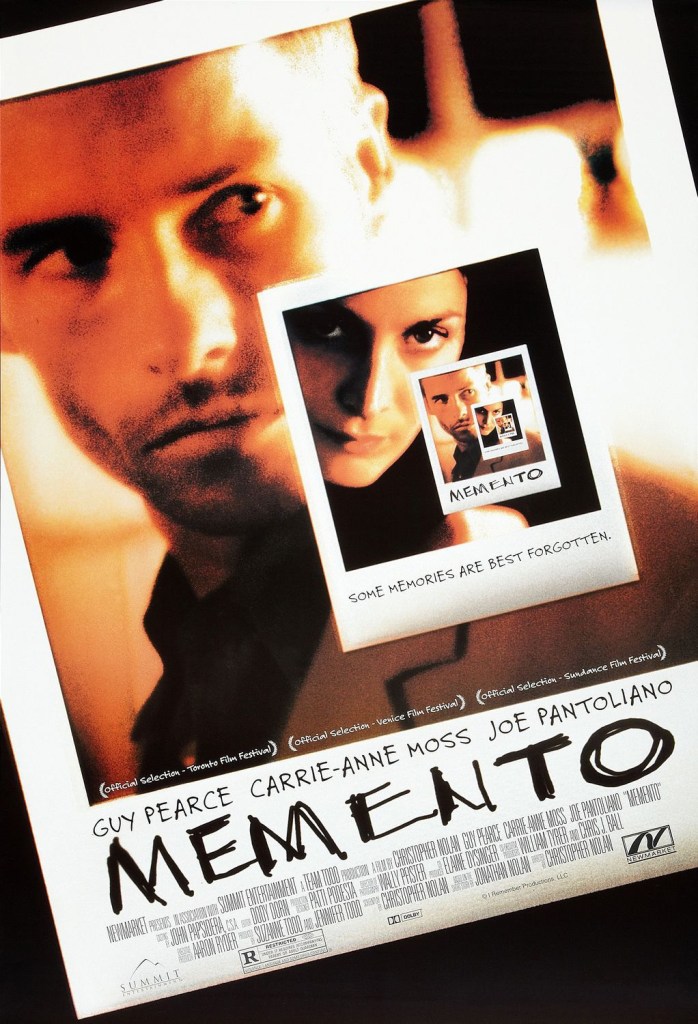
Memento is a twisty-turny thriller of man who can’t remember anything that has just happened to him. But it’s also a tragedy of a man who actually can never forget. Leonard Shelby (Guy Pearce) has anterograde amnesia, a condition that prevents him forging new memories. Every few minutes or so, his memory resets and he forgets what just happened to him. But he can never forget what happened to him immediately before his condition: the murder of his wife by a mysterious assailant. Effectively, Leonard lives forever in that last moment he remembers: it has always just happened, and has shaped his life into a relentless search for revenge.

It’s a realisation I made after a watching again Christopher Nolan’s sophomore calling-card, surely one of the most complete artistic statements of intent Hollywood has seen this century. You can see the roots of all that was to come here, from Batman to Oppenheimer, via Tenet, Inception and Interstellar. Memento is a gripping thriller and also a playful and intriguing dance with narrative conventions, largely told backwards (each seven minute or so section in colour occurs after the scene that preceded it) but also featuring a black-and-white parallel narrative that takes place (it is revealed) chronologically, that eventually links up with the other narrative (the film, effectively, ending somewhere in the middle of the story).

Far from a stunt, this is ingenious, exciting story-telling from Nolan, superbly recreating some idea of what it might be like to never remember why you are somewhere, where you have been or whether you have ever met the person you are talking to before or not. You could say the story, once rearranged in chronological order, is simple – but everything is easy to follow with a map.

Memento’s structure reflects part of Leonard’s perspective, forcing you constantly to watch the film in the moment and never be able to apply your wider knowledge of the narrative. No matter how familiar I become with the film, I find I inevitably become as confused and lost as Leonard is, your mind struggling to reorder and reinterpret “later” scenes as you discover the “earlier” ones, the whole film fracturing into mini-arcs (the chase where a bemused Leonard doesn’t know at first whether he’s chaser or chase; the bar conversation that starts in the middle; the mysterious woman who appears in a bathroom, and so on).

Even more ingeniously, we realise Leonard is essentially ‘re-born’ with every cut-to-black. He will never feel anger towards someone who wronged him minutes earlier or fondness towards someone who was kind to him. The Leonard dead-set on a goal one minute will cease to exist the next, with only any notes remaining to guide him. Essentially, Leonard is constantly handing over to himself: even he knows this: that decisions he makes in a moment effectively carry no implications, because he won’t remember them. He will never feel guilt, or regret, shame, pride and delight.

Leonard prides himself on making his life work through a rigorous system of mental conditioning. His short-term memory may be destroyed, but his ability to “learn” has not. He talks proudly of his system: carefully written notes, annotated polaroids of key people, places and objects, certain things always kept in certain places and, of course, a body littered with tattoos of crucial facts about his wife’s murder. What’s ingenious about Nolan’s film is that, like Leonard, we never know the context of any of this. When Leonard makes a note, what prompted him to do it? Like him we don’t know.

That lack of context exposes, over the course of the film, the nonsense of Leonard’s system. Trusting notes – particularly written by himself – implicitly from moment-to-moment, leaves him wide open to manipulation. If he has a polaroid of an object with the note “This belongs to you”, he will assume it is true. If someone produces evidence of a friendship or mutual interest, he will believe it. Even more chillingly, we discover Leonard himself is more than capable of leaving himself breadcrumbs he knows his future selves can (and will) misinterpret. After all he’ll never remember the deception and will never waver in the belief that he would never deceive himself.

Like Leonard we can never know the truth about the people he talks to. Should we listen to the message “don’t believe his lies” about the ingratiating weaselly Teddy – especially since the film “begins” with Leonard shooting him in the head as the killer of his wife. Or is Teddy, played with a perfectly smarmy, smart-alecky wit by Joe Pantoliano, the friend he claims to be? Does Natalie, the quiet but helpful woman who has also lost someone (memorably played with a beautifully balanced mix of the austere and tender by Carrie Anne-Moss), deserve the absolute trust Leonard accords her based on his annotated polaroids? After all, the manager of the hotel he’s staying at (a marvellously droll cameo from Mark Boone Jnr) cheerfully confesses to ripping him off, since he knows Leonard won’t remember it next time they speak.

What becomes clear is that Leonard, for all his surface assurance and confidence is a raw emotional mess, utterly lost in the world he inhabits and trapped forever in an emotional state of raw grief and fury, his politeness a ‘learned’ habit as much as his mantras and endlessly repeated stories. Guy Pearce gives a fantastic performance of a character both deeply vulnerable but carrying reserves of bitterness that are intensely dangerous when unleashed. Pearce’s empathetic performance, low-key and underplayed throughout, helps us build a deep connection with Leonard, making the audience want him to succeed, while never hiding the possibility of danger in a man who knows nothing about the world around him other it has deeply wronged him.

It’s that hidden emotional state Nolan’s twisting film hides in plain sight throughout. After all, we know Leonard is capable of acts of violent rage – its literally the first thing we see him do. Opening the film with a shot of a Polaroid developing, played in reverse (so the image gets fainter), Nolan even shows us at the start that the facts will become less clear as the film progresses. Despite both these things, it’s frequently shocking how what we think of Leonard and those around him changes.

It’s told with a superb streak of film noir, but also a dark wit (after all, a guy who you can be as blatant false to you as you like because he’ll act like your friend five minutes later, is inherently funny) that means sucker-punch moments when we make crucial discoveries about objects, characters and even the story of Sammy Jankis (a similarly afflicted man, investigated by pre-accident Leonard in his old life as insurance claims investigator) land with a real wallop.

Memento is truly unique, a near unrepeatable trick expertly pulled off by a director who even in his second film was able to present a complex, multi-layered narrative with the assurance of a veteran. What’s interesting about Memento is that, away from the mechanics of how it is told, there is very little self-conscious flash or bombast about it. It uses flair when it serves the story, but otherwise lets events speak for itself. And it unfolds like an onion, each layer rewatch revealing a fresh new layer that shocks the senses. Superbly acted and brilliantly made, it’s a modern noir masterpiece.

Groundhog Day (1993)

Bill Murray lives the same day over-and-over again. It’s Groundhog Day!

Director: Harold Ramis

Cast: Bill Murray (Phil Connors), Andie MacDowell (Rita Hanson), Chris Elliott (Larry), Stephen Tobolowsky (Ned Ryerson), Brian Doyle-Murray (Buster Green), Marita Geraghty (Nancy Taylor), Angela Paton (Mrs Lancaster), Rick Ducommun (Gus), Rick Overton (Ralph), Robin Duke (Doris)

Few films are so well known they’ve become a shorthand. But mention “it’s like Groundhog Day” to anyone, and they know exactly what you mean. That’s a tribute to the film’s brilliant concept – but also its superb execution. Never mind just comedies, this is one of the smartest and best films to come out of America in the 1990s, so good it doesn’t seem to have aged a day. Groundhog Day is an enduring classic and quite wonderful.

Phil Connors (Bill Murray) is a misanthropic weatherman on a Pittsburgh news network. Every February, he is dispatched to the small town of Punxsutawney to cover “Groundhog Day”, an annual festivity where a local groundhog is used to predict whether winter will last six more weeks. Phil makes no secret of his contempt for the event, the town, its inhabitants and indeed everything else. After being trapped in the town by a snowstorm he failed to predict, Phil wakes up the next day – to find it’s Groundhog Day again! When the same thing happens the next day, Phil realises he is trapped living the same day in the small town over and over again – and no matter what he does during the day, he will always wake up in his hotel bed at 6am on Groundhog Day. What will he use the never-ending time for? Personal advantage? Or just maybe, becoming a better man?

Groundhog Day works because its concept is gloriously simple, and yet endlessly intriguing. Who can’t relate to the idea of a prolonged déjà vu? And anyway, don’t most of us feel at some points life is a never-ending treadmill (one of the town’s residents, asked what he would do, stuck in the same place every day where nothing you did mattered, replies “That about sums it up for me”)? Whole books have been written about the film’s philosophical roots – from Nietzsche to Buddhism – and the time loop’s duration. The film invites this because it keeps these concepts gloriously unexplained.

Imagine how much less powerful (and funny) the film would have been if Ramis had caved to studio pressure to either include a scene explaining why the time-loop was happening or providing a definitive answer for how long Phil spends in it. Hilariously, studio execs settled on a short period of time measured in months – others have gone for anywhere between decades to millennia. It’s certainly long enough for Phil to learn by heart the complete biographies of the entire town’s population, know the timeline of every event in the day to the second, and master everything from the piano (to Beethoven-like proficiency), to French and ice sculpting. There is a magic about not knowing the answer to these questions, that make the story brilliantly charming.

It also helps that the film remains, at heart, not science-fiction (which explanations would tip it towards) but a Capra-esque morality tale. The time-loop is, essentially, a second-chance over-and-over again for Phil to become a better person: to change from being a selfish misanthrope into a kinder, generous soul. That’s a story everyone can relate to, and becomes more and more heartfelt as the film continues (culminating in its uplifting conclusion). It also has the Capra touch of a heartless professional from the big city discovering (eventually) a warmth and truth in small-town America where the people are straight-forward and unaffected.

Which makes the film sound tediously feel-good. It escapes this completely because of three reasons. Firstly, initially Phil uses his new super-power of 24-hour immortality for what most of us would do – gain and greed. No consequences ever. Theft is child’s play when you know the exact second bank staff will be looking the other way. Easy to seduce a woman when you can ask her a series of questions on one circuit, then use her answers to pick her up on the next one. You can do whatever you want, confident the next day you’ll wake up in your hotel bed to I Got You Babe.

Even on his journey to eventual self-improvement, Phil only begins to change after exhausting all other options, including repeated attempts at suicide, to try and break the loop. And Phil, for all his charm, is not a good guy for a long time. His attempted seduction of producer Rita (a charmingly winning Andie MacDowell) over a never-ending series of first dates constantly fails, because no matter what happens, she eventually sees through his lack of decency (Phil’s attempts to recapture moments of spontaneous genuineness in later circuits fail completely).

Secondly, the film is brilliantly, gloriously funny – even with repeat viewings. Ramis’ brilliant shooting and structuring of the film focus on its repetition. We see the same shots and sets, hear the same music cues, the film is edited to stress repetition. Few things in comedy are as funny as anticipation and watching characters fly in the face of all the social conventions we deal with everyday. Seeing Phil’s different reactions to the same stimulus each time never fails to raise a laugh. Knowing the events almost as well as Phil, we eagerly await unexpected reactions. The script – by Ramis and Danny Rubin – is packed with brilliant lines, wonderful set-ups and is superbly structured. The first loop establishes all the settings and situations Phil will spend the rest of the film continually interacting with, and the film allows us to often be in on the joke with Phil (making us like him more).

Thirdly, and perhaps almost most importantly, the film could never have worked without Bill Murray in the lead role. For all the pull for Lost in Translation, this is surely Bill Murray’s finest performance, and stands comparison with the best work of Jimmy Stewart and Spencer Tracy, laced with that classic Murray touch. There is no other actor who can present a character so grouchy, deadpan, cynical and selfish but still make us love him. And – for all the terrible things Phil does in this film – you never stop liking him. His comic timing is exquisite (his varying reactions from frustration, confusion, glee and despair at his predicament spot on) but he also taps brilliantly into moments of genuine heart, loss and despair. Murray has spoken of how the theme of redemption spoke very strongly to him – and he plays perfectly a man so selfish that only after he has exhausted all other eventualities – including death – does he start to become a better man. It’s one of the greatest film performances of the 1990s, and the film is impossible without him.

Groundhog Day is pretty much perfect. The town of Punxsutawney is presented to us at first much like Phil sees it – old-fashioned and twee, populated by well-meaning but dull residents – but over the course of the loop, like Phil, we learn to embrace it. It perfectly mixes a glee at breaking the rules and embracing your inner misanthrope, with learning to develop and improve. It’s both hilarious and heart-warming, with every scene a classic and every performance spot-on. It has a timeless (!) quality about it, and its focus on telling a rollicking good story, full of heartfelt emotion and fabulous jokes, means you can add as much or as little spiritual depth to it as you like. It’s a modern It’s a Wonderful Life that might even be better.

Thelma and Louise (1991)

Susan Sarandon and Geena Davis hit the road in Thelma and Louise

Director: Ridley Scott

Cast: Susan Sarandon (Louise Sawyer), Geena Davis (Thelma Dickinson), Harvey Keitel (Detective Hal Slocumb), Michael Madsen (Jimmy Lennox), Christopher McDonald (Darryl Dickinson), Stephen Tobolowsky (Max), Brad Pitt (JD), Timothy Carhart (Harlan Puckett)

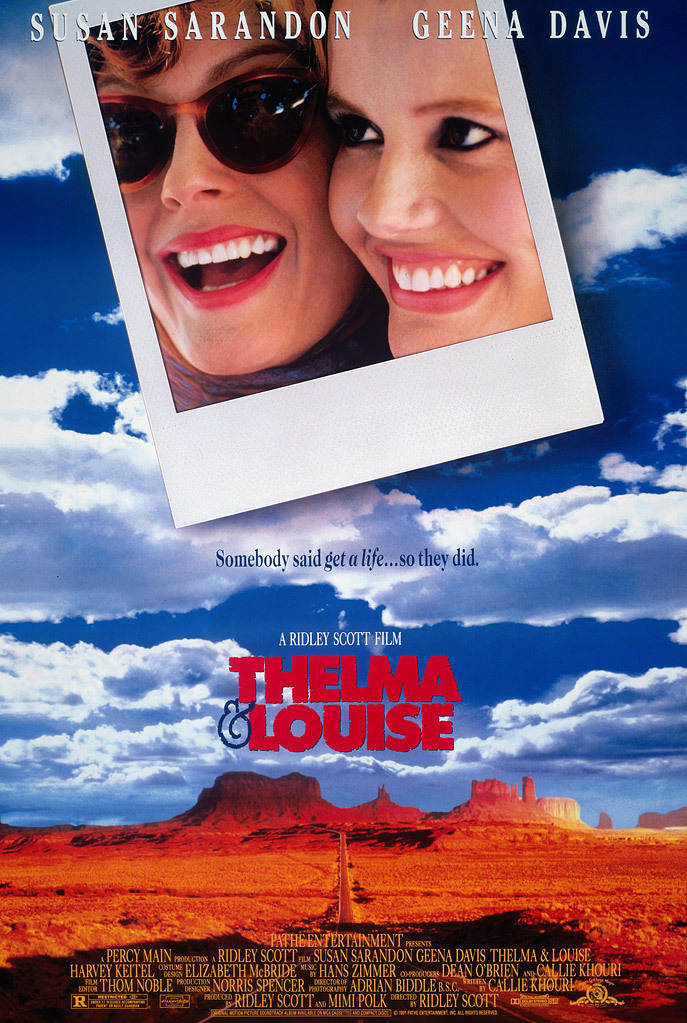
Two people on the run, dodging the police and doing what they can to survive. It’s a well Hollywood has gone back to time and time again. But in most cases the people were either two men, or maybe a man and a woman (romantically involved naturally). It was unheard of to make that most masculine of genres, the outlaw road movie, into one led by women. But that’s what we get here, in a movie that has become iconic in more ways than one, Thelma and Louise.

Louise Sawyer (Susan Sarandon) is a tough, independent-minded waitress. Thelma Dickinson (Geena Davis) is a shy housewife, whose husband Darryl (Christopher McDonald) is a jerk. With Darryl away for the weekend, Thelma and Louise head off for a weekend away together, to let their hair down and feel a bit of freedom. Unfortunately, disaster happens when Thelma flirts with a sleazy guy in a Texas bar (Harlan Puckett), who tries to rape her in the car park. Louise saves her – but guns the guy down. The two women now find themselves on the run from the law, terrified that no one will believe their side of the story. But as the women find themselves on the road, the experience changes them, with Thelma flourishing in an environment where she can make her own choices and Louise becoming more able to open herself up emotionally. But can they stay ahead of the law?

With a terrific (Oscar-winning) script from first-time writer Callie Khouri, Thelma and Louise offers a dynamic and daring twist on the Hollywood road movie. By placing women at the centre of a story like this, a fascinating new light is shed not only on the law, but also on the culture of the American South. It also gives what would otherwise be familiar situations, a fascinating new light as two underestimated people are forced to prove time-and-time again how ahead of the game they are.

Ridley Scott directs the film with a beautiful, confident flourish. The John Fordian iconography of the West is a gift for a painterly director like Scott, and this film hums with the sort of eye for American iconography that only the outsider can really bring. The film brilliantly captures the dusty wildness of the West as well as the neon-lit grubbiness of working class American bars. It looks beautiful, but also vividly, sometimes terrifyingly real. Scott then, with a great deal of empathy, builds a very humane story around this, with two characters it’s nearly impossible not to root for.

He’s helped immensely by two stunning performances from the women in the lead roles. Susan Sarandon’s is perfect for the brash and gutsy Louise, not least because she’s an actor brilliantly able to suggest a great emotional depth and rawness below the surface. Louise is a women juggling deeper traumas – past experiences (its implied a historic rape) that leave her in no doubt that the justice system will not be interested in hearing about a woman’s suffering. It’s the hard to puncture toughness that softens over the course of the film, as Louise becomes more willing to explore her emotions and allow her vulnerability to show.

Particularly so as the lead between the two is slowly taken over by Geena Davis’ Thelma. This is certainly Davis’ finest work, her Thelma starting as a beaten down housewife, just trying to let her hair down in a bar, into a scared victim, a horny teenager lusting over Brad Pitt’s hunky JD then finally into a road warrior who discovers unimagined determination and resources inside herself, toting guns and robbing stores. It’s the sort of once-in-a-lifetime part Davis seizes upon. She’s sensational and totally believable at every turn.

Placing these two women at the centre of a story like this puts the feminine perspective front-of-centre – and it’s alarming to think how little some things have changed. Can we imagine today that there wouldn’t be policemen and lawyers willing to blame Thelma – or claim she asked for it – for her near rape in a bar? Or that there wouldn’t be a fair crack of the whip in the system for Louise for gunning down an unarmed rapist? On top of that, the majority of the police tracking the two women (with the exception of Harvey Keitel’s decent cop – Keitel is very good in this) find it hard to take “these girls” seriously, finding it hard to imagine them being anything other than a joke.

Mind you the attitudes of men are laid bare at every turn. Thelma’s husband Darryl (a very good performance of selfish patheticness by Christopher McDonald) is a waste of skin, a man who can’t imagine a world where Thelma could be his equal. Timothy Carhart is all charm until Thelma denies him the sex he believes he was due for in exchange for a night if flirting and drunks, and promptly turns extremely nasty. The cops – gun totting with itchy trigger-finger – just seem to be waiting for an excuse to throw the ladies down. Even JD (a star marking early performance by a deeply attractive and charismatic Brad Pitt), who seems so charming – and proves the sort of generous and skilled lover Thelma has never experienced in her life – has no qualms about robbing the ladies of their life savings, leaving them hung out-to-dry.

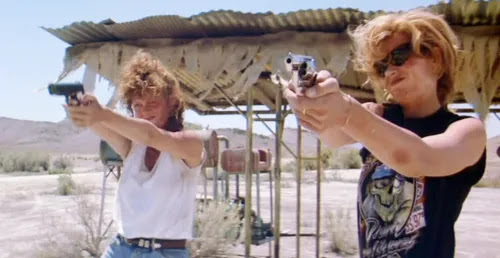
Many men at the time complained (pathetically) about the presentation of men in this film (as if men haven’t had any films where they were sympathetically placed front and centre), but I think it’s a pretty clear judgement that women are not held to the same standards. Khouri’s script shows time and time again the casual sexism (and sexualisation) the women encounter – to the extent that when they finally confront (and pull guns) on the sexist, aggressive truck driver who has been following them for most of the film, you cheer along with them when they shoot out first his tyres, then his oil tanker. We’ve even had a warm-up with Thelma turning a tough intimidating cop into quivering jelly by taking control of the situation.

But that’s what this film is about – the unexpected taking control. Because this isn’t just a feminist statement because it puts women into a male genre. It does so by showing how few choices these women have in their lives before they take into the road and how liberating it is to be able to make their own choices. Because these characters have had all their choices made by men, from Thelma’s smothering marriage to Louise’s undefined past as a victim. And their futures are as much out of the control, likely to find themselves on death row for shooting a rapist. On top of all that, men continue to see them both as sex objects.

How could you not be moved by this? It’s why the films iconic ending carries such impact. These are women discovering they have the power to make their own choices and their own mistakes. It has an undeniable power to it. It’s a power that runs through the entire film, perfectly shepherded by Scott’s astute and sharp direction, with Davis and Sarandon superb. It will still give you shocking insights today into what life is like for women in a world still dominated by men.

More recently its writer and stars pointed out that the film actually ended up changing very little for women in Hollywood. There was no new wave of daringly different female-led movies, with “women’s drama” still mostly restricted afterwards to family drama and romances. There are still few exciting opportunities for female filmmakers. (And it’s a sign of the times back then that the very idea of a woman directing this feminist film was never even raised as a possibility.) Perhaps that’s why Thelma and Louise remains such an icon, because it’s still such a one-off. Either way, it’s a film that hasn’t aged a day since it was released.