Tag: Strother Martin

True Grit (1969)

True Grit (1969)

The Duke wins an Oscar in this solid Western (already old-fashioned in 1969) put together with a professional solidity

Director: Henry Hathaway

Cast: John Wayne (Reuben “Rooster” Cogburn), Glen Campbell (La Boeuf), Kim Darby (Mattie Ross), Jeremy Slate (Emmett Quincy), Robert Duvall (Lucky Ned Pepper), Dennis Hopper (Moon), Alfred Ryder (Goudy), Strother Martin (Colonel Stonehill), Jeff Corey (Tom Chaney), John Fiedler (Daggett)
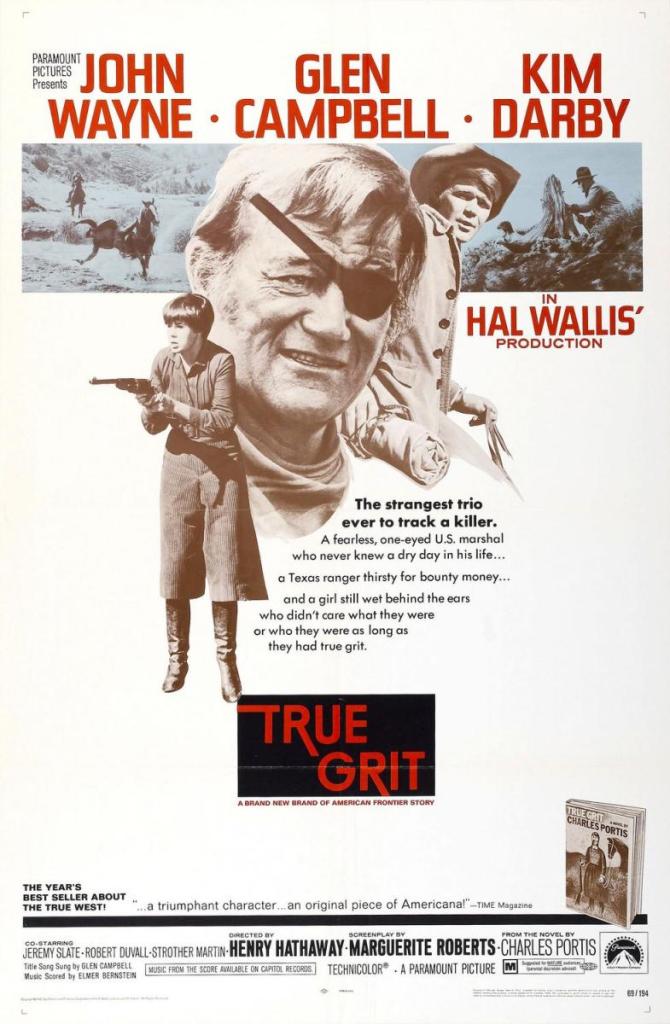
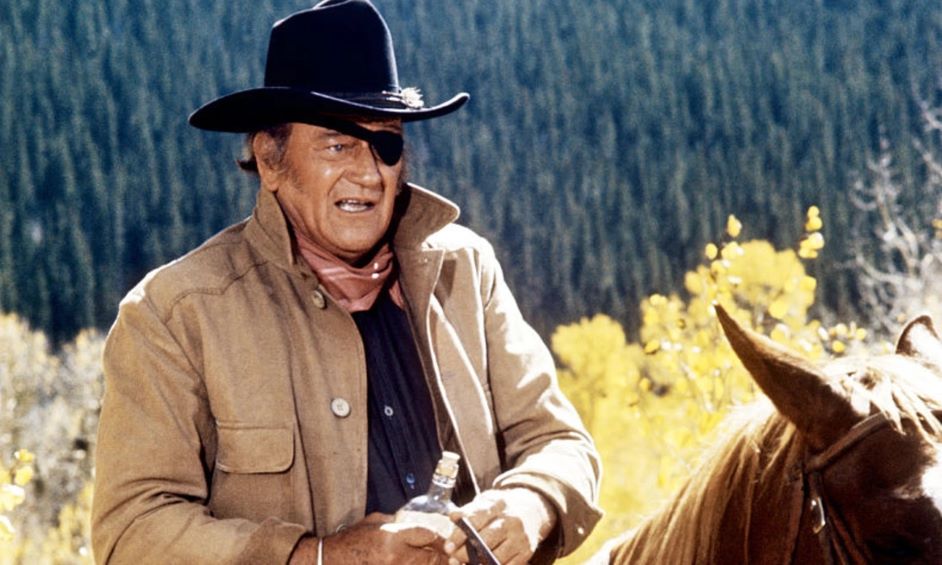
By 1969 John Wayne had been pulling his six shooters against rascals and rapscallions for thirty years, ever since making one of the all-time great entries in Stagecoach. He’d been an American icon, box-office gold and practically the Mount Rushmore of Hollywood. What he never really had was recognition that, underneath the drawl, he was a fine actor who knew his business. He’d only had the single Oscar nomination in 1949, so by 1969 there was a sentimental urge to correct that – especially since illness had already seen the Duke (one of the first major stars to be open and frank about his cancer and urge others to get checks) lose a lung a few years previously.

And correct that they did, as Wayne beat out two respected thespians (the perennially unlucky Burton and O’Toole) as well as the whipper-snapper stars of Midnight Cowboy (the sort of cowboy film the Duke would never even consider making!) to scoop the Best Actor prize for taking a character-role lead (all Wayne roles are lead roles) in True Grit. Wayne was “Rooster” Cogburn, a hard-drinking but hard-riding, always-gets-his-man US Marshal, hired by Mattie Ross (Kim Darby) the teenager daughter of a murdered father to track down his killer Tom Chaney (Jeff Corey). Rooster develops an avuncular relationship with Mattie, despite his penchant to get pissed and (of course!) eventually proves he has the ‘true grit’ that made Mattie hire him in the first place.

True Grit is a traditional yarn, directed with a smooth competence (but lack of inspiration) by Henry Hathaway. It must have felt quite a throwback in 1969: you could imagine it pretty much would have been shot-for-shot identical if it had been filmed in 1949 (especially since Wayne had been playing the veteran since at least Fort Apache). Compared to other major Westerns made that year – Butch Cassidy and the Sundance Kid and, especially, the grim nihilism of The Wild BunchTrue Grit looks like the cosiest film imaginable. It even shies away from the book’s ending where Mattie loses an arm after a snake bite (something the, frankly superior, Coen Brother’s remake would not do 40 years later).

It does feel odd to see Wayne, that bastion of old-school Hollywood, sharing the screen with New Hollywood icons like Dennis Hopper (playing a yellow-bellied squealer at the baddies hideout) and Robert Duvall (a belated villain, looking uncomfortable in this genre saddle-flick as a bad-to-the-bone gang leader). But Hathaway makes sure it’s The Duke’s show. Which it is from start-to-finish.

Rooster isn’t really a stretch for Wayne. Compared to his work in The Searchers and Red River, Cogburn is a cosy and straight-forward hero, a straight-shooter who always holds to his word. But it’s a perfect showpiece for his charisma. Wayne shows a decent comic-timing (he has a nice line in deadpan reactions, particularly when he meets Mattie’s famed lawyer Daggett for the first time, discovering far from the imposing figure he imagined he’s actually the mousy John Fiedler) and there’s just a little hint of lonely sadness in Rooster as he talks about the family who left him or the homes he’s never known.

Wayne also has a lovely chemistry with Kim Darby, the relationship flourishing in a rather sweet big-brother-“little sister” (as Rooster calls her) way. Although of course it takes time to form: Rooster spends most of the first half of the film trying his best to shrug her off so he can hunt down the gang Tom Chaney runs with (and collect the bounty for them) unencumbered. The two of them form a tenuous alliance with Texas Ranger La Bouef, who is far keener to deliver Chaney to another state for a higher bounty than that offered for the killing of Mattie’s father.

La Bouef is played with try-hard gameliness by singer Glen Campbell, largely hired to commit him to singing the film’s best-selling theme tune. To be honest, he makes for a weak third wheel – but it’s hard not to hold it against Campbell when he charmingly later said he’d “never acted in a movie…and every time I see True Grit I think my record’s still clean!”. Far better is Kim Darby, who gives a spunky tom-boyish charm to the shrewd and persistent Mattie who is far too-smart to either by cheated by short-changing landlords or to be ditched from the trail by Rooster and La Bouef.

It’s Wayne’s film though, and a final act face-off with the villains shows that there were few people better with a gun on screen (his one-handed shotgun twirling reload while riding a horse is surely the envy of Schwarzenegger’s similar move in Terminator 2). The whole enterprise is carefully framed to showcase Wayne and he rises to the occasion. Think of it like that, and it hardly matters that Hathaway offers uninspired work behind the camera and fails to provide either any moments of visual interest or dynamism (or work effectively with the weaker actors).

True Grit is an entertaining, second-tier Wayne film, lifted by his charisma and enjoyment for playing a larger-than-life gravelly cool-old-timer and cemented in history by his reward with that sparkling gold bald man. Compared to other Westerns – both before and at the time – it’s traditional, straight-forward and unchallenging. But it’s fun, has some good jokes and offers decent action. And it’s a reminder that no one did this sort of thing better than the Duke.

The Wild Bunch (1969)

William Holden and Ernest Borgnine lead The Wild Bunch into one last adventure

Director: Sam Peckinpah

Cast: William Holden (Pike Bishop), Ernest Borgnine (Dutch Engstrom), Robert Ryan (Deke Thornton), Edmond O’Brien (Freddie Sykes), Warren Oates (Lyle Gorch), Ben Johnson (Tector Gorch), Jamie Sánchez (Angel), Emilio Fernandez (General Mapache), Strother Marin (Coffer), LQ Jones (T.C.)

SPOILERS: Discussion of The Wild Bunch is pretty much impossible without discussing its ending – but then it does have a pretty famous ending. Well you’re warned…

It’s easy to look back the Wild West with rose-tinted glasses. To remember it as being when the American spirit was at its best and a romance ruled. To basically take the “Wild” out of the picture. Peckinpah’s The Wild Bunch is all about putting that “Wild” front and centre, a stunning exploration of the closing days of the Wild West that replaces sentiment and nostalgia with violence and a group of men who know nostalgia is just the vanity of hardened, brutal killers.

In 1916 Pike Bishop (William Holden) is the leader of a notorious gang of criminals, ruthless killers all, wanted by the law – and the rail company they have been robbing for years – at any price. Pike’s latest bank job winds up being a trap, with a deadly shoot-out taking place in the middle of a town (with the population lethally caught in the crossfire) as the rail company tries to kill Pike’s crew, their efforts led by Pike’s former partner Deke Thornton (Robert Ryan), forced to work against Pike or return to the hellish jail at Yuma. The massacre sees only a few members of the gang survive – Pike, his best friend Dutch (Ernest Borgnine), the Gorch brothers Lyle (Warren Oates) and Tector (Ben Johnson), Mexican gun-slinger Angel (Jamie Sánchez) and old-timer Freddie Sykes (Edmond O’Brien). The gang flees to Mexico, with Deke and his posse dispatched on their heels by the furious railway company. In a Mexico ripped apart by civil war, the gang are hired by would-be warlord General Mapache (Emilio Fernandez) to hijack guns from the American army – but there are other dangers when Angel has friendly contacts with the Mexican revolutionaries.

Peckinpah’s film is a stunning exploration not only of the dying dreams and way of life of old men in the West – Pike, Deke, Dutch and Freddie are all old men while the Gorch brothers are hardly in the first flush of youth – but also the endemic nature of violence. Peckinpah’s film is unfailingly brutal in its depiction of violence, an infection that runs through every level of society. Everyone from the children – the film opens with a gang of children laughingly feeding two scorpions to a mass colony of ants, before setting all the animals on fire (look in vain for the “no animals were harmed in the making of this picture” message) – to the men themselves. The film’s opening shoot-out – a technical marvel and also a masterpiece of slow tension building by Peckinpah – is shocking in its brutality.

Unlike Leone, to whom violence is shocking in its suddenness, Peckinpah slows down the action so that we can see (and feel) the horror of each bullet. The Wild Bunch set some sort of record – in its final shoot-out sequence – for blood squibs used. It’s not a surprise after watching the opening shoot-out between the Bunch and the railway forces. With the Bunch using a passing Temperance march to cover their retreat, bullets are fired indiscriminately, killing passers-by and men from both sides alike. No one, aside from a furious and appalled Deke (the only character who has suffered himself from violence in prison) expresses a moment’s guilt for this massacre.

But then Pike and the bunch are hardened killers to a man. Pike cares nothing for the members of the gang lost – even forgetting until late on that he left a man guarding the bank staff while the gang rode out of town – and when a wounded survivor can’t ride and agrees that Pike should finish it, he doesn’t pause for a second. Any ideas of these men as being rogues or there being any charm to living a life on the margins of the law are rapidly dispelled. 

And this violence isn’t just an American thing – it dominates life in Mexico as well, where the drunken, bullying General Mapache is a brutal would-be dictator, whose soldiers frequently terrorise, steal from and murder the villagers around them. In Mexico, the gun is law even more than the US, and these guys have even closer to being criminals in uniform, just as Deke’s posse could just as easily be working with the Bunch as against them.

So what motivates these men? What is brilliant about Peckinpah’s film is acknowledging that these violent killers may feud and fight, but they are still stretching for some sort of meaning in their life. These are world-weary old men with little to live for, who are trying to work out what – if anything – is left in their lives. And that life has to have some sort of code, some sort of grounding basis, even if everything else is up for grabs. Pike says when you “side with a man, you stay with him and if you can’t do that you’re finished”. It’s a flexible rule for these guys – and they frequently shirk it in the film when events are dangerous – but it’s a code they need to believe they would keep.

It’s that code that comes into play late in the film as Angel falls increasingly foul of Mapache’s anger and whims. It takes the gang a while to stand by it, but when they do it’s also partnered by a sad realisation that for these old men what else is there? Their lives have been ruled by the gun and shoot-out after shoot-out. Peckinpah views the West with no nostalgia, but he understands that men need to view their own lives with nostalgia at times, to understand that they may yearn to point at something and say that was what their lives were for.

And what else is there? Everyone in the film knows it’s over. They’re old men, and the world is moving on and leaving them behind. At one point the gang look on at wonder at a car owned by Mapache, and the Gorch brothers flat out can’t believe in the existence of an aeroplane. The modern world is ending the world of these guys, and Pike knows it: “We need to start thinking beyond our guns” he says at one point, but offers no solutions at all about what that might be. The modern world is the real deadly bullet that’s taking out the gang: in the final shoot-out, the key weapon even turns out to be a modern machine gun, spraying death at a level ordinary shooters can’t even begin to match.

That final shoot-out sees all these themes come together brilliantly. It could almost be a rebuttal of Butch Cassidy and the Sundance Kid (released the same year) that sees our heroes captured in romantic sepia freeze frame, charging into certain death against the Bolivian army. Here we effectively see the battle, with additional machine guns and thousands of blood squibs as the Bunch take on Mapache’s army in fury at Mapache’s murder of Sanchez. In a furious shoot-out lasting almost ten minutes, it’s a blood bath as the Bunch mow down dozens and dozens of Mapache’s army while themselves being repeatedly shredded by bullets, adrenalin alone keeping them going. Peckinpah even has the final fatal bullet that takes out Pike coming from a child soldier.

But the Bunch are taking this suicidal last stand because it’s their last –  their only – chance to have stood for something, to have a code they stuck by. To stand by their partner and if that means going down in a hail of bullets, at least there is some sort of glory to it. And besides – what else have they got? The modern world has drained all purpose from their life, so why not at the end wordlessly agree to leave behind the greed that has dominated their lives and die for something?

Peckinpah’s film is simply brilliant, fabulously made and brilliantly shot and edited. The cast of pros is simply excellent. Holden’s world-weary faded glamour now leaving only a cold ruthlessness and a wish that he had more to show for it is perfectly partnered with Borgnine’s easy-going sidekick who wants to do the right thing but needs to find the reasons. Ryan is excellent as a guilt-ridden Deke, who finally has begun to understand the impact of violence. The rest of the cast also excel. The Wild Bunch may be the least nostalgia infected Western ever made, a grim reminder that the West really was Wild. But it’s also a stunningly well-made and challenging picture.

Butch Cassidy and the Sundance Kid (1969)

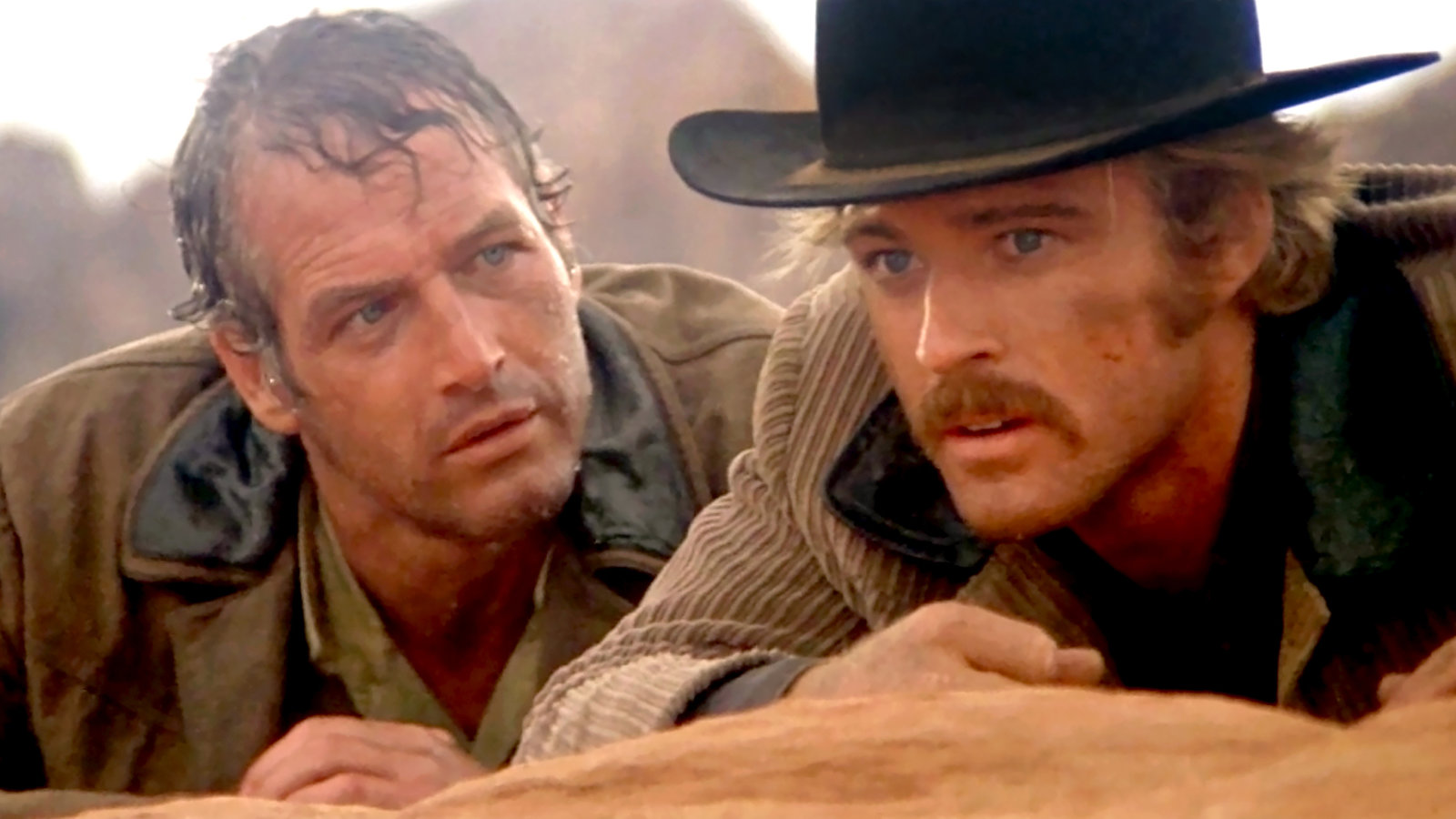
Paul Newman and Robert Redford in the perfect partnership in Butch Cassidy and the Sundance Kid

Director: George Roy Hill

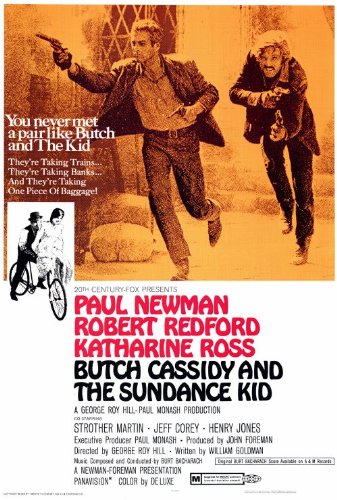
Cast: Paul Newman (Butch Cassidy), Robert Redford (The Sundance Kid), Katharine Ross (Etta Place), Strother Martin (Percy Garris), Henry Jones (Bike Salesman), Jeff Corey (Sheriff Bledsoe), George Furth (Woodcock), Cloris Leachman (Agnes), Ted Cassidy (Harvey Logan), Kenneth Mars (Marshal)

Butch Cassidy and the Sundance Kid was a monster hit in 1969. It struck cinematic gold by combining Newman (originally first choice for the Sundance Kid) and Redford (fourth choice at best after Jack Lemmon – and what a different film that would have been! – Warren Beatty and Steve McQueen) and got the tone just about spot on between old school charm and hit 1960’s chic. It reinvents no wheels, but it’s a prime slice of classic Hollywood entertainment.

In the dying days of the Old West, the Hole in the Wall Gang is finding trade tough. The banks are wising up to how easy they are to rob, and the new idea of holding up trains is fraught with danger. Not least from the powerful backers who don’t like to see their money and goods being half-inched off the tracks by a gang of desperados. The leader of the gang, affable, fun-loving Butch Cassidy (Paul Newman) and his sidekick sardonic ace-shot the Sundance Kid (Robert Redford) continue to ply their trade of stealing, but they are fighting a losing battle. Hounded out of the states by a crack squad of lawman they make their way to Bolivia – but find the life of crime isn’t easier there either, what with no one speaking English and the Bolivian army being even more trigger happy than the American law and order forces. What’s a couple of guys to do?

Butch Cassidy and the Sundance Kid is really a celebration of nostalgia, repackaged with a wry sense of 60s cool that merrily seizes on its lead characters as the sort of anti-authoritarian, free-spirited, jokers who were bucking the rules of Vietnam-era America. But fundamentally at heart, it’s a joke filled sad reflection on a lost America and a lost sense of freedom – even if it was the freedom for two basically decent guys to make a living from robbing banks – that even shoots most of its opening segment in a romantic sepia. 

Because this is all about Butch and Sundance being two guys left behind by progress. Their way of life is dying out around them – the opening sequence sees Butch walk around a new bank, with its impressive new security measures. What happened to the beautiful old bank? Asks Butch: “People kept robbing it” comes the cold response. This follows on from a recreation of old sepia newsreal footage that states that the entire membership of the Hole in the Wall Gang is now dead – meaning that we know where the film is heading from day one. It’s a world where the train and modern communications are leaving our heroes behind. Even the humble bicycle is a sign of the future – “the horse is dead!” crows a bike salesman to a crowd of red necks.

The film may be cool and whipper-sharp in its style and the characterisation of its lead characters, but it’s a firmly nostalgic film that sentimentalises the Wild West and our heroes. No wonder at its conclusion it freeze frames (famously) as the heroes charge out to certain death in a shoot-out with the Bolivian army. It’s like Hill can’t bear seeing these guys torn apart ala Bonnie and Clyde or The Wild Bunch by the cold hard truth of a bullet. 

The film makes an interesting comparison with The Wild Bunch released the same year. In many ways the latter is a more traditional western, both in its style and its content. But in every other way it’s a far more radical piece, really embracing the lack of rules, the cruelty and the lack of glamour of life in the west – and ending with its heroes being shot to pieces on screen in a prolonged bloody shoot out that set a new record for use of squibs. Compared to this, Butch Cassidy is very light stuff, with its final image almost hopeful in its sepia toned romanticism.

Not that it’s not entertaining for all that. Its sense of sixties defiance is perfectly captured in the film’s lightness and playfulness – and in the fine lines and gags in William Goldman’s well structured (and Oscar winning) script. From its opening lines “Most of what follows is true” through the offbeat wisecracks of its lead, it’s a lot of fun. Newman and Redford are both just about perfect. Newman is the very picture of relaxed, casual cool while Redford’s style of handsame smartness works perfectly for the more plugged in Sundance. The two of them also form a very swinging sixties sexfree-Thruple with Katharine Ross as Sundance’s girlfriend, but essentially a companion to both men.

Not that Etta isn’t aware that the good times are coming to end. She makes it clear she won’t stick around to watch them die, and when (late in the film) she announces she will return to the US, it’s a clear sign to everyone that things are near the end. But then Butch and Sundance have already faced the cold realities, as an attempt to go straight protecting bank money from robbers see them gun down a group of bandits (the first real bloodshed in the film), an action that leaves them both slightly stunned.

It’s very different from the hijinks of the film’s first three quarters. The two of them spend a chunk of the film trying to evade the lawmen chasing them, each attempt failing, ending in them making a desperate jump off a cliff into water (because no one would follow unless they had to) and even their early career robbing banks in Bolivia is hampered by their inability to speak Spanish (cue a series of lessons from Eta on the rudiments of larceny in Spanish). The film’s lightness and warmth early on lies behind its popularity.

Butch Cassidy is a film that is designed to please and for you to love it. It has two fine actors giving superbly entertaining performances. It has some wonderful scenes, not least the introduction of each character, two superb scenes (Butch’s facing down of a challenge against his leadership of the gang is a scene so good I don’t think the film bests it). But Hill’s film is also a cosy and safe picture, that drips with sentimentality towards its leads and nostalgia for its era. It’s successful because it’s such an unchallenging and safe film.