
Tag: Tadeusz Janczar

Kanał (1957)

Kanał (1957)

Wajda’s war-epic is a brilliantly filmed, unsettling critique of the truth behind national myths

Director: Andrzej Wajda

Cast: Teresa Iżewska (Daisy), Tadeusz Janczar (Jacek “Korab”), Wieńczysław Gliński (Lt. Zadra), Tadeusz Gwiazdowski (Sgt. Kula), Stanisław Mikulski (Smukły), Emil Karewicz (Lt. Mądry), Maciej Maciejewski (Gustaw), Vladek Sheybal (Michał, the composer), Teresa Berezowska (Halinka)
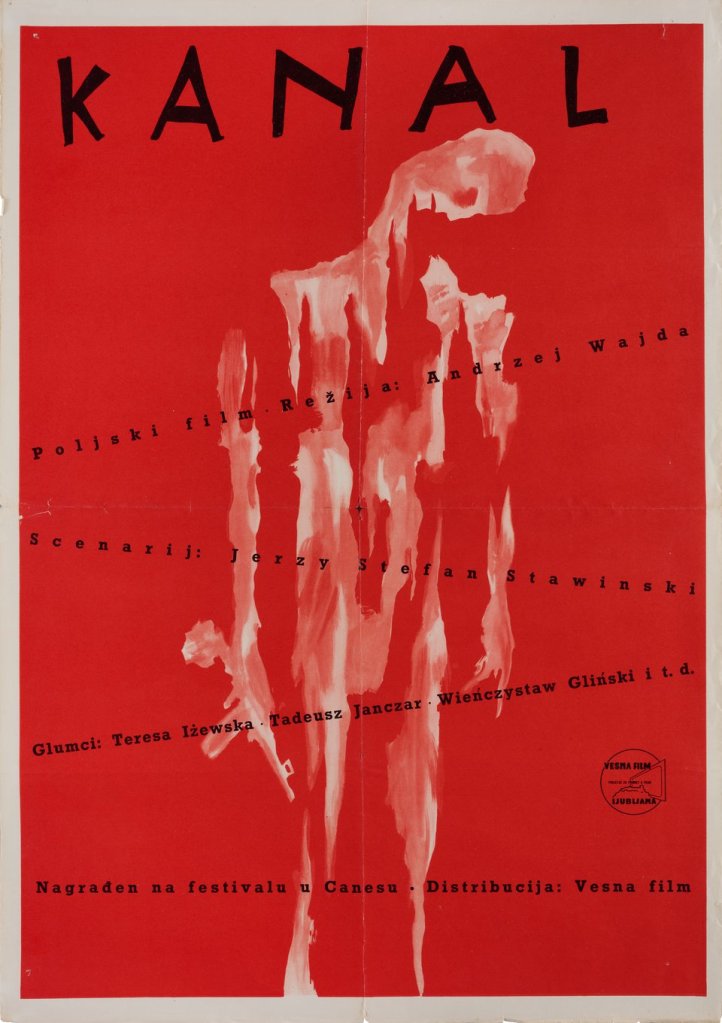
By 1957, Wajda was working under a very different Polish government from the one in place for his debut feature A Generation. With the fall of Stalinism came an easing on restrictions and controls. Wajda could address themes he couldn’t touch before, helping make Kanał perhaps even more controversial than A Generation, as it explored Polish sacrifices during the Second World War and, by implication, asked what the point might have been. Focusing on the final days of the 1944 Warsaw Uprising – a revolt against the German occupiers which the Soviets effectively stood by and watched the Wehrmacht crush – Kanał gives a Polish National myth a tragic human face of futile effort.

Not quite what Wajda’s bosses in the Polish Film Industry expected. Perhaps the title should have tipped them off: Kanał translates as Sewer, hardly suggesting a heroic tribute to national sacrifice. Starting on the 54th day of the Warsaw Uprising, the Home Army forces are beaten, clinging to a few streets. Introducing a unit commanded by Lt Zadra (Wieńczysław Gliński) in a long tracking shot through a devastated city, an unseen narrator bluntly tells us in the opening moments everyone we see is about to die. But not in a last charge against the Germans: instead it will be in the sewers, while attempting to escape, waist deep in shit, lost in the dark and stumbling into dead ends, madness, exhaustion and booby traps.

For many Poles this didn’t fit with the idea of the Warsaw Uprising being a heroic, necessary battle for the nation. It’s rather like in the 1950s, a British film studio had made a film about the Battle of Britain in which the pilots got tanked up on booze then took to the skies to be pointlessly shot down by the Luftwaffe over the channel. At least Wajda this time could present the Home Army – who, following the government line, A Generation had condemned as bourgeoise, fusspot cowards – as heroes. And Kanał is mercifully free of blunt political messaging: no one has time for any of that when they are simply desperate to survive.

What it’s also free of though is any tangible achievements from the Polish Resistance forces. Zadra’s unit holds onto a trashed district, under heavy fire, taking more and more casualties for about a day before being ordered to withdraw through a city pounded by shells through desperate civilians. During the entire course of Kanał the Poles inflict three casualties on the Germans: one tank is hit (but not destroyed), one unmanned motorised mine is stopped and one German soldier who falls into a defensive trench is beaten to death with a stone. Other than that, this is a one-sided curb-stomp where the Germans are hardly even seen and the Poles take huge casualties without even the most basic, morale boosting minor victory.

Kanał’s first half, which covers the war up-top is gritty, immediate and a truly scintillating piece of brutal combat. Wajda’s cinematic confidence is clear from the start with that long Wellesian tracking shot introducing all the characters as they move from one ruined district to another. His combat scenes take place on a wasteland of smashed buildings and have a panicked pointlessness to them – confused and desperate soldiers responding rather than planning anything proactive. The one undeniably heroic act we see – Jacek’s (Tadeusz Janczar, once again Wajda’s complex sacrificial lamb) taking down of the motorized mine – sees him near-fatally wounded, reducing him to a limping, slowly dying passenger for the rest of the film.

The atmosphere behind the lines is already tipping into desperation: number two soldier Mądry (a swaggering Emil Karewicz) is bedding young fighter Halinka (a fragile Teresa Berezowska) openly, while composer Michal (Vladek Sheybal, excellent as a haunted outsider) attempts to call through to his wife and children on the other side of the city, only to listen in on their deaths over a phone line. Any sense of chain of command is crumbling, and the soldiers are already hardened to death and destruction: retreating through the city, none of them can muster even a flicker of interest in a desperate mother begging for news of her lost child.

That’s nothing though compared to the bleakness of the film’s second half as the unit piles into the sewer. Here, time and space start to lose all meaning. The film’s timeline becomes as unclear for us as it does for the characters as they trudge through this Dantean sludge (Wajda makes sure we don’t miss the point, in a slightly clumsy touch, by having Michal quote the poet at length). With limited light, no real idea where they are going, low motivation and toxic gases being stirred up from the excrement they are crushing under their feet, slowly sanity slips, people revert to their worst instincts and selfish, unheroic decisions are made.

There is little to build a national myth on here. An incoherent colonel is left to die in the mire. Mądry and record keeper Sgt. Kula (a comradely Tadeusz Gwiazdowski) decide their own lives are more important than those of the company. Zadra clings to his duty, but lost and confused utterly fails to maintain any duty of care to his men. Michal, teetering already with the loss of his family, disappears into his own world. Their guide Daisy (a brilliantly humane Teresa Iżewska) abandons her duty in what we already know is going to be a futile attempt to keep Jacek alive. There is no dignity or final heroic act of death, with people meeting the end with stunned silence, clumsy tiredness or panic.

And over it all is the statement Wajda implies: since the Uprising achieved nothing but the massacre of its fighters, to a Wehrmacht driven out months later with ease by the Soviet forces, what was the point? That, however much the Communist state chose to praise the bravery of the soldiers, was it brave or foolhardy to single themselves out as targets in a one-sided battle that achieved nothing? Watching the fighters of the Uprising wade through excrement towards a lonely, uncelebrated death with nothing to show for it, makes you consider the complex feelings that lie behind National myths of sacrifice. And it’s a powerful and haunting message for this mesmerising sophomore effort.
A Generation (1955)

A Generation (1955)

Wajda’s striking debut is full of politically-enforced lies but is masterful film-making

Director: Andrzej Wajda

Cast: Tadeusz Łomnicki (Stach Mazur), Urszula Modrzyńska (Dorota), Tadeusz Janczar (Jasio Krone), Janusz Paluszkiewicz (Sekuła), Ryszard Kotys (Jacek), Roman Polanski (Mundek)

Few European countries felt the brunt of the Second World War more than Poland. Invaded by the Nazis and the USSR (it’s often forgot Britain and France went to war in 1939 to defend Polish, something even we seem to have forgotten by 1945 when we allowed the country to be smothered in the Soviet embrace), it faced atrocities from both dictatorships which left lasting scars on the nation. It’s events (and legacy) was the subject of the first three films by legendary Polish director Andrzej Wajda, the title A Generation capturing the impact it had on the entire country.

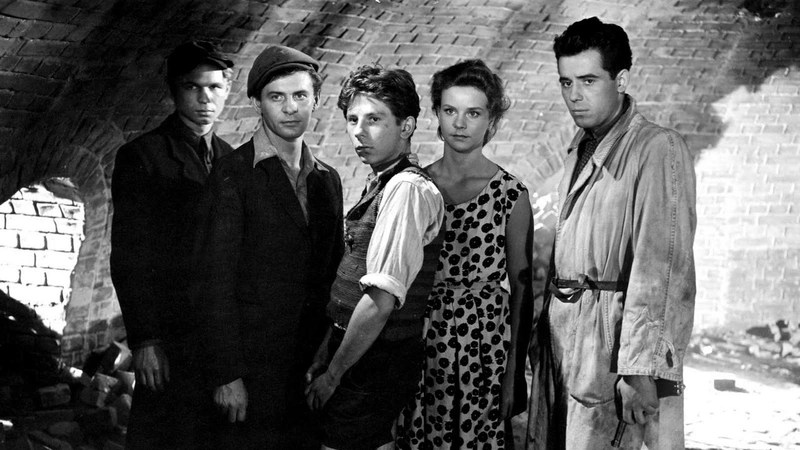
A Generation follows a group of young men drawn into the resistance movement against the German occupying forces. They include the increasingly political Stach (Tadeusz Łomnicki) and the hesitant, anxious Jasio (Tadeusz Janczar), both of whom are inducted into a resistance cell by the impassioned Dorota (Urszula Modrzyńska). As Warsaw burns during the Jewish Ghetto Uprising of 1943, the newly minted fighters take to the streets in solidarity – and at cost.

It’s a simple summary, but that only tells half the story. There are subtleties to A Generation that can be hard to pick-up on for those not born Polish. When Wajda made A Generation, Poland was in the grip of Stalinism. It’s a film not made under artistic freedom, but by an artist pushing against the boundaries of what censorship would allow him to say. Among a great deal of truth in A Generation there are also thumping great lies. Lies that surely must have hurt Wajda, whose father was murdered (along with thousands others) by the Soviets at Katyn (a war crime A Generation, by necessity, pins on the Germans).

Stalinist thinking dictated very clear lines. The resistance heroes in the film are The People’s Guard. This was a pro-Soviet force, that believed only the Soviet Union could save Poland from the Germans. The Home Army (the largest resistance group, loyal to the Polish government-in-exile in Britain) are portrayed as bourgeoisie, reactionary, scared to fight and only marginally better than collaborators. (In real life, Stalin allowed the Home Army to be massacred by the Germans in the Warsaw Uprising of 1944 – Soviet tanks effectively sat outside the city and watched – then shipped thousands of survivors to death in the gulags).

Stalinist thinking also permeates the films characterisation and opinions. Many of the characters frequently feel functional and under-developed, quietly placing the movement ahead of themselves – classic Stalinist thinking, where the individual only serves as a cog in a greater machine. Stach’s work-place mentor waxes lyrical about a wise, kind old man with a beard – Karl Marx of course – while outlining how their Home Army supporting factory boss is ruthlessly exploiting the working classes for profit. Comments about the holocaust are kept to a minimum – Stalin hardly being known for his tolerance either – with Wajda going as far as he can by praising the Jews bravery as fighters. Arguably the most developed character in the film – Tadeusz Janczar’s twitchy Jasio – is only allowed to be a more complex hero because, all his doubts, fears, bravado and individual pride, eventually lead him to the ultimate sacrifice (in the film’s most iconic moment).

If A Generation is so politically compromised, why watch it today? Because it is also a superbly striking debut from a master film-maker – and it’s important to remember, that even with its lies and political obfuscations, the Polish authorities were hardly happy with it at the time anyway. Inspired by Italian neo-realism, Wajda gives the film a lived-in, on-the-streets quality that helped revolutionise Polish cinema. Quite simply, no Polish film had ever looked like this before – it was the first to break free from its hermetically sealed studio bubble. From its opening tracking shot through the poverty-stricken streets of Warsaw’s Wola district, to its extensive location shooting in run-down factories and cobble-lined streets, A Generation embraces realism, employing several non-actors.

Mud, rain and ill-lit locations fill out the frame in a grim, sharply realist view of war. Wajda frequently shows bodies hanging from lamp-posts, while gun battles between Germans and partisans have a frighteningly random intensity to them (perhaps helped by the fact that budgetary issues meant it was cheaper to fire real ammunition on set). The film pioneered the use of squibs for gunshots (condoms filled with fake blood, then burst). Warsaw burns in the background of shots that foreground everyday life, such as fun-fares and solidly proletarian workers working happily.

The partisans huddle in sewers, drink in shanty late-night bars and work in dirty, noisy factories. Wajda’s film fully embraces the style de Sica and others introduced (and fascinatingly was doing this in parallel with Satyajit Ray’s Pather Panchali and Aparajito thousands of miles away). A Generation might keep many of its characters lightly sketched – Stach and Dorota are invested with youthful fire by Tadeusz Łomnicki and Urszula Modrzyńska which goes a long way to round-out their essentially blandly communist personalities, Donata in particular fervent and stoic in her socialism – but it makes the stakes for their struggle with Fascism grippingly real and dangerously immediate.

Wajda also, successfully, gambled that if he made the two leads reasonably acceptable symbols of Stalinist thinking he would be allowed greater scope with the third. Tadeusz Janczar’s performance as Jasio is fabulous – a fighter disgusted by killing, who kills a German with a panicked firing of an entire clip then brags how much he let him have it, whose escape from the Germans during the Uprising could be interpreted either as a noble distraction to allow others to escape or a blind panic that ends fatally. Either way, Jasio is a fascinatingly rich, contradictory character.

Wajda’s film is a powerful mission statement of his dynamism with the camera and his ability to walk a fine-line between political demands and genuine drama (though his later films would be made under a marginally more liberal government). While it must never be forgotten while watching it that it presents a slanted, false version of history, it still captures an essential truth of its haphazard chaos and savage violence. When Stach weeps when seeing teenagers not much younger than him preparing to join the People’s Guard, it hits a deeper truth about the horrors of the twentieth century on Poland that blasts through any political compromise Wajda was forced to make.