Tag: Taron Egerton

Legend (2011)

Tom Hardy plays with himself in Legend

Director: Brian Helgeland

Cast: Tom Hardy (Ronnie Kray/Reggie Kray), Emily Browning (Frances Shea), Christopher Eccleston (Superintendent Leonard “Nipper” Read), David Thewlis (Leslie Payne), Taron Egerton (Edward “Mad Teddy” Smith), Chazz Palminteri (Angelo Bruno), Paul Bettany (Charlie Richardson), Colin Morgan (Frankie Shea), Tara Fitzgerald (Mrs Shea), Paul Anderson (Albert Donoghue), Sam Spruell (Jack McVitie), John Sessions (Lord Boothby), Kevin McNally (Harold Wilson)

Tom Hardy is the sort of actor who, if you could find a role for him in your film, you certainly would. So how about getting the chance to cast him twice? That’s the happy situation Brian Helgeland was in here, with the chance for Hardy to play not one but both of the Kray twins. The buzz around Hardy taking on both roles was so strong that the film itself was almost completely forgotten in the crush. This was perhaps easy to do since the film is pretty mediocre at best, a confused mess that can’t decide if it wants to wallow in the undeserved glamour of the Krays or whether it wants to explore the darker currents below the surface.

The film covers most of the career of the Kray brothers – the seemingly more grounded, ambitious Reggie and then the more impulsive Ronnie, recently released from psychiatric prison. The Kray brothers balance competing demands: Ronnie is essentially happy where he is, king of a small pond, while Reggie has dreams of expanding a criminal empire across the Atlantic in partnership with the Mafia. Meanwhile, various gangland opponents and the police stalk the brothers, while Reggie’s relationship and later marriage to Frances Shea (Emily Browning) slowly collapses.

Helgeland’s film is a fairly bland piece of film-making that wants to have its cake and eat it. It wants to enjoy the criminal undertakings of the Krays, their clubland cool, charisma and charm. But it also wants to make clear that these are violent criminals who have very few moral qualms about anything they do. It’s a printing and an exploration of the legend, but the problem is that it never actually becomes particularly interesting, despite the best efforts of everyone involved. Perhaps everyone became too blinded by the pyrotechnics and undoubted skill of Hardy’s double performance that the overall film itself got a bit lost.

Hardy is superb, turning the brothers into two highly distinctive personalities who both seem like two halves of the same shattered personality, whose character traits slowly merge and even swap over the course of the film. Hardy also develops a key physicality and style for both characters that is very similar but also clearly different in both cases. So you get Ronnie, Churchill-bulldog like, with a muscular, growling heaviness that stinks of paranoia. And Reggie, smart-suited and slicked back, with a confident thrusting demeanour that falls apart over the film into a weasily fury.

Both these progressions make perfect sense, and Hardy is so skilled at playing both halves of many conversations that you forget while watching the film that you are looking at one actor playing two roles. Astonishingly – and perhaps the biggest trick he pulls – he turns this tour-de-force double role into something that feels so natural you don’t notice it happening. And the bond that ties the two brothers together into a descent into hell is so strong that even when beating the crap out of each other they still seem like two halves of one messed up personality.

Hardy is of course so brilliant, the rest of the skilled cast basically only get a few beats to sketch out various gangland figures and coppers. Excellent actors – Eccleston, Thewlis, Bettany, Anderson – are picked out to do this, but none make much of an impression. The thrust is always the strange dance of personality between the Krays, two brothers who effectively destroy each other with their actions, but are so closely bound together that the one cannot survive without the other.

It’s psychology like this that you wish the film could explore, especially as Hardy takes both brothers to dark and bitter places that makes both of them openly vile and terrifying to imagine meeting. Helgeland chooses to explore much of this – particularly Reggie’s darkness – through a rather tired voiceover led structure via Emily Browning’s Frances Shea. There is nothing wrong with Browning’s performance, but the predictable and rather traditional structure that this gives the story – not to mention the rather clumsy scripting – ends up dragging the film along.

Helgeland makes a decent job of directing this film, and it looks fine, but it is strangely underpowered and unengaging at every turn, a bland piece of gangland history that only really catches fire when both Hardys take the stage and this superstar actor lets rip. Away from him, there is a soft-focus nostalgia in its look back at the sixties, which confuses the attitude the film has towards the Krays, and a ticking off of historical events that gets in the way of creating a compelling narrative.

Hardy overshadows the film and he deserves to as he is more or less the only reason to watch it.
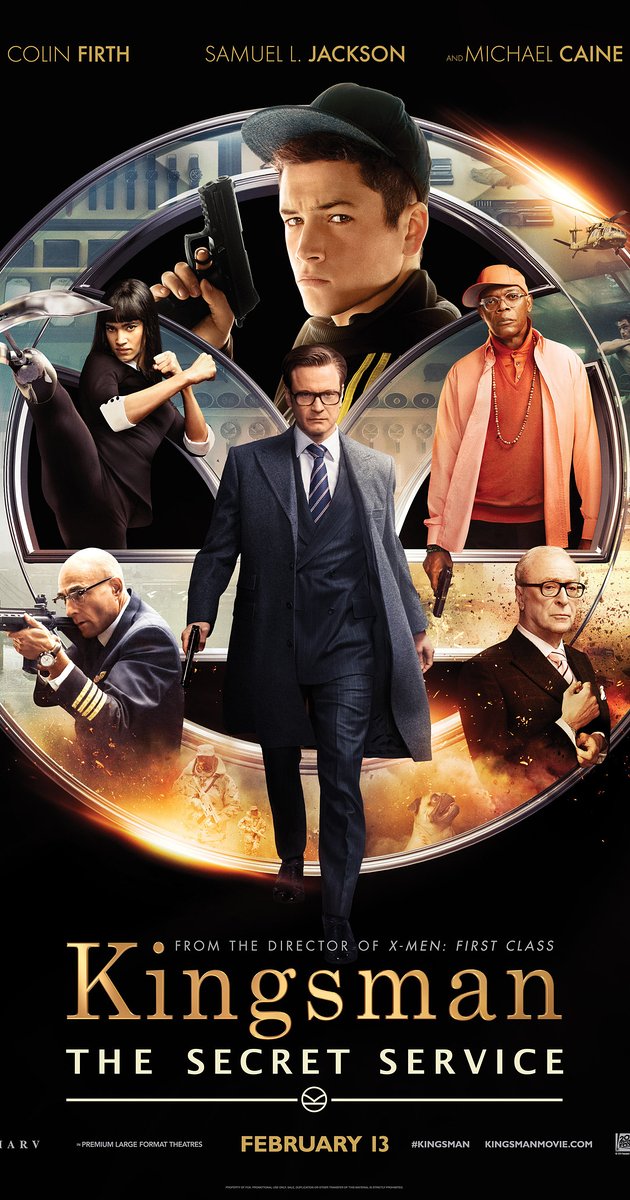
Kingsman: The Secret Service (2014)


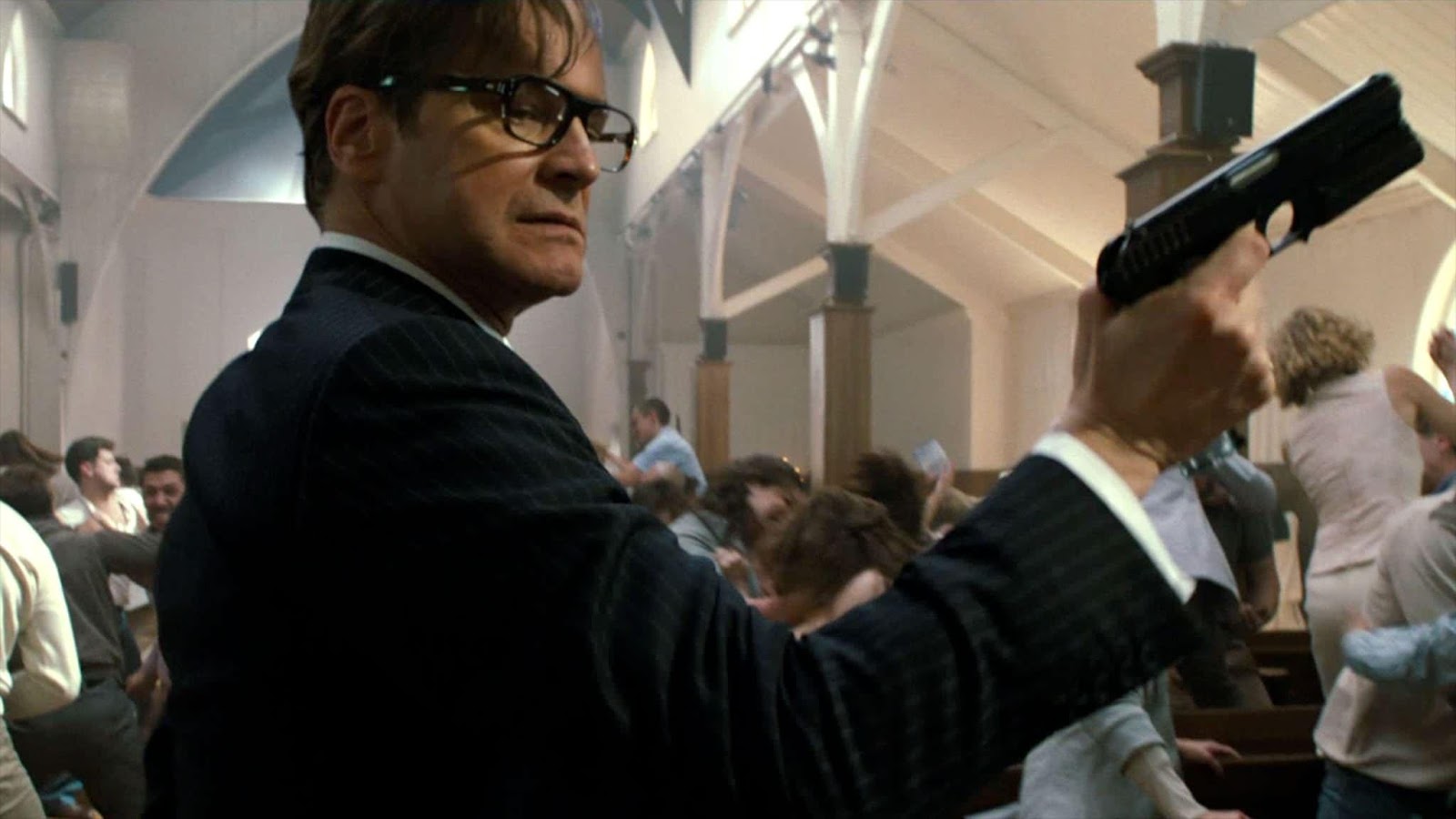
Colin Firth means business in super-violent Bond spoof Kingsman

Director: Matthew Vaughan

Cast: Colin Firth (Harry Hart/Galahad), Samuel L. Jackson (Richmond Valentine), Mark Strong (Merlin), Taron Egerton (Gary “Eggsy” Unwin), Michael Caine (Chester King/Arthur), Sophie Cookson (Roxy Morton), Sofia Boutella (Gazelle), Samantha Womack (Michelle Unwin), Geoff Bell (Dean), Edward Holcroft (Charlie Heskith), Mark Hamill (James Arnold), Jack Davenport (Lancelot)

Okay Kingsmen. I’ll hit a beat later on which explores a major problem I had with this movie, but let’s talk about the rest of the film first shall we?

Firstly, Kingsmen is for the most part rather good fun (even if it is too long). It’s an excitable, teenage-focused riff on James Bond films that throws in ultra-violence and foul language alongside the overblown villains, insane plots and super-spy skills (all themselves amped up to 11). “Eggsy” (Taron Egerton) is a drifting, working-class young man from a council estate who is recruited as a candidate for super-secretive espionage firm “The Kingsmen” by Harry Hart (Colin Firth). Bucking against the system, Eggsy must prove himself against the privileged, public-school types he is competing against for a place. Meanwhile, Hart investigates sinister plans from tech billionaire Richmond Valentine (Samuel L. Jackson), aiming at reshaping the world to fit his own insane ideas.

Kingsmen basically has a teenage sensibility, with a “too cool for school” love for swearing and extreme (if comic book) violence. It deliberately sets itself out as a grimy, modernish, street version of Roger Moore’s Bond movies (at one point, Hart and Valentine even discuss “old spy films” – presumably copyright prevented a namecheck for Britain’s finest). The plot (and the cascade of exploding heads, satellites, sinister cross world signals, world leaders in danger etc.) all have the air of the sort of stupidity you found in Moonraker or The Spy Who Loved Me: the joke being that these fantastical elements have been mixed in with a sweary working-class hero and graphic violence. It has a pop-culture knowingness about it which it just (by the skin of its teeth) manages to prevent becoming too smug or self-satisfied.

This is partly because it is so well made. The violence and fighting are rather well done in their overblown, excessive excitement. Vaughan shoots it with a loving camera, revelling in the dynamism and speed of his agents (and their ruthless efficiency) in a way that’s very hard not to find entertaining. Some interesting music choices also add an ironic commentary to the killing. Vaughan’s also to be commended for spotting the potential for ass-kicking super-spy in Colin Firth (even if Firth himself probably plays the whole film marginally too seriously). The film’s main set piece a jaw-droppingly violent but slickly made fight sequence in a church is probably the only thing it will be remembered for in ten years time – but is certainly worth remembering. The fighting is fun to watch – it’s a shame it’s not married with a wittier script, as if the wit of the visuals couldn’t be carried across to the dialogue in case we got bored.

Vaughan’s script also wants to fight the corner of the working class – although saying that, since every other working class character in the film except for Eggsy and his Mum are criminals, wannabe gangsters or thugs, it could just as well be fighting the corner of the “deserving poor”. Some rather obvious notes are hit during Eggsy’s training as he clashes with the chinless wonders that populate the Kingsmen candidates. It would perhaps work better if Eggsy himself was a more engaging and sympathetic lead – but as it is, the parts of the film without Firth (and Strong as a Scottish, grumpy Q) do drag a bit, which is unfortunate when your film is already over two hours long. It’s hardly Saturday Night and Sunday Morning but it pushes through its Pygmalion-plot line reasonably well.

For the most part, Kingsmen is stupid, teenage fun. It takes place in a spoof James Bond world of huge bases in mountains and plans to destroy the world that can only be foiled by dynamic acrobatic fighting. If you were a male teenager watching this it would probably be your favourite film ever. It’s probably a little too knowing and isn’t really as charming as it really needs to be to work really well, but it’s entertaining enough. I was happy to leave it like that. And then this happens quite late on in the film:

Now it’s important to remember when watching this, that the video contains all the interactions in the movie between these two characters. Now I suppose you could just say it’s a smutty joke that, like the rest of the movie, takes the elements of a Bond movie (“Keeping the British end up sir!”) and amps them up to 11. But it’s cruder and (in my opinion) too clumsy and sexist for that. Not only that, but it’s the sort of exploitative, sexualised rubbish that makes you suddenly address the entire film’s attitude towards women.

The film has five female speaking roles (at a push). Each of these roles fills a specific stereotyped, trope-based function. One is a victim in an abusive relationship (the mother). Another is a standard “hot action chick” (the villain’s henchperson). Another exists solely to die early on. The character in the clip only exists to provide the hero with anal sex as a reward. None of these characters serve any purpose in themselves, other than how they relate to the male characters of the movie. All of them to varying degrees require protection from a man, or exist purely to service his needs. The cliché of a physically-strong-but-still-really-hot woman being created in place of an actual character is so tired, I’ll just leave it here as I can’t be bothered to type up why this isn’t a good balance.

That leaves Roxy, Eggsy’s fellow candidate. On paper, Roxy is a strong female role – only of course she isn’t. There is the standard hand wave that she is “the best in the class” during training – but she’s also established as the only candidate to have a genuine fear (of heights) that she has to be coaxed through by the hero. Her role in the conclusion is conquering this phobia again. The subtle implication is that Eggsy to some degree sacrifices coming top of the class himself to support Roxy.

I’m sure this is all po-faced political correctness and I’m being the sort of humourless prig sitting among the “20% of offended people” Matthew Vaughn said should basically get a sense of humour. But I mean, come on. The last shot of the film is a woman’s naked bottom rearing towards the camera. And yes I know, I know, I know it’s all riffing on Bond films but at least there the heroine was a presence throughout the film. I actually would have much less of a problem if these two characters had spent at least some time throughout the film together – but jumping straight to anal sex? It’s too much. It also seems to be fighting battles of the 1960s. Overt class consciousness from the rich is terrible – but women? Nope they’re just there for the sexier times.

Leaving everything else aside, it’s not that funny a joke. It’s such a terrible joke it leaves a bad taste in the mouth. So what’s otherwise a decent, fun film chooses to end with its lead character invited to perform anal sex by a complete stranger. And how a film ends tells us something about the film we’ve just watched – and for Kingsmen it’s not good.

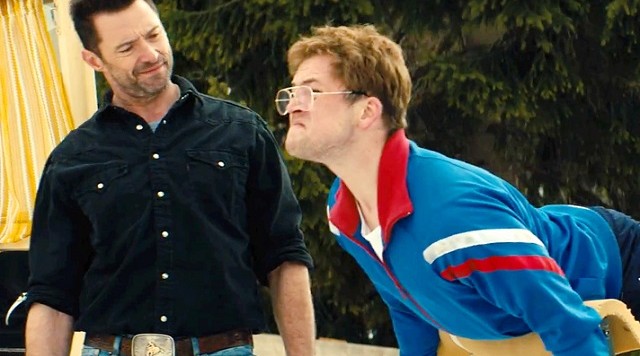
Eddie the Eagle (2016)


Some more comic escapades in the not-really-true-at-all film of Eddie the Eagle’s life

Director: Dexter Fletcher

Cast: Taron Egerton (‘Eddie’ Edwards), Hugh Jackman (Bronson Peary), Iris Berben (Petra), Keith Allen (Terry Edwards), Jo Hartley (Janette Edwards), Tim McInnerny (Dustin Target), Mark Benton (Richmond), Jim Broadbent (BBC Commentator), Christopher Walken (Warren Sharp), Rune Temte (Bjørn), Edvin Endre (Matti Nykänen)

Watching Eddie the Eagle, it’s interesting to think that Edwards was ahead of his time. An unqualified ski jumper with a certain natural talent and a lot of dedication, his unspun, naïve enthusiasm effectively made him a perfect YouTube sensation, 15 years before that term existed. His joyous reactions and “just pleased to be here” manner while coming last in two ski-jumping competitions at the Olympics meant the public couldn’t get enough of him (then or now it seems) and he’s probably about the only thing anyone can really remember about the 1988 Winter Olympics.

I found my heart completely unwarmed by this lamely predictable film, a virtual remake of Cool Runnings and Rocky, which can barely move from scene to scene without tripping over clichés. In other sports films, the snobbery against the underdog feels unjust because we know they deserve to be there. Edwards doesn’t deserve to be there, and doesn’t prove himself anything other than a brave novelty act. Perverse as it sounds, the one area where the film deviates from its predictable formula is the part that makes everything else not really work.

It’s not a particularly funny film. That may be partly because every single comic beat in it is taken from somewhere else, but joke after joke falls flat. Scenes meander towards limp conclusions that can be seen coming a mile off. Every single character is either a cliché, mildly annoying or both. Jackman strolls through the film barely trying. Taron Egerton plays Eddie as virtually a man child, a naïve mummy’s boy, an innocent in the world of men, curiously sexless, but a cheery enthusiast with a never-say-never attitude. However, I often found him less endearing and more mildly irritating.

Virtually nothing in the film is actually true. This doesn’t necessarily matter, but I felt it made the film slightly dishonest. It leaves us with the impression Edwards was set to go on to success in his career – he wasn’t. It doesn’t mention the Olympic committee changed the rules to prevent amateurs taking part in this highly dangerous sport at this level. It doesn’t even begin to mention that almost the entire cast are invented supporting characters, or that many of the real characters (such as Edwards’ father) have had their personalities totally reimagined.

It also reshuffles the truth to make Edwards seem far more incompetent and unlikely than he actually was. In reality an accomplished amateur athlete and skier who just missed the Olympic team, he’s here reinvented as a barely proficient, uncoordinated klutz, a buffoon on skis. Egerton’s otherworldly naivety (at times his childish outlook on the world borders on the mentally deficient) is to be honest rather grating. By hammering up his ineptitude, it’s hard to really think that he should be clinging to these dreams that he’s not suited to perform.

Channel 4 run a TV reality ski-jump show called The Jump. Several celebrities who have taken part in it have suffered serious injuries. With that in mind, is it really wrong to wonder if a sport isn’t right in saying “the unqualified and the amateur shouldn’t be attempting this”? Yes the Olympics is partly about competing in the right manner – but shouldn’t that mean also protecting people from themselves?

The one slightly brave move the film makes is to briefly toy with the idea that Edwards is fundamentally misguided. Before the Olympics begins, his trainer pleads with him to continue his training, wait four years and qualify as a proper athlete rather than a novelty, to have a future of several Olympics rather than cheating into one. Edwards (and the film) ignores him, but I found I was thinking “you know what, he’s right”. The film never manages to remove from Edwards the whiff of the joke act.

I’ve been incredibly hard on this film – it’s not like it’s trying to do anything serious or meaningful. It just wants to tell a nice story about a nice guy. It prides itself on being a bland formulaic piece of film making. But I didn’t find it moving or heartwarming and I didn’t warm to Edwards. I admire his determination, but he’s like those deluded singers chasing their dream on X Factor. The characterisation of Edwards makes him hard to relate to and his final “success” doesn’t mean anything as the film never escapes the feeling that he is being laughed at rather than with. Add the fundamental dishonesty of the film and I found it really unsatisfying.

Give it a miss. Watch Cool Runnings instead. That’s full of invention too of course, but the invention is truer to the facts and the spirit of the truth, and the film itself is far funnier and more satisfying than this one.