Tag: Telly Savalas

The Greatest Story Ever Told (1965)

Greatest Story Ever Told header
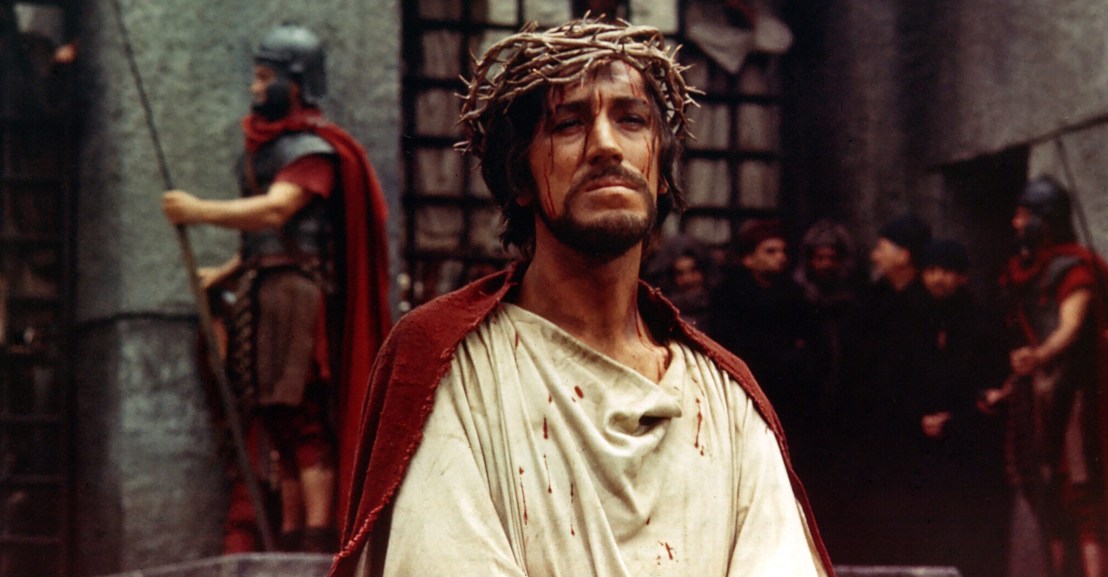
Max von Sydow carries a heavy burden in Steven’s far-from The Greatest Story Ever Told

Director: George Stevens

Cast: Max von Sydow (Jesus), Dorothy McGuire (The Virgin Mary), Charlton Heston (John the Baptist), Claude Rains (Herod the Great), José Ferrer (Herod Antipas), Telly Savalas (Pontius Pilate), Martin Landau (Caiaphas), David McCallum (Judas Iscariot), Donald Pleasance (“The Dark Hermit”), Michael Anderson Jnr (James the Less), Roddy McDowell (Matthew), Gary Raymond (Peter), Joanna Dunham (Mary Magdalene), Ed Wynn (Old Aram), Angela Lansbury (Claudia), Sal Mineo (Uriah), Sidney Poitier (Simon of Cyrene), John Wayne (Centurion)
You could make a case to prosecute The Greatest Story Ever Told under the Trade Descriptions Act. In a world where we are blessed (cursed?) with a plethora of Biblical epics, few are as long, worthy, turgid or dull as George Stevens’ misguided epic. Just like Jesus in the film is plagued by a Dark Hermit representing Satan, did Stevens have a wicked angel whispering in his ear “More wide shots George, and even more Handel’s Messiah. And yes, The Duke is natural casting for a Roman Centurion…”. The Greatest Story Ever Told has some of the worst reviews Christianity has ever had – and it’s had some bad ones.

The plot covers the whole life of the Saviour so should be familiar to anyone who has ever seen a Gideon’s Bible. It was a passion project for Stevens, who spent almost five years raising the cash to bring it to the screen. When he started, the fad for self-important Biblical epics was starting to teeter. When it hit the screen, it had flat-lined. It didn’t help that The Greatest Story Ever Told was first released as an over four-hour snooze fest, laboriously paced, that managed to drain any fire or passion from one of (no matter what you believe) the most tumultuous and significant lives anyone on the planet has ever led. The film was cut down to about two hours (making it incomprehensible) and today exists as a little over three-hour epic that genuinely still feels like it’s four hours long.

Stevens gets almost nothing right here whatsoever. Self-importance permeates the entire project. The film cost $20million, double the largest amount the studio had ever spent. Ordinary storyboards were not good enough: Stevens commissioned 350 oil paintings (that’s right, an entire art gallery’s worth) to plan the picture (which probably explains why the film feels at times like a slide show of second-rate devotional imagery). The Pope was consulted on the script (wisely he didn’t take a screen credit). Stevens decided the American West made a better Holy Land than the actual Holy Land, so shot it all in Arizona, Nevada and California. It took so long to film, Joseph Schildkraut and original cinematographer William C Mellor both died while making it, while Joanna Durham (playing Mary Magdalene!) became pregnant and gave birth. Stevens shot 1,136 miles of film, enough to wrap around the Moon.

There’s something a little sad about all that effort so completely wasted. But the film is a complete dud. It’s terminally slow, not helped by its stately shooting style where the influence of all those paintings can be seen. Everything is treated with crushing import – Jesus can’t draw breath without a heavenly choir kicking in to add spiritual import to whatever he is about to say. Stevens equates grandeur with long shots so a lot of stuff happens in the widest framing possible, most ridiculously the resurrection of Lazarus which takes place in a small part of a screen consumed with a vast cliff panorama. Bizarrely, most of the miracles take place off-screen, as if Stevens worried that seeing a man walk on water, feed the five thousand or turn water into wine would stretch credulity (which surely can’t be the case for a film as genuflecting as this one).

What we get instead is Ed Wynn, Sal Mineo and Van Heflin euphorically running up a hilltop and shouting out loud the various miracles the Lamb of God has bashfully performed off-screen. Everything takes a very long time to happen and a large portion of the film is given over to a lot of Christ walking, talking at people but not really doing anything. For all the vast length, no real idea is given at all about what people were drawn to or found magnetic about Him. It’s as if Stevens is so concerned to show He was better than this world, that the film forgets to show that He was actually part of this world. Instead, we have to kept being told what a charismatic guy He is and how profound His message is: we never get to see or hear these qualities from His own lips.

For a film designed to celebrate the Greatest, the film strips out much of the awe and wonder in Him. It’s not helped by the chronic miscasting of Max von Sydow. Selected because he was a great actor who would be unfamiliar to the mid-West masses (presumably considered to be unlikely to be au fait with the work of Ingmar Bergman), von Sydow is just plain wrong for the role. His sonorous seriousness and restrained internal firmness help make the Son of God a crushing, distant bore. He’s not helped by his dialogue being entirely made-up of Bible quotes or the fact that Stevens directs him to be so stationary and granite, with much middle-distance staring, he could have been replaced with an Orthodox Icon with very little noticeable difference.

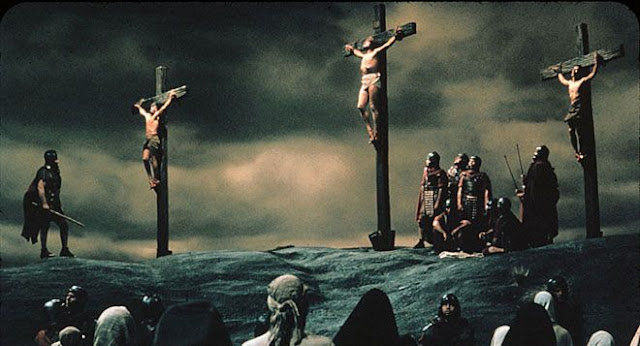
Around von Sydow, Stevens followed the norm by hiring as many star actors as possible, some of whom pop up for a few seconds. The most famous of these is of course John Wayne as the Centurion who crucifies Jesus. This cameo has entered the realms of Filmic Myth (the legendary “More Awe!”exchange). Actually, Stevens shoots Wayne with embarrassment, as if knowing getting this Western legend in is ridiculous – you can hardly spot Wayne (if you didn’t know it was him, you wouldn’t) and his line is clearly a voiceover. In a way just as egregious is Sidney Poitier’s wordless super-star appearance as Simon, distracting you from feeling the pain of Jesus’ sacrifice by saying “Oh look that’s Sidney Poitier” as he dips into frame to help carry the cross.
Of the actors who are in it long enough to make an impression, they fall into three camps: the OTT, the “staring with reverence” and the genuinely good. Of the OTT crowd, Rains and Ferrer set the bar early as various Herods but Heston steals the film as a rug-chested, manly John the Baptist, ducking heads under water in a Nevada lake, bellowing scripture to the heavens. Of the reverent, McDowell does some hard thinking as Matthew, although I have a certain fondness for Gary Raymond’s decent but chronically unreliable Peter (the scene where he bitches endlessly about a stolen cloak is possibly the only chuckle in the movie).

It’s a sad state of affairs that the Genuinely Good actors all play the Genuinely Bad characters – poor old Jesus, even in the story of his life the Devil gets all the best scenes. That’s literally true here as Donald Pleasence is head-and-shoulders best-in-show as a softly spoken, insinuating but deeply sinister “Dark Hermit” who tempts Jesus in the wilderness and then follows Him throughout the Holy Land, turning others against Him. Also good are David McCallum as a conflicted Judas, Telly Savalas as weary Pilate (he shaved his head for the role, loved the look and never went back) and Martin Landau, good value as a corrupt Caiaphas (“This will all be forgotten in a week” he signs the film off with saying).

That’s about all there is to enjoy about a film that probably did more to reduce attendance at Sunday School than the introduction of Sunday opening hours and football being played all day. A passion project from Stevens where he forgot to put any of that passion on the screen, it really is as long and boring as you heard, a film made with such reverent skill that no one seemed to have thought about stopping and saying “well, yes, but is it good?”. I doubt anyone is watching it up in Heaven.

Birdman of Alcatraz (1962)

Burt Lancaster excels in prison drama Birdman of Alcatraz

Director: John Frankenheimer

Cast: Burt Lancaster (Robert Stroud), Karl Malden (Harvey Shoemaker), Thelma Ritter (Elizabeth Stroud), Neville Brand (Bull Ransom), Betty Field (Stella Johnson), Telly Savalas (Feto Gomez), Edmond O’Brien (Thomas E Gaddis)

What is prison for? Is it just a cage – or should it offer reform and self-improvement? Debates like this have existed from the moment the first mass-prison opened. Birdman of Alcatraz taps into this, presenting a romanticised image of the life serving time of Robert Stroud (Burt Lancaster), a double convicted murderer (including killing a guard in prison) who narrowly escapes a death sentence, sentenced to a lifetime in solitary confinement. Stroud develops a passion for ornithology, eventually becoming one of the world’s experts on avian disease – all while confined to his cell.

Front and centre in Birdman of Alcatraz is Burt Lancaster. Made by his production company, and hand-picked director (after firing Charles Chrichton), Lancaster’s prickly persona and patrician distance is wonderfully re-directed as a man who, for much of the film, carries a strong whiff of danger and violence. Surly, bitter and unrepentant, Lancaster brilliantly captures Stroud’s monomania which blossoms into a realisation his own life has been wasted. Oscar-nominated, Lancaster makes Stroud hard-to-like, but one who we slowly relate to as his brutality into a sort of recognisable humanity, however sharp-edged and un-appealing he can be.

Frankenheimer’s well-made film – it’s strikingly less flashy than much of his early work, instead using a restrained sense of documentary realism – is one I found both entertaining and involving, but also strangely troubling. But first the positive: there is no doubt this is a great “prison” movie, perfectly capturing the monotony and boredom long-term solitary confinement brings. It reduces the world into something small and oppressive – Stroud has a cell, a corridor and an exercise yard – and Frankenheimer pours on the sympathy for prisoners who are caged in a system that removes any individuality from them to turn them into docile drones.

Stroud faces a permanent struggle to win the right to keep and study his birds – including going into business selling his bird illness remedies – in the face of a system that wants him to sit in his silently in his cell. It’s hard not to be engaged with Stroud, and the lengths he must go to sustain the new hobby that has given him a reason for living. A birdcage is fashioned out of a crate after months of work. Endless variations on cures are attempted to deal with an outbreak of disease. There is even a bureaucrat warden – well played by Karl Malden as a functionary who is all duty and no imagination – who strongly believes indulging this nonsense is letting him off lightly. And maybe he’s right.

And it’s that issue which I find troubling at a film. This is a conscious attempt to turn Stroud into a sort of Mandela of Ornithology. But, scratch the surface of researching the film, and you discover Stroud was a man repeatedly diagnosed as a psychopath, who committed acts of brutal murder. This is a film that asks us to look at a man and sympathise with him, based on his passion for his hobby – like a Herman Goering biopic that focuses on his love for art. Reflecting real life, in the film Stroud never expresses a jot of regret or remorse for his crimes. The film argues his work with birds shows he has been rehabilitated – but I would argue his utter inability to recognise any moral responsibility for his actions, shows he is in no-way suitable for release.

Let this idea trip into your head and then, no matter how well made the film is made – or how well acted or engaging the story is – you suddenly twig this is a film about a man who forms stronger relationships with birds than he does with other human beings. Stroud will slave for months to save his bird – but barely bat an eyelid at the death of a man. His closest bond seems to be his antagonistic relationship with Malden’s warden, while even his closest prisoner companion (an Oscar-nominated Telly Savalas) is someone who passes out of his life for years at a time with no reaction from Stroud, and who seems capable of more regret and reflection than Stroud.

Fitting his sociopathic profile, Stroud’s only real human contact is formed with his mother. And, like White Heat’s Cody Jarrett, they have the same all-encompassing (and damagingly facilitating) relationship. His mother – played with a skilful sense of control and emotional manipulation by Thelma Ritter – constantly excuses her son’s sins, while demanding she remain his principle (ideally only) personal contact. To her, all other people – especially women – are a dangerous corrupting influence. This is not a healthy relationship, but the film doesn’t explore it, other than positioning the mother as a beast, who furiously drops her son when he decides to marry (for convenience so she can visit him) a fellow ornithologist, played by Betty Field.

In real life, Stroud was a brutal killer – not the rogueish old man he becomes by the film’s end, charming journalists – but his personality is re-positioned to take a stance on the ethics of prison reform. The film has, not surprisingly, an optimistic 1960s feeling that free-will and independence should be prioritised and that the system only crushes those feelings. Life isn’t as simple as that, however much Birdman of Alcatraz wants it to be. However, it shows you can still hugely enjoy a film that you disagree with. I guess that’s the sort of oddity that makes us human.

On Her Majesty's Secret Service (1969)


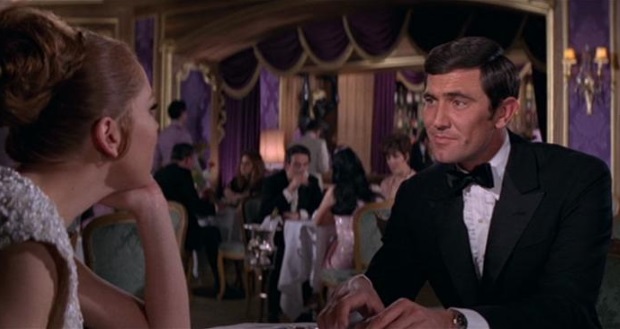
George Lazenby flirts with Diana Rigg. If only he was James Bond.

Director: Peter R. Hunt

Cast: George Lazenby (James Bond), Diana Rigg (Tracy di Vicenzo), Telly Savalas (Ernst Stavro Blofield), Gabriele Ferzetti (Marc-Ange Draco), Ilsa Steppat (Irma Bunt), Bernard Lee (M), Lois Maxwell (Miss Moneypenny), George Baker (Sir Hilary Bray), Bernard Horsfall (Shaun Campbell)

After You Only Live Twice, Sean Connery was through with Bond. Despite the producer’s pleas, Connery was off. The producers were hit with a conundrum – should they recast and start again? Or recast and pretend nothing has changed? They went with the second option and spread the net among the world’s actors, and hired… a man whose only screen work was in a chocolate advert.

Bond (George Lazenby) is on the hunt for villainous SPECTRE head Blofield (also played by a new actor, Telly Savalas). Following a lead, he meets and begins to fall in love with daughter of a Count, Tracy di Vicenzo (Diana Rigg), before infiltrating Blofield’s alpine HQ disguised as an expert in heraldry (seriously that is the plot). There he uncovers a plot for world domination that involves a dozen attractive young women, a deadly virus and the usual collection of inept SPECTRE henchmen.

It’s become a bit retro-cool to reassess OHMSS as the finest James Bond film. This always seemed odd to me: this series, more than any other, is so closely tied in with the personality and skills of the lead actor – and this film has the weakest of the lot. But compared to the two slightly tired films that came before it (YOLT and Thunderball), this one does have more narrative ambition and offers a freshness and sweep in its filming, as well as a compellingly filmed series of action pieces.

Really though you can’t talk about OHMSS without mentioning the Lazenby-sized elephant in the room. Poor George. Watching Lazenby you can never forget this is a guy who landed Bond on the basis of (a) he looked good in a tuxedo and (b) he broke a stuntman’s nose when he auditioned.  But let’s start with the positives. Well he can fight – jeez louise this guy can fight. Lazenby’s Bond is possibly the most physically aggressive until Craig. He’s totally at his ease in the fast-paced fisticuffs that fill the movie. He looks very believable when he’s asked to do anything athletic or dangerous looking. I’ll also cut him some slack that he is given a terrible wardrobe of clothes here (could he look more camp?) and that he spends a significant chunk of the film disguised as a camp heraldry expert.

It’s just a shame that anything involving acting is a bit too much of a stretch for him. His delivery of his dialogue is flat and lifeless. For a large chunk of the film, his voice is all too obviously dubbed (by George Baker). He’s frankly not that funny, despite having several gags (including of course “This never happened to the other fellow”) which are actually pretty good. He can’t bring any real emotional depth to the romance. His chemistry with Diana Rigg is pretty middling, although he does a decent job of his grief at her (spoilers!) death. But it’s the voice that you keep coming back to. It’s grating – flat, dull and monotone. Even though the material makes Bond more human than ever, Lazenby’s underwhelming performance doesn’t make us feel any closer to him.

The producers were clearly aware of the problem, so crammed the film with as many references back as they could manage, as if to reassure audiences “Yes Connery has gone, but don’t worry it’s still Bond!”. So we get a scene of Bond flicking through a desk full of knick-knacks from previous films (the film even plays snatches of the scores). M, Q and Moneypenny work overtime to treat Bond exactly the same. All this attention to continuity of course only goes so far – despite the fact they both spent a fair bit of time with each other in the previous film, Blofeld doesn’t even remotely recognise Bond when he rocks up at Blofeld’s base pretending to someone else, disguised by nothing but a pair of glasses. For a film determined to hammer home the continuity more than any other in the series (until Spectre) this doesn’t make a lot of sense.

So the real question: can you have a great Bond film, when Bond himself in it is pretty dreadful? Can you really enjoy the film when the whole time you almost force yourself to picture any of the other Bonds in place of the one you’re actually watching? Well OHMSS gets pretty close to success despite the fact it has a black hole at its centre, which is a tribute to it. This one feels closer to Ian Fleming than almost any other film in the series. It’s the straightest adaptation of the source since From Russia With Love. Lazenby’s more human take on the role (sentimental, scared at times) does feels closer to Fleming’s Bond than Connery’s Ubermensch. This doesn’t mean the plot isn’t utter bobbins – but at least it’s very Fleming-esque bobbins.

In fact the producers threw everything except the kitchen sink at this one. There’s a car chase (in the middle of a car rally), a helicopter-led storming of a SPECTRE base, no end of punch-ups, a barrage of battles, ski-chases down the alps, a final battle in a toboggan (surely the only film until Cool Runnings to build up to a climatic encounter in a winter-sports event). Many of these sequences are terrific, and Hunt films everything with a grounded realism (despite the ludicrousness of so much that happens) that makes everything immediate and exciting. He also combines this with an ability to shoot moments of epic action with sweep and majesty.

It’s also quite refreshing in how it treats its romantic lead. Diana Rigg is not only (by far and away) the best actress to play a Bond girl until the Craig years, but she is allowed to create a character who feels a worthy partner to Bond. Tracy is brave, determined, can take care of herself, rescues Bond at one point and gets to do all the driving (and is extremely good at it). Sure the film has its old-fashioned moments (when her father encourages Bond to court her, he charmingly states: “What she needs is a man… to dominate her! To make love to her enough to make her love him! A man like you!”. Okay…), but as far as it goes this is pretty advanced stuff for Bond at the time.

The plot is nonsense of course, and Telly Savalas feels like a strange choice for Blofeld (he’s far too gritty, aggressive and, above all, American!) but the action is really well counterpointed with the relationship between Bond and Tracy. Tragically, this film has exactly the rich, deep and emotional material Connery was crying out for. The love story – despite Lazenby’s limitations – feels genuine and sweet and the final tragic ending is, by far and away, the best bit of acting Lazenby gives in the entire film. But you keep imagining what it would have been like if Connery had been in this film, or indeed anyone who could actually act (even Moore could have made a lot more of this material).

That’s the problem with OHMSS. Bond films depend on their Bond – and when the Bond lacks any real charisma and struggles to deliver on anything other than the physical side of the business, your film is always going to be in trouble. Which is a real shame, because nearly everything else about this film is actually really good. It feels fresh, exciting and real in a way others felt tired and over familiar. It’s got some excellent action and excitement. It’s shot and edited with real vibrancy. The action set pieces are exciting. It’s got a sweet romance at its centre. You just don’t really connect with or care about the hero. And for a film series that rests so heavily on the lead, that is pretty terminal.