
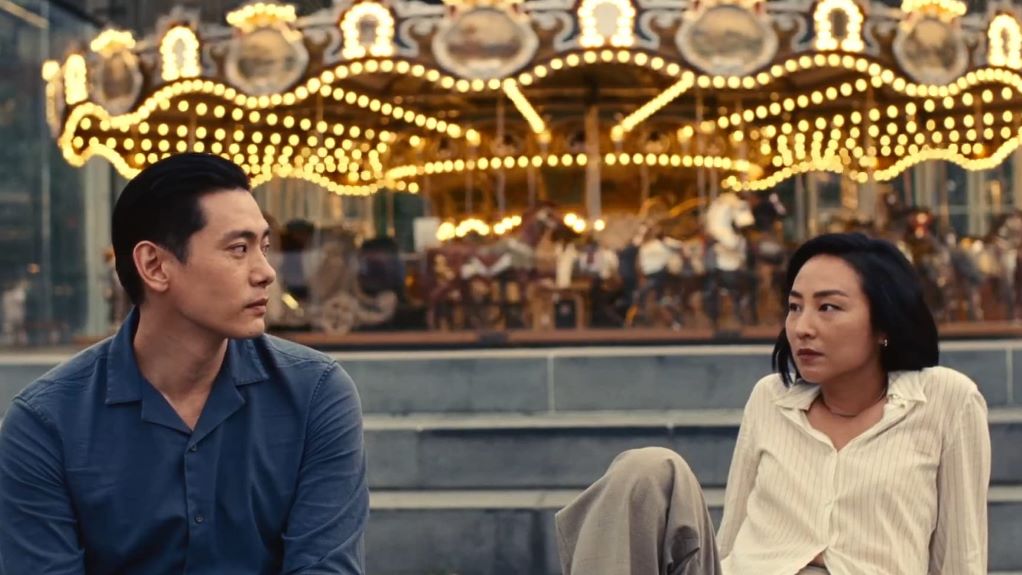
Lost opportunities and the path not taken carries real emotional force in this fabulous debut
Director: Celine Song
Cast: Greta Lee (Nora), Teo Yoo (Hae Sung), John Magaro (Arthur), Seung Ah Moon (Young Nora), Seung Min Yim (Young Hae Sung), Ji Hye Yoon (Nora’s mum), Min Young Ahn (Hae Sung’s mum)

Few things carry such mystique and indestructible promise as the paths not taken. We can invest choices we didn’t make with overpowering possibilities. In them, every moment can be perfect, every outcome joyful, every conclusion perfect. But when we look back at who we were when we made those choices, our past lives can feel like exactly that: other lives of different people. The passions, desires and dreams of those people can feel completely foreign to us today, while at the same time carrying a strong nostalgic pull.
The mystique of the past is a key theme in Celine Song’s debut. Partially inspired by events in her own life, Past Lives covers 24 years in the lives of Nora (Greta Lee) and Hae Sung (Ted Yoo). Childhood sweethearts in Seoul in the late 90s, Nora migrates to Canada with her family and the two lose touch, reconnecting in their early 20s. Nora is now a writer-in-training in New York, Hae Sung an engineering student in Seoul. Communicating by Skype, they recapture some of their closeness but never meet in person before Nora cuts off contact to focus on her writing career. Twelve years later, Nora is a playwright married to novelist Arthur (John Magaro), living in the East Side of New York, when Hae Sung visits the city, looking for he-knows-not-what from Nora, who is herself torn between the pull of her past, the happiness of her present and her plans for future.
Past Lives is a romance devoid of contact, features no words of love and built on unspoken feelings and distance (a distance that covers metres in person, continents online and years in understanding). Gentle, poetic and full of lingering moments, it’s wistful and quietly involving. In many ways very little happens, but everything is at stake for all of the film’s characters and their future happiness. Song gives the dialogue a poetic naturalness, but also knows when silence speaks volumes. It’s particularly striking that nearly half the film – and 24 years – pass by before Nora and Hae Sung actually meet in person and the extent to which they recognise the differences between who they are and who they were is one of Song’s central themes.
Nora is key to this. Beautifully played by Greta Lee, she is a mix of unspoken desires and determined ambition, focused and driven but with a deep vein of romantic nostalgia in her. An immigrant who has moved from Seoul to Toronto to New York, she has a career in English but (as her husband tells her) dreams in Korean. She is also a woman who has effectively remade herself at several junctures: from the child who dreams of the Nobel Prize, to the trainee writer who wishes to win the Pulitzer Prize for journalism, to the playwright cracking Broadway. She moves forward at every point.
This contrasts sharply with Hae Sung. Ted Yoo is wonderful as this quiet, polite, romantic soul whose ambitions are simpler and desires more homespun. He’s the sensitive boy reduced to sullen, hurt silence when Nora leaves for Canada. He supports his parents, forms friendships for life (he has a core group of three university friends who remain his closest friends 12 years later – they are, by the way, a wonderful portrait of male supportiveness) and remains unspokenly devoted to Nora all his life. While she can compartmentalise him away for a decade, it’s clear her image stays with him every day, the pain of that tearful goodbye over Skype lingering through his future relationships.
He arrives in New York to see if there may be something there, to see if in-person those long-distance Skype calls (at dawn in New York and dusk in Seoul) can turn into something real. It relates to a Korean idea of In-Yun – that over several lives, an invisible force can bring people together by destiny. In-Yun is what Nora and Hae Sung both wonder may join them together: play-dates in a park in Seoul, Skype calls in their twenties, walks along the banks of the East River in their thirties. These are like different lives, but yet they keep returning to each other. Could this mean they are meant to be together? Or could this all just be groundwork for a future life to come?
The characters don’t know. Perhaps they will never know. But as Nora and Hae Sung stroll through New York – surrounded by canoodling couples at every turn – it’s hard to escape the pull of that possibility. It’s recognised by Nora’s husband Arthur, a difficult part well-played by John Maguro. In many ways, Arthur is patience embodied. Arthur, who recognises that part of the groundwork of their marriage is the pragmatism of Nora needing a green card, doesn’t complain. He sits quietly (admittedly with flashes of pain in his eyes) while they chat in Korean at a bar and makes every effort to be welcoming. But the obvious bond makes him ask, does he have the same bond with Nora? Could he affect her life, the way Hae Sung has – and the way Nora has affected his own. In a bedroom chat, he playfully (but with a tinge of passive aggressiveness) suggests she might be happier with Hae Sung. Maybe Arthur sees a lot of himself in Hae Sung – it’s not a stretch to imagine Arthur flying halfway around the world on the off-chance of a date with Nora.
If Past Lives has a fault, it is that it doesn’t do enough of really using this relationship-that-never-was as a way to delve into the immigrant experience. Nora has a passing wistfulness for Seoul and Korean culture, but Song relies a little too much on Nora bluntly telling us this. Any sense of conflict, between the pull of these two cultural heritages doesn’t really come to life in the film. Past Lives doesn’t really delve into the alienation and lack of understanding Nora now has for parts of her Korean culture – for instance she is stunned to hear Hae Sung lives with his parents and about his sense of financial obligation before marriage, but the film treats these as more personal eccentricities rather than insights into a cultural divide that has grown up.
Past Lives though builds – in a year that feels very French New Wave and inspired by Richard Linklater – into a masterful single-shot sequence that plays out a fateful wait for a taxi in real time that carries devastating emotional force, where every possible outcome guarantees pain. It uses the slightly awkward, self-conscious distance between two people who never touch but want to, to extraordinary effect and creates an atmosphere replete with longing, sadness and inevitability. With superb performances from the three leads – who are all in turns both wonderfully patient and desperately needy – it’s a simple but universal tale that grows rich in the telling.
 Movie Musings