
Tag: Terence Davies

Benediction (2021)

Benediction (2021)

Davies’ final film is a beautifully made, deeply sad, exploration of the long-term impact of trauma

Director: Terence Davies

Cast: Jack Lowden (Siegfried Sassoon), Peter Capaldi (Older Siegfried Sassoon), Simon Russell Beale (Robbie Ross), Jeremy Irvine (Ivor Novello), Kate Phillips (Hester Gatty), Gemma Jones (Older Hester Gatty), Ben Daniels (Dr Rivers), Calam Lynch (Stephen Tennant), Anton Lesser (Older Stephen Tennant), Tom Blyth (Glen Byam Shaw), Matthew Tennyson (Wilfred Owen), Geraldine James (Theresa Thornycroft), Richard Goulding (George Sassoon), Lia Williams (Edith Sitwell), Julian Sands (Chief Medical Officer)

Few generations carried scars as deep as that which saw millions of their fellows mown down in the endless bloody slaughter of World War One. For us, whatever understanding of the horrors of that conflict we have is often filtered through the war poets, who fought in unimaginable conditions. Terence Davies’ final film explores the life of Siegfried Sassoon (Jack Lowden, ageing into Peter Capaldi) whose life never escaped the shadow of those terrible sights and awful losses.

Benediction is a sombre, mellow, deeply sad portrait of a man who spent a lifetime searching for something, anything to fill the void the war had left in him. Following Sassoon’s life in a series of tableaux-style scenes that mix poetry reading, period music, news footage with flash-forwards to the tetchy, weary older man he will become, it’s a sad, reflective work that presents memory as a sort of prison that consigns everyone to a life sentence. Davies catches this beautifully in his stately, melancholic film where survival guilt goes hand in hand with bitter regret at missed opportunities.

It opens with Sassoon’s protest against the war – denouncing its content from his first-hand experience. Saved from the possibility of a firing squad by influential friends (chief among them, Simon Russell Beale’s good-natured Robbie Ross) Sassoon is dispatched to an Edinburgh military hospital to “recuperate”. There he meets and falls in love with the sensitive, shy poet Wilfrid Owen (Matthew Tennyson), a love he is scared to confess. After Owen is killed, Sassoon commits himself to a series of romantic relationships with selfish, bitchy men including Ivor Novello (a marvellously supercilious Jeremy Irvine, whose eyes are stone cold) and the shallow, vain Stephen Tennent (Calam Lynch, full of Bright Young Thing smugness, turning into a lonely, tragic Anton Lesser). As an older man, he converts to Catholicism and struggles to understand his son George (Richard Goulding).

Davies’ film posits a Sassoon who never recovered from grief at the death of Wilfrid Owen and could never truly forgive himself for being too timid to express his feelings. Davies films Sassoon and Owen in scenes that sing of unspoken intimacy, from an overhead shot of a swimming pool dip that feels like a pirouette, to the matching body language they exhibit while sitting watching a variety show at the hospital. They laugh and dance together, but at parting Sassoon cannot move himself beyond a tightly clasped handshake and a whispered urge to stay a few minutes longer.

In discussions with his doctor and friend Rivers (a lovely tender cameo from Ben Daniels), Sassoon tearfully talks of his fear of expressing his own emotions. Perhaps this, coupled with his self-blame, is why Sassoon placed himself in so many relationships with such transparently flamboyant shits? Davies certainly seems to suggest so: Sassoon had less fear of “being himself” when he was with arrogantly confident men like Novello and Tennant. Did he also, the film suggests, feel so crippled with regret and survivor guilt, that he couldn’t believe himself worthy of the love of gentle, decent men, such as the Owen-like Glen Byam Shaw (Tom Blyth).

Sassoon becomes a man who can never fully escape the never-ending hurt of memories. Even as an older man, Davies shows Capaldi’s Sassoon sitting in his garden, the background replaced by news footage of slaughter in the trenches. It’s mixed in with the shame Sassoon felt at his “stand” against the war being, in the end, a moment that changed nothing. Davies further paints his poetry as declining post-war, as if parts of his creative life never survived the shocks he experienced.

And always he hopes something might make him whole again. Sassoon races through these false dawns during the film: relationships with men, marriage to Hetty (Kate Phillips as the younger Hetty is nearly as oppressed with unspoken sadness as Sassoon), the birth of his son – all fail to deliver. So as an older man – in a neat CGI transition during a 360 camera move – Davies transforms Lowden to Capaldi as he tries Catholicism (there is another wonderful cut that takes us from young Sassoon’s silver military cross being dropped into a river, that transitions into the grey-suited older Sassoon lying in a crucifix position on the floor of a church).

But the tragedy of Benediction – and there is no denying it’s a deeply sad and even slightly depressing film – is none of these attempts fill his soul. The older Sassoon – sharp, prickly and with a stare that goes on and on from Capaldi – snaps at things he doesn’t understand, cruelly dismisses the older Tennant and bitterly complains at the lack of recognition his later work received. He’s a man desperate for companionship, but comfortable only on his own.

It’s particularly sad having seen the brighter, passionate and warm man he was. Much of Benediction succeeds due to an exceptional performance by Jack Lowden. Lowden brilliantly conveys Sassoon’s lingering depression and loss under the surface of every interaction. The cheery wit that covers the self-loathing that leads him into destructive relationships and painful situations is as well captured as the self-deceiving optimism he had that everything could be different. Lowden ends the film with an extraordinary emotional moment – filmed in tight one-shot by Davies – where we see, one the last day of the war, his impossible burdens lead him to a single, quiet, emotional outburst of the vast reams of pain that then continued to burn inside him for the rest of his life.

Benediction is about guilt, loss, regret and denying yourself opportunities at happiness and joy through an internal determination that it is not for you. There is something profoundly personal in this – Sassoon’s life in this film, mirroring many of the regrets Davies spoke of in his own life – a fact increased by the heartfelt, gentle construction of the film with its melancholic air and rich sense of empathy for its subject. As a final work, it’s a fitting tribute to both the poet and its director.
Distant Voices, Still Lives (1988)

Distant Voices, Still Lives (1988)

Davies beautiful memory piece is quite unlike any other film in its poetic virtuosity

Director: Terence Davies

Cast: Pete Postlethwaite (Father), Freda Dowie (Mother), Lorraine Ashbourne (Maisie Davies), Angela Walsh (Eileen Davies), Dean Williams (Tony Davies), Jean Both (Aunty Nell), Michael Starke (Les), Debi Jons (Micky), Chris Darwin (Red), Pauline Quirke (Doreen)

When we study the past and our memories, we see an assortment of recollections of events and motionless snapshots of moments in time. The past can feel both distant and still, a long-ago series of happenings that our mind constantly shuffles and reinterprets depending on circumstance and situation. That vibe lies at the heart of Terence Davies’ poetic dive into that foreign land of memories, where events, people and snatched moments combine, shift and contrast in a visual attempt to reproduce our own sifting of our past lives.

Distant Voices, Still Lives follows the post-war lives of a working-class Liverpudlian family. Father (Pete Postlethwaite) is a depressive tyrant, who oscillates between moments of tenderness and acts of extreme violence. Mother (Freda Dowie) is a saint-like victim, who tries her best for her children. Maisie (Lorraine Ashbourne), Eileen (Angela Walsh) and Dean (Tony Davies) grow up, marry and forge their own lives in the community, sometimes repeating the mistakes of their parents, all in largely warm and welcoming working-class community.

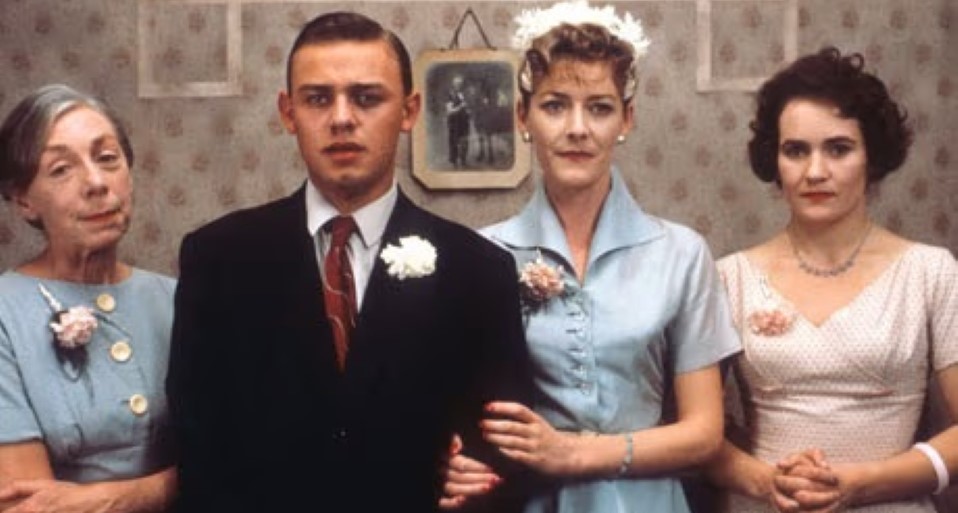
Terence Davies based much of Distant Voices, Still Lives on his own upbringing and memories of his family (a framed photo on the wall is of Davies’ own father). Shot with a rich, slightly sepia-toned classicism, the entire film replicates both the random workings of memory and watching a carefully constructed slide show. Events frequently are only tangentially connected to those preceding and following them: a memory of a marriage in the family, activates memories of the now-absent father at both his best and worst, a Christmas when he was affection itself, another when he overturned the dining room table in a sudden fury and demanded it cleaned up. It continues throughout the film, the narrative sliding from pre- to post-war, dictated more by tone and mood than by narrative.

It requires that you pay close attention to Davies’ film, to sift yourself through its moods and subtle shifts in tone. It opens with a carefully managed tracking shot that takes us inside the family house at an unspecified time, then fixes on a still shot on the staircase, while we hear conversation all around us. Is this happening at the same time? Or are we merely hearing the echoes of conversations past? In this film the past is both all around us and tantalisingly out of reach. Distant Voices, Still Lives is made up of frequent stationary, carefully assembled shots that resemble Mitchell and Kenyon photos that suddenly spring into movement (the image of the family preparing the wedding looks so like a photo, it’s a shock when all four actors suddenly walk out of frame). It’s a reminder that, to many of us, the past is a series of still lives, frozen in time.

Around everything, in a Dennis Potterish touch, is wrapped a musical backdrop of songs from the 40s and 50s. These tunes bring people together, knit together memories and (perhaps) even cover over and confuse events. Music is crucial in unity, the family and their friends frequently breaking into extended sing-alongs to popular tunes in the pub. It provides moments of warmth, closeness and intimacy – moments of mutual joy – which perhaps covers and balances the complex relations and struggles at home. It also makes the film often feel like an odd musical, like a sort of living slide show of images scored by the classics of yesteryear.

Distant Voices, Still Lives can be seen as a sort of poetic art installation, with its balance of still images bought to life and its poetic rhyming of events and persons. But it manages to involve the viewer, because it’s a very human film. There is real warmth and compassion in these memories and reflections. The love of a family, pulling together to survive trauma at home. Those moments of release in singing. The joy and delight – and tears – of coming together to watch a film at the cinema, swept up in the big screen emotion and imagination. Davies also finds a simple, pure beauty in the everyday: watching mother carefully tend and clean the house takes on a strange, natural beauty and power in the care and tenderness that lies behind it.

That’s particularly striking, considering the unflinching horror at home. Pete Postlethwaite is extraordinarily terrifying as a deeply unhappy and depressed man, who can process his complex feelings (and even, bizarre as it seems, his love for his family) only through anger and violence. He viciously beats his children and (in one terrible scene) his wife. He is charming and sweet with their friends. He oscillates between affection and fury. His children – particularly his son – are torn between despising the old man and wanting something – anything – from him in the way of affection. (Eileen will later bemoan his absence – due to death – at her wedding, to the disbelief and anger of her brother who often bore the brunt of his beatings). Davies’ film carries real power in its opening half, dominated by Postlethwaite’s tragic dark-heart, the ruler and gate-keeper of his home until his health collapses and he reverts to vulnerability.

The terrible impact on mother – beautifully played by Freda Dowie, in an extraordinary performance that feels like it’s been pulled direct from Davies’ memory of his own mother – dominates the emotional thread of the film. It also adds a dread to the possibility that Eileen’s own husband shows traces of jealousy and violence. But then the world is one of danger: the war could have ended the lives of the whole family (there is a striking sequence where they run trying to find their parents during an air raid warning, before finally finding the shelter and being greeted with relief and inevitable anger by their father). An accident nearly cripples Dean and Maisie’s husband – it’s echoes recurring throughout the film. Echoes touch nearly every moment of Davies film, flashes of memories activated by memories pulling together the film into an engrossing and heartfelt tapestry.

But the film’s real impact comes from the humanity that grounds it. It perfectly captures a moment of time, the bonds and interdependence of a working-class community in a film extraordinarily textured into something like a fictional documentary. The film is crammed with small moments of joyful intimacy, among the trouble and strife: friends laughing together, joy in music and film, laughing faces at shared jokes. All of this is shot with an exactitude that never manages to squash the tenderness at its heart. It’s a uniquely artistic, inventive and warm exploration of memory and time, with very few films even remotely like it – and rewatching it is a reminder of what a loss to cinema Terence Davies, a truly unique film-maker, is.