Tag: Terence Stamp

The Collector (1965)

Samantha Eggar is held captive by Terence Stamp in the unsettling The Collector

Director: William Wyler

Cast: Terence Stamp (Freddie Clegg), Samantha Eggar (Miranda Grey), Mona Washbourne (Aunt Annie), Maurice Dallimore (Colonel Whitman)

A lonely butterfly collector wins the pools. He’s rich, he can have everything he wants – but he’s still an outsider who can’t get a girl. Surely if a woman would just get to know him he’d find love. So the easiest way of doing that is probably kidnapping the woman you had a crush on at school, locking her in a carefully furnished basement in your Tudor mansion house and just wait for her to fall in love with you. Sounds like a perfect plan right?

William Wyler’s adaptation of John Fowles’ best-selling literary first novel sees Terence Stamp as the maladjusted loner and Samantha Eggar as his victim. It’s fascinating reading about the film today and the attitudes and perceptions towards it. Today the film is chilling in the obsessive, dangerous, self-pitying self-justifications of Freddie Clegg. But in the mid-60s a number of reviewers commented on the pity they felt for the kidnapper, and even expressed that in many ways he was acting on fantasies every healthy man has had (they haven’t). Quite rightly the film comes across differently today, a far more unsettling and disturbing portrait than it did at the time.

Wyler’s direction is intimate and a fine mixture of the theatrical – with its often single locations and two-actor scenes – and cinematic, particularly in the way he subtly builds up a Hitchcockian level of tension around the possibility of discovery and escape for Miranda. Sure visually he is a little too much in love with the crash zoom on key items (chloroform for example in Freddie’s car), and devices that seem a little too obvious (like the use of black and white for the film’s only significant flashback) but he mounts the entire film with an unsettling claustrophobia that works very well.

Further he draws out two fantastic performances from the leads. Terence Stamp was not a natural choice for the shy, timid outsider turned abductor – he’s obviously way too handsome and physically assured for the role – but he marshals very well the blinded arrogance of a man who believes the whole world would march to his tune if it only stopped and listened. His Freddie Clegg is softly-spoken, polite and controlled – so much so you almost forget how insane he is. Stamp also does a remarkable physical performance, making himself seem shorter and less dynamic than he really is, his body language having more than the hint of the schoolboy about it. Domineering, controlling, bullying and totally incapable of internal analysis of his actions. 

You realise watching the films events unfold – and Freddie’s inability to analyse the emotional truth behind them – that he is alone because he fundamentally doesn’t understand human relationships. While many of the (male) film reviewers at the time found this strangely tragic, today it’s hard to feel anything but contempt for his cruel self-pity.

The more difficult role falls to Samantha Eggar as Miranda. Wyler’s attempt to get the best performance from here seems pretty kin to the abduction the character goes through in the film – she was kept in isolation on the film set, Stamp was instructed to not talk to her outside of shooting while Wyler constantly held the threat of dismissal over her. More than a few echoes of Hitchcock in that – and Wyler’s praise on the film’s completion for Eggar’s (Oscar nominated and Cannes Award winning) performance as more than a whiff of self-praise to it. But Eggar herself is superb as a woman who oscillates between panic, desperation, ingratiating kindness, anger, contempt and fear. Miranda is a woman who tries everything she can to get out of this situation, only to constantly butt heads against the twin devils of her countryside isolation and Freddie’s own lack of emotional and intellectual intelligence.

Because the film interestingly makes clear what a tedious and not-very-bright monomaniacal man Freddie is, compared with the educated and quick-witted Miranda. When she tries to engage him on a discussion about modern art, he is utterly incapable of beginning to appreciate artists such as Picasso (‘It doesn’t look real’), completely fails to grasp any of the ideas in The Catcher in the Rye (the book she suggests he reads) or their relation to him, and is drawn only towards the blandest, most traditional drawings that she creates while whiling away the time in captivity. He fanatically collects butterflies, rooms lined with framed specimens that he can discuss in detail but with no concept of their beauty. Every time Miranda tries to scratch the surface of Freddie to connect with him she constantly discovers he has no depths at all, he’s a little boy lost in the world who can’t understand why he can’t collect people with the ease he catches and kills butterflies.

Whether the film has some sympathy for Freddie is less clear. Maurice Jarre’s luscious score certainly seems to suggest we should feel something for this misguided guy, but today it’s almost impossible to do so. The film works just as well without those feelings of implied sympathy though, which is a tribute to Wyler’s even-handed and controlled direction. Certainly Miranda’s fear and oppression are easy to connect with.

Is this a Stockholm syndrome film? Miranda – an intelligent and cunning woman – quickly realises that while she is the victim, Freddie’s desire to be seen as sort of chivalric gentleman does give her some power over his treatment of her – he wants her to fall in love for real with him. How much does she start to feel sympathy for this misguided loner? Is there any hint of real feeling at any point in her eventual attempt to seduce him (I doubt it heavily watching the film, but I may be adding a modern perspective, as I suspect Wyler wants to leave a hint there – again the score supports this feeling a bit)? I’m not sure – but the film’s eventual ending does leave little doubt that Freddie is a dangerous man, and the world is a less save place with him in it.

The Collector isn’t perfect – and perhaps its attitudes have dated – but it still has a real skill to it, some wonderful scenes – and two terrific performances from its lead actors, who I think have never been better than they are here. Wyler’s last success – and you can see his debt to the later work of Michael Powell and Alfred Hitchcock in each frame, even while he fails to match either of them – it still makes for an unsettling, troubling and fascinating watch.
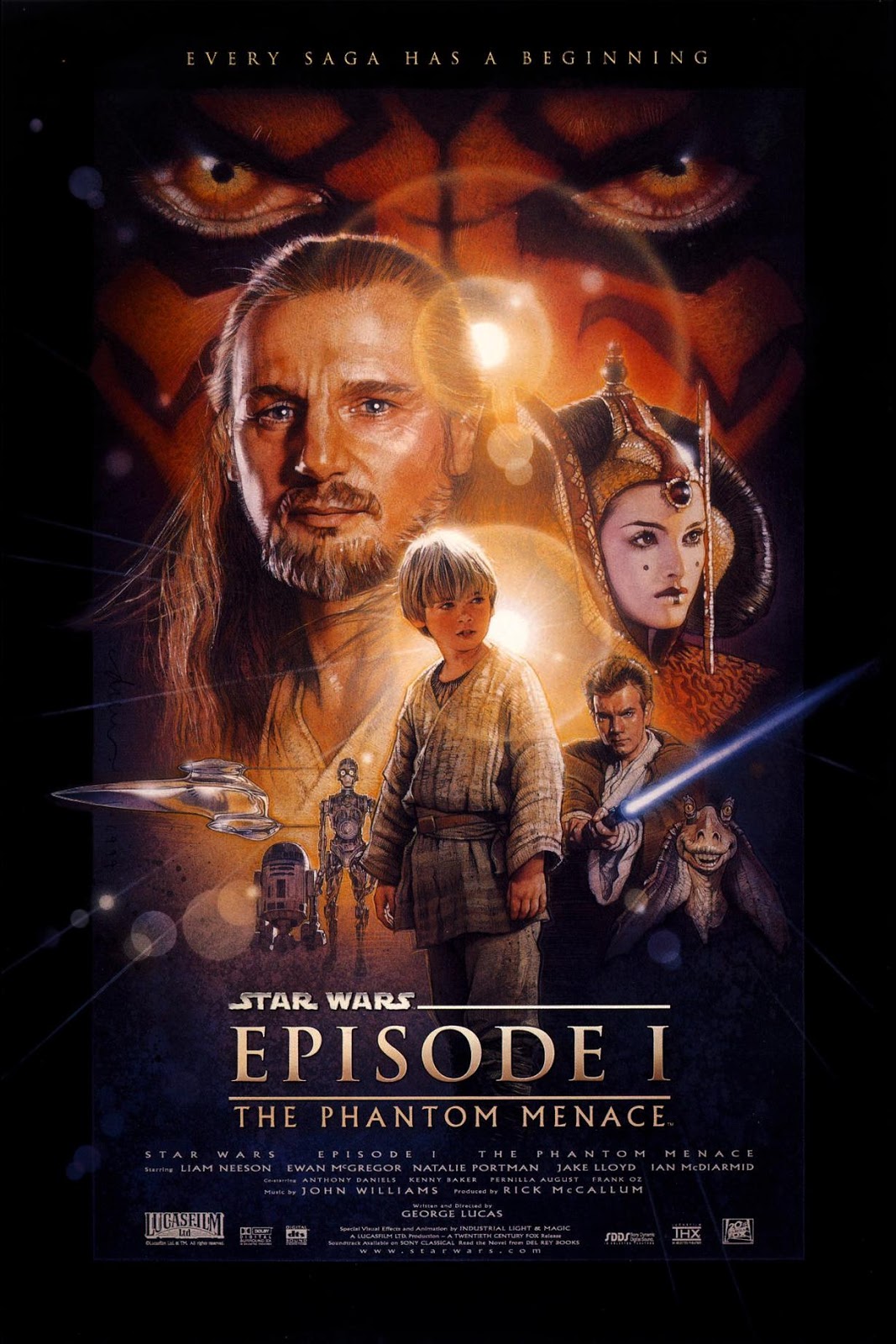
Star Wars Episode 1: The Phantom Menace (1999)

Jedi vs Sith – where did it all go wrong in The Phantom Menace?

Director: George Lucas

Cast: Liam Neeson (Qui-Gon Jinn), Ewan McGregor (Obi-Wan Kenobi), Natalie Portman (Queen Padmé Amidala), Jake Lloyd (Anakin Skywalker), Ian McDiarmid (Senator Palpatine), Anthony Daniels (C-3PO), Kenny Baker (R2 D2), Pernilla August (Shmi Skywalker), Frank Oz (Yoda), Ahmed Best (Jar Jar Binks), Oliver Ford Davies (Sio Bibble), Hugh Quashie (Captain Panaka), Samuel L Jackson (Mace Windu), Ray Park (Darth Maul), Terence Stamp (Chancellor Valorum), Kiera Knightley (Sabé), Silas Carson (Nute Gunray/Ki-Adi-Mundi), Brian Blessed (Boss Nass), Ralph Brown (Ric Olié)

Has there ever been a more disappointing film than The Phantom Menace? I don’t think any film has ever opened to so much hype and fan expectation. The Second Coming could have trouble competing with the expectations piled onto this first Star Wars prequel. Everyone thought it would be the film of the year. Until they saw it. No one thought it would be the film of the year after that.

Of course you should have sensed a disturbance in the force the second you read the opening crawl. The first sentence “Turmoil has engulfed the Galactic Republic” sounds promising right? Well let that expectation die as we hit the second sentence “The taxation of trade routes to outlying star systems is in dispute”. Not exactly a flight for the Empire with the Death Star plans is it? Perhaps only a multi-millionaire like George Lucas could have expected a storyline based around a tax dispute would get the pulses racing. 

But then this is a jumping off point for a seriously shambolic film experience. Phantom Menace is a total mess, an incoherent, poorly scripted, farce of a film, a terrible stumble through a dashed off storyline that makes no sense. Anyway, Naboo is a planet under siege from the Trade Federation. Jedi knights Qui-Gon Jinn (Liam Neeson) and Obi-Wan Kenobi (Ewan McGregor) are sent to negotiate but things quickly turn to violence and they need to flee the planet with its 14 year old (?) elected (??) Queen (???) Padmé Amidala (Natalie Portman). On the planet of Tatooine they encounter a 9 year old slave Anakin Skywalker (Jake Lloyd) with a natural instinct for the force. Qui-Gon wants to train him, while the Galactic Republic tries to resolve the siege of Naboo.

That’s sort of the story – but even writing it down seems episodic and vague. But then that’s everything in the film. Nothing is really clearly explained, and we are never properly introduced to who all the sides are in this film and what they might want. There is a complete lack of any real narrative sense at all. The antagonists and protagonists of the film are hard to define. In fact they are frequently a pile of two dimensional yawns. It’s pretty hard to care about any of them. I guess you feel a bond with Obi-Wan, but that’s based on old films – watch this and Obi-Wan is a do-nothing whiner. 

But all the characters are infected by this. George Lucas is completely unable to bring any characterisations to these people, his lines constantly falling flatly or crappily to the ground, while the actors themselves struggle to find anything to engage it. Harrison Ford famously told Lucas on the first film that “you can type this shit but you can’t say it” – and that’s pretty much nailed on for this film. There is not one single vaguely memorable line in this film. Rather you are struck every second with feeble lines that sound like they might have had depth (“There’s always a bigger fish!”) but when analysed for a second make no sense whatsoever. It’s no wonder Neeson seriously considered quitting acting after this film.

Yes these two characters will get it on in the next film. Yuck.

There isn’t a single character in the film to really invest in. There is no equivalent to your Han Solo, the witty outsider to puncture some of the grandaeur. Instead every character is a flat, po-faced, non-personality who spend all their time in the film very seriously going about their business, never explaining anything. The Jedi are particularly affected by this, written as serious stick-in-the-muds constantly lecturing and ticking off other characters. Qui-Gon Jinn makes a tedious lead character, who constantly gets in the way of the relationship building we need to see between Obi-Wan and Anakin. Because we know where the film series is going, spending time on Qui-Gon feels like wasted time. The backstory is to see the relationship build between Obi-Wan and Anakin – instead they hardly speak in the film, and we instead spend ages on Qui-Gon. It’s poor story-telling and wastes a film showing us unimportant back story rather than spending time on the core stuff. It’s bad enough that we have to waste one third of the prequel series on Anakin Skywalker: The Wesley Crusher Years (seriously has anyone, even a child, ever loved a film where a brattish, super kid is the hero? You won’t be shouting Yiipppeeee…)

Lucas isn’t a director of actors, he’d say the same. But he is supposed to be a master of visuals and special effects. This is a film where everything you could possibly imagine has been thrown at the screen. Each frame is full of complex business, every single section crammed with special effects. There is a lot going on visually all the time, but all of it comes across like an explosion in a colouring book. Unlike the effects of the original trilogy, nothing really feels real or carries any real weight. Instead you see every special effects shot in the film and see frames filled with clutter and shiny, computer generated weightless nonsense. Worst offender is the hideously overextended pod race sequence, like a particularly dull Formula One race, which carries no real stakes (as we all know the result) and, for all the high speed camera work and editing feels not one iota as thrilling as the speeder chase in Return of the Jedi.

On top of this, most of the interventions into the Star Wars backstory makes the original trilogy worse. This is the film that gave us midichlorians, some sort of magic alien thing that lives in blood and gives the Jedi the ability to use the force. The reaction to this midichlorian nonsense, undermining the mystique of the force into something that could measured like a top trump was so negative that it was mentioned at most once in the two sequels. Other areas got similarly scathed, not least turning Anakin Skywalker into the worst form of “gifted child”. I’m not even going to touch on the icky fore-knowledge we have about the fact that Anakin and Padme are going to get it on in the future, something that is hideous to think about.

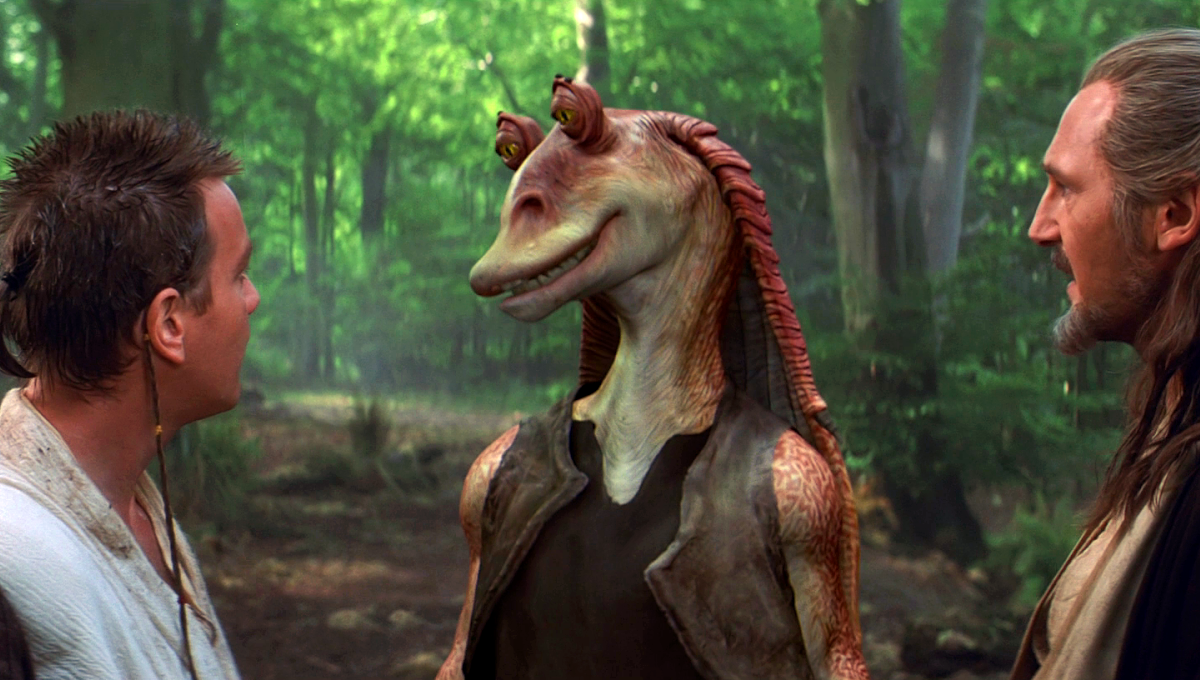
The most hated character in film history?

Lucas also fudged the new stuff he introduced in the film. The worst element: of course it’s poor old Jar-Jar Binks. I genuinely feel sorry for Ahmed Best, an actor whose career never recovered, who is just doing here what he was told to do. But Binks is the most irritating character possibly ever conceived for a hit blockbuster. An idiotic, comic creation designed for the kids who falls over, trips up, says stupid things and steps in shit he does nothing useful for the whole course of the film and tries to entertain kids who were way more interested in Darth Maul. Binks is almost irredeemable, every sentence enough to send everyone’s teeth on edge. 

Lucas trumpeted how much Binks was setting the trend of being the first major computer generated character. Lucas was incapable of guiding the actors to respond (or even look at) the correct spaces where Binks was standing. And Lucas was so pleased with it, he never stopped to think. Binks makes no sense. Like the rest of the Gungans he’s a joke. There is literally no reason at all for the Jedi to take him anywhere with them, particularly as he constantly gets in the way, causes trouble and offends people. Even in the “desperate” final battle, Binks prats about – compare him to the moments of tragedy and sacrifice given to the Ewoks in Jedi and you’ll see how bad this is.

Yes Watto loves Money. What? What’s the problem?

And of course he and the Gungans are shocking racist caricatures in their Jamaican accent. If you had any doubts that Lucas had no one saying no to him on anything, this film is stuffed with pretty shocking racist characters. Binks is terrible, but the villains of this place are the money obsessed Trade Federation, all with Japanese accents. On Tatooine, Anakin is kept by a greasy, fly ridden, money obsessed, big nosed, fly-covered alien Watto who looks, sounds and acts like a children’s version of The Eternal Jew. Did no one watching the film take a second and say “hang on this looks a bit dodgy…”

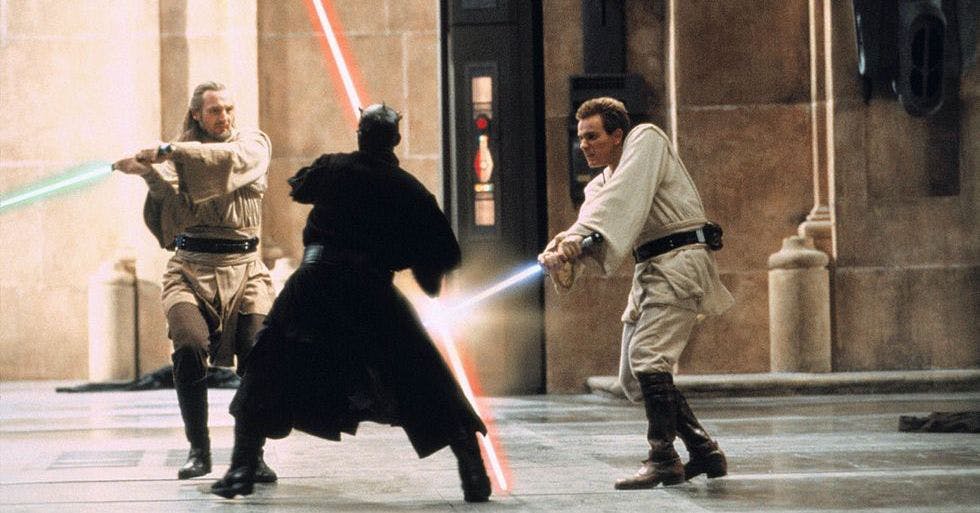
All of this nonsense finally comes together in a grand final battle which sums the whole film up, in a sequence where the tone shifts and changes all the time with no sense of a single person doing so intentionally. We have the Gungans comically fighting the droids in a series of awful little vignettes. We have the Queen chasing through the palace in a poorly explained subplot. We have a 9 year old child accidentally flying a ship into space and accidentally blowing up the baseship (Anakin saves the day without even realising it, the one thing that could make the child even more irritating than he already is). And we have the Jedi fighting Darth Maul in a battle that looks impressive at first but is in fact overly busy and overly choreographed. 

The Phantom Menace has few reasons to like it at all. You get bored with the story. You don’t invest in the characters. You don’t engage with the events. You don’t feel your pulse racing. The plot drifts from planet to planet with very little logic at all. The dialogue is terrible. The story telling is abysmal. The direction is flat. The film throws in moments that crap over the original trilogy. Lucas made is wait for decades – but then seems to have produced a film that he didn’t really want to do. It’s a truly dire film.