Tag: Terrible Films

Die Another Day (2002)

Pierce Brosnan signs off as Bond with the mess that is Die Another Day

Director: Lee Tamahori

Cast: Pierce Brosnan (James Bond), Halle Berry (Jinx Johnson), Toby Stephens (Gustav Graves), Rosamund Pike (Miranda Frost), Rick Yune (Tang Ling Zao), Judi Dench (M), John Cleese (Q), Michael Madsen (Damian Falco), Samantha Bond (Miss Moneypenny), Colin Salmon (Charles Robinson), Will Yun Lee (Colonal Tan-Sun Moon), Kenneth Tsang (General Moon), Madonna (Verity)

Die Another Day was the highest grossing Bond film ever released. So why was it almost four years before another one was made? Put simply, because this one weren’t no bloody good. Released at the Bond series’ 40th anniversary, Die Another Day was meant to be a celebration of everything Bond – instead it’s like the final nail in the coffin of an entire lifecycle in the franchise that started probably around the early Roger Moore films. When Bond came back out after this, he was radically different. 

James Bond (Pierce Brosnan) is sent undercover to Korea to take out renegade Korean Colonel Moon (Will Yun Lee). The mission is a success – but Bond is betrayed and captured by the North Koreans. Coming out of Korean prison a year later, Bond is no longer wanted by MI6. So he goes off on his own to find out who betrayed him – and finds newly emerged diamond businessman Gustav Graves (Toby Stephens) might have something to do with it. With a trail that starts in Hong Kong and heads to Cuba, the UK, Iceland and back to Korea he’ll work alongside CIA agent Jinx Johnson (Halle Berry) to find out how this all ties together and get his revenge.

Die Another Day starts a bit like a Connery Bond – and about half way through it segues into being perhaps the most ridiculously overblown Roger Moore-esque Bond you’ll ever see. I suppose you could say this was the scriptwriters trying to capture the essence of 40 years in one movie. But actually it’s probably just incoherent scriptwriting and stupid storytelling. It starts trying to be grounded – Bond is captured and tortured for a year! – but then shrugs off any aftereffects of this year of hell with lackadaisical ease before throwing us into the sort of “Ice palace! Invisible cars! A weapon that channels the power of the sun!” malarkey that even Roger might have thought was a little bit too much.

It’s not helped by the fact that the entire film is so shoddily put together and so lazy in its execution. The one liners in this film are terrible – there are no double entendres in this film only single entrendres (words like thrust, pleasure, weapon and mouthful are used with gleeful abandon) – and far from being a playful exercise in Bond’s cheekiness are just hand-in-the-mouth embarrassing. But that’s almost as nothing compared to the woeful special effects. Even in 2002, nothing in this film looked real. 
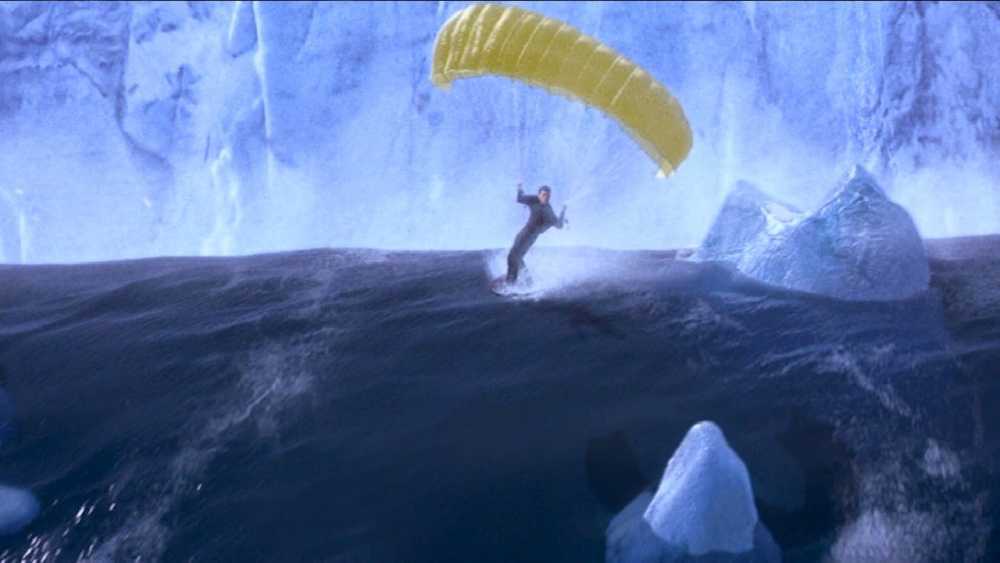
I hardly know where to start with the awful plasticky sheen of the effects here. The film opens with Bond and fellow agents surfing (!) into a deserted island – at the end of which Brosnan in front of blatant blue screen rips off his mask to show it-was-definitely-him. As if that wasn’t bad enough (Bond surfs? I’m out!) Bond surfs AGAIN in the movie halfway through, using a parachute as a sail to escape possibly the least convincing wave ever put onto film. It really has to be seen to be believed (or rather not believed). That’s not to mention the wonky overblown final plane sequence, or a laughably unrealistic looking Jinx dive from a cliff down into the water below.

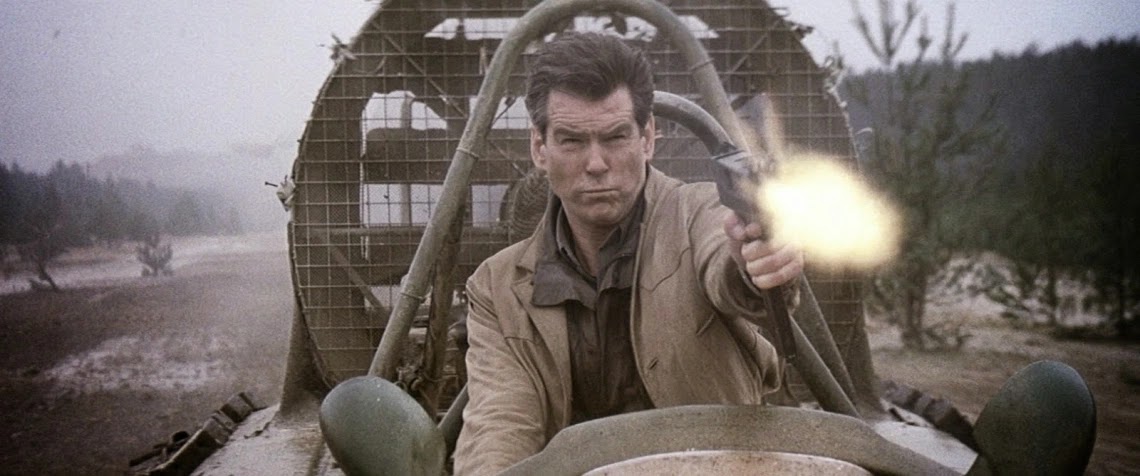
Brosnan probably tries his best in all this, but even he can’t save this total mess. How does a film that started with Bond in prison and emerging damaged and on a gritty quest for revenge end with a villain wearing a robot suit controlling the sun? The script after the first 15 minutes gives Brosnan nothing to play with. The film loses all interest in the traitor plotline about halfway through, and when she is unmasked (in a twist that surprises no one at all) Bond barely seems to care. Pierce himself looks frankly too old and a little out of shape (his running in this film with his arms pumping up to his face looks terrible), something only magnified by the youth of his co-stars. 
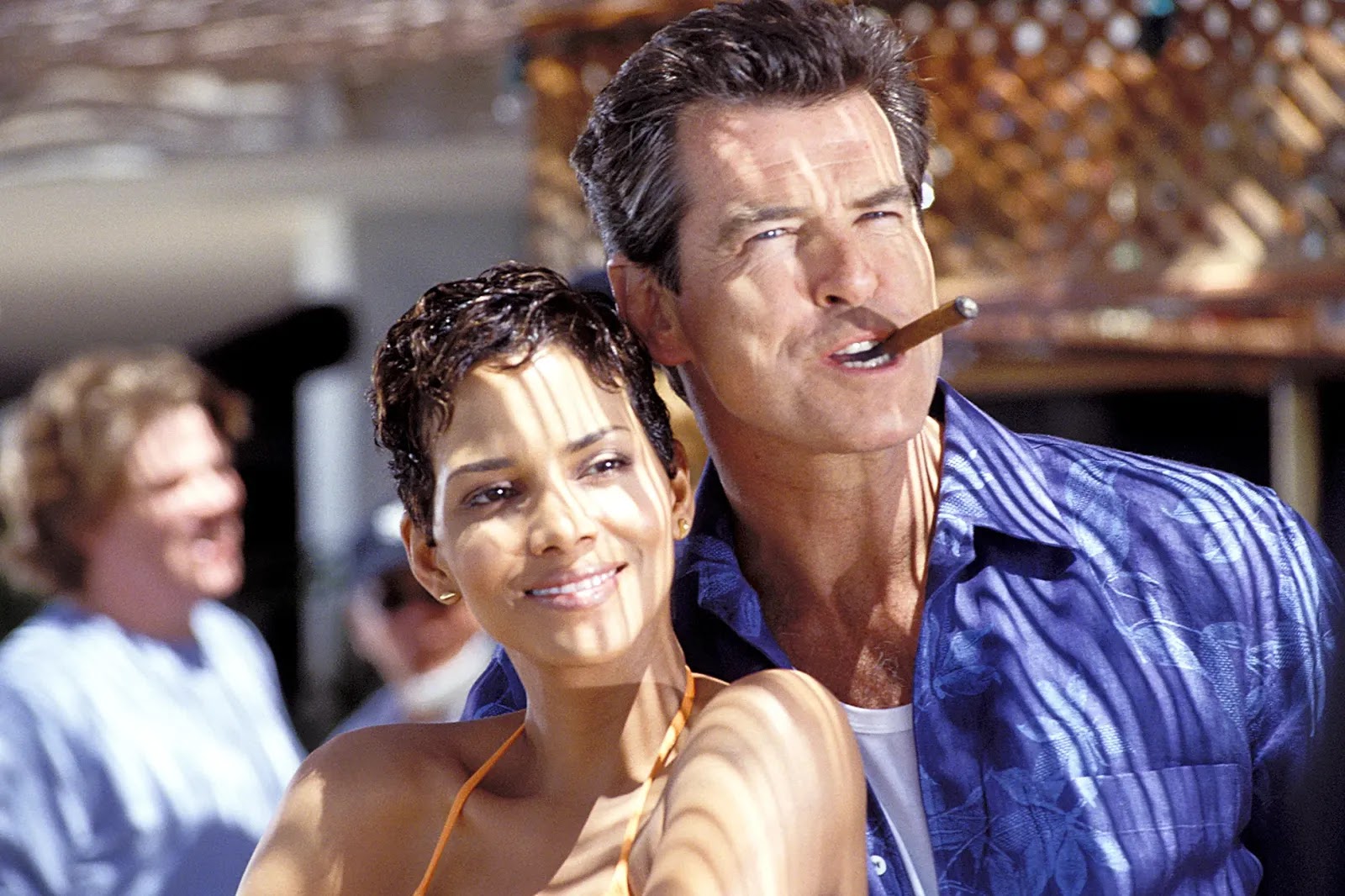
Not that I’m saying his co-stars are any good either. When this film came out there was a brief flurry of excitement that Halle Berry’s Jinx would be worth a franchise of her own. That died shortly after the film came out – this is a character that acts tough when needed, but still needs to be saved twice in quick succession by Bond, who says faux-tough things like “Yo Mama!” but has barely two personality facets to rub together. Berry simply does her bit and meets the requirement of looking sexy and fighting. Mind you she still fares better than an embarrassing Toby Stephens, whose villain is so paper-thin the actor seems to have taken the bizarre decision to channel Alan Partridge. Rosamund Pike’s fencing MI5 agent barely registers.

Needless to say Bond beds her – as he beds all the women in this with a perfunctory inevitability that fits the box-ticking exercise of the whole film. The film is littered with references to past Bond films, although that is probably only going to make you want to watch almost any of the other films instead. Perhaps to try and up the ante and make this one “even biggerer and betterer than before” there are more gadgets than ever before. These are topped with the crowning turd of the invisible car, a nadir for the franchise, a senseless advantage (Bond at one point follows directly behind two walking heavies in the car – it’s invisible NOT silent for goodness sake!) and something so overblown that however much the producers at the time tried to justify it by pointing at military technology just sounds silly. Don’t get met started on the bizarre VR training sequence Bond carries out (later replayed for a grotesquely demeaning Moneypenny joke that made me feel sorry for Samantha Bond).

But then the whole thing basically sounds silly. Giving the villain a huge ice palace lair might have seemed like a cheeky nod, but again it just looks absurd and the producers desperately trying to find a location that hasn’t been used before. The entire film feels like a rushed attempt to get something out for the 40th anniversary (perhaps the rush helps explain the insane product placement, leading to the film being nicknamed Buy Another Day). The script has been assembled from the off-cuts of other Bond films. There are no fresh ideas at all and everything that happens in the film has the air of “well this sort of thing happens in Bond films”. The script and special effects feel half finished. Rather than a tribute to how Bond was done in the past, it feels like a tombstone. Here lies James Bond c. 1967-2002. No wonder under Daniel Craig he needed to be reborn as someone who felt vaguely in touch with something approaching reality.

Star Trek: The Motion Picture (1979)

The Enterprise crew head to space in a tedious misfire that almost killed the franchise: Star Trek: The Motion Picture

Director: Robert Wise

Cast: William Shatner (Admiral James T Kirk), Leonard Nimoy (Spock), DeForest Kelley (Dr Leonard McCoy), James Doohan (Montgomery Scott), Walter Koenig (Lt Pavel Chekov), Nichelle Nichols (Lt Uhura), George Takei (Lt Hikaru Sulu), Persis Khambatta (Lt Ilia), Stephen Collins (Captain Willard Decker), Majel Barrett (Dr Christine Chapel), Grace Lee Whitney (Lt Janice Rand), Mark Lenard (Klingon Commander)

In the late 1970s the success of Star Wars meant every single studio was checking to find anything that could be turned into the next space-set mega-hit. Paramount’s eyes fell on a TV show that had been cancelled over ten years ago but had attracted a cult following. Hell it even had the word “Star” in the title! Quickly rejigging plans for a sequel TV series, instead Star Trek found itself heading towards the big screen. With a budget probably bigger than the amount spent making every single episode and two-time Oscar winning director Robert Wise calling the shots, what could go wrong?

Well as it transpires almost everything. Has there ever been a duller, flatter, less-engaging film that started a thirteen film franchise? Star Trek: The Motion Picture seems to have been made by people who looked at everything that made Star Wars a huge success and then decided “we ain’t going to do that!” Then they looked at everything that occasionally made the TV series self-important and hard to take seriously and said “We’re going to have some of that!” What we end up with a stupefyingly boring film that takes an immense amount of time to do almost nothing, with a story that might have made a passable 40 minutes of television into an empty and tedious two and a bit hours. Truly it was The Motionless Picture.

Anyway the plot, such as it was, features the now Admiral Kirk (William Shatner) taking back the reins of the newly revamped USS Enterprise to confront a giant cloud that is destroying everything it comes into contact with – and is on a direct course of Earth. Getting the old gang back together – including dragging Dr McCoy (DeForest Kelley) out of retirement and welcoming back Mr Spock (Leonard Nimoy), Kirk takes the place of the Enterprise’snew captain Willard Decker (Stephen Collins) and zooms out to encounter the cloud. What does the machine at the heart of this cloud want? Who is the mysterious creator that V’Ger wants to return to?

Where did it all go so wrong? The key problem lies with the script – and blame for that lies with Gene Roddenberry, Star Trek’s creator who took direct personal control of it. Determined that only he would control the Franchise’s future – after all it was his baby – Roddenberry rejected or minimised as much as possible many of the elements many of traditional film narratives (like villains, inter-personal conflict or the need for characters to ‘learn lessons’) for a science-fiction story he obviously felt dripped with importance. However, this shapeless machine like cloud searching for its “creator” tells us precisely nothing at all about the nature of faith or questions of identity. Because firstly V’Ger has no character and, secondly, the film takes so long to get this (almost three quarters of its running time) that there is no time to explore any of these themes anyway. 

No parallels are drawn between the questions V’Ger is asking, and issues the core characters are dealing with. It makes for a big airey expanse of nothing. We learn nothing about our heroes personalities from this adventure, and they in turn are so little affected by it that at the end of the film they jet off to some new random adventure. A potentially interesting idea about progress and faith gets completely lost – despite ample opportunities to have built contrasts between V’Ger’s loss of faith and the barely-explored crises that Kirk (back in command after five years) and Spock (struggling to work out if he should purge all his emotions) are experiencing. Instead no comparisons are drawn, no insights are made and all three crises either peter out completely or utterly forgotten. It’s part of the film’s failure to really make us engage with any of these characters, or to find a reason to care about them – like Roddenberry felt investment was pandering. It’s also The Emotionless Picture.

On top of which the film was obviously so thrilled with having the budget to include the sort of sweeping space vistas the show could only dream of, that a huge portion of the film was given over to watching these images draft past the screen. Slow, 2001-like pans across space vistas, around alien crafts and then through the trippy details of V’Ger’s inards clog up the film. But while Kubrick invested those with intense meaning, Wise makes them dull as ditchwater and as empty as light show. The bar is set early on with Kirk being given a long – almost four minute – silent shuttle tour around the exterior of the Enterprise. By the time the film is eating up almost ten minutes of the Enterprise flying through V’Ger, the actors have exhausted their “stare in wonder” faces and the audience are dozing off.

It’s not helped by the sub-par acting by all involved. Shatner and Nimoy give perhaps their worst, most lifeless performances in the history of the franchise. Perhaps they were caught between the mess of the script, the lifeless pace, the pressure of bringing these characters to the big screen – or perhaps the film just doesn’t give them anything interesting to do. Kelley gets a few moments of irascible charm, but the rest of the cast have barely got a few lines to rub together. Stephen Collins as Decker looks like he doesn’t really understand what he’s involved with, while Persis Khambatta looks more animated after her character has been lobotomised than she did intact.

The film drags on with a sonorous and stately pace, making no points at all and lacking any real thematic depth whatsoever. It’s not helped by Robert Wise’s lost direction. Wise prepared for making the 80th live-action entry into the franchise by watching precisely zero episodes of the show –and his utter lack of comprehension of what made the series popular in the first place perhaps explains why none of it made it into the film. There is no charm or wit here at all – everything is handled with such portentous importance it only draws attention to how little there is going on.

And it looks so bad as well. The overwhelming 1970s beige and muted colours that have been chosen for the new uniforms make it look as dull and disengaging as the words that are coming out of the actor’s mouths. It becomes even easier to notice the blandness of everything you are looking at that isn’t a matte special effect when you notice how full the script is with filler. Other a third of the film gone before the Enterprise leaves space dock. A tedious non-drama about problems going to warp (in a sequence of embarrassingly bad “slowed down” time disturbance as the ship falls into a wormhole). Almost two thirds gone before the crew make contact with V’Ger our nominal antagonist. A reveal about V’Ger’s origins and the identity of the creator that would have been shock only to people who had never seen an episode of the show before or had been living under a rock since about 1969. 

There are precisely two good things about the movie. Firstly the music is superb – Jerry Goldsmith’s themes for the film (re-used for The Next Generation) and other bits of music, especially his martial Klingon music, is so perfect, so brilliant it was used in the franchise forever more. Secondly the opening sequence with the re-designed Klingons nailed a look, design and language for them that would also stick for the rest of time and the sequence itself is pretty exciting. Other than that, there is almost nothing to recommend the film. 

As an advert for making someone want to watch any Star Trek ever again, it’s a disaster. Having gone way over budget, the series only returned due to loyal fans paying over the odds at the box-office. Roddenberry was dispatched from any future involvement, and the series bounced back with its best ever film with Star Trek II – which corrected all the script mistakes this one made.

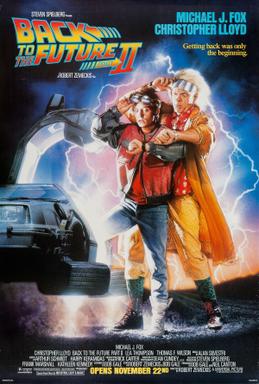
Back to the Future Part II (1989)

Marty and Doc head to the Future at last – alas – in the weak middle chapter Back to the Future II

Director: Robert Zemeckis

Cast: Michael J Fox (Marty McFly/Marty McFly Jnr/Marlene McFly), Christopher Lloyd (Emmett Brown), Lea Thompson (Lorraine McFly), Thomas F. Wilson (Biff Tannen/Griff Tannen), Elisabeth Shue (Jennifer Parker), James Tolkan (Strickland), Jeffrey Weissman (George McFly), Flea (Needles)

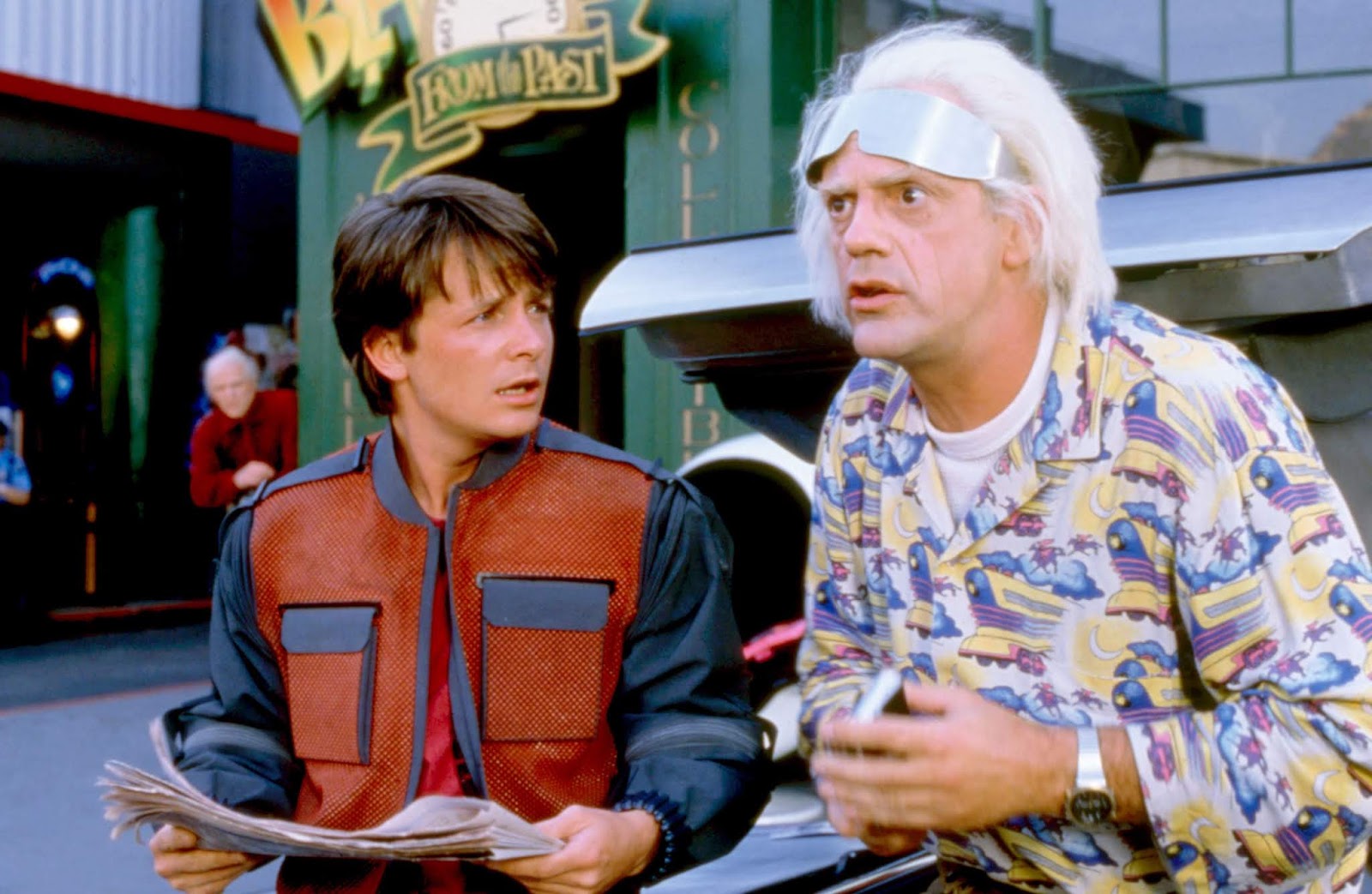
After the smash hit of Back to the Future a sequel was inevitable – particularly with that hook ending with our heroes zooming off into the future to fix Marty and Jennifer’s kids. Back to the Future Part II is often fondly remembered for its journey into 2015, a typically 1980s view of what the future might be like, but this is journey is mostly a slightly embarrassing mess that the film has to spend quite a bit of time getting over before the plot can start in full.

The journey into the future is largely a narrative cul-de-sac, which is mostly there to introduce a Sports Almanac covering 1950-2000 which Marty (Michael J Fox) picks up in an antiques store with an eye on placing some bets in the future. He’s firmly told by Doc (Christopher Lloyd) not to mess with the timeline, but that’s never here nor there to Old Biff (Thomas F. Wilson), who pinches both Almanac and DeLorean to head back in time to 1955 and handover the Almanac to his younger self. Which means when Marty and Doc return to 1985 from 2015, having not noticed the theft and return of the time machine, they find 1985 has been transformed into a nightmare dystopian world where Los Angeles is ruled by multi-billionaire Griff. So it’s back to 1955 to repair the timeline again – and this time dodge round their younger selves who are still going through the events of the first film. 

Zemeckis and Gale, it’s pretty clear, actually wrote themselves into a bit of a corner with their visit to the future. Firstly, the problem with the kids turns out to be fairly quick and easy to solve. Secondly, they are stuck with Jennifer (Elizabeth Shue replacing the unavailable Claudia Wells) who is instantly unceremoniously knocked out not once but twice in order for her not to be a third wheel on the boys adventures. Thirdly, the real interest and delight of these time travel films is seeing the past through the perspective of the present, and we lose that completely in a silly painfully of its time vision of the future. Gale himself had ruled out visiting the future in the first film, because all visions of the future date quickly on film – so it’s a shame he didn’t listen to himself.

The future sequence of the film is honestly pretty awful, in the midst of a film that takes a long time to get going and then relies very, very heavily on recreating the first film either spiritually (several set pieces in the future echo the first film, from feuds in a diner to the skateboard chase here done with a hoverboard) or literally (the third act of the film is a point-by-point recreation of the first film from different angles). The future sequence lacks any real point or drive, other than to establish two plot points: the sporting almanac and how Marty’s character flaw of pride leads him to take stupid, self-destructive risks. 

Other than that it’s an increasingly embarrassing look at what a 1980s person thinks the future might be like – flying cars, hovering skateboards, strange futuristic clothes, cybernetic implants, loud, bright colours – it’s all there. Sure there are some things correctly predicted – principally the idea of something approaching the internet and video calls – but the attempts at presenting a humourous view of the 2010s falls flat. This isn’t helped by the desperate mugging of several of the actors – none worse than Fox sadly, who plays his whiny Grandson, a latex covered middle aged version of Marty and (worst of all) his granddaughter – straining for laughs, but missing completely. It’s a cheesy, awkward sequence that says more about the hang-ups of the 1980s than anything else.

The film only starts to pick-up when we head back to the hellish Mad Max version of 1985 caused by Biff’s meddling. Sure it’s also an excuse for retreading some other elements of the previous film – and conveniently means that George McFly can be killed off, resolving the problem of working around a second recasting after the difficult to work with Crispin Glover turned down the film – but at least it kicks a bit of a plot going, away from the more feeble moments and overacting in the future section.

Which it brings us to the final act as the film reworks, reimagines and represents the events of the first film once again. I’m split on this between it being a fun, fresh idea of looking again at a beloved film (as well as opening up some comedy opportunities to play on the viewer’s expectations) or a sign of the well running dry. Either way it works a lot better than the future sections of the film, even if again the narrative structure is an almost exact re-tread of the first film, once again showing Marty trying to juggle events to get the outcome he needs and a race against time ending that culminates in a bolt of lightning and a cliffhanger.

There are some fun moments in the film, but Back to the Future II generally falls between two stools, trying to tell a new story while also setting up Part III. I appreciated more watching it again the way it carefully sets up themes and ideas for Part III – from Eastwood avoiding death in a shootout on a TV screen (the same way as Marty will) to establishing Marty’s character flaws that the third film shows him struggling to overcome. But it’s a slightly cheesy, slapdash film – short as well, as the opening 5 minutes are a reshoot of the first film and the last five are a trailer for Part III and the credits. It feels like Gale and Zemeckis felt forced to deliver the future against their will, and then spend the rest of the film course correcting to bring us back to the Past.

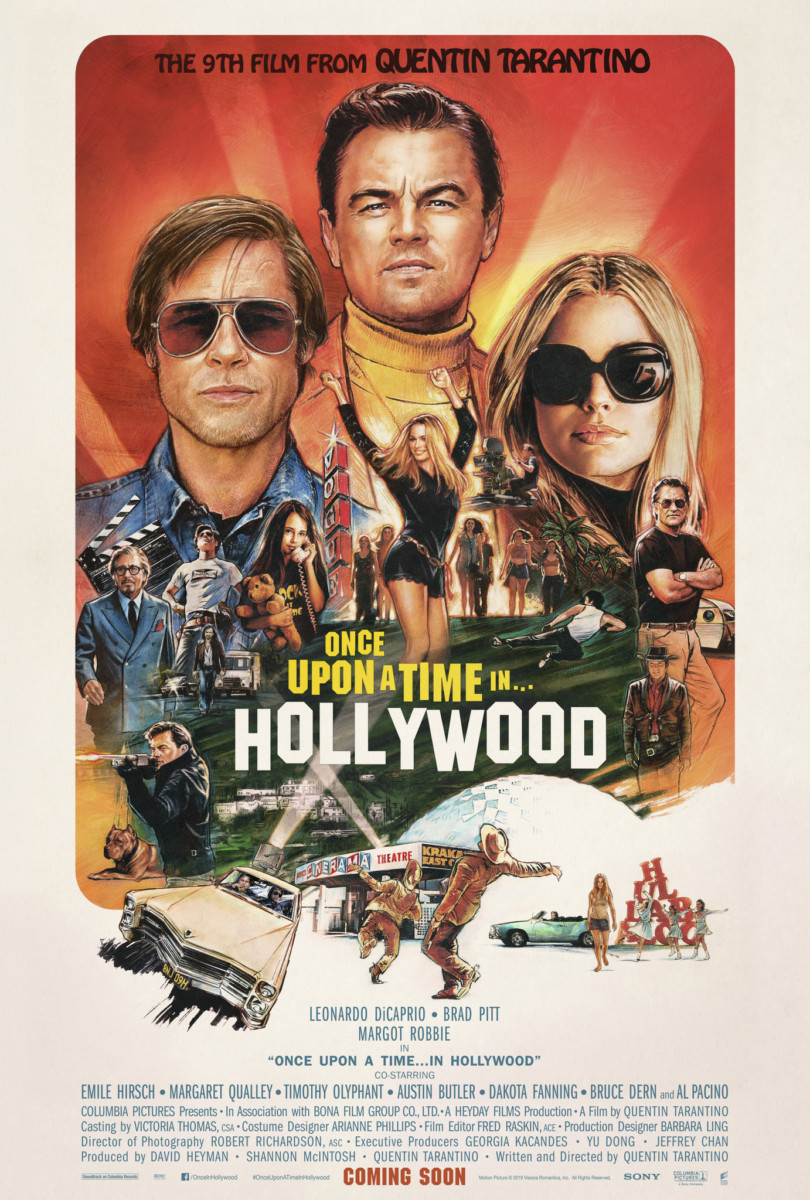
Once Upon a Time In Hollywood (2019)

Brad Pitt and Leonardo DiCaprio have fun in Tarantino’s appalling Once Upon a Time in Hollywood

Director: Quentin Tarantino

Cast: Leonardo DiCaprio (Rick Dalton), Brad Pitt (Cliff Booth), Margot Robbie (Sharon Tate), Al Pacino (Marvin Schwarz), Emile Hirsch (Jay Sebring), Margaret Quailey (Pussycat), Timothy Olyphant (James Stacy), Julia Butters (Trudi Fraser), Austin Butler (“Tex” Watson), Dakota Fanning (Squeaky), Bruce Dern (George Spahn), Mike Moh (Bruce Lee), Luke Perry (Wayne Maunder), Damian Lewis (Steve McQueen), Brenda Vaccaro (Mary Alice Schwarz), Nicholas Hammond (Sam Wanamaker)

Spoilers: I’ll discuss the film’s final 40 minutes in detail. I mean when you watch it you can guess where it’s going. But those final moments are truly central to my visceral hatred of this film.

There seems to be three eras of Tarantino movies. The first (Reservoir Dogs, Pulp Fiction and Jackie Brown) saw him work with pulpy themes focused on strong stories and character development. The second (Kill Bill and Grindhouse) saw him indulge his fascination with the B-movie and low-rent TV of his childhood. His third (Inglorious Basterds, Django Unchained) sees him making strange revenge fantasies on behalf of other groups. Once Upon a Time is a marriage between his second and third eras. And I hated it. I hated, hated, hated, hated it. I genuinely can’t remember seeing a film I hated more at the cinema (maybe Transformers: Revenge of the Fallen). It’s a self-indulgent, tasteless, overlong, smug, unbearable pile of pleased with itself shit. It’s grotesque and it left me feeling dirty.

The plot (such as it is) follows three days in the lives of fictional Hollywood-turned-TV actor Rick Dalton (Leonardo DiCaprio) and his stunt double Cliff Booth (Brad Pitt), Dalton’s best friend, chauffeur and personal assistant who can’t get a job in Hollywood due to his terrible reputation. Dalton lives next door to Roman Polanski and his wife Sharon Tate (Margot Robbie). On Feb 8th 1969, Dalton is offered a role in spaghetti westerns and preps for his next episodic TV show. On Feb 9thDalton shoots the pilot of Lancer a new TV western (and a real TV show) as the baddie, suffering a crisis of confidence about his career and talent. Meanwhile Booth does some odd jobs and has an odd encounter with the Manson family. Intercut with this are scenes of Sharon Tate going about her everyday life, including joyfully watching one of her films in the cinema. Finally we join the action after a time jump on August 8thas, after returning from filming in Italy, Dalton and Booth get drunk and high and accidentally waylay the Manson gang on their way to Sharon Tate’s house and – this being now Tarantino’s thing – brutally and bloodily murder the three Manson family killers.

Sigh. I think a question now has to be asked about what Tarantino’s problem is. As I realised where this film was going, my heart sank. This sort of revenge porn is, I’ll be honest, revolting, demeaning, tasteless and, leaving all else aside, not Tarantino’s place. It also demeans and cheapens the actual tragedies that happened to real people. Just as shots of Hitler’s head being machine-gunned to pieces in Inglorious Basterds while Jewish-American paratroopers machine-gunned a room of Nazi’s seemed to be grossly inappropriate, lowered the victims to the level of the killers and cheapened the actual deaths of real people in the Holocaust, making them seem like weak victims (as well as hardly being Tarantino’s place being neither Jewish or having any connection to the Holocaust) so it’s equally tasteless here. He just about gets away with it in Django Unchained, a black revenge thriller from a director who is not black and has littered his scripts with the “n-word” as all these guys were at least fictional people. But here it’s just grotesque.

We pride ourselves now that we have left the Gladiatorial ring behind, or that we no longer gather round on a Bank Holiday weekend to watch a convicted criminal being hung, drawn and quartered. But as I watched the Manson killers being bludgeoned to death, mutilated by a dog, their Glasgow kissed skulls crushed against a mantelpiece and immolated by flame thrower, I thought we’re not that far off. It’s basically a pornographic level of violence, that the film excuses because the Manson killers were bad guys (don’t get me wrong they were) but asking us to take pleasure in killing, is basically what Manson himself asked his followers to do. I find watching this sort of stuff not only feels like it cheapens the actual brutal, tragic murders of an eight-month pregnant Tate and her three friends, but also lowers me the level of the killers themselves. Tarantino’s films increasingly feel like the director himself would be fully on board with that episode of Black Mirror (“White Bear”) – where a killer is tortured everyday by tourists, and then has her mind wiped so she can go through it every single day – being turned into a reality.

In fact Once Upon a Time in Hollywood is a worrying voyage into the man’s soul, and what I saw there was partly this muddled vanity and obsession with revenge (I mean who gives him the right to take revenge on behalf of others? Someone please tell me? There is an arrogance to that I find deeply unattractive), partly the tragically boring geeky tedium of the video-store nerd, mixed with a loving regard for white men and a worrying lack of interest (bordering on contempt) for anyone different.

I loathed and despised the final forty minutes of this film, but to be honest the opening two hours are not a lot better. This film is almost three hours long and contains about thirty minutes of plot if that. What it mostly is, is a chance for Tarantino to indulge to a ludicrous degree his obsession with low-rent culture of the 1950s and 1960s. To show off his knowledge of obscure films of the age (he’s heard of The Night They Raided Minsky’s you know…) and recreate in painstaking detail pastiches of the type of TV shows he grew up watching. These sequences seem to go on forever and ever, with the odd good line and decent gag not suddenly making it anything other than increasingly tedious.

What he really, really, really needs is a collaborator to tell him when less is more and certainly when too much is too much. The first two thirds of the film seem to stretch on for an indulgent eternity, and their content reveals more and more of the director’s obsession. White men are idealised and the old-school values of Hollywood, the world of the studio and simpler non-PC times are looked back on with a fussy nostalgia. The film takes every opportunity for Booth and Dalton to lambast hippie culture and the growing anti-establishment of the era, and has every character we meant to like yearning for the good old days.

Bruce Lee appears in the film, here interpreted as a braggart arsehole, showing off to the stunt men, who is humiliated by Cliff in a brawl. It’s a scene that amuses for a second and then makes you uncomfortably realise you are watching the most prominent non-white person in the film being put into his place by a middle-aged white man. It’s got more than a hint of racism to it. And Tarantino claims to be a fan of Bruce Lee! By contrast, while the film brutally murders the Manson killers, James Stacy (played by Timothy Olyphant here) the chiselled white-male star of Lancer, a man later jailed for repeated child molestation, is treated with a laudatory romance. Guess there are different rules for white guys who starred in Tarantino’s favourite shows. Whither the revenge saga where his victims mutilate him eh?

Women don’t get a better deal in this film. Sharon Tate is essentially an elevated extra, although Tarantino gets one lovely sequence out of her watching her latest film – a playful swinging 60s spy caper with Dean Martin – in a cinema and gleefully enjoying both the film and the audience reaction with a childish, delighted grin. But then a lot of the success of this is due to Robbie’s marvellous performance. Tarantino himself does his best to ruin it with his foot fetish, throwing Margot Robbie’s naked feet into virtually every shot. Aside from this, the film shoots and treats Tate like a teenager observing someone they have a crush on, romantically idealising her without ever getting anyway near understanding her or scratching the surface of her personality, instead following her with doe-eyed devotion.

But at least she gets lines. Every other woman in this is either a slut or murderer (or both) from the Manson cult, a shrew (like Booth’s dead wife and Kurt Russell’s stunt manager’s wife) or a bimbo (like Dalton’s eventual Euro-wife). There is no in between. It’s a film for men, written by a man, where the men take centre-stage, and a smugly held up as never doing anything wrong, with the film uncritically indulging their vices as symptoms of their tragedy of being left behind by a more progressive and changing country.

Both Pitt and DiCaprio enjoy swaggering twists on their images. DiCaprio overacts wildly, in an overly mannered performance full of actorly quirks (he has a stammer so we know he’s a sensitive soul deep down!), that riffs on other performances of his and largely involves shouting and swearing. Even scenes of emotional vulnerability carry a method fakeness about them – but then Once Upon a Time is a film with no heart, so it’s not surprising that when one of its characters tries to show one, the film stumbles spectacularly into artificiality. Pitt fares better, with a performance of McQueen like-cool, even if the film seems to believe that even if Cliff did kill his wife (as many believe) it’s fine because she was clearly a bitch.

All of this is shot with a flatness and lack of visual interest that is surprising for Tarantino, usually a much more vibrant director. Maybe he was just echoing the TV styles at the time. Maybe he was saving the fireworks for his orgy of (what he would call) cathartic violence at the end. Maybe it’s just a pretty mundane film. Maybe if Tarantino wasn’t the film-buffs darling, more people would call out his flatness and lack of imagination behind the camera and the soulless flatness of much of the films shooting and pacing. Its mediocrity and smug wallowing in the culture of yesteryear is appalling.

Because Once Upon a Time is a teenager’s film, and worst of all, a teenage bore. It’s got a major crush on Sharon Tate, but barely any interest in her personality. It drones on endlessly about geeky knowledge and old film and television that no one else knows anything about so that it sounds interesting and cool. It takes a childish, immature, sickening delight in fantasising about killing bad people in the most horrific ways it can possible imagine. It thinks it’s really clever and profound, but it’s actually a horrible, horrible film that’s also really tedious and which leaves a deeply unpleasant taste in the mouth, while demeaning the real-life victims of a crime by spinning some ludicrous revenge fantasy around them. It morally offended me after two hours of boring me. I hated it. I hated it. I really, really, really, really hated it. I hated it so very much.

The Time Machine (2002)

Guy Pearce wastes his time in The Time Machine

Director: Simon Wells (Gore Verbinski)

Cast: Guy Pearce (Dr Alexander Hartdegen), Samantha Mumba (Mara), Orlando Jones (Vox 114), Mark Addy (David Philby), Jeremy Irons (Über-Morlock), Sienna Guillory (Emma), Phyllida Law (Mrs Watchit)

Every so often during this hysterical travesty of poor film-making, it’s worth remembering that it was was directed by HG Wells great-Grandson. If that’s not a reason for HG Wells to invent a time machine and travel into the future, in order to give his descendant a slap, I don’t know what is.

Anyway, with a plot vaguely reminiscent of some elements of the original novel, but just as inspired by a strange mixture of Hollywood blockbusters and Colin-Baker-era Doctor Who, The Time Machine stars Guy Pearce as Dr Alexander Hartdegen. In New York in 1899, Hartdegen is exactly the sort of naïve, floppy haired, genius eccentric so beloved of Hollywood movies, fascinated by time. When his fiancée Emma (Sienna Guillory) is killed in a mugging gone-wrong, obsession to prevent this leads him to invent a time machine – but he finds himself unable to prevent Emma’s death. Travelling forward into the future to find out why he eventually finds himself 800,000 years in the future where the Earth is occupied by the peace-loving Eloi and their brutal hunters, the subterranean Morlocks.

It’s hard to know where to begin with this film, but let’s try. It’s very poorly written. The dialogue clunks to the ground in a way reminiscent of the lumps of the moon that fall to the Earth in the future Hartdegen sees. There is scarcely any logic in the events we see, from the mechanisms of time travel to computers lasting hundreds of thousands of years with no identifiable power source. Characters tend to do things because the plot needs them to do it, rather than for any actual logical reason. Character development occurs with a randomness: Hartdegen starts the film as a buck toothed, shaggy haired “eccentric” and ends it as a ripped, action-hero haired heartthrob. No idea how that progression is meant to work, but you certainly won’t find the answer in the script.

It’s also poorly directed. Wells, working for the first (and only) time with live action actors has no idea at all about how to set a film’s tone or pace. The tone veers wildly from lowbrow comedy to highblown tension from tragedy to farce. Scenes that are meant to pluck the heartstrings will bring out tears of laughter. The actual comic bits will only bring out groans. Action scenes late in the film are shot with a ham-fisted bluntness that reduces them to laughable, cheesy crapness. Bright lights and wide angles frequently make a film that cost over $100 million to make, look like one that cost a tenth of that. I will cut Simon Wells some slack, as he had to stand down from the production, meaning it’s final moments were put together by Hollywood Hack Gore Verbinski, who probably just wanted to be out of there as soon as possible.

Also the whole design is so stupid. It’s a sort of steam-punk cool, but with no logic applied. The time machine never moves from its fixed geographical point, so it’s just as well no one tried to build a house on it or that the moon collapse didn’t drop a pile of moon rock on top of it. The time machine itself is a wonky contraption, full of spinning metal things and odd surfaces but of course Hartgeden doesn’t even consider installing a seat belt or any head protection. The Morlock design is equally bad, bright lighting making them look more like the bastard spawn of the Orcs from Lord of the Rings and Oscar the Grouch from Seasame Street.

At the middle of it all you have the sort of bizarre cast that could only have been assembled by some sort committee asking first “who’s cool?” and second “who needs money?”. Cool is surely the only reason Samantha Mumba (yes that Samantha Mumba) ended up in this film, as a sexy Elio lady who might just make Hartgeden forget all about that fiancée he’s spent four years obsessing about. At the other end, in one of his finest performance of cash-grabbing ham, we have Jeremy Irons. I have to admire his pluck, going through a laborious (Oscar-nominated!) make-up job (albino with a brain growing down his back), but the sort of sub-Scar speechifying the Über-Morlock delivers at the film’s climax (not to mention a bizarrely wonky final fight scene) is the work of a man already mentally spending the money on restoring his new castle in Ireland.

At the centre, Guy Pearce. I think at this time Pearce was going through some sort of career crisis. He’s handsome enough to play rugged, leading-man, action heroes like the type Hartgeden becomes. But in his heart, he’s more at home playing weirdos, outsiders and oddball (witness the happiness with which he embraces the buck-toothed oddness of early Hartgeden). So God knows what he made of this, but you can sort of tell he thinks the whole thing is crap, but doesn’t know what to do other than play it with a straight-jawed commitment (he’d soon learn, as Irons has, to meet crap with ham). Copper-bottomed crap at that, the sort of crap that would normally have you running for the hills. So Pearce sort of gets his head down and just gets through it and clearly hopes to still have a career when he comes out the other side. Which I suppose is more than Samantha Mumba managed.

Events sort of happen at this film, which seems to have some sort of confused message about moving on (“Your fiancée is dead? Man up and get over it!”) and wants us to live a life of individualism even while Hartgeden sets about giving the poor Eloi the sort of post-Victorian education that eventually led to their ancestors cracking the moon in half and wrecking the world. It’s the sort of film that ends things (literally) with a bang, Hartgeden creating some sort of time bomb out of his time machine and then running super-fast away (fortunately much faster than the allegedly super-fast Morlocks. Also the shockwave decides to stop once it’s killed all the Morlocks meaning Hartgeden is only guilty of mass genocide rather than wiping out the world). 

It’s all so far away from HG Wells cautionary tale of scientific progress gone awry that you wonder if his grandson even read his book. Did HG envision one day that a film would be made where a Morlock does a head turn double take, like some sort of Seasame Street reject, a few seconds before he blows up? That Jeremy Irons would pale up to play a character who might as well be called Gruber-Morlock? That Sienna Guillory would be saved from a mugger only to be hilariously killed off camera by a horse? That the future would be the singer of Gotta Tell Ya repopulating the planet with a bored Australian actor? If HG did make that time machine, we better tell him 2002 is a year to miss.

“Where would you go?” The poster asks. “To another film” replied the cinema audience.

Red Sparrow (2018)

Jennifer Lawrence tries but fails with dismal material in the dreadful Red Sparrow

Director: Francis Lawrence

Cast: Jennifer Lawrence (Dominika Egorova), Joel Edgerton (Nate Nash), Matthias Schoenaerts (Ivan Vladimirovich Egorov), Charlotte Rampling (Marton), Mary-Louise Parker (Stephane Boucher), Ciaran Hinds (Colonel Zakharov), Joely Richardson (Nina Egorova), Bill Camp (Marty Gable), Jeremy Irons (General Vladimir Andreiovich Korchnoi), Thekla Reuten (Marta Yelenova), Douglas Hodge (Colonel Maxim Volontov)

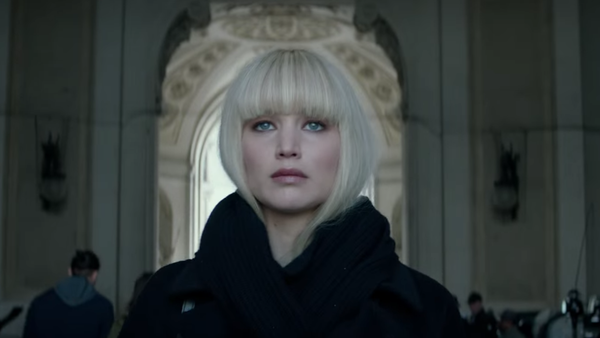
Dominika Egorova (Jennifer Lawrence) is in trouble. After an act of sabotage by her dance partner, her career in ballet is over. Out of options, she is forced into enrolling at the elite FSB Sparrow School by her uncle Ivan (Matthias Schoenaerts). There young men and women are trained, under the tutelage of its controlling Matron (Charlotte Rampling), to sacrifice all their pride and their bodies for the good of Mother Russia. Thrown into the field, Dominika finds herself entangled with the CIA Agent Nate Nash (Joel Edgerton), whom she has been ordered to seduce.

Red Sparrow is a bad film on several levels. Firstly, it’s at heart a trashy espionage movie that confuses being about intelligence with actually being intelligent. A few late twists doesn’t suddenly make this a work of genius. Secondly, its attitude of being about this damn dirty business of spying manages to make it so grim it’s not even fun to watch. Finally, it’s the sort of film that thinks constantly telling us it has a strong female lead at its heart is the same as actually having a strong female lead at its heart.

To take that final point last… Poor Jennifer Lawrence. Surely only the $20million she was paid for this film attracted her to this. I’ll start by saying she feels miscast in a role that requires a ruthlessness and capacity for viciousness that is not a natural part of her range. But this film struggles to make her feel like a character with real agency. During the course of this film, she has her leg broken, nearly gets raped (twice), strips down in front of a group of people (twice), gets smacked in the face, beaten, tortured, stabbed, shot… And a few sudden last minute gear reversals which suggest that she has been playing her own game this whole time don’t shake the impression that the film is wallowing in the torture and violence that runs through the film.

Anyway, the film is reliant on that because it’s not sharp or clever enough to really have anything else in there in its place. So we stumble from violent set piece to violent set piece, while the characters talk incessantly about macguffins and characters we care almost nothing about. The film has an almost impenetrable plot, not because it’s complex, but because it’s poorly explained and impossible to care about. Actors who are way too good for this material – and I mean the whole cast – struggle to put fire and energy into a shaggy dog story that never goes anywhere.

This all serves to make it a dull film. It really should be a guilty pleasure. All the right material is in there. Spy thrillers make for fun films. It’s interesting to have a woman at the centre of it. It’s got good actors. But too many scenes and set pieces veer towards the overly violent and sexual. For a film that is about a silly spy training school turning out honey trap agents, this film seems determined to ram the grimness of spying in our faces at every turn. This makes sense for a high brow Le Carre adaptation. It makes no sense for silly high-concept Jennifer Lawrence star vehicle.

Who really needs to watch poor Jennifer being slapped about and ill-treated for over two hours? Who has the patience for it? Who is going to enjoy it? The film struggles to get across the idea that Dominika is good at this spying game so it needs other characters to say it openly. Its rug pull towards the end lacks all signposting so gives no satisfaction whatsoever. By the time it comes round you’ll have long ceased stop caring about anything in it as well. A tedious, grimy and rather unpleasant film from start to finish that leaves a sour taste in the mouth.

Brideshead Revisited (2008)

Hayley Atwell, Ben Whishaw and Matthew Goode make for a bad revisitation to Brideshead

Director: Julian Jarrold

Cast: Matthew Goode (Charles Ryder), Ben Whishaw (Lord Sebastian Flyte), Hayley Atwell (Lady Julia Flyte), Emma Thompson (Lady Marchmain), Michael Gambon (Lord Marchmain), Greta Scacchi (Cara), Patrick Malahide (Mr Ryder), Felicity Jones (Lady Cordelia Flyte), Ed Stoppard (Lord Brideshead), Jonathan Cake (Rex Mottram), Joseph Beattie (Anthony Blanche)

There are some books that have been filmed definitively and you feel just shouldn’t be touched again. Perhaps the most definitive case is Brideshead Revisited. An 11-part, almost 13-hours-long, series from the height of the mini-series era, ITV’s 1981 Brideshead Revisited dramatised literally every page and every event of the just over 300 page novel, and did it with a perfect understanding of the book’s richness and complexity. So what hope could a film have – even if it is written by that man who had such a triumph with that other definitive production, the BBC Pride and Prejudice – Andrew Davies himself?

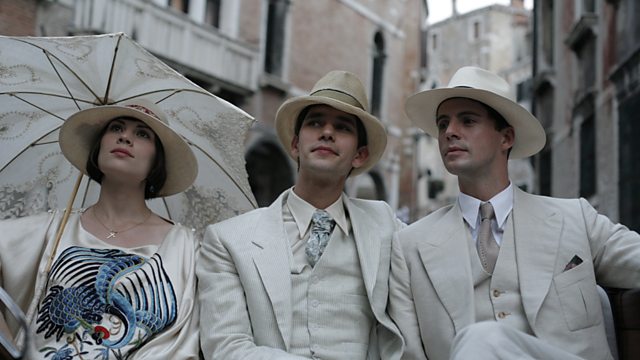
In the 1920s in Oxford, aspiring artist Charles Ryder (Matthew Goode) falls in with the bohemian set of fellow student Lord Sebastian Flyte (Ben Whishaw). Sebastian takes Charles to his family home of Brideshead, a beautiful, entrancing family estate. But Sebastian is an unhappy man, increasingly prone to drinking, conflicted about his family’s strong Catholic faith and his own sexuality. He’s also tortured by the growing love between Charles and his sister Julia (Hayley Atwell). Their domineering mother Lady Marchmain (Emma Thompson) attempts to guide the family as she wishes, but Sebastian’s alcoholism leads to a crisis. Years later Charles and Julia restart their relationship, only to find Catholicism and fate once again intruding to complicate matters.

Brideshead Revisited is a rich, sweeping, heartfelt and profound look at so many themes it seems impossible to cover them all in a single sentence. It touches upon questions of faith, class, politics, friendship, sexuality, love – all of them sensitively and intelligently explored by Evelyn Waugh. The TV series captured all these themes with an acute, empathetic emotional intelligence. This film, forced to telescope action into two hours, simplifies and sexualises the novel to make it as boiled down and simple as possible. While this probably makes for a decent, but nothing new, film for those who don’t know the novel, for those of us who do it’s nothing less than a total travesty.

Everything is made as straight-forward and basic as possible. Subtle suggestions from the novel are turned into blunt, simplified assertions that clang out of the actors’ mouths and hit the ground. This is especially clear in the character of Charles Ryder, a fascinating observer in the novel, both a snob and a romantic, capable of great warmth and kindness and also a distant indifference. Here, he’s little more than a social climber (his lower middle class roots are stressed), constantly being asked “What do you really want?” by other characters. His attachment to Sebastian, and introduction to the Brideshead house, seems based less on a magnetic friendship and more on his unspoken desire to be part of an “in-crowd”.

Ah yes, that relationship with Sebastian. Ben Whishaw’s performance as Sebastian is, quite simply, one of the worst realisations of an iconic character you are ever going to see. The novel’s Sebastian, is an impossible glamourous, handsome, slightly effete, but magnetically charismatic figure who effortlessly wins admirers and friends everywhere – so much so, that his intensely vulnerability, sadness and self-loathing that lead to his alcoholism are spotted way too late, and then hideously mismanaged. The character Whishaw plays here is so different, he’s effectively Flyte in name only.

It all stems from the film’s longing to put the book’s suggestion of a homosexual bond between Charles and Sebastian to the forefront. So we are made perfectly aware of Flyte’s feelings, and Whishaw turns the character instead into a stereotypical, limp-wristed, effete, tragic gay man struggling with a hopelessly unrequited love for Charles that pushes him over the edge to depression. Oh yes, it has to be unrequited love because we can’t have Charles show any homosexual inclinations. Particularly as the film is desperate to reposition Charles and Julia into a “love-at-first-sight” romantic couple from the start. So of course we have Charles twice rejecting sexual advances from Sebastian (once with the cold shoulder, the second time with an angry push). 

But in sexing up the content on the surface, the film totally kills the bond between the two characters. There is, frankly, no reason for Charles and Sebastian to be friends. Sebastian is from the start a slightly pathetic figure, so you never get a sense at all why Charles is drawn towards him. This then magnifies the feeling that Charles main motivation is the house (and Julia) and that he sees Sebastian as someone he must tolerate (and whom he later feels guilty about) rather than as a friend. Sebastian himself loses all his complexity, instead becoming a slightly pathetic, tragic, overlooked figure reduced to screaming at Charles “You only wanted to be my friend because you wanted my sister!” By pumping up the subtext, the film kills the central relationship of the book – and completely undermines the tragedy of Sebastian.

But then Andrew Davies was keen – as he stated himself in interviews – to reposition the novel as a conventional great romantic novel. Now it’s true that Charles calls Sebastian in the novel the “fore runner” for his feelings for Julia (and this relationship between Julia and Charles is, I will say, one thing the TV series didn’t quite nail), but in no way was she his main focus from the start. It makes Charles’ treatment (and, let’s be honest, leading on) of Sebastian crueller, and it also crudely simplifies the novel into a “love against the odds” story that we’ve seen a thousand times before. It drains the novel of one of the factors that made it original in the start.

So we end up with a Charles who basically, rather oddly, suffers the company of Sebastian but treats him as someone he wants to shrug off. We’ve got a romantic plot line between Julia and Charles that has been reduced to the most basic, cookie-cutter, Mills and Boon romance you can imagine. And the film still struggles through to attempt to deal with the book’s (perhaps) other major theme, religion. Catholicism, guilt and the power (and domination) of faith is key to the book – but here, it’s a crude subplot that positions religion as a sort of trouble-causing piece of mummery that gets in the way of happiness. Pretty much as far as you can get from Waugh’s understanding of the complex demands of faith, denial, guilt and love.

You could say it’s unfair to continually compare the film to the book and TV series. But not only is this meant to be an adaptation, but the film chose to shoot at Castle Howard in Yorkshire, just as the TV series did. So we see scenes play out, often in the exact same location as the masterful TV series. If the film doesn’t want to try and be original and find a new location, and visually apes the TV series as much as possible, it feels fair enough to compare it – and it find it wanting.

It’s a well-made film, I’ll give it that, and I like Adrian Johnstone’s score, but it’s turned an intelligent and absorbing novel into a sub-Merchant Ivory period prestige piece, with the focus on the lovely locations and the beautiful costumes rather than anything else. Performances wise, Matthew Goode is fine (but can’t escape the shadow of Jeremy Irons), but Hayley Atwell probably comes out best as a vibrant Julia (who gets, in a way, much more to do than the book gives her). For the rest, Emma Thompson gives a far too mannered performance as the domineering Lady Marchmain (here unquestionably a villain) and Michael Gambon coasts as the dying Lord Marchmain (who here turns up literally out of the blue at the end of the film to die).

Brideshead Revisited is an irrelevant piece of celluloid that brings nothing new whatsoever to the novel or the TV series. Worse it takes the key themes of the novel and subverts, ruins or mangles them in order to try and turn the story into a straightforward heterosexual romance. In doing so, it removes everything that makes the original interesting, unique or compelling – and makes people wonder why they should bother going back to the book – surely the worst offence of all.

Star Wars Episode II: Attack of the Clones (2002)

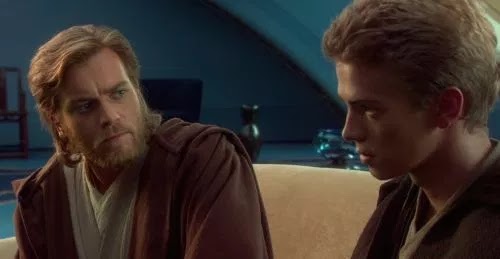
He hates sand you know. Anakin puts the moves on Padmé in Attack of the Clones

Director: George Lucas

Cast: Ewan McGregor (Obi-Wan Kenobi), Hayden Christensen (Anakin Skywalker), Natalie Portman (Senator Padmé Amidala), Ian McDiarmid (Chancellor Palpatine), Christopher Lee (Count Dooku), Samuel L. Jackson (Mace Windu), Temuera Morrison (Jango Fett), Frank Oz (Yoda), Anthony Daniels (C-3PO), Kenny Baker (R2 D2), Jimmy Smits (Bail Organa), Ahmed Best (Jar Jar Binks), Pernilla August (Shmi Skywalker), Joel Edgerton (Owen Lars), Silas Carson (Nute Gunray/Ki-Adi-Mundi)

Nothing could be as bad as The Phantom Menace. Surely? Well, umm, Attack of the Clones is pretty bad, but it’s not quite as stodgy and racist as the first one. It really isn’t. But don’t get me wrong, it’s still tone death, poorly written, crappily directed, poorly assembled, textbook bad film-making disguised under a lot of money.

Anyway, ten years have crawled by since Phantom Menace. Padmé (Natalie Portman) is now a senator campaigning against a revolutionary Separatist movement in the Republic, led by mysterious former Jedi Count Dooku (Christopher Lee). After a failed assassination attempt, Jedi Knight Obi-Wan Kenobi (Ewan McGregor) and his Padewan pupil Anakin Skywalker (Hayden Christiansen) are assigned to protect her. After another assassination attempt throws up a strange link to a mysterious planet of industrial cloners, Obi-Wan investigates leaving Padmé in Anakin’s care: but the two of them are falling in love, strictly against the rules of the Jedi order.

Sigh. Attack of the Clones is once again a mess, overly computer engineered, badly directed by a director with no knack for visual storytelling other than throwing special effects at the screen. It has a densely disinteresting plot about shady dealings around a mysterious Clone army that eventually the film doesn’t bother to resolve. Lucas shoots the entire film in a shiny, sterile, entirely computer generated environment that looks worse and worse the older the film gets. It builds towards a series of clashes at the end that have impressive spectacle on first viewing, but are hugely empty viewing experiences the more you come back to them. But all this isn’t even the film’s main problem.

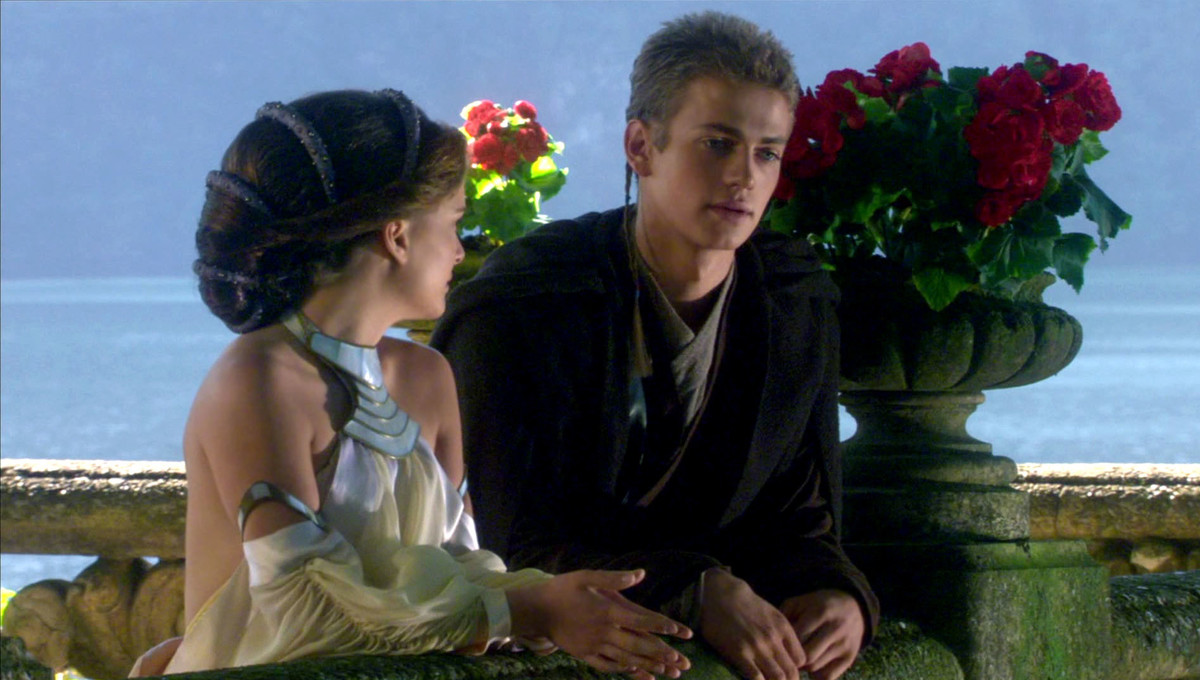
First and foremost, the most egregious problem with this film is the romance at its heart. This romance, whose impact is meant to be felt through every film is to come, is as clumsy and unconvincing as anything you are likely to see. Not for one second are you convinced that this couple could ever actually be a thing. For starters Anakin is a whiny, preening, chippy rather dull man who over the course of the film murders a village full of people. Hardly the sort of character to make women swoon. On top of this, his romantic banter and tendency of staring blankly and possessively at Padmé has all the charm of a would-be stalker, mentally planning out the dimensions of the basement he’ll imprison his love in. 

Padmé is hardly much more engaging. Her way of handling this love-struck young man, who she claims she doesn’t want to encourage? To flirt with him in a series of increasingly revealing costumes, while constantly telling him “no we can’t do anything” – for unspecified reasons. But then as she says “you’ll always be that 12 year old boy to me” (Oh yuck George!). Portman looks she can barely raise any interest in holding Anakin’s hand, let alone conceiving future generations of Skywalkers. The desperate attempt to create a sense of “love across the divide” falls flat, flat, flat with all the sweep of a Casualty romance of the week. Put it frankly, we are never ever given any reason at all for us to think that they have any reason to be in love.

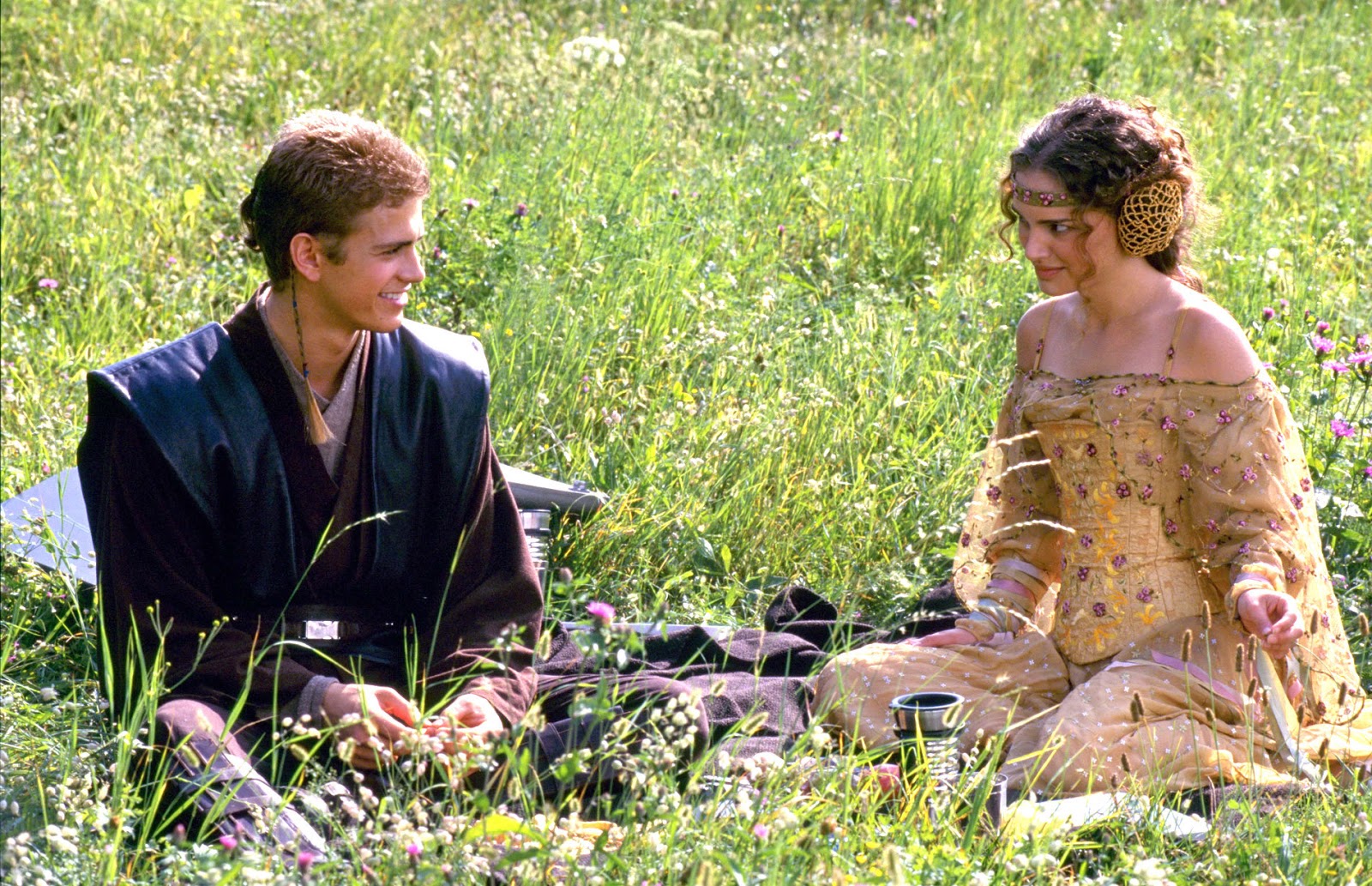
Despite all this the film desperately tries to throw them together into a series of clichéd romantic encounters, from candle-lit meals to gondola cruises around the lakes of Naboo. Jesus the film even throws in a flirtatious picnic (in which, true to form, Anakin espouses the benefits of totalitarianism, hardly the sort of thing to get a young girl’s heart fluttering!) followed by a roll around in the long grass after a bit of horseplay. To be honest it’s sickening and all the fancy dressing in the world never disguises the utter lack of chemistry between either characters or actors. And you’ll suffer with the actors who are trawling through the appalling “romantic” dialogue. The infamous “I don’t like sand. It’s coarse and rough and irritating and it gets everywhere. Not like here. Here everything is soft and smooth” sums it up – especially as Anakin ends it with stroking Amidala’s exposed shoulder possessively. Late in the film Padmé says “I’ve been dying inside since you came back into my life” – I know how she fuckin’ feels.

But then to be honest nothing really works in this simply terrible film. Of course a lot of the blame rests with Lucas whose overwhelming ineptitude as a writer and director is exposed in scene after scene. Most of the dialogue lacks any wit or lightness at all, constantly straining for a grandeur it can’t deliver and reads like George simply knocked out the first draft and left it at that. As for his directing: the camera positioning lacks any imagination what-so-ever. Most scenes that don’t have lightsabers feature characters sitting talking at each other to fill in plot details (I’m not joking here, there are so many different designs of chairs in this film it’s like strolling around IKEA). Sometimes George spices it up by having characters work slowly and aimlessly from A to B telling each other the plot (I’m failing to resist saying this is a pretty decent metaphor from the film).

The film shakes this up with a few action sequences which either tediously ape things we’ve seen before, but not-as-good (a chase through an asteroid field smacks of Empire Strikes Back) or having a computer game realism to them that never involves you. A prolonged sequence in a battle droid factory literally looks like a computer game from its hideously shiny lack of realism, to its logic, to the way George shoots it with the conveyor belt moving relentlessly forward visually like a dated platform game.

In fact computer game is a pretty good way of thinking about this film. When making this film, Lucas was convinced this would be the start of a new age: that only dull, traditional directors would be building sets and that all the cool kids would make everything in computers. Watching this film today in hi-def blu-ray does it no favours. Lucas’ computer generated sets (in most shots everything except the actors and their costumes are not real) look ridiculously shiny and unrealistic. There is no weight and reality to anything. Instead it all looks like some sort of bizarre, wonky computer visuals. How can you invest in anything in this film when even the goddamn sofa they are sitting on is a visual effect? How can anything have any weight or meaning? Compared to the lived in appearance of the Millennium Falcon, nothing looks realistic or carries any weight at all.

George Lucas isn’t really a director of action either. It’s hard not to compare the epic battles here with the style and substance of the (equally effects filled world) of Lord of the Rings being released at the same time. There, the battle scenes not only carry real emotional weight and peril but also have at least some sense of tactics and story-telling. This is just a collection of special effects being thrown at each other, like an exploding fart in a special effects lab. This makes for events that look impressive when you first see them, but carry no lasting impact: when you revisit the film, nothing feels important or dangerous or coherent – instead it’s just a lot of stuff happening, loudly.

This goes for the famous Yoda-Dooku light saber duel. Sure when I first saw this, seeing a computer generated muppet take on a stunt double with an octogenarian’s face super-imposed on his felt really exciting. But again, on repeated viewings, it’s just a load of wham and bang that kind of leaves you cold (not least because the fight is a showy bore-draw). It’s as ridiculously over-made and over stuffed as half a dozen other fights in the film. It’s almost representative of how crude these prequels are: a character always defined by his intellect and patience in Yoda reduced to a bouncy special effect for a moment of cheap “wow” for the fans. I’ll also throw in the lousy fan service of turning Boba Fett (a character who has a fascination for a lot of fans for no real reason) into an integral part of the Star Wars backstory – as if George intended this character at any point to be so popular, until he released the merchandising opportunities…

Lucas’ direction fails time and time and time again. Even small scenes fall with a splat or feature moments that get the wrong type of chuckles. The moment where Anakin embraces his dying mother? Forever ruined by the snigger worthy collapse of Pernilla August’s Shmi in his arms, looking like a primary school child miming playing dead (tongue out and all) in a school play. Obi-Wan and Anakin’s chase through the skies of Coruscant packed with “jokey” attempted buddy cop lines that never ring true. The film has even more skin crawlingly embarrassing scenes than Phantom Menace, from a sickeningly cutesy room of “younglings” learning Jedi skills to Obi-Wan’s bizarre encounter with a greasy alien in some sort of American diner. There is precisely one moment of wit in the film (Obi-Wan using the force to tell a drug dealer to “You want to go home and rethink your life”). Other than that – nope, it’s poorly made, poorly written, poorly assembled rubbish.

None of the actors emerge with credit. Pity poor old Hayden Christiansen, left to his own devices by Lucas’s inept, direction free, direction. But he is absolutely, drop-down, unreedemably awful in this film. In fact Anakin, far from being a jumping off point, was the death-knell of his career. Was there really no other young actor with charisma who could have stepped in to take this role instead? Portman fairs a tiny bit better, while at least McGregor, Jackson and Lee have enough experience to take care of themselves. But there is no sense of relationship between any of these characters. The two most important relationships Anakin has in the film contain no chemistry: he and Padme and he and Obi-Wan (neither of whom seem to particularly like each other).

Attack of the Clones could never be as disappointing as Phantom Menace (what could?) but it’s far, far, far away from being a good film. It’s got a simply terrible script, is directed with a dull flatness that all the CGI flair and shouting can’t distract you from. There is nothing in there for you to invest emotionally in. It’s built around a relationship that quite frankly doesn’t work at all on any levels. It builds to a random ending that feels like George ran out of ideas rather than because it meets any thematic reason. How could it all have gone so wrong?

Star Wars Episode 1: The Phantom Menace (1999)

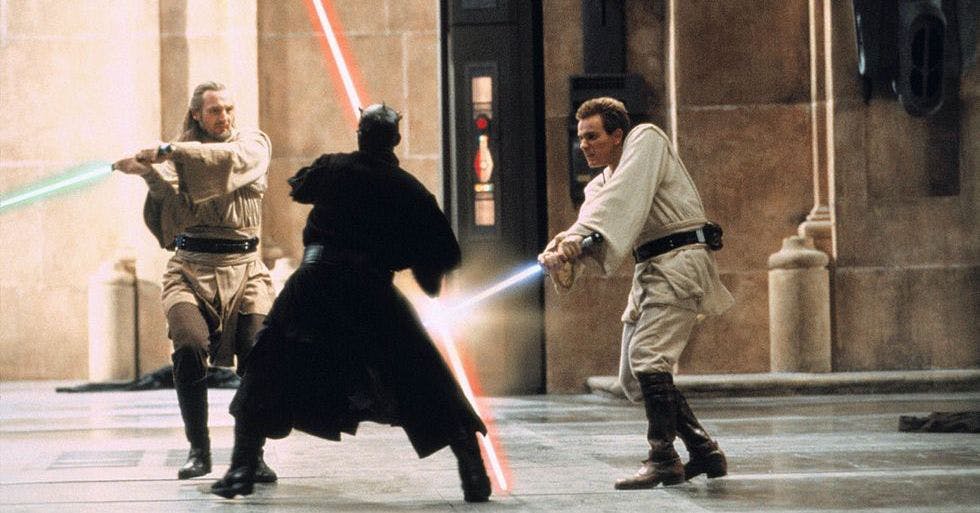
Jedi vs Sith – where did it all go wrong in The Phantom Menace?

Director: George Lucas

Cast: Liam Neeson (Qui-Gon Jinn), Ewan McGregor (Obi-Wan Kenobi), Natalie Portman (Queen Padmé Amidala), Jake Lloyd (Anakin Skywalker), Ian McDiarmid (Senator Palpatine), Anthony Daniels (C-3PO), Kenny Baker (R2 D2), Pernilla August (Shmi Skywalker), Frank Oz (Yoda), Ahmed Best (Jar Jar Binks), Oliver Ford Davies (Sio Bibble), Hugh Quashie (Captain Panaka), Samuel L Jackson (Mace Windu), Ray Park (Darth Maul), Terence Stamp (Chancellor Valorum), Kiera Knightley (Sabé), Silas Carson (Nute Gunray/Ki-Adi-Mundi), Brian Blessed (Boss Nass), Ralph Brown (Ric Olié)

Has there ever been a more disappointing film than The Phantom Menace? I don’t think any film has ever opened to so much hype and fan expectation. The Second Coming could have trouble competing with the expectations piled onto this first Star Wars prequel. Everyone thought it would be the film of the year. Until they saw it. No one thought it would be the film of the year after that.

Of course you should have sensed a disturbance in the force the second you read the opening crawl. The first sentence “Turmoil has engulfed the Galactic Republic” sounds promising right? Well let that expectation die as we hit the second sentence “The taxation of trade routes to outlying star systems is in dispute”. Not exactly a flight for the Empire with the Death Star plans is it? Perhaps only a multi-millionaire like George Lucas could have expected a storyline based around a tax dispute would get the pulses racing. 

But then this is a jumping off point for a seriously shambolic film experience. Phantom Menace is a total mess, an incoherent, poorly scripted, farce of a film, a terrible stumble through a dashed off storyline that makes no sense. Anyway, Naboo is a planet under siege from the Trade Federation. Jedi knights Qui-Gon Jinn (Liam Neeson) and Obi-Wan Kenobi (Ewan McGregor) are sent to negotiate but things quickly turn to violence and they need to flee the planet with its 14 year old (?) elected (??) Queen (???) Padmé Amidala (Natalie Portman). On the planet of Tatooine they encounter a 9 year old slave Anakin Skywalker (Jake Lloyd) with a natural instinct for the force. Qui-Gon wants to train him, while the Galactic Republic tries to resolve the siege of Naboo.

That’s sort of the story – but even writing it down seems episodic and vague. But then that’s everything in the film. Nothing is really clearly explained, and we are never properly introduced to who all the sides are in this film and what they might want. There is a complete lack of any real narrative sense at all. The antagonists and protagonists of the film are hard to define. In fact they are frequently a pile of two dimensional yawns. It’s pretty hard to care about any of them. I guess you feel a bond with Obi-Wan, but that’s based on old films – watch this and Obi-Wan is a do-nothing whiner. 

But all the characters are infected by this. George Lucas is completely unable to bring any characterisations to these people, his lines constantly falling flatly or crappily to the ground, while the actors themselves struggle to find anything to engage it. Harrison Ford famously told Lucas on the first film that “you can type this shit but you can’t say it” – and that’s pretty much nailed on for this film. There is not one single vaguely memorable line in this film. Rather you are struck every second with feeble lines that sound like they might have had depth (“There’s always a bigger fish!”) but when analysed for a second make no sense whatsoever. It’s no wonder Neeson seriously considered quitting acting after this film.

Yes these two characters will get it on in the next film. Yuck.

There isn’t a single character in the film to really invest in. There is no equivalent to your Han Solo, the witty outsider to puncture some of the grandaeur. Instead every character is a flat, po-faced, non-personality who spend all their time in the film very seriously going about their business, never explaining anything. The Jedi are particularly affected by this, written as serious stick-in-the-muds constantly lecturing and ticking off other characters. Qui-Gon Jinn makes a tedious lead character, who constantly gets in the way of the relationship building we need to see between Obi-Wan and Anakin. Because we know where the film series is going, spending time on Qui-Gon feels like wasted time. The backstory is to see the relationship build between Obi-Wan and Anakin – instead they hardly speak in the film, and we instead spend ages on Qui-Gon. It’s poor story-telling and wastes a film showing us unimportant back story rather than spending time on the core stuff. It’s bad enough that we have to waste one third of the prequel series on Anakin Skywalker: The Wesley Crusher Years (seriously has anyone, even a child, ever loved a film where a brattish, super kid is the hero? You won’t be shouting Yiipppeeee…)

Lucas isn’t a director of actors, he’d say the same. But he is supposed to be a master of visuals and special effects. This is a film where everything you could possibly imagine has been thrown at the screen. Each frame is full of complex business, every single section crammed with special effects. There is a lot going on visually all the time, but all of it comes across like an explosion in a colouring book. Unlike the effects of the original trilogy, nothing really feels real or carries any real weight. Instead you see every special effects shot in the film and see frames filled with clutter and shiny, computer generated weightless nonsense. Worst offender is the hideously overextended pod race sequence, like a particularly dull Formula One race, which carries no real stakes (as we all know the result) and, for all the high speed camera work and editing feels not one iota as thrilling as the speeder chase in Return of the Jedi.

On top of this, most of the interventions into the Star Wars backstory makes the original trilogy worse. This is the film that gave us midichlorians, some sort of magic alien thing that lives in blood and gives the Jedi the ability to use the force. The reaction to this midichlorian nonsense, undermining the mystique of the force into something that could measured like a top trump was so negative that it was mentioned at most once in the two sequels. Other areas got similarly scathed, not least turning Anakin Skywalker into the worst form of “gifted child”. I’m not even going to touch on the icky fore-knowledge we have about the fact that Anakin and Padme are going to get it on in the future, something that is hideous to think about.

The most hated character in film history?

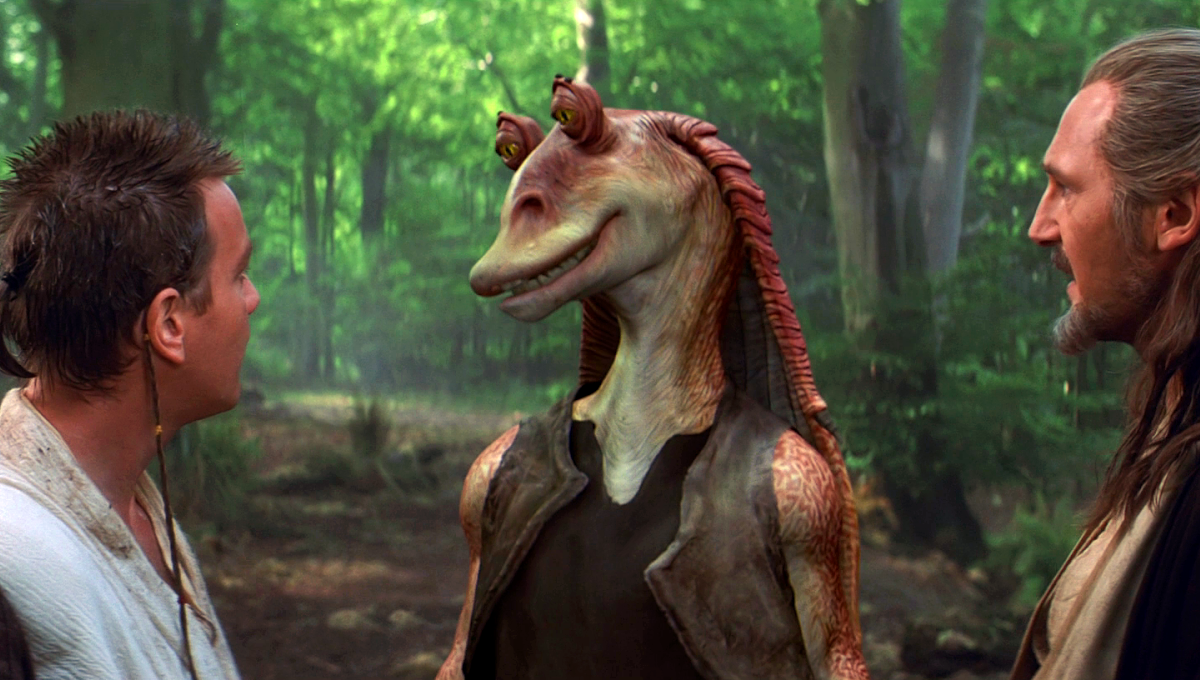
Lucas also fudged the new stuff he introduced in the film. The worst element: of course it’s poor old Jar-Jar Binks. I genuinely feel sorry for Ahmed Best, an actor whose career never recovered, who is just doing here what he was told to do. But Binks is the most irritating character possibly ever conceived for a hit blockbuster. An idiotic, comic creation designed for the kids who falls over, trips up, says stupid things and steps in shit he does nothing useful for the whole course of the film and tries to entertain kids who were way more interested in Darth Maul. Binks is almost irredeemable, every sentence enough to send everyone’s teeth on edge. 

Lucas trumpeted how much Binks was setting the trend of being the first major computer generated character. Lucas was incapable of guiding the actors to respond (or even look at) the correct spaces where Binks was standing. And Lucas was so pleased with it, he never stopped to think. Binks makes no sense. Like the rest of the Gungans he’s a joke. There is literally no reason at all for the Jedi to take him anywhere with them, particularly as he constantly gets in the way, causes trouble and offends people. Even in the “desperate” final battle, Binks prats about – compare him to the moments of tragedy and sacrifice given to the Ewoks in Jedi and you’ll see how bad this is.

Yes Watto loves Money. What? What’s the problem?

And of course he and the Gungans are shocking racist caricatures in their Jamaican accent. If you had any doubts that Lucas had no one saying no to him on anything, this film is stuffed with pretty shocking racist characters. Binks is terrible, but the villains of this place are the money obsessed Trade Federation, all with Japanese accents. On Tatooine, Anakin is kept by a greasy, fly ridden, money obsessed, big nosed, fly-covered alien Watto who looks, sounds and acts like a children’s version of The Eternal Jew. Did no one watching the film take a second and say “hang on this looks a bit dodgy…”

All of this nonsense finally comes together in a grand final battle which sums the whole film up, in a sequence where the tone shifts and changes all the time with no sense of a single person doing so intentionally. We have the Gungans comically fighting the droids in a series of awful little vignettes. We have the Queen chasing through the palace in a poorly explained subplot. We have a 9 year old child accidentally flying a ship into space and accidentally blowing up the baseship (Anakin saves the day without even realising it, the one thing that could make the child even more irritating than he already is). And we have the Jedi fighting Darth Maul in a battle that looks impressive at first but is in fact overly busy and overly choreographed. 

The Phantom Menace has few reasons to like it at all. You get bored with the story. You don’t invest in the characters. You don’t engage with the events. You don’t feel your pulse racing. The plot drifts from planet to planet with very little logic at all. The dialogue is terrible. The story telling is abysmal. The direction is flat. The film throws in moments that crap over the original trilogy. Lucas made is wait for decades – but then seems to have produced a film that he didn’t really want to do. It’s a truly dire film.

The Core (2003)

The Only Way is Down for our heroes in super silly Sci-fi disaster The Core

Director: Jon Amiel

Cast: Aaron Eckhart (Dr Josh Keyes), Hilary Swank (Major Rebecca Childs), Delroy Lindo (Dr Edward Brazzleton), Stanley Tucci (Dr Conrad Zimsky), Tchéky Karyo (Dr Serge Leveque), Bruce Greenwood (Commander Robert Iverson), DJ Qualls (“Rat”), Alfre Woodward (Dr Talma Stickley), Richard Jenkins (Lt General Thomas Purcell)

Dr Josh Keyes: “Even if we came up with a brilliant plan to fix the core of the Earth, we just can’t get there”

Dr Conrad Zimsky: “Yes, but – what if we could”

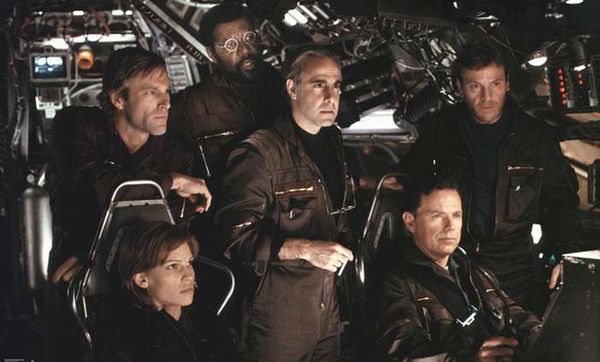
If you have any doubts about the type of film you are going to watch, then that tongue-in-cheek dialogue exchange (and the words can’t capture the playful, I-know-this-is-crap wink that Stanley Tucci tips practically to the camera) should tell you. The core of the Earth has stopped rotating. Which basically means all life on Earth is going to end in the next few months. Unless, of course, we can restart the rotation of the Earth’s core. So time to load up a team of crack scientists into a ship-cum-drill, made of metal that doesn’t buckle under pressure (this metal is, by the way, literally called unobtainium by the characters) so that they can sprinkle nuclear bombs through the centre of the Earth to kickstart the rotation of the planet and blah, blah, blah.

It’s perhaps no surprise that The Core was voted the least scientifically accurate film ever made by a poll of scientists about 10 years ago. Nothing in it makes any real sense whatsoever, and it’s all totally reliant on the sort of handwave mumbo-jumbo where you can tell getting an actual logical explanation was going to be far too much hard work, so better to roll with a bit of technobabble and prayer. Questions of mass, physics, pressure are all shoved aside. The film sort of gets away with it, with a leaning on the fourth-wall cheekiness – no fewer than three times in the film the impossible happens with a “what if we could” breeziness, as a character pulls out a theory or discovery with all the real-world authority of the fag-packet calculation.

But then scientific accuracy is hardly why we watch the movies is it? And this is just a big, dumb B-movie piece of disaster nonsense, which throws in enough death-defying thrills, predictable sacrifices and major landmarks being wiped out topside to keep the viewer entertained. In this film Rome and the Golden Gate Bridge both get taken out by spectacular disasters. Beneath the surface, the characters go through the expected personality clashes and learn the expected lessons.

The script (most of which is bumpkous rubbish) really signposts most of this personal development. Will Zimsky and Brazz rekindle their respect and overcome decades of rivalry? Will Serge, on the mission to save his wife and kids “because it’s too much to think about saving the whole world”, have to pay the ultimate sacrifice? Will Major Childs finally get the courage and determination to take command and make the hard calls? I won’t tease the fate of Mission Commander Bruce Greenwood, but he is called upon so often to reassure Childs that one day she will be ready to take command, alongside other mentoring advice, that the only surprise is that he lasts as long as he does.

So why is hard to not lay into The Core? Because, not that deep down at its core, it knows it’s a silly film. The script has enough awareness of its cliché and scientific silliness that it almost doubles down on it. And the actors play it just about right: for large chunks of it they perfectly hit the beats of sly archness that suggest just enough respect to not take the piss, but enough self-awareness of what they are making. But these are all very, very good actors and when the serious moments come, it’s remarkable how much they can shift gear – with the grisly death of one character (while the others powerlessly try and save him) played with an almost Shakespearean level of tragedy by a distraught Eckhart and Lindo. Later, as three characters juggle over who will go on a suicide mission to keep the mission on track, the bubbling emotions of shame, relief, pride, respect and buried affections are genuinely rather affecting. Its moments like this that makes me kind of love this big, dumb, stupid film.

But it remains stupid. Topside, Alfre Woodard and Richard Jenkins bumble through roles they could play standing on their heads. A hacker – Rat – is as clichéd and full of techno-nonsense as any of the science, which is even more painfully obvious to us now that we’re all so much more tech-savvy than we were in 2003. Events happen because, you know, they can. Discoveries and scientific conclusions are made because the script needs them. But the film knows this, it doubles down on it and it accepts that every problem is just a “But what if we could!” away from being solved. Stupid, but strangely loveable.