
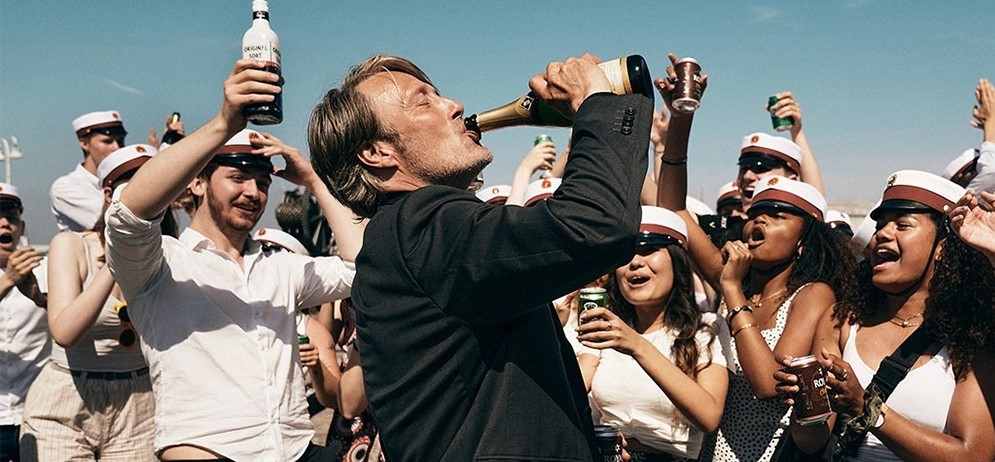
Vinterberg’s film explores our complex relationship with alcohol with a surprising lack of judgement
Director: Thomas Vinterberg
Cast: Mads Mikkelsen (Martin), Thomas Bo Larsen (Tommy), Magnus Millang (Nikolaj), Lars Ranthe (Peter), Maria Bonnevie (Anika), Helene Reingaard Neumann (Amalie), Susse Wold (Principal)

Mankind’s most difficult relationship? Might just be with alcohol. Ever since Noah first toppled over pissed, we’ve struggled to balance that delightful buzz a touch of intoxication gives with the destructive impact way too much has. It’s a relationship explored in Thomas Vinterberg’s curious mix of warning and celebration, Another Round, which (slightly obliquely) looks at the positives and negatives of alcohol consumption.
In a gymnasium school in Copenhagen, history teacher Martin (Mads Mikkeslen) has lost all passion and interest in his students (so much so they try to have him removed) and his marriage is stuck in an increasingly distant rut. After a birthday meal, he and three friends – PE teacher Tommy (Thomas Bo Larsen), psychology teacher Nikolaj (Magnus Millang) and music teacher Peter (Lars Ranthe) – agree to a pact to combat their ennui. After reading a theory that mankind is born with 0.05% blood alcohol content deficiency (and topping it up makes you more creative and relaxed), they decide to experiment with maintaining a certain level of inebriation. At first it has a positive impact; but as they push the boundaries of the experiment, the negatives swiftly multiply.
Vinterberg’s film is notable for not taking an obvious (or firm) stance on alcohol consumption. It’s easy to imagine an American or British film dwelling on the negatives at the cost of everything, or demonstrating deep regret in the friends for ever starting on this journey in the first place. Another Round doesn’t do this. In fact, it rather bravely points out the positives we can feel from the happiness and relaxation alcohol can give. So much so that, at first, it actually improves people’s lives. After all, if it was always all bad – we wouldn’t drink it would we?
This is most notable in the case of Martin. He might stumble in the staffroom on the way to class, but (after a swig of vodka) his teaching becomes more inspiring, electric and engaging. He rediscovers a passion for working with students, dropping the disengaged drawling of semi-confused facts we see him use earlier (where he doesn’t even seem to be listening to himself, randomly drifting from the Industrial revolution to Churchill) and replacing it with insightful parallels, high-energy tempo and fun activities. Whether it’s psychological or something else, being able to relax clearly has a positive short-term impact on his ability to teach.
It’s matched in the others as well. Peter gets his students singing with an intensity and beauty he couldn’t begin to get them to reach earlier. Tommy, in his work with a primary school football team, brings out the skilled footballer in a shy, bespectacled student (although his uncomfortable blurring of the line between teacher and surrogate parent with this boy hints at Tommy’s lack of control, which the film will explore in more depth). Vinterberg echoes the giddy feeling of elation all four feel by subtle use of a free-moving handheld camera, compared to the more staid rigidity of the earlier stable shots.
Martin also dramatically improves his personal life. He starts to reconnect with his family and rebuild passions with his wife. Sure, there are negatives. Hidden alcohol stashes at the school are discovered. It becomes harder to hide their intoxication in the common room. But it still feels good, right? Problem is, Martin makes the mistake many of us have. If a small amount of this makes me feel this good – why don’t I take a large amount? Surely if I up the blood alcohol content even higher, the positives will be all the greater. Sadly, of course, it doesn’t work like that.
Vinterberg’s film is careful not to use labels like alcoholism. But, in the same way it isn’t afraid to show the world-beating confidence a stiff drink or two can give you, it doesn’t shy away from the impact of over-consumption. Deciding, “as an experiment”, to push their drinking to absurd levels for one night only, to get as intoxicated as possible, the four have a fab night. But the next morning? Peter loses all his clothes diving in the sea. Nikolaj wets the marriage bed in a confused stupor. Martin wakes up, face bleeding, on the pavement having tried (and failed) to use his keys on his neighbour’s house, and is carried home by his humiliated children.
This is as nothing compared to the terrible impact of alcohol on Tommy. While all four of the men no doubt become increasingly dependent, it’s Tommy who tips into full blown alcoholism. Beautifully played by Thomas Bo Larsen, its painful to watch this gruff-but-playful bachelor dip increasingly into confused, stumbling, permanent inebriation, living in a home made of finished bottles and unable to hide from colleagues or students his intoxication.
But, for all that much of the second half of the film focuses on these negatives, it doesn’t offer easy solutions. All four realise things have gone too far – but none of them can forswear (or even seem to consider doing so) alcohol. Martin’s marriage collapses and Nikolaj’s nearly goes the same way. But they still gather at the film’s end for a drink. It’s at this point that it can be a little unclear what Vinterberg’s thoughts are on the demon. But then perhaps that is the point: we all know it’s bad for us anyway, so a film that looks at how we balance that desire with a certain level of responsibility is always, perhaps, going to shy away from either easy answers or definitive statements.
It’s perhaps why the film ends with a surprisingly blissful, up-beat ending of hope for the future rather than despair, as Martin explodes into a riotous improvised dance routine. It’s easy to forget Mikkelsen is a trained dancer, and the fact he provides such a striking, memorable ending to the film is fitting as it’s a triumph for him. At first a shambling, sad-sack figure, Mikkelsen’s Martin finds a casualness and relaxation that seemed beyond him (the film is a physical triumph for Mikkelsen – his drunken move through a common room worthy of Gene Kelly or Buster Keaton). Mikkelsen’s work is extraordinary in its emotional complexity – bursts of pained sorrow, rage, guilt, self-loathing, despair and hope flash across his face and he holds the entire film together.
He’s ably supported by Larsen, Millang and Ranthe – all superb – and Vinterberg’s deceptively casual and unobtrusive direction helps craft a film that offers scenarios but not lectures. While I could have hoped for the film perhaps taking a bit more of a stance one way or the other – or give a more unflinching look at the impact on others of alcohol abuse – as a personal story Another Round is vibrant, honest and (strangely) hopeful, for all the terrible impacts it displays. It lingers with you like a hangover.
 Movie Musings