
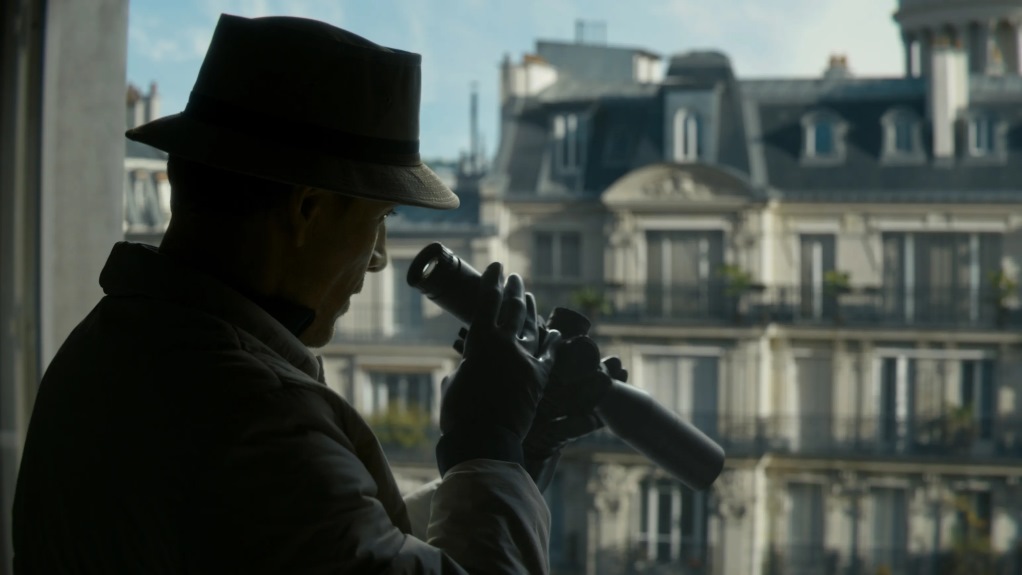
Fincher’s lean, spare film is a perfectly constructed thriller and an intriguing character study
Director: David Fincher
Cast: Michael Fassbender (The Killer), Tilda Swinton (The Expert), Charles Parnell (The Lawyer), Arliss Howard (The Client), Kerry O’Malley (Dolores), Sophie Charlotte (Magdala), Emiliano Pernia (Marcus), Gabriel Polanco (Leo), Sala Baker (The Brute)

A man sits in monastic silence, starring out of a window at the best hotel in Paris that money can buy. He moves only to sleep, exercise with a monotonous rigour and consume a carefully calculated daily calorie amount from McDonalds. He wears gloves all the time, never moves from the sheeting he lays across surfaces and sometimes assembles and reassembles his rifle. He’s a nameless hitman for hire (Michael Fassbender) and a freak accident on this job will shatter his world of pristine order and leave him hunted by his employers and on a campaign of revenge to guarantee his safety.
The Killer is a lean, slimmed-down thriller full of Fincher’s love for procedure and detail, that delights in every beat of its detailed look at how a professional killer might go about his daily business. Be it lock-ups crammed with mountains of equipment, from guns to false number plates and endless zip-bound folders of fake IDs (all using character names from 70s and 80s TV shows) to the practised ease with which he penetrates even the the highest security building with an Amazon purchased card copier and light-fingered pick-pocketing. All of it assembled with Fincher’s pin-point precision and clockwork eye for detail.
On the surface, you might expect The Killer to be a sort of twist on Le Samouri, Melville’s look at a zen-like hitman. The Killer seems to fit much of the bill. Embodied with an athletic suppleness by Fassbender (his body seems to be almost elastic in the parade of physical stretches and exercises he performs, not to mention the fingertip press-ups he relentlessly pumps his whipper-thin body through). But Fincher gives us a seemingly never-ending insight into the Killer’s inner-mind, via a prolonged (near continuous) monologue of his inner thoughts, ideologies and mantras that dominate much of the film (the first twenty minutes plays out in near on-screen silence, just watching Fassbender and listening to his voiceover).
What’s fascinating is this interior monologue is only a shade away from a stream of corporate middle-management think. (It’s even implied the Killer was originally recruited while training as a lawyer). There are mantras with the air of an assassin’s version of positive thinking (“Stick to your plan. Anticipate, don’t improvise. Trust no one. Never yield an advantage. Fight only the battle you’re paid to fight.”) and passive-aggressive demands to hit a personal standard (“Forbid empathy. Empathy is weakness. Weakness is vulnerability.”). Far from the glamour of an unknowable force acting to a mystical code, this Killer sounds alarmingly similar to a self-doubting white-collar worker using Sun Tze to plan out his pitch meetings.
Beneath the sheen of Fincher’s beautifully dark film, is the suggestion we are watching a character study of a man perhaps only partially aware that his life, and his inner picture of who he is, is falling apart. For starters, despite his mantra of perfection and continued assurance of ‘every detail covered’ and ‘every angle anticipated’, our Killer makes a host of errors. Almost everything we see him do goes wrong in some-way: from that initial hit that takes out the wrong target, to stabbings that leave victims bleeding out faster than he intended, doses of knock-out drunks that are incorrectly calculated, house invasions that fail to surprise the victim… The mantra is clearly an ideal not quite a reality and the Killer’s greatest strength actually turns out to be his ability to improvise in unexpected circumstances.
In addition, for all he maintains he acts only professionally and things are never personal, the entire film chronicles a campaign of revenge in which he takes out a host of targets for personal reasons. The idea of the killer as a man separate from connections is already shattered from his obvious distress, returning to his home in the Dominican Republic after his botched hit, to find his girlfriend seriously assaulted and hospitalised. Michael Fassbender’s mastery of micro-features throughout the film, suggests waves of doubt and insecurity flooding behind the eyes of a man who has tried to master himself as an unfeeling violent limb of faceless masters.
As such, The Killer is a sort of pilgrim’s progress of a man discovering small, unexpected elements of himself while as impassively as possible knocking off anyone he considers a threat (effectively anyone who might know where he lives). No attempt is made in this to make the Killer entirely sympathetic – he ruthlessly kills at least one completely innocent person, and doesn’t hesitate to murder those he has identified, no matter how much he might sympathise with them.
But the monastic chill he aspires to is cracking. You can see it in his conversation with “The Expert” played with a mix of relish and resignation by Tilda Swinton. A professional killer like him, the Expert has not let this stand in the way of “a normal” life outside her trade. She’s married, is a popular regular at a posh restaurant and has achieved a level of compartmentalism the Killer can only dream of. Is the envy and self-doubt in his eyes as he listens to her emotionally articulate reflection on the life they have chosen?
Fincher’s film quietly explores this alongside some skilfully assembled sequences. In many ways the film mirrors its lead character: limber, dedicated, obsessive, executing its sequences with clockwork exactitude and following a fit-bit like a metronome. But it’s also a dark character study of a man (perhaps) realising how empty he has made himself, drowning out doubts with the music of The Smiths. Fassbender is the perfect actor for this, few matching his skill to be both blank and overflowing with suppressed emotion at the same time.
It makes The Killer a fascinating film, a Fincher film that feels at first like a minor work but offers more and more depths for reflection. On one level an auteur John Wick, which brilliantly outlines each trick of its expert lead character. On another level, a sort of dark character study of a man in the midst of an epic breakdown, falling back on mantras and mottos, processing his doubts and guilt through the only thing he really knows how to do: kill people.









 Movie Musings