
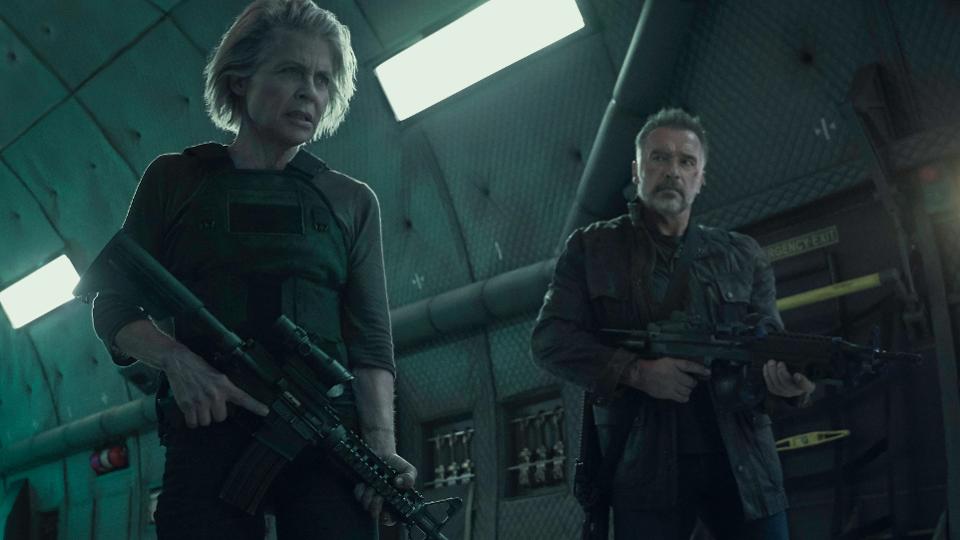
Even re-uniting Hamilton and Arnie couldn’t save this from an (undeserved) Dark Fate
Director: Tim Miller
Cast: Linda Hamilton (Sarah Connor), Arnold Schwarzenegger (Carl), Mackenzie Davis (Grace), Natalia Reyes (Dani Ramos), Gabriel Luna (Rev-9), Diego Boneta (Diego Ramos), Tristan Ulloa (Felipe Gandal)
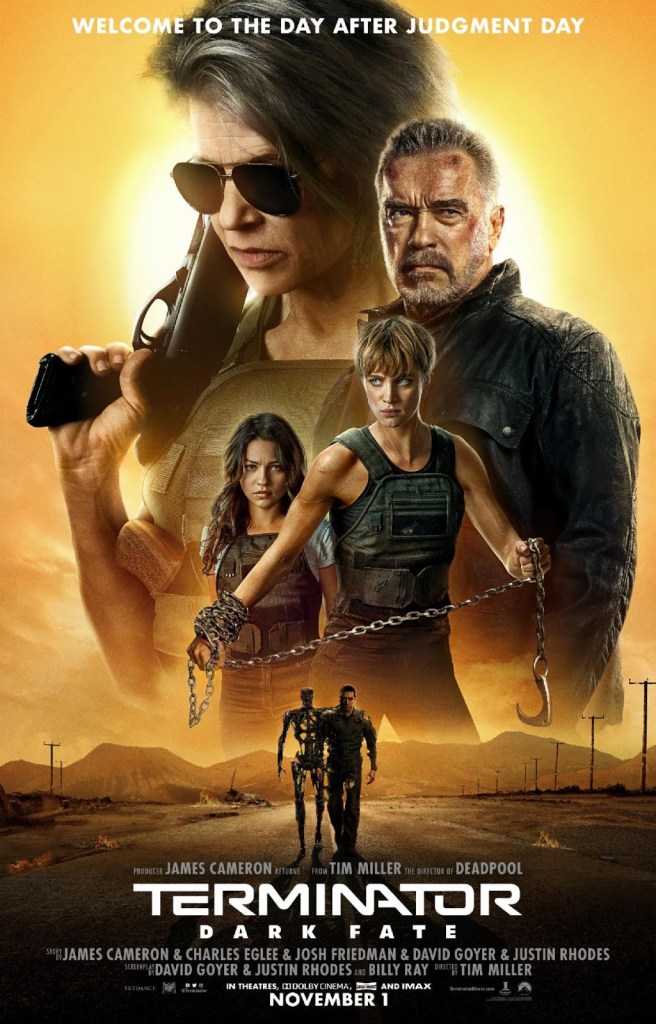
It should have been a hit. The third attempt in the last ten years to restart the Terminator franchise, after no less than two cancelled planned trilogies, this one bought back James Cameron in a producing and story capacity, pulled in Linda Hamilton to return as Sarah Connor for the first time in nearly thirty years and finally seemed to be the “true” Terminator 3. But it bombed anyway, worse than either Salvation or Genysis and finally put paid (probably) once and all for the franchise. How did it come to this?
In 1998 a T-800 Terminator (Arnold Schwarzenegger) – one of a number sent back in time by Skynet before erased from history by our heroes in Terminator 2 – finally succeeds in killing John Connor (a CGI recreation of Edward Furlong from T2), leaving Sarah Connor (Linda Hamilton) distraught. Twenty-two years later and a new artificial intelligence from the future, Legion, has sent back a Terminator (Gabriel Luna) to wipe out a pivotal future figure for the human resistance Dani Ramos (Natalia Reyes), with the resistance once again sending back its own champion Grace (Mackenzie Davis), an artificially enhanced human. The inevitable combat between man and machine is on again, with Grace and Dani joining forces with Sarah Connor, as well as other unexpected allies.
That paragraph probably gives you a sense of what’s good and what’s bad about the film. Starting with a twist that seems to finally try and send the franchise off in a new direction – the eradication of John Connor, the person every film has been about protecting – is a brave decision. The confirmation that eternal enemy Skynet has indeed been erased from history finally changes the enemy. Arnie’s T-800 is confirmed as literally the last in existence – a killer sent from a future that now no longer exists. It looks like we are set for something entirely different.
And then of course we aren’t. Because it seems man’s reach will inevitably exceed his grasp, just as would-be Terminator film producers will always overreach themselves. Even with Skynet gone, there must always be some artificial intelligence super-computer that destroys the future, there must always be some sort of special one who must be protected at all costs, always a hero sent from the future who knows more than they can say and always an Arnie Terminator on hand for good or bad. Just as Genysis tried to re-set the table, but only reminded us what a small world is, this film tries to shake up the pieces but then replaces most of them with like-for-like and throws us into a film that has effectively exactly the same structure as the first two films.
So, after that opening scene twist, we get the arrival and meet up of the two future warriors, a scrap at an everyday setting for her hero, a series of shocked reveals about the future, some gonzo chases (this one does at least up the anti – literally – by setting one of them in a plane), a lull in proceedings while our on-the-run heroes work out whether they can trust each other, then a final smackdown in a factory where self-sacrifice is all the rage. For a film that tries to do something new, it is remarkably conservative and shows that for all the time-travel inspired gymnastics of the universe it operates in, the series is strictly tied to a set number of rules and plot mechanics.
But it’s all really confidently told. That’s almost the tragedy. This is a pretty good film. Easily the third best Terminator film made. I actually pretty enjoyed it. It has a simple narrative drive to it, an old-fashioned world where the characters throw each other about and punch each other really hard into things rather than engage in balletic, choreographed fight scenes. Tim Miller directs the whole thing with a pace and drive and if Cameron feels like he may have only really been happy to attach his name to the whole thing in return for a few story ideas and a paycheque, at least it can boast it has his definite seal of approval.
The acting is also pretty good. Linda Hamilton is a welcome return, getting some fascinating beats of intense drive mixed with deep grief. It’s a great to see an action film like this front-and-centre female characters so much. It’s a shame that this is such a franchise with such a masculine reputation, as this realignment has probably not had the impact it could have had in bringing new people in. Mackenzie Davis is impressive as Grace, Natalie Reyes growing in confidence and strength as the new messiah. Even Arnie gets to do something very different with his T-800 characterisation (after 22 years of living as human, the robot has changed beyond all recognition from the remorseless killer), not least seeing him successfully terminate a target for the first time in the franchise.
It’s just a shame that this energetic re-telling of an old story probably suffered above all from franchise exhaustion. After reboots and restarts from Salvation to Genysis have seen their plotlines, developments and future sequels sent to the scrap heap (certainly the last two) it really seems a case that once bitten, twice bitten makes us not just shy, but running scared. At the end of the day any interest and affection the franchise had from the first two films has been burned up beyond all recognition – and this film, in the end, doesn’t reinvent the wheel enough to encourage you to come back and see what’s different. It’s a shame that this sprightly entertaining film has been terminated not by its future, but by its weary, error-strewn, past.

 Movie Musings