
Tag: Timothy Spall

Enchanted (2007)


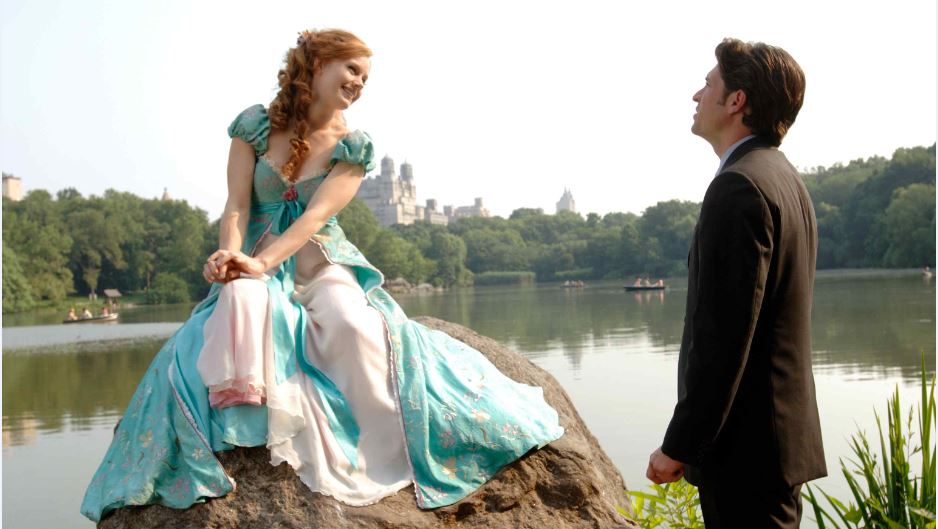
Amy Adams excels as Disney heroine in the real world Giselle in Enchanted

Director: Kevin Lima

Cast: Amy Adams (Giselle), Patrick Dempsey (Robert Philip), James Marsden (Prince Edward), Susan Sarandon (Queen Narissa), Timothy Spall (Nathaniel), Idina Menzel (Nancy Tremaine), Rachel Covey (Morgan Philip)

With Disney devoting themselves full-time to remaking their back catalogue of classics, replacing animation with live actors, it’s nice to be reminded how imaginative combining animation and live actors can actually be. Enchanted is an original story, packed with charm and feel-good warmth – and for my money it’s streets ahead of the production-line remakes churning out of Disney.

In the animated world of Andalasia, Giselle (Amy Adams) is the classic Disney heroine – singing joyfully, talking with animals, all the usual trappings. She falls (instantly, of course) in love with the dashing Prince Edward (James Marsden), but Edward’s cruel step-mother Queen Narissa (Susan Sarandon) is determined to thwart the match so she can retain the crown. On Giselle’s wedding day, Narissa pushes her through a magic well to a place where there are no happy endings: modern day New York. Stuck in the real world, Giselle meets quietly disillusioned family lawyer Robert (Patrick Dempsey) and his 6 year old daughter Morgan – can Giselle adjust to the modern world? Can Edward save her? And will she want to go back?

The star turn is Amy Adams, and she is terrific. This is one of those performances that looks easy, but is in fact extraordinarily difficult. She simultaneously plays a fairytale character in the real world, with a cartoon’s outlook and understanding, but also subtly deepens and enriches this character with real world traits, developing and growing her personality to become someone who feels “real”. She does this without jarring gear changes or sudden swings – and holds both these characterisations together simultaneously. So Giselle’s fundamental personality doesn’t change, while her outlook and understanding changes dramatically. She’s endearing, a wonderful light comedian, and her singing and dancing is terrific. It’s not too much of a jump to say she basically is the movie.

And an enchanting movie it certainly is, one part affectionate recreation of Disney, one part affectionate send-up. Relocating the conventions and style of a Disney movie to the real world allows a lot of fun, as Giselle musters the animals of New York to help her clean (pigeons, rats and flies) or recruits the people of Central Park into an extended song and dance routine while Robert looks on with bemused confusion. It helps that the songs are so well written – Alan Menken and Stephen Schwartz’s tunes are basically classic Disney tunes with a satirical bent, which means it’s perfectly possible to enjoy both for what they are and for the dry commentary they offer on Disney.

In fact that’s why the film works so well: it is so blinking affectionate. There is no cruelty about it and none of the tedious “smarter than thou” referencing of, say, Shrek. Instead it teases Disney, while simultaneously understanding the vast majority of us love these films: that if we had the chance, as Nancy does, we might well jack in the real world for a fairytale. We don’t want “gags for the grown-ups” or dumb film references: if a film concentrates on making itself sincere and engaging, it will engage both adults and children at the same time.

The film really successfully bowls along, full of entertaining charms and gags. In fact the appeal of the fish-out-of-water plotline with Giselle is so effective the sub-plot around the villainous Queen Narissa actually becomes less interesting. While the presence of a villain of this type is a pretty central part of the Disney structure, it never quite comes together here – it feels like something inserted due to the rules of the genre rather than an organic part of the story. Now it is essential there is some peril to propel the story forward, but Narissa just isn’t quite interesting enough (and the final battle with a CGI dragon, while a great recreation of similar moments isn’t really gripping). Fundamentally the emotional and dramatic culmination of the film is Giselle realising what she wants – and it’s this compelling human story that powers the film.

But this is a niggle in a charming and very funny film. Amy Adams is of course the star, but Patrick Dempsey very successfully adds warmth to the “stick-in-the-mud” straight man who flourishes as the film progresses (in a nice touch, he slowly takes on the very singing, dancing, cartooney traits he finds so bemusing in Giselle). James Marsden has huge fun as the gently egomaniacal Prince Edward, providing many of the film’s belly laughs with his unreconstructed fairy-tale hero view of the world.

Enchanted works so well because it’s both a subtle commentary on Disney fairytale films and also a marvellous fairytale itself. With a terrific performance from Amy Adams (how did she not get an Oscar nomination for this?) and some cracking songs, the film is wonderfully entertaining, making some gentle fun of its genre, while also celebrating it. It only wants to entertain and enchant you – and it certainly succeeds.

Love's Labour's Lost (2000)


Shakespeare meets Musicals in Kenneth Branagh’s Love’s Labour’s Lost

Director: Kenneth Branagh

Cast: Alessandro Nivola (King Ferdinand of Navarre), Alicia Silverstone (Princess of France), Kenneth Branagh (Berowne), Natascha McElhone (Rosaline), Carmen Ejogo (Maria), Matthew Lillard (Longaville), Adrian Lester (Dumaine), Emily Mortimer (Katherine), Timothy Spall (Don Armado), Nathan Lane (Costard), Richard Briers (Nathaniel), Geraldine McEwan (Holofernia), Richard Clifford (Boyet), Jimmy Yuill (Constable Dull), Stefania Rocca (Jaquenetta)

Love’s Labour’s Lost is one of Shakespeare’s lesser-known comedies. There is a reason for that – it’s simply not that good (it’s certainly the weakest Shakespeare play Branagh has brought to the screen). I’ve sat through some turgid, and terminally unfunny, stage productions of the play in the past – but this movie version presented something different, as Branagh plays fast and loose with the script and turns it into an all-singing, all-dancing musical, with only the barest sprinkling of Shakespeare dialogue.

LLL isn’t really about anything. The King of Navarre (Alessandro Nivola), invites his three best friends (Kenneth Branagh, Adrian Lester and Matthew Lillard) to join him in three years of academic study, during the course of which they will forsake all female company. Of course, no sooner than the deal is made but the Princess of France (Alicia Silverstone) and her three companions (Natascha McElhone, Emily Mortimer and Carmen Ejogo) arrive in Navarre. Will love blossom to prevent the plans of the King? You betcha.

It’s slight stuff. The play always feels a little bit unfinished – it ends with the lovers separated (or as the play puts it “Jack hath not Jill”) but with hints of hope. It’s oddly structured – more like the first part of a series of plays than a standalone (the lovers don’t get together until almost Act 4, and the men and women spend very little time together). There is a series of dull sub plots revolving around the academics of Navarre, with whole scenes made up of obscure Latin jokes. As the icing on the top, a clown and a foppish Spaniard form a bizarre love triangle with a busty country wench. None of these plots is really resolved at the end. It’s a play that focuses a lot more on floral dialogue and intricate poetry rather than narrative.

Branagh addresses a lot of these problems by simply trimming the play to the absolute bone. I would guess at least 65% of the dialogue has been cut – probably more. Although this means some roles are now so small they feel like sketches (in particular many of the more working-class characters and academics), it does mean that this has a bit more narrative thrust and energy than most productions. Moving the setting to 1939 also gives a good context to the play, and places the political issues into an understandable context. It also gives a tension to underlie the lightness of the rest of the play. Branagh manages to remove most of the cumbersome exposition dialogue by replacing it with a series of 1930s-style cine-news reels (spryly voiced by Branagh himself). He even resolves the “cliffhanger” ending of the play with a similar device (reflecting the tonal shift at the end of the original play), which helps to ground the otherwise lightweight play in a very real world, where war carries a cost.

Of course, the main invention was to replace the intricacy (and obscurity!) of some of the dialogue with song and dance routines. The songs are carefully chosen from the great musical composers of the 1930s and 40s, and are delicately interwoven with the dialogue. Now for the purist this could of course be a source of fury, but when the material is one of the weaker plays, getting this “greatest hits” version of the text alongside some excellent songs works really well.

The song and dance numbers also have a certain charm about them. Most of the cast are not especially talented singers and dancers – only Nathan Lane and Adrian Lester have song and dance experience (and it certainly shows when Branagh allows them to let rip). The actors went through an extensive “musicals boot camp”, which certainly taught them the steps, but the musical numbers still retain a charming amateurishness about them. Sure it helps a truly gifted dancer like Adrian Lester stand out, but it’s also quite sweet to see actors like Richard Briers tripping the light fantastic. (Check Lester out at around 3:10 in the video below).

The real issue with some of the actors chosen is less with their song-and-dance strength, but that their acting strength doesn’t quite cut the mustard. Branagh’s delivery and comic timing is spot on, and McElhone is a worthy adversary cum love interest for him; but Nivola and Silverstone are a little too out-of-their-depth to bring much more than blandness to their key roles. Amongst the supporting roles, Nathan Lane stands out in making Costard actually quite funny, but Lillard mistakes gurning for wit. Mortimer and Ejogo are engaging but have precious little screentime.

The film is shot with Branagh’s usual ambition on a set that has a deliberate air of artificiality about it, evoking the classic 1930s studio musical. All exteriors deliberately feel like interiors, and there are homages aplenty, from Singin’ in the Rain to Ethel Merman. Each musical number has its own unique feel and the majority are shot with Branagh’s usual love of long-take. Some of the numbers stick in the head longer than others – but that’s just the nature of musicals. Particularly good are I Won’t Dance, I Get a Kick Out of You, I’ve Got a Crush on You, Cheek to Cheek and a steamy tango to Let’s Face the Music and Dance.

LLL doesn’t want to do anything more than entertain – and sometimes it probably tries a little too hard to be light and frothy, as if Branagh was consciously kicking back after the mammoth undertaking of his uncut Hamlet. Perhaps that is why LLL appealed to him – Shakespeare comedies don’t get less treasured or more inconsequential than this, so he had total creative freedom to do what he liked, in a way that a Twelfth Night or a Much Ado About Nothing wouldn’t allow him. It’s the sort of film you need to plug into the mindset of – and some aren’t going to be able to do that. It’s not a perfect film, but the lightness Branagh handles things with pretty much carries it through.

Perhaps that lightness however is slightly the problem: in Branagh’s previous films he found a perfect mixture between influential reimaginings (Henry V), wonderful crowd-pleasers (Much Ado) and reverential labours of love (Hamlet). People probably expected something else from him than a high-budget, lightly amateur musical with precious little Shakespeare in it. I think this partly explains the hesitant response this has received from the public and critics since: it’s just such an unlikely ideal that people didn’t seem to know how to respond to it.

Of course, as anyone who has sat through an average production of the play can tell them, they weren’t missing much from what has been cut – and this is still an infectiously funny, frothy concoction. It may have a slightly mixed acting bag – some of the leads are underpowered, while some strong actors like Timothy Spall are underused – but the actors do seem to be enjoying themselves, and this enjoyment basically communicates to the audience. It’s not a concept that could have worked with a long running time, but it sure works for the short term. It’s an odd concept – and it was a huge box office bomb – but it’s one that works.

Denial (2016)


Timothy Spall as Holocaust denier David Irving in this misfiring courtroom drama

Director: Mick Jackson

Cast: Rachel Weisz (Deborah Lipstadt), Tom Wilkinson (Richard Rampton), Timothy Spall (David Irving), Andrew Scott (Anthony Julius), Jack Lowden (James Libson), Caren Pistorius (Laura Tyler), Alex Jennings (Sir Charles Gray), Mark Gatiss (Professor Robert Jan van Pelt), Harriet Walter (Vera Reich), John Sessions (Professor Richard J. Evans)

In 2000, historian David Irving (here played by Timothy Spall) was exposed as a Holocaust denier who forged and distorted historical records to help his pro-Hitler agenda. This came after his unsuccessful attempt to sue American historian Deborah Lipstadt (Rachel Weisz) for accusing him of Holocaust denial in her book Denying the Holocaust. The decision led to the destruction of Irving’s reputation, career and financial wealth. This film tells the story of this case. Lipstadt’s legal team are played by Andrew Scott (solicitor Anthony Julius), and Tom Wilkinson (barrister Richard Rampton). The publicity-hungry Irving famously acted as his own lawyer.

Denial has a fascinating story at its core, but bungles it by getting the focus wrong. Now I’ll admit I might know more about this trial than the regular guy-on-the-street. But the drama here was in the detail of the debunking of Irving’s denier bullshit. The film benches most of this, reducing Irving’s career of historical re-adjustments into a few simple sound bites. The fascination of this trial was the dissection of denier myths – but the film aims for more conventionally “drama”, by introducing a series of “could Irving win?” moments that never ring true. Not only does this detract from the drama – it also, arguably, makes it easier for Holocaust deniers out there to claim the film doesn’t give the appallingIrving a fair crack of the whip.

It’s a shame, as when the focus is on the facts of the case, it’s very good. Tom Wilkinson is excellent as the maverick Rampton, whose abrasiveness hides his humanitarianism. The drama skirts over the trial’s cut and thrust, but when it does tackle these moments it’s very interesting. The sequence where Rampton pins Irving to the floor over theories that the gas chambers were de-lousing stations for dead bodies (“then why are there bolts on the outside of the doors?”) or air raid shelters (“are we to imagine the SS running 2.5 miles from their barracks to a shelter in an air raid?”) are compelling, and far more interesting than anything else in the film. Even the Cliff’s Notes version of Irving and his views in this film is enough to repulse any sane viewer, and watching him skewered on the witness stand is fascinating and satisfying. There just isn’t enough of it.

One of the film’s greatest problems is pushing Lipstadt front and centre. This seems logical on paper but, as her lawyer says, “this trial is happening to you, it’s not about you”. Lipstadt was deliberately not part of the trial strategy, to keep the focus on Irving. But the film can’t accepts her “story” was to do nothing. It keeps wanting to give her a ‘Hollywood moment’, but the facts can’t provide one – so we get lots of scenes of Lipstadt jogging, or feeding her dog, or watching news reports – time that could have been much better spent elsewhere.

Despite this, Weisz’s performance is very good –she bravely makes Lipstadt prickly and hard to like . Similarly, Andrew Scott is excellent as Julius, but his character is poorly explained (“He’s using you for the publicity” Lipstadt is told – we see no indication for this anywhere) and his decision to exclude Holocaust survivors from the witness list to prevent them being harangued by Irving is botchily explained, the film not wanting to admit that this was a wise decision.

I feel a lot of the film ended up on the cutting room floor. Short scenes pop up now and again around paralegal Laura making you feel she must have been a more important character at some point. I feel huge parts of courtroom reconstruction got trimmed. I suspect there was more around Harriet Walter’s Holocaust survivor. Even Irving feels heavily trimmed – Spall is very good (and subtly vile, but with a persuasive old school charm) as the faux-historian, but the film needs more of him, if only to explore his views more, rather than just treating him like a demon.

That sums the film up: it’s ham fisted. Too much dialogue thunkingly introduces historical events or legal procedures. The film talks about the importance of research, but relies on characters “cracking the case” with flashes of inspiration. It handles the research trip at Auschwitz sensitively (and daringly, shows Rampton taking an aggressive questioning stance of the guides to prepare for the case) – but then the film can’t help throwing in Lipstadt imagining victims clawing at the gas chamber door for escape. I hated the final shot, lingering on the disputed holes in the gas chamber roof used to drop in Xyklon-B, as if we needed this to be confident that, yes, the Holocaust did happen.

I really wanted to like Denial, but it’s no more than an adequate dramatisation of a fascinating court case. It’s brilliantly acted, in particular the four principles. There is an interesting film to be made here about the increasing struggle we have with the abuse of free speech to give equal importance to views that are offensive or just plain wrong. But Denial never really becomes that film – instead it turns its fascinating historical event into a run-of-the-mill Hollywood tale of a plucky heroine vanquishing the bad guy.