Tag: Toby Jones

Harry Potter and the Chamber of Secrets (2002)


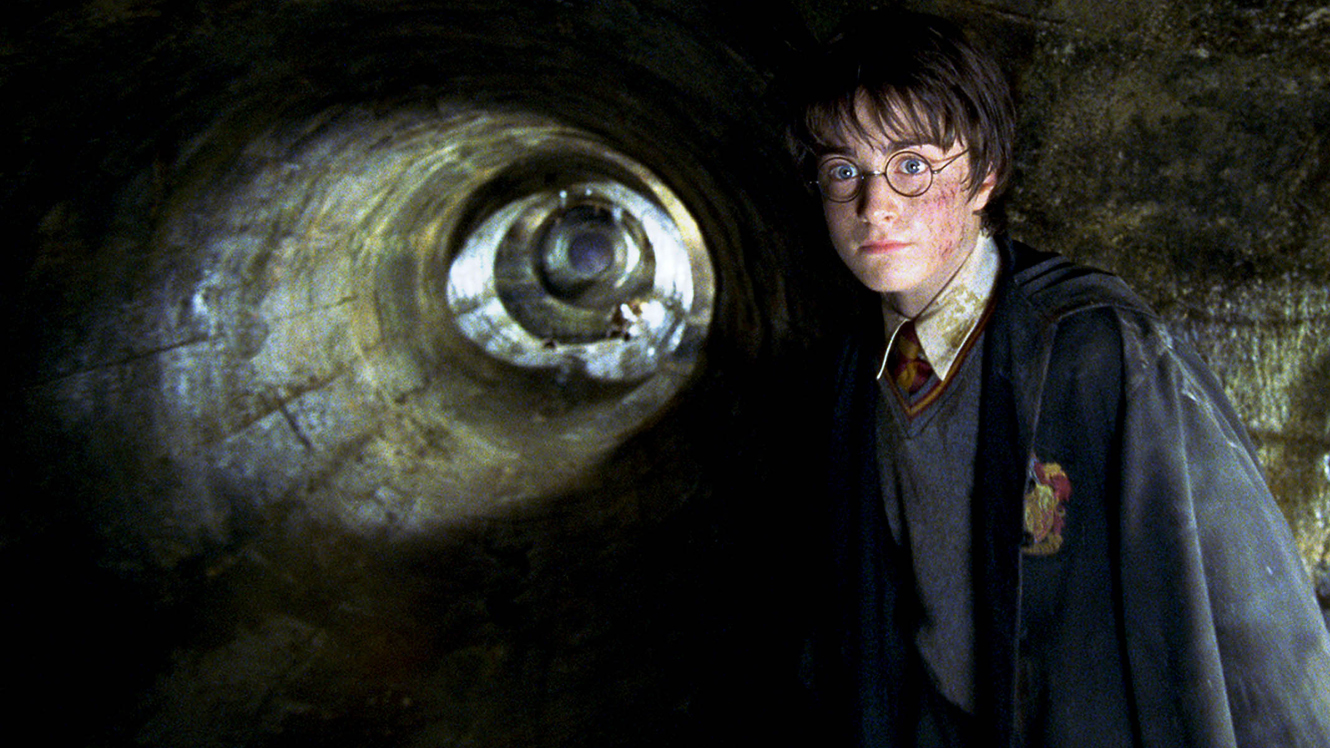
Daniel Radcliffe discovers dark goings on in the bowels of Hogwarts in Harry Potter and the Chamber of Secrets

Director: Chris Columbus

Cast: Daniel Radcliffe (Harry Potter), Rupert Grint (Ron Weasley), Emma Watson (Hermione Granger), Kenneth Branagh (Gilderoy Lockhart), John Cleese (Nearly Headless Nick), Robbie Coltrane (Rubeus Hagrid), Christian Coulson (Tom Riddle), Richard Griffiths (Vernon Dusley), Richard Harris (Albus Dumbledore), Jason Isaacs (Lucius Malfoy), Miriam Margolyes (Professor Snout), Alan Rickman (Severus Snape), Fiona Shaw (Petrunia Dursley), Maggie Smith (Minerva McGonagall), Julie Walters (Molly Weasley), Mark Williams (Arthur Weasley), Tom Felton (Draco Malfoy),  David Bradley (Argus Filch), Toby Jones (Dobby), Gemma Jones (Madam Pomfrey), Robert Hardy (Cornelius Fudge), Matthew Lewis (Neville Longbottom), Julian Glover (Aragog)
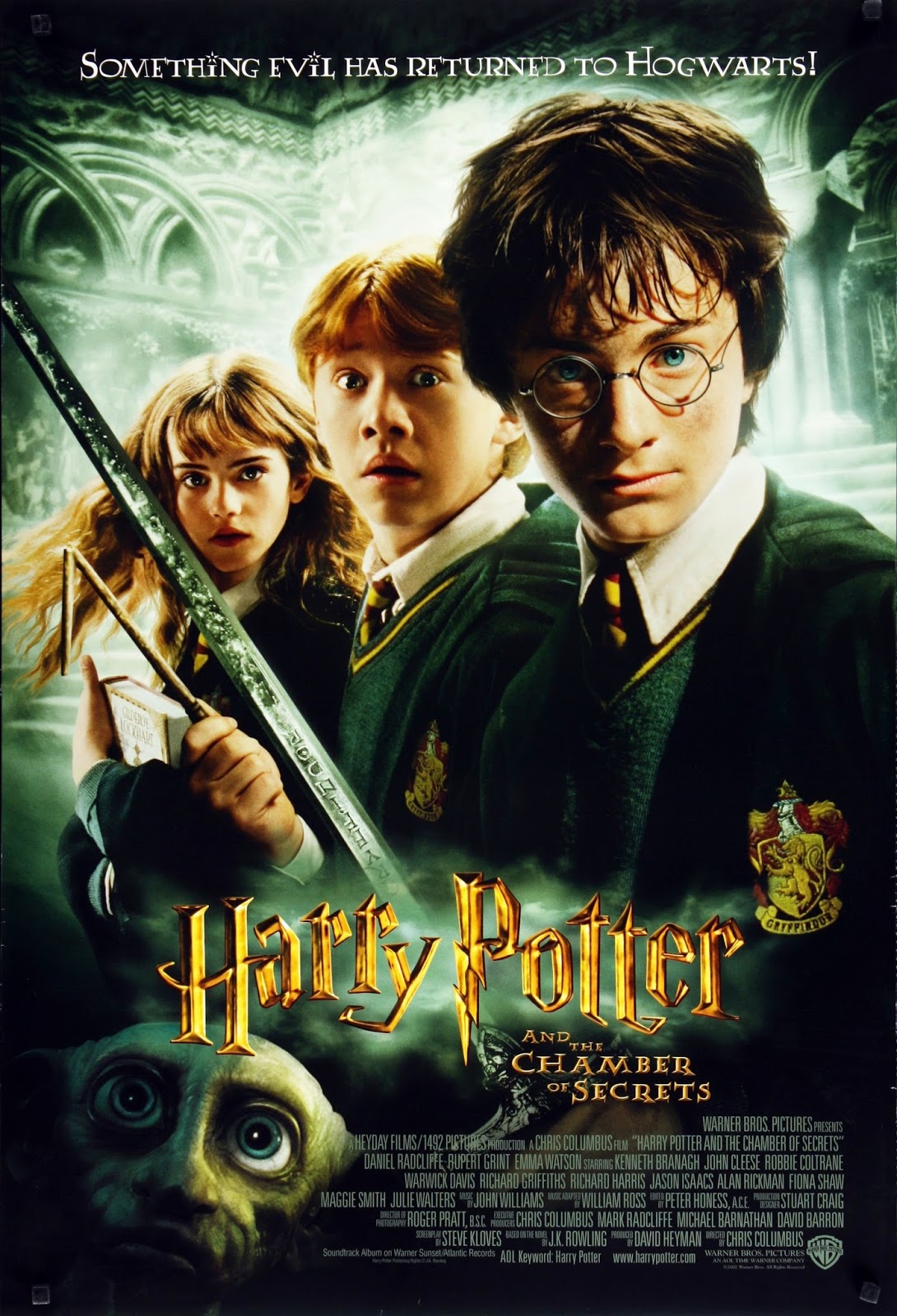
Another movie, and time for another everyday school year for Harry and friends: classes, exams, sports days and saving the entire population of the school from a grisly death. It’s a tough job but someone has to do it right? So welcome to the second Harry Potter film, that mixes the fun of flying cars and tricky elves with giant spiders and ferocious snakes.

Chris Columbus and team went virtually straight from the first film into making this one, and it’s pretty clear they had learned a lot from the last one. Sure, Columbus is still a safe pair of hands rather than an inspired director, but there is a bit more flair from cast and crew here. It also manages to look a lot less like a primary colour explosion or an illustrated version of the book, and more like a piece of film-making. Maybe this can be attributed to new cinematographer Roger Pratt, who gives the film a far more imaginative palette of darks blacks mixed with beautiful core colours (no surprise he returned to shoot Goblet of Fire). In addition, both design and costumes are far more adult and less Dickensian-robey than I remembered (though there’s still a way to go until we get to the steampunk 50s look of Prisoner of Azkaban that would dominate the rest of the films).

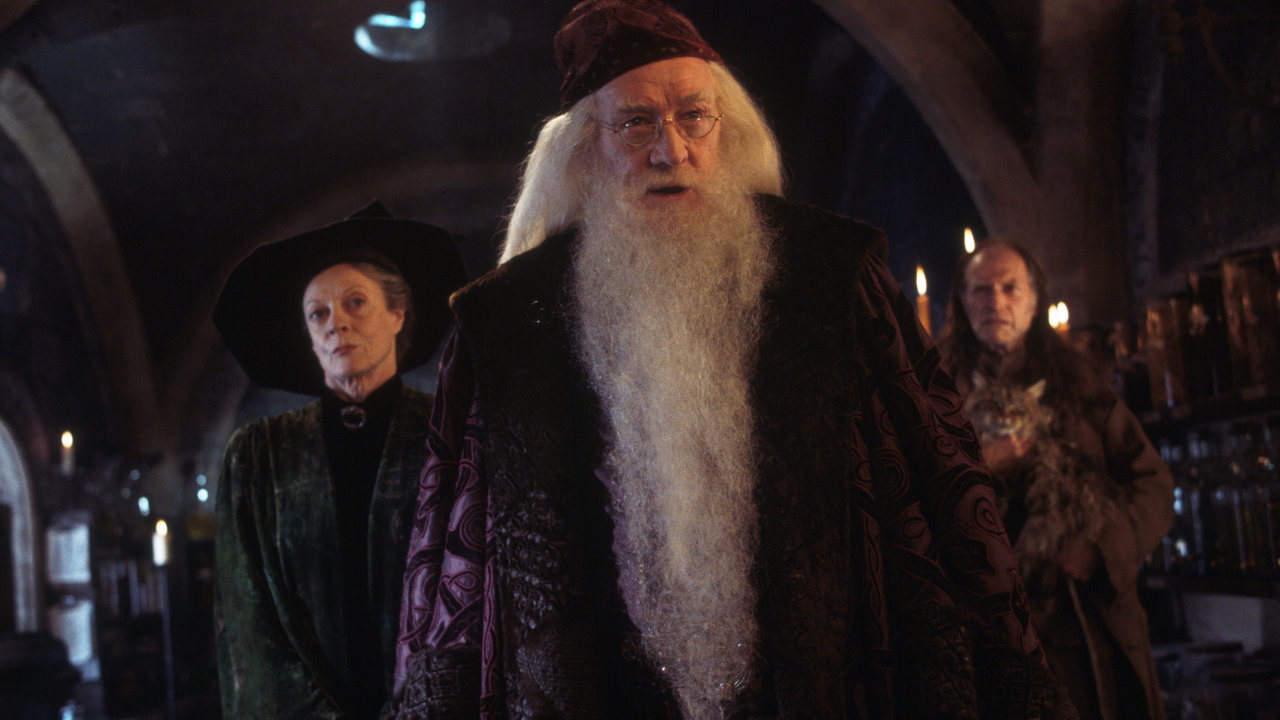
It also helps that the introduction to the wizarding world was covered so well in the first film. In fact, this is the last film where anyone felt it necessary to shoe-horn recaps into the dialogue, reminding us of who (and what) everything is. A particular moment of irritance for me is the first entry of Dumbledore and McGonagall: met with Harry breathlessly saying their names – just in case you were one of those people who didn’t contribute to the $1billion the first film made worldwide, or who hadn’t read any of the books by this point.

Anyway, Columbus got the principles out of the way in the first film so he could focus a bit more on this slightly darker, more developed story (just as Rowling was able to do in the books). The mystery of the Chamber of Secrets is more compelling than that around the Philosopher’s Stone in Potter’s first outing, and this is the film where we properly meet the series antagonist Voldemort – here played with a smarmy, casual cruelty by Christian Coulsen (it’s a shame this didn’t lead to bigger things for Coulsen). Radcliffe gets the chance to get his teeth into a decent final confrontation – and also the series’ first big action set-piece, quite well-shot with a creepy menace – as he takes on a basilisk.

In fact Radcliffe is much stronger in this movie – more relaxed, more confident and embracing Harry’s essential decency and sense of honour (the qualities that are always duller to play as an actor). He’s still struggling a bit at the moments that call for real emotion – but he does very well here indeed. Most importantly, you believe him and everything he does – which is quite something for a child actor to accomplish. 

He gets more depth and range to play with than Rupert Grint who was already being shoehorned into being gurning comic relief. There are few faces Grint isn’t asked to pull in this movie – and get used to that sad-sack downward grin, or the teeth-clench of terror, because these are going to become major weapons in his arsenal. Watson doesn’t actually get a lot in this movie, but even by this point it was becoming clear that she was pretty much a perfect fit for the character. 

The series also confirmed it had great roles for the cream of British acting – and that it was going to be a fine pension plan for most of Equity. Jason Isaacs plays the wicked Lucius Malfoy with relish and a scowling, patrician pride – no wonder he became not only a regular in the series, but one of its champions. He’s very good here indeed, as is other new addition Mark Williams, a perfectly charming shambolic dad as Arthur Weasley.

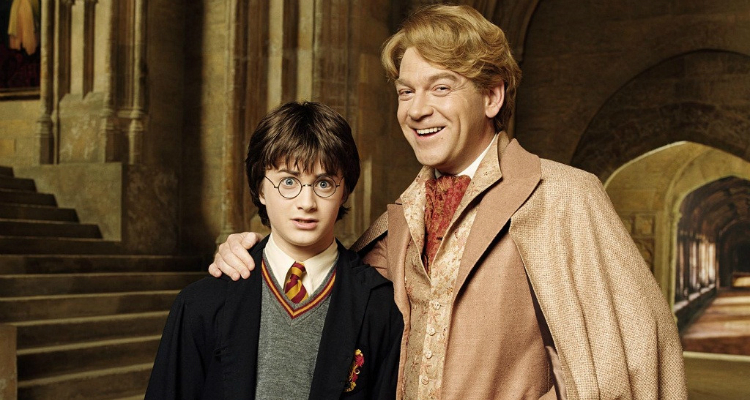
The show however is carried off by Kenneth Branagh as Gilderoy Lockhart. Branagh offers a performance close to of self-parody of his public perception, as a swaggering self-promoter, a preening egotist who can’t help but brag about his (almost non-existent) achievements and accomplishments. Branagh is deliriously funny as Lockhart, not only getting a lion’s share of the best scenes, but also bringing out some delicious comic rebuttals from the rest of the teachers – not least Rickman and Smith – who clearly can’t stand Lockhart. It’s a great performance – cocky, old-Etonianesque, full of surface charm and puffed up pride, but with a nasty selfish mean steak just below the surface.
It all feels part of the generally more free and engaging direction this film takes compared to the first one. Some of the best actors from the first film get relegated in screentime, but it shows the greater confidence the filmmakers have in the kids. The film really begins to introduce the ideas of good vs evil and the principles of friendship, humanity and love that differentiate Harry from Voldemort. Columbus isn’t quite the director to bring all this together into an epic vision, but he is good enough to deal the cards effectively. He gives it enough pace and shine so that we are never bored, though we’re also never wowed.

Despite the increased darkness and greater emotional depth, Columbus never loses track of the sense that he is making a family entertainment. He may still not be able to bring an artistic flourish to events, but he balances the light and dark very well. Not least the fact that the racism under the surface of the wizarding world emerges here. In the first film Voldemort alone was the villain, but in this one we first hear the term “mud blood” bandied about to describe Muggle-borns. We also find out that the wizarding world has its own slave class in elves (given a sometimes irritating Jar-Jar Binks-lite face by Dobby, a character with far more appeal to the kids than the parents). These are complex ideas – and all part of the world becoming richer.
Harry Potter and the Chamber of Secrets is still in the lower tier of Harry Potter films, but it’s a significant step-up from the first film. Visually it’s richer and more interesting. The stakes are higher, the themes deeper and more intriguing. It’s still very much a children’s film, and it still inclines towards being an over-faithful adaptation – it’s a bum-numbing 2 hours and 40 minutes so keen is it to not leave anything out – but this has far stronger material in it than the first film, and is a sure sign that this series was building a foundation it could flourish from.

The Man Who Knew Infinity (2015)


Dev Patel is mathematical genius Srinivasas Ramanujan, struggling against prejudice in The Man Who Knew Infinity

Director: Matthew Brown

Cast: Dev Patel (Srinivasas Ramanujan), Jeremy Irons (GH Hardy), Devika Bhise (Janaki), Toby Jones (John Edensor Littlewood), Stephen Fry (Sir Francis Spring), Jeremy Northam (Bertrand Russell), Kevin McNally (Percy MacMahon), Richard Johnson (Vice Master Henry Jackson), Anthony Calf (Howard), Padraic Delaney (Beglan), Shazad Latif (Chandra Mahalanobis)

The British Empire. It’s a difficult slice of British history, and it undoubtedly contributed to contemporary attitudes of superiority that affected British people and their institutions. It’s these attitudes that form the central themes of The Man Who Knew Infinity, an effective story of a struggle against the odds. 

In the early 1900s, Srinivasas Ramanujan (Dev Patel) works in Madras as a junior accountant – but his superiors quickly realise his mathematical abilities far outstrip his mundane tasks, and encourage him to write to mathematics professors to bring his theoretical work to their attention. Ramanujan starts a correspondence with GH Hardy (Jeremy Irons) of Trinity College, Cambridge, who invites him to England to explore his potential. Once there, Ramanujan quickly proves his genius but, despite Hardy’s support, he struggles to be accepted by the fellows and students of the college, who only see an upstart from the colonies.

The Man Who Knew Infinity is a conventionally structured biography – struggles personal and professional, success followed by setback and a final triumph combined with a bittersweet ending. It’s structurally nothing different from things you’ve seen before, but it’s told with calm, quiet, engrossing dedication, with unflashy direction, a solidly written script and some truly excellent acting. No wheel is reinvented, but it revolves with a highly enjoyable and heartfelt tenderness.

It’s a film that manages to present mathematics without using spurious real-world clunky metaphors, and gets a lovely feel for the hard work and theoretical study that go into mathematical theory. It also brilliantly communicates what the maths is about. I’m no theoretical mathematician (football stats are my limit) but even I could follow (just) why Ramanujan’s insights were so important and what they meant to the field of theoretical mathematics. The film has a real feel, not only for rhythms of academic work, but also the politics of academia (which needless to say are labyrinthine).

But the film’s main point is the resentment and outright racism Ramanujan must overcome. Played by Dev Patel with a quiet decency and modesty that only rarely bubbles over into bitterness, Ramanujan is constantly hit with everything from misunderstanding to contempt. His every achievement is met by questioning and doubt. His proofs must be demonstrated time and time again. To win the support and respect of his peers, he must constantly revise and revise his work, while the slightest slip is held up as proof his fraudulence or luck. 

If you do want to criticise the presentation of this, you could say that much of the campaigning and struggle for acceptance is championed by the establishment figure of Hardy – it’s he who does most to convert others, and who presents Ramanujan’s key theories to the Royal Society at the end. Stressing Ramanujan’s politeness and humbleness does have the downside of making him a slight passenger at times in his own movie.

But then it’s not just his movie, because this is a story of a deep, near romantic, bond that forms between the gentle Ramanujan and the shy and sensitive Hardy. Hardy, the film implies, was a man uncomfortable with emotional closeness, but he feels a huge bond with Ramanujan, having overcome similar class-based prejudice. The two men have a natural understanding, and support each other, finding themselves in perfect sync in their opinions on mathematics and their outlooks on life. In the nature of the British, nothing is ever said – but it’s clear that both men feel an intense personal connection that, quite possibly in Hardy’s case, mixes with a suppressed romantic yearning.


This relationship largely works so well because Jeremy Irons is quite simply fantastic as Hardy. Cast so often as superior types, here he gets to flex other parts of his arsenal as someone shy, timid, and sensitive. Hardy is so uncomfortable with personal friendships, he can rarely bring himself to look directly at other people. Irons sits on the edges of frames, or hunches and shrinks, his eyes permanently cast down. Saying that, he brings out the inner steel and determination in Hardy, his devotion as an advocate for Ramanujan. Irons is so shyly withdrawn, that the moments he allows emotional openness with Ramanujan, and most movingly with fellow mathematician Littlewood (played with a kindly good nature by Toby Jones), are wonderfully affecting. This might be one of Irons’ finest performances in his career.

The Man Who Knew Infinity is in many ways a conventional film, but performances like Irons’ lift it into something a little bit special. It’s a well-meaning and heartfelt film that embraces some fascinating concepts and also presents a story of triumph against adversity that feels genuinely moving and engaging. Filmically and narratively it’s very much by-numbers at times – but it hits those numbers so well, you’ll certainly have no complaints.

Sex & Drugs & Rock & Roll (2010)


Andy Serkis and Bill Milner recreate the 1970s in this mixed bag Ian Dury biography

Director: Mat Whitecross

Cast: Andy Serkis (Ian Dury), Bill Milner (Baxter Dury), Naomie Harris (Denise), Ray Winstone (Bill Dury), Olivia Williams (Betty Dury), Noel Clarke (Desmond), Toby Jones (Hargreaves), Ralph Ineson (The Sulphate Strangler), Mackenzie Crook (Russell Hardy), Michael Maloney (Graham), Luke Evans (Clive Richard), Tom Hughes (Chaz Jankel), Arthur Darvill (Mick Gallagher)

Ian Dury, one of the leading new wave British musicians of the late 70s, has his life brought to the screen in an eclectic and inconsistent film with flashes with genius. The film covers Dury’s life, from his early polio to initial success and later revitalisation. Front and centre is the effect disability has on Dury’s life, and the relationship with his son, wife and girlfriend.

The film’s main claim to fame is Andy Serkis’ brilliant performance as Dury. The role is a perfect match for Serkis’ vocal range and physicality. As a reconstruction of Dury’s style and manner it is triumphantly perfect (he has a standing invitation from the Blockheads to tour with them as Dury). What Serkis does really well here though is to delve into the heart and mind of Dury, to bring out the emotional confusion, pain and mixed desires within him – to believably present someone confusingly in love with two people, but causing both of them great pain. A man who can idolise the relationship his late father had with him, but confusingly repeat many of the mistakes of his isolated later childhood with his own children. Serkis burns up the screen, and motors the film – he’s the heart, the lungs and most of the brain as well.

It needs this ­tour-de-force of committed resurrection from Serkis, boiling with righteous indignation and cheeky charm, as the film itself is a little uninteresting to anyone not already into this era of British pop. In fact, I’d go so far as saying some initial study of Dury is pretty much essential to understand what is going on – and above all to understand the impact of various moments on the wider world. The film is rather confused in explaining the impact of this band on the cultural scene, and tends to fly too quickly over events.

It’s also stylistically an odd film. It starts with a fantastic device of Dury presenting the film like a compere at a surreal lecture, or music gig. Filmed in a concert hall, Dury runs through the events and even drags onto stage at times, like props or exhibits, moments from his past. It’s a rather avant garde idea, returned to only sporadically throughout – I suspect limited access to the filming location may have had something to do with it – but it sets up an expectation of a film that will be a bit more thematically and structurally daring than it eventually becomes. The film has a scattergun range of filmic styles, from animation to surrealist recreation, as if the director had a host of ideas about how to make the film, and threw them all in, rather than make something tonally consistent.

Away from the stylistic flourishes, you are constantly reminded that this film follows a pretty familiar series of music biog tropes: the early struggles, the success, the drugs, the loss of form, the triumphant return. The film does mine some interesting material from the relationship between Dury father and son, but even this is fundamentally a “Dad and Lad” story we have seen before.

So what makes the film stand out is the performances. Naomi Harris is heartfelt and sweet as Dury’s lover, while Olivia Williams is excellent as his understanding, undervalued wife. There are decent supporting turns from the rest of the cast, while Bill Milner underlines his promise as a performer with an intelligent turn as a son pushed into being a rebel.

It’s a decent rock biography, but depends too much on you already knowing the story – and forgiving the fact that it’s not nearly as different from other films as it likes to think it is.

Anthropoid (2016)


Jamie Dornan and Cillian Murphy plan to remove The Butcher of Prague

Director: Sean Ellis

Cast: Cillian Murphy (Jozef Gabčík), Jamie Dornan (Jan Kubiš), Anna Geislerová (Lenka Fafková), Harry Lloyd (Adolf Opálka), Toby Jones (Jan Zelenka-Hajský), Charlotte Le Bon (Marie Kovárníková), Alena Mihulová (Mrs Moravcová), Bill Milner (Ata Moravec), Vaclav Neuzil (Josef Valcik), Andrej Polak (Jaroslav Svarc), Sam Keeley (Josef Bublík)

Reinhard Heydrich, Head of the SD, Reichs-Protector of Bohemia and Bavaria (the new German name for Czechoslovakia) and the architect of the Final Solution, was the only leader of the Nazi party to be assassinated by Allied forces during the Second World War. In revenge for his death, German soldiers destroyed the town of Lodz, executing the entire adult male population and sending the rest of the population to concentration camps. The reprisals eventually numbered over 5,000 people.

This film covers the build-up and planning of the assassination (code-named Operation Anthropoid), the assassination itself and the eventual fates of the assassins. It begins with Jozef Gabčík (Cillian Murphy) and Jan Kubiš (Jamie Dornan) parachuting into Czechoslovakia, with orders to plan and execute the assassination of Heydrich. With the assassination at the half way point of the film, the second half then focuses on the immediate aftermath and the fates of those involved.

Anthropoid was a box-office disappointment when released. Personally I think a large part of this was connected to its terrible title. Anthropoidis a word that means nothing to people watching and gives you no idea what the film is about – it sounds more like a sci-fi film than anything else. It’s also a film without big-name stars, with a fantastically downer ending, and about an event many people have not heard of. It’s a shame though, as this deserved an audience.

It’s a tense, tightly structured film, sharply directed, that has events as its primary momentum over character. The characters in the film are primarily defined by their purpose within the plot. Saying that, there is scope allowed for characterisation. Cillian Murphy’s Gabčík begins the film as a man who believes himself willing to sacrifice anything for the cause. However, when the losses begin to happen, he is the man who most quickly succumbs to anger and sentiment. Conversely Jamie Dornan’s Kubiš begins as hesitant about the taking of lives, but becomes the most effective soldier among the group.

The film is actually fairly even-handed in its portrayal of the resistance members, not afraid of showing that they were not always a unified group willingly sharing a purpose. Many of the members of the resistance are hesitant about the effect the plan will have on their already decimated ranks. Others, such as Harry Lloyd’s Opálka seem almost obsessively dedicated to their duties as soldiers, at the expense of any other considerations. Even the eventual traitor is shown to be motivated at least partly by fear for the fate of his family. Similarly the film is not afraid to show the somewhat haphazard planning of the assassination, or its bungled execution (expertly reconstructed).

There is a definite mood shift after the assassination. If the first half of the film is a subdued men-on-a-mission tale, the second half is a brutal depiction of the onslaught of retribution. Ellis’ direction is crisp, taught and unflinchingly truthful, recording the actions of the police state with honesty and no sensationalism – from doors kicked in to some brutal torture scenes (the torture of one character in particular is tough to watch, without ever being graphic). The final stand of the assassins in the church is similarly brilliantly filmed and difficult to watch, a blazingly tight and bloody display of gunplay and violence, in which doomed men determine to take as many of the enemy down with them as they can.

However, as it goes on, I think the film becomes so seduced by the courage and bravery of its characters, that it stops questioning the value of their actions. From the start, many members of the Czech resistance are shown to question the worth of the plan when balanced against likely reprisals. This is an issue the film loses sight of in its second half. It is not completely surprising, considering the immense bravery of the assassins during their final stand, that the film doesn’t wish to undermine this by probing the reasoning behind their actions. But it’s a point that needs to be made and the film, in the end, dodges it: was killing Heydrich worth sacrificing 5,000 innocent Czechs in return? I’d argue probably not. The allies at the time certainly decided it wasn’t – no other attempt would be made to assassinate a leading Nazi during the war – and the question needed to be asked more in  this film. Killing Heydrich didn’t stop anything he had set in motion and had little overall impact on the outcome of the war.

Instead the film ends on a note of optimism, stressing Heydrich’s vileness and the fact that the successful assassination made the Czechs more recognised as members of the Allies. It is understandable, considering the tragic ending of the film, that its makers didn’t want to end with any doubt about the righteousness or value of their actions. And there is no doubt that Heydrich deserved his fate. But the film avoids truly addressing the collateral damage to the Czech population. It’s a single question mark over other an otherwise gripping and tense dramatisation.