Tag: Toby Kebbell

Control (2007)

Sam Riley excels in this heartbreak life story of Ian Curtis

Director: Anton Corbijn

Cast: Sam Riley (Ian Curtis), Samantha Morton (Deborah Curtis), Alexandra Maria Lara (Annik Honoré), Joe Anderson (Peter Hook), Toby Kebbell (Rob Gretton), Craig Parkinson (Tony Wilson), James Anthony Pearson (Bernard Sumner), Harry Treadaway (Stephen Morris), Andrew Sheridan (Terry Mason), Matthew McNulty (Nick Jackson)
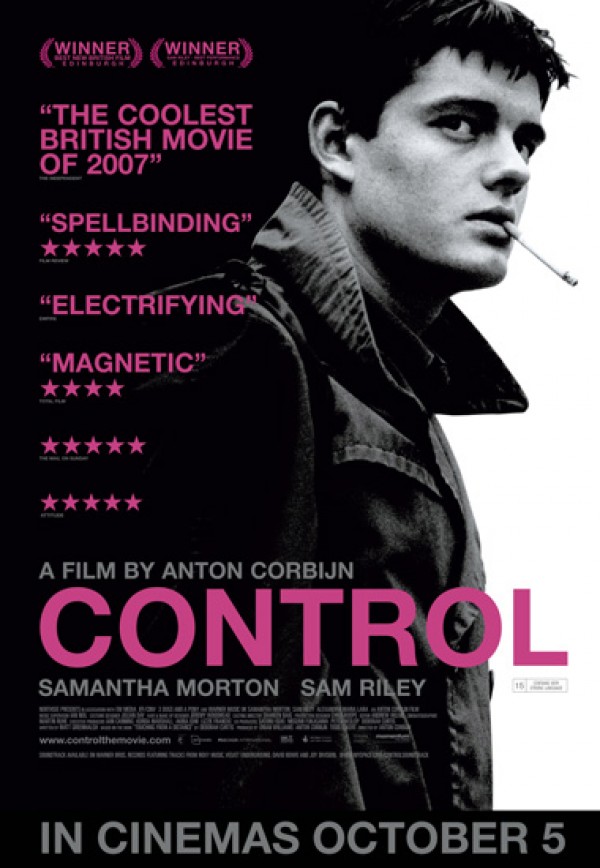
Depression is no respecter of fame or success. You can have everything many people would give their right arm for, and still find the prospect of life overwhelming. Control is a heartfelt, deeply affecting film about Joy Division lead singer Ian Curtis, who committed suicide shortly before a career-changing tour of America. Anton Corbijn knew Curtis and the band personally, and his deep connection with this story is obvious in every frame of this beautifully shot film.

In 1975, fresh out of school, Ian Curtis (Sam Riley) marries Deborah Woodruff (Samantha Morton). Curtis is a would-be poet, but finds his interest piqued when he attends a gig by the Sex Pistols and quickly forms a band – Joy Division – with a group of friends. Powered by Curtis’ imaginative lyrics, the group starts to make a name for itself, taking on a manager Rob Gretton (Toby Kebbell) and winning the attention of the influential Tony Wilson (Craig Parkinson). However, all is not well with Curtis: beginning to suffer increasingly from epilepsy, Curtis is also falling in love with a young Belgian journalist Annik Honoré (Alexandra Maria Lara) while still in love with – although increasingly lacking in mutual understanding with – Deborah. These pressures slowly build up on Curtis.

Control is a film about a person’s longing to have security and a sense of mastery over their own life, but finding they lack both this and the emotional strength to deal with the consequences. Curtis is a man buffeted by competing pressures and desires, as well as a paralysing fear that epilepsy will eventually claim his life. He is frequently unable to relax, and tries his utmost to divorce himself from the reality of his situation by living as much as he can in the moment, ignoring until it is impossible the burdens of making choices about his life and relationships.

Living in the moment is what, for Curtis, makes it all possible. You can see it in reflection in his performances of Joy Division songs – the intense focus, mixed with the channelling of his own epileptic fits into a series of mesmeric on-stage dances, filled with wild and jerky movements. The entire film suggests much of Curtis’ output could be retrospectively seen as a cry for help, many of his lyrics about concerns that would eventually lead to him taking his own life. At one point, Curtis sings heartbreakingly of his isolation in a recording studio booth – with Corbijn cutting straight to the rest of the band and studio technicians talking and going about their business in the studio, oblivious to the underlying desperation that runs through it.

Because the film makes clear no one knew how to help Curtis or even how to identify his problem. To his manager and the band, its all part of the rough and tumble of rock ‘n’ roll. To his studio, it’s the artistic personality. Doctors seem to barely understand how to treat his epilepsy and miss all the signs of the personal stress it places on him. Neither his wife nor girlfriend can imagine that his guilt and self-loathing run as deep as they do. 

Corbijn’s beautifully evocative black and white photography adds hugely to this sense of dream-like non-reality around Curtis’ life, against the backdrop of some beautifully rendered Macclesfield locations. It helps wonderfully capture the sense of Curtis’ life somehow never coming fully into colour, as well as adding a deeply affecting air of melancholy over every frame. It’s also perfect for capturing the atmosphere of the 1970s clubs and bars that the band experienced.

The photography gives the film a feeling of the classic kitchen-sink dramas of the 1960s, and that is no bad thing, adding a certain depth to the tragedy of a working-class lad swept up by success and largely unable to cope with the burdens of expectation. Curtis is shown to be constantly overwhelmed by the pressure of live performance and the expectations of fans and viewers, yet also desperate to continue to have this channel to express himself.

Corbijn doesn’t give him a free pass though, and shows how he deliberately distanced himself from Deborah and their child. Often silent and disengaged, with a glazed look of a man who would rather be anywhere else than having to support a wife and child before he was 20, Curtis and Deborah’s marriage is one of affection but no shared interests of outlook. Deborah clearly provides Curtis with no kindred-spirit feeling, but he uses her as an emotional prop. Simultaneously he uses Annik for the same, while conducting an affair that clearly gives him a deep sense of shame, but finds impossible to resist. It’s living in the moment again: clearly, at every point, he would rather forget the other woman altogether, and is incapable of making the final life-altering decision needed.

This balance works so well because Sam Riley is astonishingly good as Curtis – real, pained, gentle, tender, selfish, with eyes that seem to have the life and will to go on drain out of them as the film goes on. Riley’s performance is pitch-perfect, and his empathetic brilliance for this man who did not know how to express his own feelings clearly is deeply moving. Over the film you see a sensitive man slowly fall apart in self-loathing, feeling trapped in his own life and unable to break free.

The film is stuffed with excellent performances, with Samantha Morton very good as Curtis’ deeply caring wife who unwittingly smothers him with demands – demands that are more than fair considering she is left frequently to hold the baby while her husband disappears for days on end. Alexandra Maria Lara has less to work with, but does a lot with Annik. Toby Kebbell provides some much needed lightness as Joy Divison’s manager, a blistering, foul-mouthed force of nature who can’t even begin to entertain the idea that his lead singer might consider ending his life.

The final sequence of the film, as Curtis (off camera) decides to follow-through on committing suicide (his second attempt to do so, another clear sign of those around him being totally unable to respond to the signals) is unbearably sad, ending with a beautifully evocative, tear-inducing shot of the crematorium releasing its ash – the last vestige of this lost life – into the sky to drift and disperse freely in a way Curtis never could. Control is a modern classic of British realism and possibly one of the finest music biopics ever made. Corbijn has the soul and eye of an artist, and brings all this to bear on a deeply heartfelt and moving film.

Destroyer (2018)

Nicole Kidman goes way-against-type as a bend the rules cop in Destroyer

Director: Karyn Kusama

Cast: Nicole Kidman (Detective Erin Bell), Sebastian Stan (Chris), Toby Kebbell (Silas), Tatiana Maslany (Petra), Bradley Whitford (DiFranco), Jade Pettyjohn (Shelby Bell), Scoot McNairy (Ethan), Toby Huss (Gil Lawson)

There are few things that pique the interest of reviewers and viewers more than a celebrated Hollywood star going well against type, looking rough, playing tough and letting those shades of grey flow freely. That’s the cheap interest in Destroyer, Karyn Kusama’s engaging, well-made thriller which showcases the sort of way-against-type performance by Nicole Kidman that practically demands the poster scream “Kidman as you’ve never seen her before!”. Of course this all serves to obscure that Kidman is a damn fine actress and a committed performer, and she gives it everything in this grimy, underworld thriller of compromised cops and ruthless robbers.

Erin Bell (Nicole Kidman) is a detective with a shady past: an undercover operation with an FBI Agent Chris (Sebastian Stan) which went wrong 15 years ago. In the present day, the body of a John Doe in Los Angeles opens up links to this case from the past, causing Erin to start a rogue investigation into her old undercover days and the gang members she knew back in the day, specifically her long-held grudge against the psychopathic Silas (Toby Kebbell).

Destroyer gives us a familiar story – the cop with the dodgy past, gone to seed, playing against the rules, tired of life, with a shattered family background, investigating what could be one last case that has devastating links to the past – but presents it from a slightly new angle by making the protagonist a woman. This calls for a terrific performance from Nicole Kidman, who is bashed up, run down, grouchy, seedy and above all immensely damaged. Kidman’s skill at a performer is evident in every scene, creating a character who cannot escape from the burdens of her past, who rejects all help and who is unable to live with the burden of some sort of unspecified guilt.

Much has been made of Kidman’s roughed up, broken nosed, run down, alcoholic appearance (the film gets a lot of mileage over close ups of her ravaged, aged, alcoholic’s hands), but her commitment to the role transcends any deliberate slumming. She is completely believable as the sort of rough-and-tumble, rule breaking cop. The make-up also means that the flashback scenes to a 15-years younger Erin are immediately clear – and give us a clear indication of how far she has fallen since her more hopeful days.

The film is all about the burden of the past, and the film constantly flashes back and forth between the present day and Erin’s time undercover. The film carefully and slowly unveils the exact reasons for Erin’s guilt and why she has become the person she is, but the burden of it hangs over every scene in the present and is visible in Kidman’s eyes in every scene. It brings these themes to life extremely well and weaves an engaging story, even if everything in it seems like a collection of familiar events from other films.

In fact that is the film’s biggest weakness, right there. Many of the events, characters and themes in it feel like they have been plucked from a range of noir thrillers, thrown up into the air, and then reassembled into a new patchwork. As impressive as Kidman’s character is, it’s familiar to us from any number of hard-boiled cops past. The film’s structure – of Kidman going from contact to contact to get closer to Silas – basically allows for a series of actors to give performances that, for all their skill, end up feeling like a random collection of stock characters. None more so than Silas himself who, despite Toby Kebbell’s best efforts, is a totally forgettable rent-a-psycho. But then you can say the same for Tatiana Maslany’s aged junkie and, for all his slimy excellence in the role, Bradley Whitford’s sleazy money launderer. Other characters feel the same as well, from Kidman’s troubled teenage daughter, her would-be gangster boyfriend, Erin’s put upon ex-partner or her wearily understanding partner. These people all seem, to various degrees, to be stock caricatures rather than characters.

What really makes the film work is the dynamic, often hand-held, kinetic energy of Karyn Kusama’s direction. Jittery, immediate and very real, Kusama makes a number of these stock situations – from shoot outs to roughing up suspects – look at least new and exciting. The two main shoot outs in the film are extremely excitingly done and make for gripping set pieces, with the added originality of seeing the main players being women. 

But the film itself is just a little too obvious and stock for it to really stand by itself, for all the quality of the direction and the excellence of Kidman. There are some moments that work brilliantly with the unexpected twist of having a woman in the lead role and seeing Kidman throw herself into a gunfight with a heat-packing disregard for her own safety is all the more electric for it. But it’s still a little too predictable and familiar – for all the fact that there is a decent semi-twist towards the end that reveals not all is as we thought at the start – which perhaps doesn’t make it a film for all time.

Kong: Skull Island (2017)


The ape headlines and all other parts of the movie get crushed in Kong: Skull Island

Director: Jordan Vogt-Roberts

Cast: Tom Hiddleston (James Conrad), Samuel L. Jackson (Colonel Preston Packard), John Goodman (Bill Randa), Brie Larson (Mason Weaver), John C Reilly (Hank Marlow), Corey Hawkins (Houston Brooks), Toby Kebbell (Major Jack Chapman), John Ortiz (Victor Nieves), Jing Tian (San Lin), Jason Mitchell (Glenn Mills), Shea Whigham (Earl Cole), Thomas Mann (Reg Slivko), Richard Jenkins (Senator Al Willis)

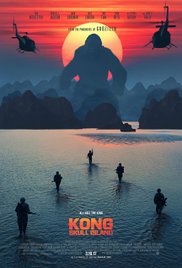
Kong: Skull Islandis another attempt to kickstart a monster franchise (rumours abound that eventually Kong and Godzilla duke it out. I’d start worrying about all those major landmarks.). So anyway, Kong: Skull Island sees a team of explorers head towards the mysterious Skull Island to… well to poke around I think. Actually the aims of the expedition rarely trouble the screenwriters so they shouldn’t trouble us. Anyway, Kong (larger than ever) is deeply pissed at this invasion of his territory so trashes every helicopter going. Our heroes are stranded on the island, while their incursion releases numerous monsters who endanger the whole world that only Kong can stop.

This pretty feeble film is a crumby repackage of numerous (much better) films – and yet another example of a generation of film-makers producing films whose only points of reference are older, better movies. This one plays like Apocalypse Now humped by King Kong. Perhaps one day we’ll actually get some truly original, distinctive films that make their own points rather than reworking others. And perhaps we’ll still get genre films that actually are interested in character and development, rather than bashing and blowing things up.

Anyway, the human characters are almost completely pointless in this B-movie retread. I was wondering how they persuaded such an illustrious cast of actors to come on board. This mystery was solved when I watched a remarkably bland DVD-feature – Tom Hiddleston’s video diary. This was basically shots of Hiddleston talking about having a great couple of weeks in Hawaii flying in helicopters, four weeks sunning himself in Australia and three weeks of travelling down a Vietnamese river. And he got paid millions of dollars to do it. No wonder he ends the video saying he’d recommend this life to anyone.

It certainly wasn’t the character that lured him in. Conrad is interesting for precisely one scene – as a troubled drunk in the bar – before he reverts into clean shaven, upright and heroic. His vaunted skills as a tracker are never used. His set-up as the natural survivor and leader never comes to fruition. His relationship with Brie Larson is based solely on them being the two most attractive members of the cast. As for Larson: has an Oscar-winning actress ever followed up her win with such a truly pointless, empty, non-part? 

The film is completely uninterested in human beings – it can’t even bother to make those that buy it early in the film distinctive individuals. Even the ones left at the end barely pass as people we know. Only John C Reilly crafts a truly engaging character as a sort of Ben Gunn figure. Samuel L Jackson gets the “soldier maddened by war” so that we have the typical “the real danger is man” sub-plot, but everything is by the numbers. The characters are so mix-and-match that you feel no peril at any point. It’s so cynical that it can even drop in a Chinese scientist from nowhere (who does nothing at all in the film) solely to try and sell the film to that market.

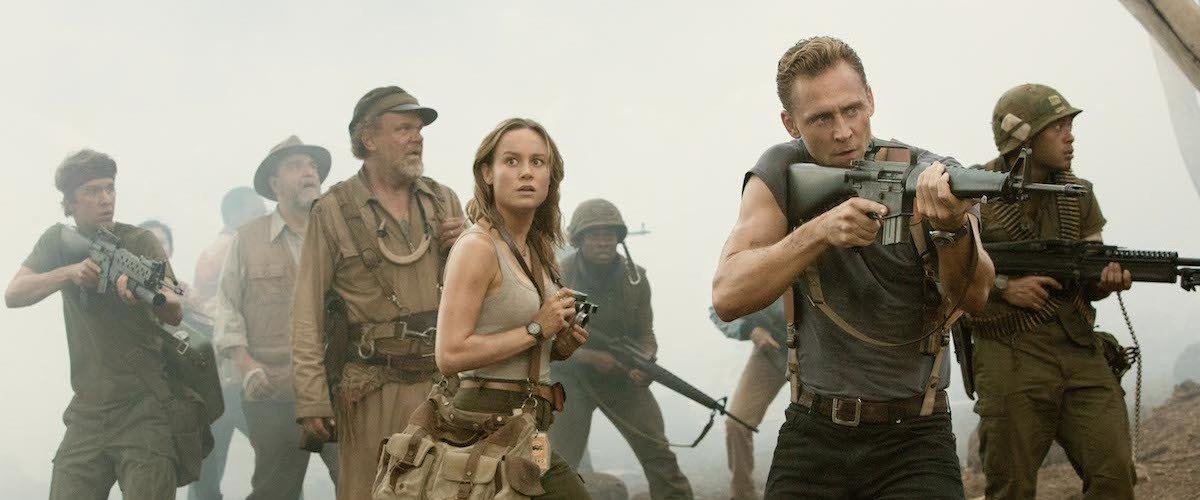
Our nominal heroes: most of them I’ve already forgotten

Kong is the real focus of the movie – and there is limited interest you can get out of a gigantic ape bashing and ripping things apart. Protracted battles go on and on and on. You really see the difference between the work of Andy Serkis and Peter Jackson in their Kong movie and this one. That Kong actually felt like a character you could bond with. This is just the wet-dream of a boy who grew up watching too many Harryhausen pictures, a behemoth who everyone stares at with wonder but whom the audience never feels any emotional investment in. And for all the faults of Jackson’s Kong, it was a film with brains, with heart, made with artistry and which understood character and emotion give meaning to spectacle, rather than being dull speed bumps a film needs to get over.

The film aims sometimes for an Apocalypse Now-style dread of humanity and the madness of war etc. etc. – but nearly always misses. The humans (and their aims) are such non-event blanks that we can’t care less about the danger of humanity. The film itself has none of the poetry of Apocalypse Now, and instead just wants a lot of (PG rated) violence and a bit of madness. Some of the madness even seems a bit uncomfortable – a tribe of natives are treated as humble exotics. It’s aiming to piggy-back on an attitude of America being humbled by Vietnam and lashing out – but never adds any material in the story to actually take this idea anywhere. Calling characters Conrad and Marlow doesn’t suddenly give it a Heart of Darkness depth – it just makes you think the screenwriters thumbed through CliffNotes before naming their characters. 

Instead the film winds on, never really getting entertaining, boring us with the characters and taking way too long lingering over monsters and bashings. The only thing the film loves is the bang, the buck and the “ain’t it SO COOL” shots of a monster ape hitting things. It’s totally empty, boring trash and it has all the grace and skill of a child’s home movie. Don’t get me wrong, it’s professionally made – but totally empty. Nothing in there is designed to stick with the audience or even remotely make them think. Harryhausen movies had a depth and magic to them that inspired a generation. Films, like this one, churned out by today’s imitators are empty light shows that won’t last a week in the imagination.

War for the Planet of the Apes (2017)


Andy Serkis goes to war as Ape Leader Caesar in the final entry in the new Planet of the Apes saga

Director: Matt Reeves

Cast: Andy Serkis (Caesar), Woody Harrelson (The Colonel), Steve Zahn (Bad Ape), Karin Konoval (Maurice), Terry Notary (Rocket), Ty Olsson (Red), Michael Adamthwaite (Luca), Toby Kebbell (Koba), Judy Greer (Cornelia), Sara Canning (Lake), Gabriel Chavarria (Preacher)

The Planet of the Apes trilogy of the past few years is so far superior to the original films (bar the first) that even decent efforts still stand tall over their forebears. War isn’t quite the classic you want, but it is a worthy companion to the two previous films, and sets a tough act to follow for (inevitable) sequels and remakes.

Caesar (Andy Serkis) is nearing the end of a long war with humanity, desperate for peace to allow the apes to set up their own home. But after a night attack by demagogue rogue soldier The Colonel (Woody Harrelson) leaves Caesar suffering a huge personal loss, he finally succumbs to his rage and anger and goes on a quest for vengeance, accompanied only by his oldest and closest companions. Along the way he discovers the doom of mankind has already begun, with a virus slowly robbing them of the power of speech and reason.

It’s a slight shame that the final film in an excellent trilogy isn’t quite the knock-out I hoped it would be. It’s a good film, but not a great one. It won’t exactly leave anyone disappointed, but it doesn’t quite send the entire trilogy out on as triumphant a high as hoped. Part of the problem is that I just found it a slightly more straightforward, less thematically rich than the other films. It’s more of a simple “revenge” story, married up with a host of film genre references from Apocalypse Now to Westerns to old-school Hollywood Biblical epics.

The title suggests a bit more action than the film actually offers. The war, such as it is, turns out to be almost a macguffin – a feud between rival groups of humans rather than an ape-human smackdown. It’s actually the most internalised conflict yet – the war to decide the sort of planet the apes will inherit is in the soul of the sort of leader Caesar will decide to be. Like all revenge dramas around sympathetic characters, the big question is will our hero decide to lay aside vengeance – to be the better man. It’s a tribute to the film that the answer is as difficult and unclear-cut as you expect the question would be.

As this film, more than any other, is ape-centric (there are at best three human characters), it rests even more than on the strength of Serkis’ acting. It feels unoriginal to say it now, but what Serkis has achieved is astonishing. He has turned a special effect with an actor behind it into a living, breathing character – someone you never doubt is real. His performance is a complex internalisation, as far away from flashy as you can get – it’s all about the eyes, and Serkis’ shine with life.

It’s lucky that Serkis is  here, as he elevates the entire film to a higher level, where otherwise it can occasionally  feel like a careful assembly of bits and pieces of other films. Caesar and gang’s journey through the snowy depths of North America looks and feels like a spaghetti western. By the end of the film, Caesar feels like a Moses figure leading his people to the promised land. The biggest influence by far however is Apocalypse Now. The soldiers all feel like angry Vietnamese war vets, the opening battles through the forest have a definite air of the jungle, while Woody Harrelson’s slightly underpowered villain is so reminiscent of Kurtz, he even does a Brando impersonation at points. The structure of the film even matches Heart of Darkness, Caesar on a trek “down river” to confront a rogue soldier turned cult leader.

It’s not exactly unique and recycles much of its content, but Reeves is still a damn fine director and not only shoots with dynamism, but also ensures there is heart and depth behind everything. There is a subtle understory of ape civil war, with the followers of Koba now serving the humans out of an “enemy of my enemy” mentality. Making the Colonel the leader of a maniacal cult also makes him a good contrast with Caesar’s standing with the apes. At least two characters develop in ways far different than you are led to expect, due to clever playing with the viewer’s expectations of how movies are “supposed” to pan out.

So why doesn’t it all quite work as well? If it’s so full of good stuff, why doesn’t it sing like the others? Well maybe it’s a little too long. Maybe the Colonel isn’t quite a good enough antagonist for Caesar. Maybe the grim mood and focus on the revenge arc mean some of the thematic richness of the previous films has been lost. Maybe there just isn’t quite enough “humanity” in this story of apes. It’s hard to put your finger on – but it’s just not quite as good as the others, not quite as memorable. It’s a strong well-made film, very well directed and superbly acted by Serkis and the other motion capture artists – but it’s not quite the classic it feels like it could be. You’ll be slightly unsatisfied but find it hard to work out exactly why.

Dawn of the Planet of the Apes (2014)


Andy Serkis becomes the Ape Caesar in a triumphal marriage of performance and special effects

Director: Matt Reeves

Cast: Andy Serkis (Caesar), Toby Kebbell (Koba), Jason Clarke (Malcolm), Gary Oldman (Dreyfus), Keri Russell (Ellie), Kodi Smit-McPhee (Alexander), Kirk Acevedo (Carver), Judy Greer (Cornelia), Terry Notary (Rocket), Karin Konoval (Maurice)

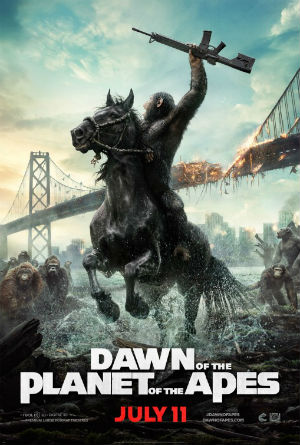
In 2011, Rise of the Planet of the Apes was another attempt to relaunch the money-spinning ape vs. human franchise. Unlike Tim Burton’s disastrous 2001 effort, it took a stance that felt truly unique. Sure, it still felt the need to reference back to the original film in places, but it was a terrific piece of story-telling. Anticipation was high for this sequel – and it met those expectations.

Ten years after the outbreak of a virus that has decimated the human race, the apes have built their own community in the forests near San Francisco, led by Caesar (Andy Serkis). A human party, led by Malcolm (Jason Clarke), enters the forest looking to restart a hydroelectric dam to supply power to the human’s San Francisco community. As the two communities collide, Caesar and Malcolm must work out a truce, despite the doubts of human leader Dreyfus (Gary Oldman) and Caesar’s lieutenant, former lab-chimp Koba (Toby Kebbell).

Dawn is an intelligent and visceral piece of film-making, which enrichens the first film in the series, as well as offering a surprisingly deep analysis of human (and ape) nature. Marry this  up with some quite astonishing special effects, and staggering work from the actors creating the apes through motion capture, and you have a hugely rich science fiction film that helps to cement this trilogy as the finest version of the Apes story so far. It’s also damn good fun.

Even more than the first film, Dawn places apes front-and-centre. The film is book-ended with close up shots of Caesar’s eyes, the determination and resolve in them springing from very different causes. The questioning of the nature of humanity revolves around Caesar – the leader balancing the urge to protect his own people against a willingness to support the needs of his people’s only potential threat. Caesar is the most humanitarian character– yet his determination to view other apes as does himself prevents him from seeing Koba’s treachery. It’s his own generosity that is his Achilles heel.

Andy Serkis, the Master of Motion Capture, has mastered this art like few other actors, but his performance as Caesar is his triumph. The degree of emotion he is able to communicate is astounding, while his physicality is extraordinary – it’s a perfect marriage of ape traits and human characteristics. It’s a triumph as well of special effects, but you quickly forget this and embrace the character you are watching. Serkis gives Caesar a deep hinterland of warmth and emotion, a desperation to protect what he has built, touched with a hint of blindness to the reactions his dismissal of Koba’s concerns will have on someone so damaged.

What’s interesting is that, although the film swings heavily in favour of the Apes, it’s the humans who become the victims of aggression, and the humans who are the most open (or desperate) to negotiation and co-operation. A simpler film would have turned Gary Oldman’s Dreyfus into a despotic counterpart to the traumatised Koba. Instead, Dreyfus proves surprisingly open to negotiation, demonstrates great affection for his followers, weeps ecstatically over finally being able to turn his tablet back on and look at photos of his family and only resorts to drastic measures after the human colony seems doomed.

The villain of the piece is Koba (remarkable work from Toby Kebbell). The film, though offering many indicators of Koba’s ruthless lack of regard for any life but his own, gives us reasons (even though these are sometimes stated directly for his feelings and the trauma that lie underneath them. The film doesn’t short change us on Koba’s obvious bravery in battle or his ability to inspire troops. Koba’s inability to adjust his thinking (unlike any other character in the film) leads to the violence. Just as Caesar’s urge to see all apes as meeting his own standards allows violence to grow around him, so Koba’s urge to judge all humans by the standards he has given them leads him to sacrifice countless ape lives in a bloody attack.

These themes of divided loyalty and the damage our own urges (for both good and evil) play out in a cracking storyline, packed to the rafters with action, shot with a confidence and skill by Matt Reeves. Despite being a film that always feels about larger themes, it wears this rather lightly, and offers more than enough popcorn thrills to please any Ape action fan. Koba’s assault on the human stronghold is both grippingly exciting, but also unbearably tense – the film embraces the grim sacrifice and slaughter of war. The final confrontation between Caesar and Koba is shot with a giddying, vertigo-inducing sharpness.

The ape effects are, it goes without saying, extraordinary. These are expressive, living, breathing characters – a brilliant meeting of some wonderful acting and brilliant special effects. Could you imagine a few years ago a film being anchored by a special effect ape played by motion capture? You quickly forget that they are not ‘real’ and accept them as genuine characters. Even more so than Rise, Caesar and the apes are front-of-centre and this is Caesar’s story. Serkis is of course a huge part of this – his influence and dedication to the motion capture and ape portrayal is superb.

Dawn of the Planet of the Apes is a terrific and thought provoking epic film, one that deepens, darkens and enriches the previous film and leaves an audience with not only a lot to consider but also highly thrilled. Unlike the previous film it doesn’t shoe-horn in weak references to earlier films, but concentrates on telling a terrific and character-led story. It’s another terrific entry into a series that feels like it could become one of the great science fiction trilogies.