Tag: Tom Hanks

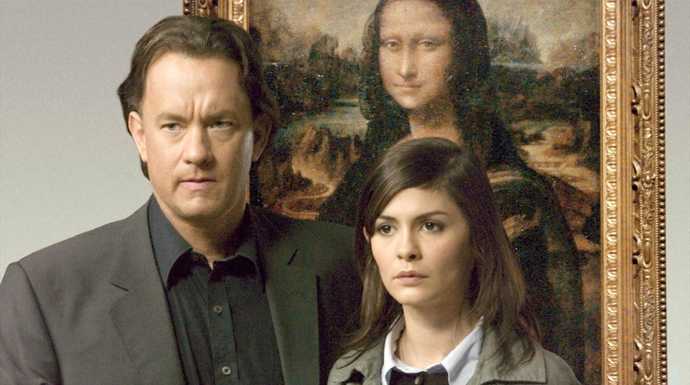
The Da Vinci Code (2006)

Tom Hanks and Audrey Tautou stumble through the dire The Da Vinci Code, possibly one of the dullest films ever made

Director: Ron Howard

Cast: Tom Hanks (Robert Langdon), Audrey Tautou (Sophie Neveu), Ian McKellen (Sir Leigh Teabing), Jean Reno (Captain Bezu Fache), Paul Bettany (Silas), Alfred Molina (Bisoph Aringarosa), Jürgen Prochnow (André Vernet), Étienne Chicot (Lieutenant Jérôme Collet), Jean-Yves Berteloot (Remy Jean), Jean-Pierre Marielle (Jacques Saunière)

In 2003 the world went a little crazy. Maybe it was all the buzz of conspiracy that seemed to be everywhere. Maybe people wanted a bit of escapism from the misery of our post-9/11 world. Or maybe there is just no accounting for taste. But inexplicably, a staggeringly poorly written thriller by a hack author, peddling a tired old conspiracy, became one of the most popular books of all time. Yup, ladies and gentlemen, it was a time of silliness, paranoia and poor taste. It was the time of The Da Vinci Code.

When the curator of the Louvre (Jean-Pierre Marielle) is found dead in the museum, with his body covered with bizarre self-inflicted wounds and symbols, visiting Professor of Symbology from Harvard Robert Langdon (Tom Hanks) is called in to consult. Langdon quickly finds himself the main suspect and on the run, aided only by the victim’s granddaughter Sophie (Audrey Tautou in a truly thankless part of continual question asking, devoid of any agency). Following a trail of bizarre clues, Langdon ends up investigating a conspiracy that leads to the heart of the Catholic Church – could the Church be founded on a lie? Could Jesus Christ have in fact been married to Mary Magdalene? Could she have been his intended heir? Did she have a child? Has a secret society run (at various times) by the Knights Templar, Leonardo Da Vinci and Isaac Newton worked since the dawn of time to protect the secret? Of course they haven’t, but that’s not going to stop the film.

Okay let’s get the main event out of the way. This is a terrible film. But it’s not terrible for the reason you might think. I mean, sure, it’s poorly scripted bobbins, with poorly developed ciphers for characters, and it peddles a conspiracy theory which is total, illogical nonsense from top to bottom. But that’s not the main reason. The main reason this film is terrible is that it is so unbelievably fucking boring.

The film is an utterly faithful, practically scene-by-scene reproduction of Dan Brown’s book. And it immediately reveals how little Brown knows about how to write a good thriller. The film has two or three action “set pieces” or moments of tension – at least, they would be tense, if only there were any stakes to the situation, or the characters’ motivations or the peril they’re in made the slightest bit of sense. They don’t. You’ll barely remember the car chase, or any of the moments where the heroes are held at gunpoint. None of the characters have any definable personalities, other than what they are invested with by the actors playing them. But then that’s no surprise from a novel where the lead character is defined solely by being brainy, having a Mickey Mouse watch (such a character!) and (film rights pleading ahoy) looking like Harrison Ford.

Just like Dan Brown’s turgid original, this film quickly turns into a series of scenes where characters fling exposition at each other to whizz us through a series of sub-par brainteasers and anagrams, which are only solvable with information the characters have but the audience doesn’t (hardly making it a fun thing to play along with). You’ll find yourself wishing for those anagrams back though, once they move on to spunking the novel’s bizarre conspiracy theory into our ears. The low point of this is when Ian McKellen’s polio-suffering billionaire historian (a billionaire historian! Who has a private plane! Of course he does…) tees up a handy PowerPoint presentation he just happened to have sitting around ready, and regurgitates all the mystic mumbo-jumbo that the film tries to pass off as fact.

I’m sure I don’t need to recap the nonsense of this film, but seeing it boiled down from the book is a real reminder that Brown clearly read widely but with no depth. For starters, most of his understanding of everything from the church, to the Templars, to the history of Europe is bogged down in inaccuracy and misinterpretation. By the time the film is claiming that Isaac Newton’s discovery of gravity angered the church you’ll have lost all ability to take anything the film says seriously (for the record, the Catholic church didn’t have a problem with gravity, and even if they did, as an Anglican living in a Protestant country, Newton wouldn’t have given a damn anyway).

None of the film’s (or book’s) ideas are even that original – it was all spewed forth in a book called Holy Blood, Holy Grail (several characters here have names that are anagrams of the writers and editors of these books) in 1982. The idea of Jesus having a whole line of secret descendants is arrant bollocks. The idea of a secret society working to protect this secret is even more stupid (it was revealed after the publication of Holy Blood, Holy Grail to be a total hoax, swallowed whole by that book’s writers). There is not a shred of reality here – rather, it’s typical paranoia and anti-establishment bollocks repackaged as dark reveal.

This is before we even touch on the – heaven help us – “art analysis”. The dark hints of conspiracy in The Last Supper by Da Vinci boil down to: (a) there is no Grail in this painting, (b) the bloke to the left of Jesus looks a bit like a girl so must be Mary Magdelene (“a hint of bosom” McKellen tells us playfully), (c) there is an inverted triangle between Christ and this man/woman – so surely a sign of the female dominance! The fact that the painting shows only 12 disciples and Jesus – meaning that if Mary was there, it should show 14 people not 13 – isn’t considered worth mentioning. But then that’s par for the course for the film’s bullshit clues “discovered” in works of art to support the film’s bullshit, anti-Catholic agenda (the church being staffed in this film exclusively by shadowy, Bond-villain types, with a ruthless agenda for extremist Catholicism and murderous Albino hit-monks they dispatch at will). Give me a break.

But if the film had packaged this all up in a gleefully silly, high energy story, it could still have been an entertaining watch. Unfortunately, it’s completely and utterly boring. It goes on (and on) for almost two and a half hours, and in between unengaging lectures and tedious dialogue scenes it drags like you wouldn’t believe. It’s almost impossible to get engaged in anything at all, and it’s really not helped by the flat, dimly lit, for-the-money direction from Ron Howard. There is no zip or fun about the film whatsoever, as if the book’s massive popularity made the producers worried that if they treated the book like an action adventure yarn, or a fun bit of nonsense, then it might offend people. Instead they treat this nonsense with a deathly reverence usually reserved for Biblical epics that’s fatal for the viewing experience of the entire film. 

It’s supremely dull, very self-important, and for all the hard work of an interesting cast of actors (who do their very best) it’s a complete, yawn-filled, pile of stinking crap. As the man said: “Holy Blood? Holy shit.”

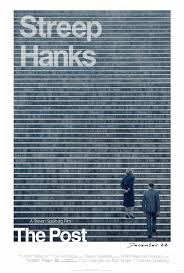
The Post (2017)

Hanks and Streep bust Watergate in advance in Spielberg’s too dry The Post

Director: Steven Spielberg

Cast: Meryl Streep (Katharine Graham), Tom Hanks (Ben Bradlee), Sarah Paulson (Tony Bradlee), Bob Odenkirk (Ben Bagdikian), Tracy Letts (Fritz Beebe), Bradley Whitford (Arthur Parsons), Bruce Greenwood (Robert McNamara), Matthew Rhys (Daniel Ellsberg), Alison Brie (Lally Graham), Carrie Coon (Meg Greenfield), Jesse Plemons (Roger Clark), David Cross (Howard Simons), Michael Stuhlbarg (AM Rosenthal)

There are few things newspaper journalists like more than old-fashioned films about the glory days of the press, showing journalists to be uniformly noble, upstanding, seekers of truth. There are few things Hollywood likes more than films the feature Streep and Hanks and/or are directed by Spielberg. As such, it’s not really a surprise that The Post received laudatory reviews, or that it crept into the Best Picture list of 2017 (it only got one other nomination, inevitably for Streep).

The film covers the Washington Post’s decision in 1971 to publish details from the Pentagon Papers, originally leaked to the New York Timesby former Defence Department official Daniel Ellsberg (Matthew Rhys). The papers detail the American government’s deceptive public messages on Vietnam, a war they knew to be unwinnable for almost ten years. The Nixon administration has blocked publication in the New York Times, but when the Post gets the same papers, owner and publisher Katharine Graham (Meryl Streep) and editor Ben Bradlee (Tom Hanks) have a difficult decision to make – suppress the truth or publish and face crippling legal penalties that could destroy the business.

The Post is quite similar in some ways to Spielberg’s far more successful Lincoln – a po-faced history lesson, told with panache, but essentially a dry civics lesson which draws some neat, but a little too on point, parallels with current events. Certainly it’s clear whom we are meant to be thinking of when the camera shows a shadowy Nixon in long shot from outside the White House, ranting into a phone in the Oval office late at night (admittedly, in a nice touch, the film uses the actual audio from Nixon’s Oval Office recordings). The parallels between press freedom and the spin of politics (or the charges of Fake News flung at any story the powers that be don’t like) are pretty clear. They are also pretty obvious.

Part of the film’s problem is that, unlike All the President’s Men (where the story covers full investigative journalism and Woodward and Bernstein need to piece the story together against the odds), this film hands everything to the journalists on a plate. It doesn’t even try to put a puzzle or some form of mystery before the viewers. Instead, the history is painstakingly (and drily) explained to give us the context, then each stage of the Post getting the papers is shown in simple and rather undramatic steps. There isn’t a sense – despite Bob Odenkirk’s deputy editor doing a bit of legwork – that the Post needed to work that hard to land the story. Crikey, you can see why The Times (who really did the crack the story) were a bit pissed at the film stealing their glory.

Once the papers are in the Post’s hands, the story almost immediately jumps to one night in which the papers are read and the board and the journalists squabble over whether they can legally publish or not. After that we get a swift coda where everything turns out fine, backs are slapped and the Supreme Court says it’s all good. There just isn’t quite enough drama. In fact we feel like we are watching a footnote, rather than the real story, which seems to be happening on the margins (for starters, the scandal of government lies on Vietnam, how The New York Times broke the story, and the Watergate break-in, a recreation of which rather clumsily closes the picture).

And I get that the film is trying to tell a story about how important a free press is and, yes, it’s great – but despite having a number of characters talk at length about this, I’m not sure what the film really tells us that we don’t already know. Instead it moves methodically but swiftly through events, carefully telling us what happened but never turning it into a really compelling story. Pizzazz for its own sake is not a strength, but a little more oomph in delivery here might have helped.

Alongside this, the film also wants to make points about the struggle of a woman in a man’s world and the institutional sexism (that probably hasn’t changed that much) of many boardrooms. Meryl Streep’s Katharine Graham – having inherited the company after the suicide of her husband – is a brow-beaten woman struggling to impose herself in a room of men whom she feels inferior to. Even this plotline though feels slightly rushed – we have Graham cowering in a boardroom meeting and struggling with paperwork, next thing we know she hesitantly makes the call to publish and is facing down her chief opponent (Bradley Whitford, rolling out another of his arrogant men of privilege). It’s all a bit rushed, perfunctory and all as expected – and Streep can clearly play this sort of role standing on her head.

But then the whole film has this slight comfort job feeling about it – everyone clearly invested in the story and the importance of the film’s points, but clearly without being challenged by the content. By the end of the film we’re are awash with clichés, from newspaper print rolling through old machines, to Graham walking through a crowd of admiring women outside the Supreme Court. The interesting and well assembled cast don’t get enough to do, with many of them feeling slightly wasted, not least Sarah Paulson in a thankless role as “the wife”.

The Post wants to be a big, world-changing film that talks about our modern age. Instead it’s a very middle brow, middle of the road history lesson that flatters to deceive, entertaining enough just about, but immediately forgettable.

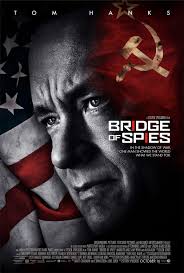
Bridge of Spies (2015)

Tom Hanks and Mark Rylance find common ground in the Cold War in Spielberg’s Bridge of Spies

Director: Steven Spielberg

Cast: Tom Hanks (James B Donovan), Mark Rylance (Rudolf Abel), Amy Ryan (Mary Donovan), Sebastian Koch (Wolfgang Vogel), Alan Alda (Thomas Watters), Austin Stowell (Francis Gary Powers), Scott Shepherd (CIA Agent Hoffman), Billy Magnussen (Doug Forrester), Jesse Plemons (Joe Murphy), Dakin Matthews (Judge Mortimer W Byers)

Steven Spielberg is perhaps best known for his cult block busters – and has indeed directed some of the finest popular adventure movies you are likely to see. But more of his output – particularly in recent years – is focused on intelligent, slightly old-school, handsome, period films that look to shed light on political and social issues of the past. Bridge of Spies falls firmly into this camp, an extremely well-made (if rather dry at times) prestige picture, blessed with a fascinating story and some very fine performances.

In 1957, Soviet agent Rudolf Abel (Mark Rylance) is arrested in New York and put on trial. He’s the most unpopular man in America – except perhaps for the man plucked from a list of New York attorneys to defend him, James B Donovan (Tom Hanks). Donovan doesn’t endear himself to the American public by successfully defending Abel from the death penalty, but he’s proved right when U-2 pilot Francis Gary Powers (Austin Stowell) is shot down over the USSR, and a prisoner exchange is set up for Abel and Powers, with Donovan negotiating the details in a wintery Berlin.

Bridge of Spies has an old-fashioned charm to it – you can totally imagine it popping up on a bank holiday afternoon. It’s what you might call “grown-up entertainment” in the sense that it tells a character-focused story. It’s made with an unfussy assurance that never allows its cinematic excellence to get flashy, and it patiently unfolds an intriguing character study that gives excellent opportunities to some gifted actors. 

It’s also got a vein of wit running through it – you can see the fingerprints of the Coen brothers, brought in to do a polish of the script. They are there in the touches of the absurd as Donovan goes behind the Iron Curtain, mixing with an eccentric group of East Germans pretending to Abel’s family. Their also there in the moments of chill around the East German forces who suppress freedom and endanger lives. But it’s brought to life because Spielberg is such a wonderful, vibrant director.

Spielberg knows where to bring the flash and where to settle and let the camera watch the actors at work. Despite the calm of the general shooting, the film is packed with some wonderful sequences of bravura film-making, told so skilfully and with enough confidence that they don’t need to draw attention to themselves with overly flashy camera work or editing. But sequences such as the one that begins the film with Abel unknowingly being followed through New York, or Powers’ U-2 flight being shot down, or a horrified Donovan watching luckless Germans try to climb the Berlin Wall while he rides a train expelling him from East Germany, are made with a confident, unflashy flair.

It’s a film which has a real understanding of the paranoia and knee-jerk prejudice of the Cold War (on both sides of the curtain, but particularly in America), that mixes this with a note of hope in the essential decency of those on the ground – Roger Ebert described it as like a John Le Carre if it had been directed by Frank Capra – and that’s a good description. Spielberg’s film casts Donovan as the “little guy” who has to do the right thing and struggle to be accepted by his fellow Americans. Donovan’s travails in East Berlin have a Capra-ish quality to them, as his straight-shooting decency and integrity come up against the oblique games and half-truths of professional diplomats and spies. Abel as well is basically a solid, stand-up guy with a very clear moral compass and a dry wit that points out the quirks of both American and Soviet systems.

Tom Hanks is perfect casting as Donovan. He’s much overlooked as a great actor, and Donovan plays to his strengths, using all his integrity and trustworthiness to great effect. His Donovan is an honest broker, a man who believes above all in the cause of justice and has a good-natured confidence that allows him to never be flummoxed or even to show too much impatience with those putting obstacles in his way, even as he works overtime to get his way. It’s a perfect Hanks part played by perfection.

The film also boasts an excellent, Oscar-winning, performance by Mark Rylance as Rudolf Abel. Embracing the movies for the first time, Rylance could probably play Abel standing on his head, and this acting heavyweight turns in a performance full of sparkle and wit. Rylance is softly spoken, with a combination of world-weariness, wry humour and a dry unreadability. Abel however is also a fiercely loyal and decent man – and it’s the contrast and bond that develops between him and Donovan that powers the movie.

In fact you can’t help but miss him in the second half, interesting as Donovan’s patiently done and labyrinthine negotiations between the KGB, Stasi and CIA become. At times this second half becomes slightly drier than the rest – as if Spielberg can’t quite manage to keep the sense of intimidation and danger in place for the whole of these protracted scenes of bluff and double bluff. It’s also probably a fraction too long. It’s not a perfect movie after all – Donovan’s family are a series of bland identities (“Honey stop trying to end the Cold War and come to bed”) and the film’s final coda of Donovan getting the approval of the American people on contrasting train rides is a little too trite in its “ain’t freedom great” tone.

But I really like Bridge of Spies. It’s calm, it’s assured, it’s very well made, it’s very well acted. There is a lot of quality on show here – it practically drips off the show – and it’s made by a director who knows he doesn’t need to wrestle your attention with every shot to keep it. Spielberg is a director so talented that he can excel at making intelligent, grown-up movies that have something for everyone. For all that it’s slightly overlong and can’t quite keep its momentum up, I really like it.

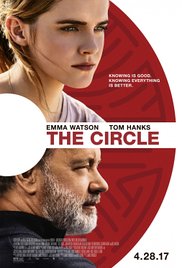
The Circle (2017)


Emma Watson struggles against the surveillance state in shockingly bad adaptation The Circle

Director: James Ponsoldt

Cast: Mae Holland (Emma Watson), Tom Hanks (Eamon Bailey), John Boyega (Ty Lafitte/Kalden), Karen Gillan (Annie Allerton), Ellar Coltrane (Mercer), Patton Oswalt (Tom Stenton), Bill Paxton (Vinnie Holland), Glenne Headly (Bonnie Holland)

Is there anything sadder than seeing a book you thought was fantastic get totally screwed up by film producers? Worst of all, Dave Eggers, the book’s author, even gets a screenwriting credit here. I hope to God his contribution was a rejected earlier draft, rather than the bland, aimless drivel on display here. It would be too depressing to think he gutted his own work and then mutilated its corpse.

Mae (Emma Watson) is thrilled to land a job at The Circle, an all-powerful, Google-style corporation with a virtual monopoly over the internet. However, she discovers while she works at the Circle that there are (of course!) dark secrets at the heart of the company, and that its charismatic CEO Eamon Bailey (Tom Hanks) may not be all that he seems.

Imagine an adaptation of 1984 at the end of which Winston Smith defeats Big Brother but decides there are positive sides to living under a dictatorship, so carries on doing so. That’s exactly as ballsed-up as this total misreading of Egger’s gripping critique of our internet age. In this terrible adaptation, the novel is neutered beyond recognition into just another bland “Big Corporations Acting All Corporation-y” nonsense. The film is pretty much exactly as awful as the book is brilliant.

Where did it all go so completely and utterly wrong? Did they not understand the book? The novel is not only a critique of the pervasive power of its shady Google-like organisation. It’s also a savage attack on our own tweeting, social media obsessed world – the sort of world where private actions are theft as they rob everyone else from experiencing them vicariously through tweets, photos and posts. It’s this part of the story the film completely (and almost wilfully) misses the point of.

They seem terrified at the thought that the social media Twitteratti might take against the film if it too openly attacks the actual users of systems like this, with their (at times) shallow, demanding and entitled pushing of their own opinions, and intrusions into others’ lives. Instead the film gives a complete pass to all the users of the systems, while attacking the corporation providing them. So we get the bizarre set up of a film that seems to say it’s totally fine for normal people to record everything and push it all onto the internet, turning their world into a judgemental surveillance state, but it’s evil for a corporation to create the devices they use to do it.

Even the film’s criticism of corporations isn’t very clear, largely because we never get a sense of the Circle’s power and its hunger for getting more and more control. The film throws away its involvement in politics and its control over everyday lives. Perhaps because it knows so many of the viewership love gadgets, there is no exploration of the creepy, controlling aspect of the many tracking and recording devices the Circlers wear throughout the film, as there is in the novel. Instead the target is the shady business people at the top (not that we learn anything about what they want) because everyone hates businessmen don’t they? Nice easy target. I can tweet my loathing of them very easily.

It’s a film devoid of any challenge. A character’s suicide from the book is changed to an accidental death. The more vulnerable and desperate of the characters from the book have been deleted. The obsessive self-definition the Circlers gain from what other people tweet about them is downplayed. The ending of the film completely inverts the novel, and leaves us with a bizarre final image of our hero kayaking on the lake, but warmly smiling at the drones watching her, even after she has destroyed the “villains” who run them. It makes no sense whatsoever. My jaw literally dropped when this happened by the way.

Mae is a character who now has no consistency. Her growing obsession with the power of social media – and the destructive effect it has on her actual human relationships – is completely ignored. It’s the key part of her character from the book, and its removed here to try her as traditionally ‘likeable’ as possible. An anti-hero becomes a flat out hero. The film shows the impact of actions she carries out in the book – particularly on Annie – but removes these actions from the film. Why do people slip into depression or depart from the film? Who knows. Left with nothing to work with from the original book, Emma Watson gives a bland and forgettable performance. No one else really makes an impact, playing dull, neutered versions of the characters from the source material, devoid of depth or interest.

The Circle might be one of the worst literary adaptations I’ve ever seen. It guts the original book and removes any of the most challenging and interesting content. It’s terrified of criticising in any way anyone who might be watching. It’s a satire on the social media age that has no satire in it, and is desperate not to talk about social media. Worst of all it will discourage people from reading the original novel. In the words of the modern age: #uttershit.

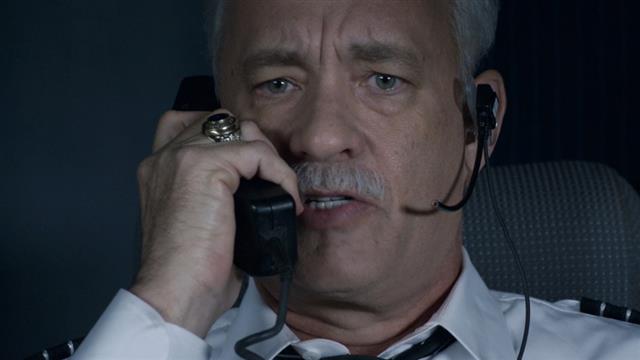
Sully: Miracle on the Hudson (2016)


Tom Hanks braces for impact as heroically normal hero pilot Chesley Sullenberger

Director: Clint Eastwood

Cast: Tom Hanks (Chesley “Sully” Sullenberger), Aaron Eckhart (Jeff Skiles), Laura Linney (Lorraine Sullenberger), Anna Gunn (Dr Elizabeth Davis), Autumn Reeser (Tess Soza), Ann Cusack (Donna Dent), Holt McCallany (Mike Cleary), Mike O’Malley (Charles Porter), Jamey Sheridan (Ben Edwards)

On January 15th 2009, a miracle happened in New York. A plane struck birds, causing double engine failure. Captain Chesley “Sully” Sullenberger, left with no options, decided to land the plane on the Hudson River. Amazingly, all 155 passengers and crew survived unharmed.

Eastwood’s emotional, skilfully made film brilliantly recreates this true-life event, with Hanks taking on the lead as Sully. The framing device Eastwood uses is the National Transportation Safety Board investigation into the crash, here re-imagined as an almost persecution, convinced that pilot error and failure to react quickly enough were the causes.

What’s most striking for me is this film’s tribute to the professionalism and heroism of everyone involved. Just as Sully states during his hearing, this was a team effort, not the work of a lone hero. This comes across strongly here. Air hostess is a profession which, god knows, it’s easy to mock: but this film shows their unflappable bravery, calmness and leadership. Similarly, the first responders are dedicated and compassionate. I’m not ashamed to say I felt myself choke up at one point, when a first responder tell one waterlogged passenger “no one dies today”. The film ends with a tribute to New York coming together to save lives – and it’s a message ringing through the film.

Eastwood knows the drama of the film is directly linked to the crash, so weaves this event throughout the film, returning to it at least four times from different angles. He opens the film with Sully’s nightmare of what could have happened if he had flown towards an airport (the plane ploughing into New York) – a grim reminder of what could have been, which hangs over the rest of the runtime. The evacuation of the downed plane is gripping, and is filmed with a restraint that lets the events speak for themselves. The emotional force throughout these sequences is compelling.

Tom Hanks is perfectly cast as the low-key everyday hero achieving the impossible with only quiet courage and years of experience behind him. To be honest, it’s a role Hanks could probably play standing on his head, but his quiet everyman quality is essential to the film’s success. He’s well supported by Eckhart and other members of the cast.

It’s good Hanks is so assured, as he is required to anchor much of the film’s plot. The plot is where the film struggles as, to put it simply, the story away from the crash isn’t actually that dramatic or interesting. An attempt has been made to make the investigation into the crash into a sort of inquisition into Sully’s actions, but it never really rings true (it largely wasn’t) and it’s never really interesting enough, certainly not when compared to the crash itself.

In fact, it’s hard not to think that there is some sort of message being built into the film here, contrasting the low-key individual Sully with the faceless, procedural suits who can’t imagine the importance of the human element. Maybe that’s reading a bit much into it, but either way it’s average drama: there is never any doubt in the viewer’s mind that Sully will be completely exonerated. It’s an attempt to add dramatic tension to a story everyone already knows.

Furthermore, Sully is too “normal” a man to sustain a drama around his life: in another film inspired by these events, Flight, Denzel Washington played a drunken pilot who saved an aeroplane in a moment of inspired flying. The drama of that film was based on the film’s exploration of Washington’s character’s lack of responsibility vs. his act of heroism. Sully doesn’t have this, so we don’t get that sense of conflict within the character or with others. Put simply, Sully is such a regular decent, guy that, outside these unique circumstances, he is not really a dramatically interesting character – and the film can’t create a plot that brings drama out of his situation.

So Sully is a mixed bag of a film. Hanks gives his best as ever, but the film can’t really get over the fact that it’s recreating a moment in history, and fails to give that moment an effective dramatic framework. There is some good supporting work, although many of the other roles are thankless (Laura Linney’s role in particular is literally phoned in), but the film only flies when the plane doesn’t. The reconstruction of the event, and the people who were involved in it, is inspiring and stirring – but the rest of the film is little more than a humdrum courtroom drama.

Catch Me if You Can (2002)


Leonardo DiCaprio lives out his fantasies in Catch Me if You Can

Director: Steven Spielberg

Cast: Leonardo DiCaprio (Frank Abagnale Jnr), Tom Hanks (Agent Carl Hanratty), Christopher Walken (Frank Abagnale), Nathalie Baye (Paula Abagnale), Amy Adams (Brenda Strong), Martin Sheen (Roger Strong), James Brolin (Jack Barnes), Nancy Lenehan (Carol Strong)

Conmen. You wouldn’t want to meet one but they don’t half make for great stories: largely because tell a great one. Watching cons has the same tension as watching a high-wire artist: will they slip? We all like to think we could fool people if we wanted to – and the movies give us a chance to watch someone else live those fantasies for us.

Frank Abagnale Jnr (Leonardo DiCaprio) was a teenager who was a natural at the arts of the short and long con, as well as an accomplished forger. The film tells the story of his late teens and early twenties when, as well as impersonating a senior paediatrician and a junior district attorney, Abagnale stole almost $3 million from Pan Am by impersonating a pilot and forging checks between 1963 and 1969. Hanks plays Carl Hanratty, the dedicated FBI investigator on the case.

What’s great about this film is that, by and large, it isn’t trying to be a lot more than an entertainment. In fact, Spielberg deliberately shoots the film in a low key, unflashy style that puts the focus on the story and acting. And there is something hugely entertaining about the chutzpah of conmen, particularly those who are only fleecing huge businesses, which this film really understands and taps into. It’s probably Spielberg’s funniest “comedy”.

It’s witty throughout with a sly sense of humour. In his roles as both doctor and lawyer, Abagnale is shown carrying out research by watching TV shows and reading pulp novels – and then repeating their clichés, to the bemusement of those around him (but he delivers it with such confidence it still works). I also enjoyed the fact that his chosen careers (air pilot, doctor, lawyer) are all approached with the same naive understanding a kid would have for what the job involves (and DiCaprio’s look of childish terror slipping past his adult facade watching a plane take off from the cockpit and when asked for his opinion on the treatment of an injured child at a hospital are endearingly genuine). The film is told with a great deal of bounce and lightness, taking on the structure of a Wil-E Coyote/Roadrunner chase cartoon, with Hanratty defeated several times by Abagnale’s confident sleight of hand.

The script does have depth to it, rooting Abagnale’s actions in his trauma from a broken family and witnessing his father’s humiliating fall into poverty after charges of tax evasion. The film suggests this to be the main motive for Abagnale’s actions – a misguided attempt to redeem his father and take back what was taken from him. This theme of a son trying to win his father’s respect gives the film a heft that balances the fluff – especially as it’s clear the son has taken many of the wrong lessons from his father’s life on the edges of legality. It’s helped in this respect by a wonderful performance of twinkly charm and fatherly pride by Christopher Walken, combined with a sly sense of roguishness.

Leonardo DiCaprio is the motor that really makes this film work. His boyish good looks are perfect for this and he has both the confidence to convince as a trickster and the vulnerability to be the young boy underneath. As such he has the lightness of touch that the story needs and the acting chops to convey the inner pain Abagnale is working so hard to soothe. He’s also effortlessly charming and endearing here, surely the perfect traits of a con man.

For the rest of the cast, Tom Hanks very generously plays second banana as the investigator and gives the role a strong sense of the surrogate father. Amy Adams in one of her first roles is wonderfully sweet as Abagnale’s fiancée, totally unaware that he is a 17 year old kid. Martin Sheen and Natalie Baye also give good performances.

The film is a light and frothy confection that shades in just the right amount of nuance and depth to make us care for its lead character. With John Williams’ zippy score and its luscious recreation of the late 1960s, it’s also a film in love with the vibrancy of the era. A terrific unpretentious entertainment, it’s not one of its director’s great works, but it might be one of his most joyful.