Tag: Toni Collette

Mickey 17 (2025)

Mickey 17 (2025)

Indulgent, over-long satire that mixes painfully obvious political targets with on-the-nose comedy

Director: Bong Joon-Ho

Cast: Robert Pattinson (Mickey 17/Mickey 18), Naomi Ackie (Nasha Barridge), Steven Yeun (Timo), Toni Collette (Ylfa Marshall), Mark Ruffalo (Kenneth Marshall), Patsy Ferran (Dorothy), Cameron Britton (Arkady), Daniel Henshall (Preston), Stephen Park (Agent Zeke), Anamaria Vartolomei (Kai Katz), Holliday Grainger (Red Haired recruiter)

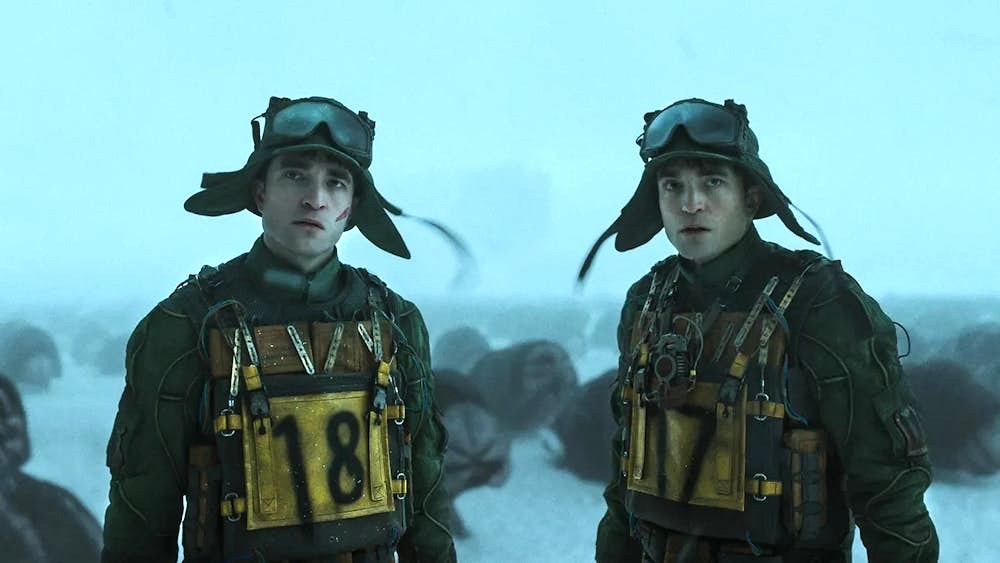
In 2050, everyone on the colony ship to the planet Niflheim has a job. Even a washed-up loser like Mickey (Robert Pattinson). His job is the most loserish of all: he’s an ‘expendable’, hired to die repeatedly in all forms of dangerous mission or twisted scientific and medical experiments, with a new body containing all his backed-up memories rolling out of the human body printer. The one rule is there can never be more than one Mickey at a time – so it’s a problem when 17 is thought dead and the more assertive 18 is printed: especially as they are flung into a clash between the colonisers and Niflheim’s giant grub-resembling lifeforms ‘Creepers’. Can Mickey(s) prevent a war that the colony’s leader, a failed politician and TV-star Kenneth Marshall (Mark Ruffalo) and his socialite wife Ylfa (Toni Collette), want to provoke?

It’s all thrown together in Bong Joon-Ho’s follow-up to Parasite which trades that film’s sharp, dark social satire and insidious sense of danger for something more-like a brash, loud, obvious joke in the vein of (but grossly inferior to) his Snowpiercer. Mickey 17 is awash in potentially interesting ideas, nearly all of which feel underexplored and poorly exploited over the film’s whoppingly indulgent runtime of nearly two-and-a-half hours, and Bong lines up political targets so thuddingly obvious that you couldn’t miss these fish-in-a-barrel with a half-power pea-shooter.

Mickey 17 actually has more of a feel of a director cutting-lose for a crowd-pleaser, after some intense work. Mickey 17 is almost a knock-about farce, helped a lot by Robert Pattinson’s winning performance as the weakly obliging Mickey 17 who grows both a spine and sense of self-worth. A sense of self-worth that has, not surprisingly, been crushed after a lifetime of failure on Earth leads him to series of blackly-comic deaths (the film’s most successful sequence) that has seen him irradiated and mutilated in space, gassed with a noxious chemical, crushed, incinerated and several other fates.

Not surprisingly, there is a bit of social commentary here: Mickey is essentially a zero-hours contract worker, treated as sub-human by the businessmen and scientists who run this corporate-space-trip. It’s an idea you wish the film had run with more: the darkly comic idea of people so desperate to find a new life that they willingly agree to have that life ended over-and-over again as the price. It’s not something Mickey 17 really explores though: right down to having Mickey sign on due to his lack of attention to contract detail (how interesting would it have been to see a wave of migrant workers actively pushing for the job as their only hope of landing some sort of green card?).

Mickey 17 similarly shirks ideas around the nature of life and death. Questions of how ‘real’ Mickey is – like the Ship of Theseus, if all his parts are replaced is he still the ship? – don’t trouble the film. Neither does it explore an interesting idea that each clone is subtly different: we’ve already got a clear difference between the more ‘Mickey’ like 17 and his assertively defiant 18, and 17 references that other clones have been more biddable, anxious or decisive. Again, it’s a throwaway comment the film doesn’t grasp. Neither, despite the many references to Mickey’s unique experience of death (and the many times he is asked about it) do questions of mortality come into shape: perhaps because Mickey is simply not articulate or imaginative enough to answer them.

Either way, it feels like a series of missed opportunities to say something truly interesting among the knock-about farce of Mickey copies flopping to the floor out of the printer, or resignedly accepting his (many) fates. Especially since what the film does dedicate time to, is a painfully (almost unwatchably so) on-the-nose attack on a certain US leader with Mark Ruffalo’s performance so transparent, they might as well have named the character Tonald Drump. Ruffalo’s performance is the worst kind-of satire: smug, superior and treats it’s target like an idiot, who only morons could support. It’s a large cartoony performance of buck-teeth, preening dialogue matched only by Toni Collette’s equally overblown, ludicrous performance as his cuisine-obsessed wife.

Endless scenes are given to these two, for the film to sneer at them (and, by extension, the millions of people who voted Trump). Now I don’t care for Trump at all, but this sort of clumsy, lazy, arrogant satire essentially only does him a favour by reminding us all how smugly superior Hollywood types can be. So RuffaTrump fakes devout evangelical views, obsesses about being the centre of attention, dreams of his place in the history books while his wife is horrified about shooting Mickey because blood will get on her Persian carpet. It’s the most obvious of obvious targets.

It’s made worse that the film’s corporate satire is as compromised and fake as the conclusion of Minority Report. It’s a film where a colonialist corporate elite defers to a preening autocrat, keeps its colonists on rationed food and sex and sacrifices workers left-and-right for profit. But guess which body eventually emerges to save the day? Yup, those very corporate committee once they learn ‘the truth’. Mickey 17 essentially settles down into the sort of predictably safe Hollywood ending, with all corporate malfeasance rotten apples punished. For a film that starts with big anti-corporate swings, it ends safely certain those in charge will always do the right thing when given the chance.

Much of the rest of Mickey 17 is crammed with ideas that usually pad out a semi-decent 45 minute episode of Doctor Who. Of course, the deadly, giant insect-like aliens are going to turn out to be decent, humanitarian souls – just as inevitable as the mankind bosses being the baddies. It’s as obvious, as the film’s continual divide of its cast list into goodies and baddies.

Mickey 17’s overlong, slow pacing doesn’t help. An elongated sequence with Anamaria Vartolomei’s security guard who has the hots for Mickey 17 (every female in the film, except maybe Collette, fancies him proving even losers get girls if they look like Robert Pattinson) could (and should) have been cut – especially as that would also involve losing an interminable dinner-party scene with Ruffalo and Collette. The final sequence aims for anti-populist messaging and action – but is really just a long series of characters saying obvious things to each other. Despite Pattinson’s fine performance – and some good work from Ackie – Mickey 17 is a huge let-down which, despite flashes of Bong’s skill, feels like a great director cruising on self-indulgent autopilot, taking every opportunity for gags over depth or heart. Not a success.

The Sixth Sense (1999)

The Sixth Sense (1999)

Shyamalan’s opus has just enough to reward re-watching after the world learned its secret

Director: M. Night Shyamalan

Cast: Bruce Willis (Dr Malcolm Crowe), Haley Joel Osment (Cole Sear), Toni Collette (Lynn Sear), Olivia Williams (Anna Crowe), Donnie Wahlberg (Vincent Grey), Glenn Fitzgerald (Sean), Mischa Barton (Kyra Collins), Trevor Morgan (Tommy), Bruce Norris (Mr Cunningham)

Does this film have the most famous twist of all time? M. Night Shyamalan’s opus is so dominated by its final reveal (look away now) that Bruce Willis was is in fact a ghost, that every single viewing of it afterwards is focused on watching every second and seeing if you can spot the joins. I’m not sure if that has made for a long shelf-life or not for The Sixth Sense, an otherwise surprisingly sweet Stephen King-ish story of a child coming to terms with a miraculous power. Is there much more to The Sixth Sense by a third viewing though – can the magician’s trick land a third time?

I’d say just about. A year on from the shooting of famed child psychologist Dr Malcolm Crowe (Bruce Willis) by a former patient he failed to help, his traumatised wife Anna (Olivia Williams) has stopped speaking to him and Malcolm needs redemption. Could he find it with the case of troubled ten-year-old Cole Sear (Haley Joel Osment). Cole, despite his obvious good nature, is frequently moody and terrified by curious incidents. His mother Lynn (Toni Collette) despairs as Cole seemingly refuses to talk to her. Can there be truth in Cole’s belief that he can see, and talk with, dead people?

The Sixth Sense has the reputation of a supernatural chiller. But, bar a few jump scares as ghosts walk across screen to sudden, loud musical notes, it’s actually a far more gentle story. In Shyamalan’s world the ghosts are not malevolent or cruel – they are simply confused, lost souls (of course “some of them don’t even know they’re dead”) with unfinished business. They are, in other words, rather like the rest of us – and Cole’s realisation of this is actually rather sweet.

This humanity is the real triumph of the film, helped enormously by the untricksy care Shyamalan unfolds his story with. While almost every film he made since teetered from disappointment to disaster (with ever more desperate attempts to recapture the rug-pull zeitgeist to ever diminishing returns from increasingly savvy audiences), The Sixth Sense is a reminder of the road not taken. If Shyamalan had focused on small-scale, intimate character dramas like this he could have had quite the CV. His camera work is careful, often unobtrusive, gentle in its slow, immersive movement and he backs aware almost entirely from fast cutting. The Sixth Sense is really a spooky fairy tale.

It also creates an environment for four impressive actors to tackle four challenging roles. From Olivia Williams, whose marvellously detailed performance of utterly naturally not reacting goes a huge way to maintaining the film’s delicate tightrope to the (Oscar-nominated) Toni Collette, who superbly channels deep motherly love and pained helplessness under a blowsy exterior.

Bruce Willis (who only took the film on under contractual obligation) gives possibly his finest performance here. Suppressing his natural cocksure confidence into suppressed confusion and guilt, he convinces as an expert plagued with self-doubt. It’s a quiet, expressive performance that’s a tribute to the acting chops Willis had when he was moved beyond smirks.

It’s also a very supportive performance that helps bring the best out of a gifted child actor. Haley Joel Osment carries a large chunk of the film. He’s vulnerable and scared but also older than his years, alternating between the innocent excitement of a child and the weary reflection of a much older man. He creates a character you both want to comfort and also cheer for his growing strength. Shyamalan works with both actors to continually subtly shift the power balance between them without ever showing the film’s hand.

Because, of course, Cole knows the truth from the start – no one is better at spotting these things than him, and his unwillingness to speak to Malcolm within ear shot of others (such as during their first real consultation while his mother prepares dinner in the kitchen) speaks volumes. No wonder he keeps shooting him those looks of pity and concern which we, at first, interpret as fear.

You can’t escape that the film’s pretence, on repeated viewing, demands the viewer to reach some tenuous conclusions on how Ghosts operate. I think there is just enough there to suggest – from the sudden appearance and disappearance of ghosts – that they operate like we do in a dream, suddenly finding themselves in places with no memories of how they got there. They can move some objects, but only if they allow themselves to “see” them. They imagine what their own appearances are (the film implies Malcolm always appears in his blood soaked shirt to Cole, it’s just we see Malcolm’s perception of himself as a suited psychiatrist) and are subconsciously drawn towards people who can see them or who they have unfinished business with. The pretence just about sustains itself.

But is there more to the film than that? Pleasingly – and a little to my surprise – there is. While The Sixth Sense is more spooky than terrifying, that’s because it’s a film where helping and caring for people is the answer. No matter how horrific looking the ghosts seem, they are really scared people looking for help. This realisation – and the way Cole seemingly decides to commit his life to helping them – is actually extremely affecting. It’s a basic message of not judging a poltergeist by its cover, that really works.

It’s these beats that really work on a second or third viewing. I would trade the whole “he’s a ghost” twist for that gorgeous final scene between Collette and Osment in a car, where he finally confesses and shares a family secret from the grave to Collette’s initial confusion, anger and then emotional release. It’s a beautiful scene (it surely nailed Collette an Oscar nomination) and is the finest moment of Shyamalan’s career. It also shows the heart of the film – this is a parent-son film (with two parents), that’s about learning to love and accept. Everything else is really just set-dressing.

The magic trick (and Shyamalan hints at the sleight of hand he’s pulling by having Malcolm perform a similar distraction trick) may lose its mystique, but it then allows you to focus on the emotion that made you care about the trick in the first place. And, let’s be honest, the emotional heart is really what made the film a phenomenon. Any film can have a rug-pull twist – but it only really connects if people already cared about what they were watching. The Sixth Sense focuses on making sure we invest and it’s that which makes the film last, when all the glitz of the trick has faded.

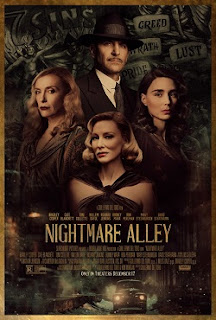
Nightmare Alley (2021)

Nightmare Alley (2021)

A mysterious drifter gets more than he bargained for in del Toro’ flashy but unsatisfying film

Director: Guillermo del Toro

Cast: Bradley Cooper (Stanton Carlisle), Cate Blanchett (Lilith Ritter), Rooney Mara (Molly Cahill), Toni Collette (Zeena Krumbein), Willem Dafoe (Clem Hoatley), Richard Jenkins (Ezra Grindle), Ron Perlman (Bruno), David Strathairn (Pete Krumbein), Mark Povinelli (Major Mosquito), Mary Steenburgen (Felicia Kimball), Peter MacNeill (Judge Kimball), Paul Anderson (Geek), Clifton Collins Jnr (Funhouse Jack), Jim Beaver (Sheriff Jedediah Judd), Tim Blake Nelson (Carny Boss)

There isn’t any magic left in the world, it’s all show and tricks and no wonder. Nightmare Alley is del Toro’s follow-up to his Oscar-winning The Shape of Water and you can’t not admit it’s a triumph of style. It’s a glorious fusion of film noir and plush, gothic-tinged horror. There is something to admire in almost every frame. But it’s also all tricks and no wonder. There’s no heart to it, just a huge show that in the end makes nowhere near the impact you could expect.

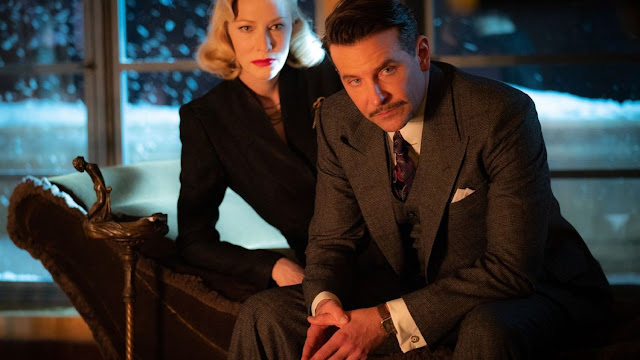
In the late 1930s Stanton Carlisle (Bradley Cooper) is a drifter with a dark past, who is recruited as a labourer in a travelling carnival. Learning the ropes from freak show owner Clem (Willem Dafoe), he’s taken under the wing (in every sense) by mesmerist mind reader Zeena (Toni Collette) and taught the tricks of the art (observation and careful word codes using an assistant to guess names, objects and other facts) by Pete (David Strathairn). Eventually Stanton and his love, circus performer Molly (Rooney Mara), head to the big city where, after two years, Stanton reinvents himself as celebrity mind-reader and medium. There Stanton gets involved with psychiatrist Lilith Ritter (Cate Blanchett) in a long con where he will use the recordings of her sessions with patients to act as a medium to put them in touch with their lost ones. But is there a danger Stanton isn’t ready for in one of his clients, powerful businessman Ezra Grindle (Richard Jenkins)?

Nightmare Alley looks fabulous. But it’s hellishly overlong and curiously uninvolving. It’s like Del Toro fell in love with the whole project and forgot to search for the reason why somebody else would love it. It’s a strangely unshaped film, alternating between long, loving scenes glorying in the dark mood, baroque performances and design but then makes drastic, swift jumps in character psychology that constantly leaves you grasping at engaging with or understanding the personalities of its characters.

Its design is faultless though – it’s no surprise that its only Oscar nominations outside the Best Picture nod were all in technical categories. Dan Lautsen’s cinematography is inky black, with splashes of all-consuming colour. It’s a marvellous updating of film noir, with deep shadows spliced with angles reminiscent of Hammer-style horror. The production design is a labour of love, the carnival sets a hellish nightmare of unsettling shapes, forms and structure contrasting with the art deco grandness of the big city. The design is pretty much faultless, a real labour of love.

But the same effort didn’t go into pacing and story. This is a slow-moving, self-indulgent film, that frequently seems to be holding itself at arm’s length to make it all the easier for it to admire itself. It looks extraordinary, but it’s a frequently empty experience, more interested in mood and striking imagery than character and emotion.

Bradley Cooper gives a fine performance as Stanton. He has an air of cocksure charm, and Cooper skilfully shows this is largely a front of a man who, when push comes to shove, is capable of sudden and unflinching acts of violence. We get an early hint of this when he reacts to being struck by an escaping circus freak with unhesitating brutality. It recurs again and again in the film, and Stanton proudly states his avoidance of alcohol with all the assurance of a man who knows the bottle could unleash dark forces that he could never control. Cooper is vulnerable but selfish and above all becomes more and more arrogantly convinced of his own genius and bulletproof invulnerability, so much so that he drives himself further and further on into self-destruction.

There is some rich material here, so it’s a shame that for all that we never really seem to be given a moment to really understand who he is. Much has to be inferred from Cooper’s performance, since the film seems content to state motivational factors – troubled parental relationships, greed, ambition, a desire to make something of himself – without ever crafting them into a whole. Stanton remains someone defined by what he does.

And Stanton is the only character who gets any real oxygen to breathe, with the others largely ciphers or over-played caricatures. Rooney Mara as his gentle love interest is under-developed and disappears from the film for long stretches. Cate Blanchett gives a distractingly arch performance, somewhere between femme fatale and Hannibal Lector and is so blatantly untrustworthy it’s never clear why Stanton (an expert reader of people!) trusts her completely. Richard Jenkins is miscast as a ruthless businessman, lacking the sense of danger and capacity of violence the part demands.

Most of the rest of the cast are swallowed by the long carnival prologue, that consumes almost a third of the film but boils down to little more than mood-setting and a repeated hammering home of a series of statements that will lead into a final scene twist (and I will admit that is a good payoff). The carnival seems like a self-indulgent exploration of style, and several actors (Perlman, Povinelli and even Collette) play roles that add very little to the film other than ballooning its runtime.

The earlier section would have perhaps been better if it was tighter and more focused on Stanton and his mentor, well played by David Straithairn. I appreciate that would have been more conventional – but it would also have been less self-indulgent and helped the opening third be less of a stylish but empty and rather superfluous experience (since the film’s real plot doesn’t start until it finishes). Drive My Car demonstrated how a long prologue can deepen a whole film – Nightmare Alley just takes a long, handsome route to giving us some plot essential facts, without really telling us anything engaging about its lead character.

It makes for an unsatisfying whole, a cold and distant film packed with arch performances – although Cooper is good – and events that frequently jump with a dreamlike logic. It’s a marvel of design but way too much of a good thing, and constantly seems to stop to admire itself in the mirror and wonder at its own beauty. It becomes a cold and arch study of a film not a narrative that you can embrace. And you can’t the same about many of Del Toro’s other films – from Pan’s Labyrinth to Pacific Rim they’ve got heart. Nightmare Alley doesn’t really have that.

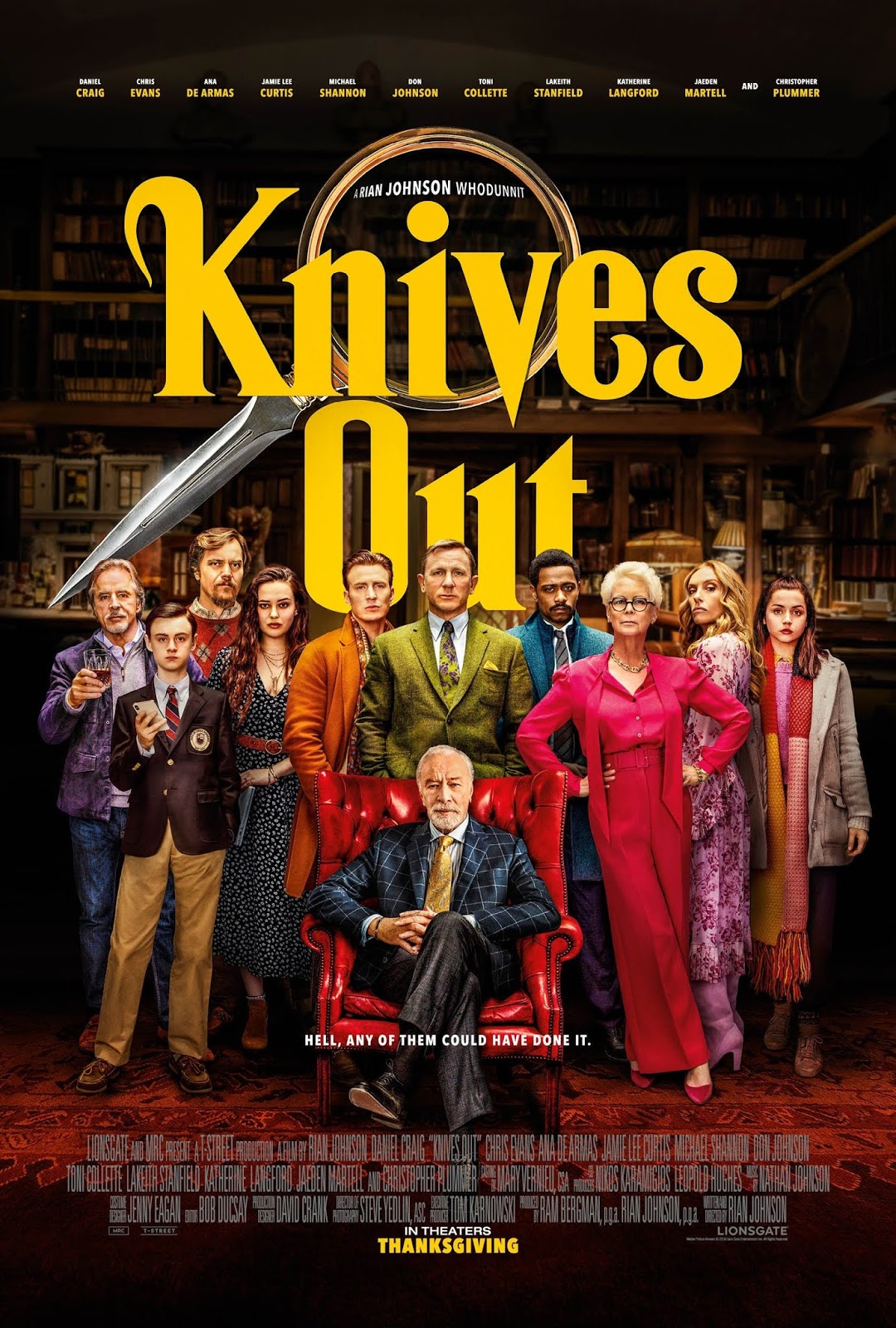
Knives Out (2019)

Daniel Craig investigates in Rian Johnson’s amusing Christie-pastiche Knives Out

Director: Rian Johnson

Cast: Daniel Craig (Benoit Blanc), Chris Evans (Random Drysdale), Ana de Armas (Marta Cabrera), Jamie Lee Curtis (Linda Drysdale), Michael Shannon (Walt Thrombey), Don Johnson (Richard Drysdale), Toni Collette (Joni Thrombrey), Lakeith Stanfield (Lt. Elliot), Katherine Langford (Meg Thrombey), Jaeden Martell (Jacob Thrombey), Christopher Plummer (Harlan Thrombey), Noah Segan (Trooper Wagner), Frank Oz (Alan Stevens)

Rian Johnson’s film CV is full of interesting (and affectionate) twists on assorted genre films. While many will be most familiar with his controversial and iconoclastic Star Wars film The Last Jedi, Knives Outfits more neatly in with his imaginative twist on time-travel Looper and, most tellingly, his film-noir high-school thriller Brick. Knives Out plays into Johnson’s love of old-school, all-star, Agatha Christie style murder-mysteries. Johnson even pops up before screenings of the film to beg viewers – like Alfred Hitchcock in his prime – to not give away the twist endings. So I won’t do it here. Rian Johnson’s way too sweet to disappoint.

The murder that leads to the mystery is Harlan Thrombey’s (Christopher Plummer), the film opening a week after his apparent suicide (or was it!?). If everything is so straight forward, then who has anonymously hired “last of the gentlemen sleuths” Benoit Blanc (Daniel Craig) to investigate the death? There seems to be no shortage of motives either: in his last day, Thrombey threatened to expose his son-in-law Richard’s (Don Johnson) affair, cut-off his daughter-in-law Joni’s (Ton Collette) allowance due to theft, fired his youngest son Walt (Michael Shannon) as head of his publishing company and cut Richard and his daughter Linda’s (Jamie Lee Curtis) playboy son Random (Chris Evans) out of his will. On top of that, his live-in-nurse Marta (Ana de Armas) may have secrets of her own. Will Blanc be able to unpick this web?

Going too far into detail around Knives Out would be to spoil the general sense of fun that Johnson’s film manages to create. The film is not a spoof or parody in any way, but a very intelligent reworking of genre tropes and Agatha Christie style plot twists (a distant house, a mysterious killing, a host of suspects, a barrage of motivations, a house crammed with bolt holes, blackmail, muddy footprints, medicine and acting all get a look in), all governed by an eccentric detective bubbling with his own unique methods for solving a case. It’s all told with a brilliant affection, a wonderful twinkle and a great deal of invention and intelligence from Johnson. 

It’s also a film with a brilliantly assembled plot – and a neat reminder of what a strong writer Johnson is, as well as an inspired stylist. The film creates a host of superb characters for the audience to enjoy and puzzle over – each of them of course attracting a wonderful company of actors, a perfect mix of the skilled and wildcard choices, all of whom pay off. It’s also a structurally daring film: it reveals what it leads many to think is its full hand very early in the film, before subtly revealing that there are multiple mysteries wrapped up within the main mystery (“a doughnut within a doughnut” as Blanc puts it in his own unique way).

And interestingly the film more and more revolves around Marta, its seeming Captain Hastings-figure (or Watson as the film prefers to quote). Played with a charming guilelessness and honesty by Ana de Armas (in more ways than one, since all lies cause Marta to vomit, a joke that sounds crass but is executed perfectly throughout), Marta is the eyes we follow the film’s plot through, meaning we discover events as she does. Marta’s decency and honesty also work as a wonderful device to flag up the increasing hypocrisy and mean-spiritedness of Thrombey’s family. 

The Thrombey clan are an extraordinary group of self-obsessed, greedy and selfishly entitled so-and-sos, who seem to be lacking all expected principles. From Jamie Lee Curtis’ domineering elder daughter, who believes she is a self-made-woman but quickly resorts to bullying when she wants something, to Michael Shannon’s softly spoken but bitterly two-faced Walt, to Toni Collette’s seemingly liberal lady of the people Joni, who is actually as lazy and entitled as all the rest. It’s a host of delightful performances, not forgetting Don Johnson who is a revelation as Curtis’ conniving husband and Chris Evans (having a whale of a time) as the waspishly intelligent, smirking playboy.

Each of the family is as convinced of their own virtue as they are indifferent to those around them. Is it any wonder Thrombey wants to be shot of all of them? Even with the good-natured Marta, none of the family seem to have a clue of anything about her (much as they protest she is part of the family), each of them seemingly naming at random some South American country she hails from and each member in turn telling her confidingly that they would have loved to have had her at the funeral, but they were outvoted by the rest. It makes for a perfect collection of suspects for our detective.

Benoit Blanc himself is a fascinating collection of mannerisms and little touches. The name brings to mind the idea of Hercule Poirot, and Blanc has touches of the man’s arrogance and humanity. Craig has a whale of a time with the part, lacing it with a Southern charm and an eccentric swagger. It’s a part though that actually is a bit of a homage to Columbo, with Blanc also encouraging people to underestimate him and not take him seriously, only to suddenly reveal his insight (including in a last act revelation that is so pure Christie that super-fan Trooper Wagner can barely contain his glee). Blanc is in any case a brilliantly deployed near decoy protagonist, one who Johnson is encouraging us to underestimate as much as most of the characters do.

Thrombey’s murder – and Thrombey has a slight air of Agatha Christie to him, not least the fact that he has written the same number of best-selling books as Christie – is the key to it, and hinges on the overcomplex mind of the great murder writer himself. Johnson’s script is superbly playful, brilliantly written and a delight for murder mystery fans, full of wit and invention and also a very genuinely constructed and intelligent murder mystery. A terrific, playful and witty little treat.

The Hours (2002)

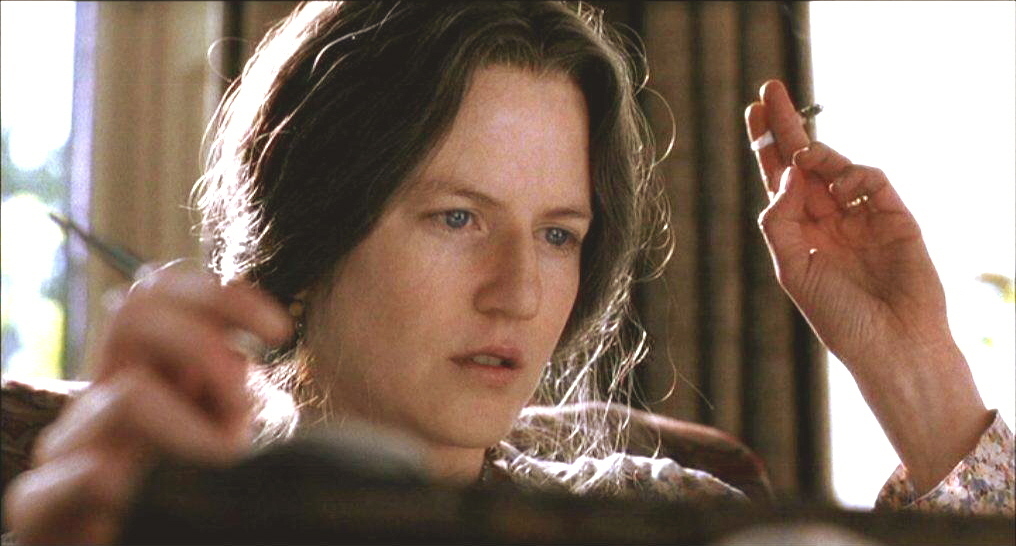
Nicole Kidman’s Oscar winning role produced a gallery of nose based puns, everyone convinced they could sniff out comedy gold

Director: Stephen Daldry
Cast: Nicole Kidman (Virginia Woolf), Julianne Moore (Laura Brown), Meryl Streep (Clarrisa Vaughan), Stephen Dillane (Leonard Woolf), Ed Harris (Richie Brown), Allison Janney (Sally Lester), Claire Danes (Julia Vaughan), Jeff Daniels (Louis Waters), John C Reilly (Dan Brown), Toni Collette (Kitty), Miranda Richardson (Vanessa Bell)

I remember when this film was released that it was garlanded with much praise as an intelligent and compassionate piece of filmmaking and a literate masterpiece. Well I’ve never seen it before and I have to say it holds up pretty well, even though it’s much more of a solid, impressive piece of professional film making than anything you might call a masterpiece.

The film covers three time periods each looking at one day in the life of three different women.  Inspired by Virginia Woolf’s novel Mrs. Dalloway, the day we see encapsulates in microcosm the life of each women. So we have Nicole Kidman as Virginia Woolf struggling to deal with depression while working on Mrs.Dalloway; Julianne Moore as a depressed 1950s housewife trapped in a suburban marriage; finally Meryl Streep as an editor in the 200s who has dedicated her life to looking after a poet friend who is dying of AIDS.

Each of these three plot lines are carefully intercut with both sharp scriptwriting and patient direction (Hare and Daldry’s stage experience here is a real boon for a concept that is actually quite theatrical). Although the opening sequence of the film suggests we might be in for a dizzying series of intercuts (the time period in this sequence switches almost every shot) it soon settles down into some well structured conversation scenes, moving almost in a cycle from our plot lines to another and only rarely directly cutting mid scene from time line to time line.

Of the plot lines I found Meryl Streep’s more modern day plot the most engaging and that Streep’s performance as the patient martyr carried the heart of the film. This was despite Ed Harris’ overblown performance as the dying poet, one of those two scene cameos that draw far more praise than they deserve. But this story has a tragic simplicity and Streep brings a lifetime of vicarious hopes and dreams out from every beat of the day.

Nicole Kidman however won the notice and awards as Woolf. Well deserved as these notices were, this is a more traditional part with clearer “award worthy” acting moments. While these are excellently done (Stephen Dillane is terrific as Leonard Woolf), the Woolf parts don’t quite link with the two other plot lines and, for me, didn’t carry the same emotional force that the tragedy of normal lifes did in the later plot lines.

Julianne Moore also does great work as a depressed housewife who lacks the emotional articulacy to fully understand her feelings, though the decision to introduce a direct link between the 1950s and 1990s plot lines later in the film does mean that the Woolf plot line feels even more like a slightly disconnected story. But this section of the film crackles with claustrophobia and Moore demonstrates the confused sexuality below the surface of Americana.I feel like I’ve been hard on this film, which is a very professional piece of work with some great performances and some real emotional high points. There are some great cameos from classy actors like Toni Collette, Jeff Daniels, Miranda Richardson, John C Reilly, Claire Danes and Allison Janney. It also is a very sensitive exploration of the pressure sexuality and emotions can press on people – even in the 1990s where homosexuality isn’t a dirty secret, Streep’s character still has more than enough confused emotional hang ups to sort out.

It’s a very good film but it’s so professionally done and smoothly assembled, the acting so sharp and on the money, that I’m not sure if there is as much heart behind the scenes in its making than appears on screen.