
Tag: Tony Hale

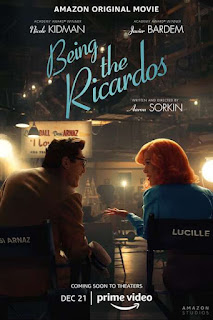
Being the Ricardos (2021)

Being the Ricardos (2021)

I Love Lucy is bought to life in this behind-the-scenes drama that bites off more than it can chew

Director: Aaron Sorkin

Cast: Nicole Kidman (Lucille Ball), Javier Bardem (Desi Arnaz), JK Simmons (William Frawley), Nina Arianda (Vivian Vance), Tony Hale (Jess Oppenheimer), Alia Shawkat (Madelyn Pugh), Jake Lacy (Bob Carroll), Clark Gregg (Howard Wenke), John Rubenstein (Older Jess Oppenheimer), Linda Lavin (Older Madelyn Pugh), Ronny Cox (Older Bob Carroll)
A film about I Love Lucy is always going to lack cultural cache outside of the US: it would be the same if a British film about Dad’s Army or Hancock’s Half Hour played there. Without a legacy of growing up on endless re-runs, I think a lot of British audiences (like me) will be left playing catch-up working out who the stars are and what the show is about.

Sorkin’s Being the Ricardos follows one week in the making of I Love Lucy in 1952. It’s a big week. There are rumours of infidelity (from him) in the lives of the married co-stars Lucille Ball (Nicole Kidman) and Desi Arnaz (Javier Bardem). On top of that, the media is running stories that Ball is a card-carrying communist (not completely true). And finally, she’s pregnant, something the network can’t imagine would be acceptable to include in a family show. All these problems come to a head as that week’s show is finalised, rehearsed and shot.

Sorkin’s film is by far and away at its best when dealing with the backstage mechanics behind bringing a TV show to the screen. Which perhaps isn’t a surprise, as that is obviously material he’s very familiar with. The film is fascinating at showing the technical side of things like rehearsals, and it’s very illuminating on the dedicated perfectionism Ball bought to making the comedy work. We see every single gag being worked on over and over to mine the maximum number of laughs from it. There are long back and forth conversations on timing, positioning and nuances of line delivery.

There are similarly fascinating ideas during scenes in the writers’ room. A huge board maps out the details of future episodes. The writers – a neatly squabbling but fundamentally loyal Alia Shawkat and Jake Lacy, headed up by executive producer Tony Hale – are constantly pushed to fine-tune their ideas, while passionately defending many of their own jokes to the sceptical stars.

A sequence essentially showing Ball and the writers spit-balling ideas that will develop into future set-pieces is particularly well done. Sorkin also comes up with a neat visual concept showing how Ball considers the impact of the gags: events from the show play out in black-and-white then switch to colour as the action pauses and Ball considers what to do next to get the most laughs. It’s all part of the film’s primary strength: a fascinating look at the energy and passion required to produce a half-hour sitcom, be it arguing over camera placement to a sleepless and worried Ball calling her co-stars to the studio in the wee small hours to fine-tune a pratfall.

Where the film is less certain is all the other stuff it tries to cover. Being the Ricardos is almost the dictionary definition of a film biting off more than it can chew. It tries to cover: the making of a TV show, McCarthyism, a biography of the marriage of the two stars, the sexism of network TV, racial unease at the Cuban Arnaz playing Ball’s husband, the sexual prudishness of the 1950s, and expectations around gender roles. On top of which, Sorkin’s film trumpets continuously that this was the “most difficult week ever”. It’s an onslaught of stakes the film finds hard to deliver on.

For starters, most of the action focuses on the mechanics of making the show – mechanics that surely would be the same every week. The communist plotline is introduced then largely dropped for most of the film until the final rousing hurrah. McCarthyism is barely tackled, other than a new perspective from Arnaz, who remembers being forcibly driven from Cuba by Communists. Awkward flashbacks fill in some of the backstory around Lucille and Desi’s meeting but end up feeling like superfluous additional information that adds nothing to anything other than the runtime.

Tensions in their marriage bubble away before finally coming to a head, as if Sorkin didn’t want to spoil the rat-a-tat dialogue with some deeper content. The film is very good at showing what a great team they made: Ball’s creativity and comic genius matched with Arnaz’s business-sense and ability to plan every aspect of the show’s technical and financial set-up. But again, more could have been made of this – too often it’s an idea crowded in amongst others, with a tone that can’t decide how it feels about Arnaz’s possible betrayal or Ball’s fixation on it.

More could have been made about the prudish and sexist struggles Ball and Arnaz went through to get her pregnancy integrated in the show. It’s a fascinating realisation that the implication that a happily married couple must have had sex to produce a baby was anathema to TV networks in the 50s. A film that focused on the battle to get this integrated into the show – and the impact that doing so had on America and television – would not only have been more focused, it would also have played into the film’s real strengths: the mechanics of actually making television. As it is, this sense of the struggle Ball had to get due recognition in a male-dominated industry is lost.

As the two stars Nicole Kidman (under layers of latex to transform her facial features into Ball’s) and Bardem are very good, Kidman in particular brilliantly conveying Ball’s comedic genius as well as her self-doubt and insecurity, expressing itself in worries about her marriage to making sure her female co-star looks less attractive than her on the screen. Kidman pounces on Sorkin’s fast-paced dialogue and provides much of the film’s drive and focus. There are also neat supporting turns by JK Simmons and especially Nina Arianda as their co-stars.

In the end though, yet again, it feels like Sorkin the writer is ill-served by Sorkin the director. While the film is more sharply directed than his others, it lacks focus, discipline and drive, like Sorkin can’t bear the idea of cutting some of his own words and ideas so tries to include them all. It ends up meaning nearly all of them lack the impact they should have.

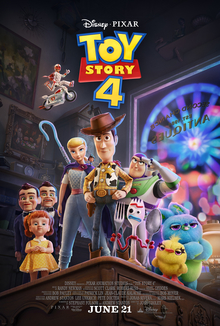
Toy Story 4 (2019)

Woody is tempted by a new life in Toy Story 4

Director: Josh Cooley

Cast: Tom Hanks (Woody), Tim Allen (Buzz Lightyear), Annie Potts (Bo Peep), Tony Hale (Forky), Keegan-Michael Key (Ducky), Jordan Peele (Bunny), Christina Hendricks (Gabby Gabby), Keanu Reeves (Duke Caboom), Ally Maki (Giggle McDimples), Joan Cusack (Jessie)

Probably the hardest thing about making the fourth film in an acclaimed, perfectly-formed trilogy (yup) is justifying its existence in the first place. That’s basically the main task that faces Toy Story 4 – does it manage to exist without ruining the other three? And was there any need to go back to a story that had already been pretty much finished perfectly.

After the third film, Woody (Tom Hanks), Buzz (Tim Allen) and friends are now settled with their new child, Bonnie (an imaginative 6 year old). But Woody is being played with less and less, and is struggling with the adjustment from being Andy’s most important toy to becoming a little-used toy in the box. Taking it upon himself to accompany Bonnie to her first day at kindergarten, he sees her use an art-class to turn a spork into a toy – a toy that quickly comes to life as Forky (Tony Hale). As Bonnie’s parents try to ease her anxiety about starting kindergarten by taking her on a road-trip, Woody obsessively tries to train the reluctant Forky – who doesn’t want to be a toy – in how to be a favourite toy.

When Toy Story 4 rapped up, I basically said I didn’t really need to see it again. That’s quite a sad statement to make considering the original trilogy of films are so damn good. But this never really feels like it does justify its existence. Toy Story 3 finalises the whole saga so well with Woody and the other toys coming full circle, having helped Andy grow up and now being passed to Bonnie to help her deal with her childhood. It’s a beautiful, heart-warming story – and there isn’t a need to see what happens next. 

Toy Story 3 ended with Woody accepting that Andy has grown up, choosing to stay with his friends as a toy rather than going to college with Andy. But here we need to hit the reset button so that Woody is now missing Andy and his previous status – but is also in denial about this. I think there is something in this that is working towards Woody working out whether he wants to continue with a life of dedicated service or whether he wants to move on and change his life completely. Of course the scales are weighted a bit by the fact Woody is no longer a favourite toy and – worse! – is gathering dust in a cupboard. But it’s all a bit unclear and gets a bit lost.

Part of this is the amount of time given over to Forky, a rather trying and faintly irritating “comic” character, whom I could certainly have done without. He exists primarily as a motivation for Woody to remain at the funfair the road-trip gets stuck at, but the long stretch of time they spend apart means the mentor-mentee relationship the film starts with trails off and disappears for a large chunk of the film. As a mirror on Woody, the part is a failure.

In fact most of the plot gets stuck at the funfair along with the road trip, as the film introduces Gabby Gabby (voiced by Christina Hendricks) a voice-box doll from the 1950s with a misfunctioning voice box who has lived her life in an antiques store and dreams of being a real toy. Gabby’s obsessive belief that gaining a working voice-box (from Woody!) will get her the love of a child drives most of the rest of the film, a slightly rambling action-adventure that features Woody, Buzz and a gang of newly-met toys breaking in, then out, then back in to the antiques store. It’s a sprawling series of adventure scenes, that seems a million miles away from the film’s original opening of Bonnie dealing with going to school for the first time.

In fact, poor Bonnie gets almost completely shelved after the first act of the film, along with the rest of the original cast who barely appear. Jessie, Rex, Slinky Dog, Hamm and co are left “guarding the base”, hardly having any impact on the film and kept separate from Woody and Buzz for ages. Since the first three films revolved so heavily around the “family” mechanism of the group of toys, to shelve most of them into background characters seems a real shame. 

Instead the film starts to focus on Woody’s fear of being “a lost toy” – something put sharply into perspective by him re-encountering Bo Peep (Annie Potts) his sometime love-interest from films 1 and 2 (not present at all in 3). With a “nine years earlier” flashback opening the film, showing Bo Peep being gifted on to a new child, the film catches up with her having escaped from Gabby’s antiques store and now leading a free life, without a child, doing what she wants, when she wants. There is some decent chemistry between the two, but more could have been made of showing Woody slowly seeing that there are positives in not having a child as well as the negatives he has always associated it with. But like so many things in the film, with so much going on and so many new characters being introduced, the thematic issues get lost.

There is just too much plot. Essentially Forky exists to give Woody a reason to remain at the funfair. Gabby exists as an obstacle to stop them leaving. The funfair is a sort of existential trap for the heroes. But everything just bogs down the film, making the storyline increasingly top heavy. Buzz seems to have taken a step or two down in intelligence. Most of the new characters don’t engage as well as the old ones, even though Keanu Reeves has great fun as a nervous stunt toy. But the film has no economy, it gets crowded over with events.

Which is a shame as there is a simple thematic story here of Woody accepting that one stage of his life has finished and he needs to move on to the next. There was, I am sure, a way of telling this story that didn’t feature all these new characters, the confusing setting and the overlong adventure sequences. There was a way of doing this in parallel with Bonnie needing to grow up a little and start going to school. Of making it harder for Woody to think about leaving, because he has the whole family of toys with him (rather than on the sidelines). But the film doesn’t do it. It’s all too often flat footed, slow and missing the emotional target. It’s Toy Story so there are good moments. But they should have stopped at three.