Tag: Topol

Fiddler on the Roof (1971)

Fiddler on the Roof (1971)

Film adaptation successfully aims for drama and emotion over showbiz bells and whistles

Director: Norman Jewison

Cast: Topol (Tevye), Norma Crane (Golde), Rosalind Harris (Tzeitel), Michele Marsh (Hodel), Neva Small (Chava), Molly Picon (Yente), Paul Mann (Lazar Wolf), Leonard Frey (Motel Kamzoil), Paul Michael Glaser (Perchik), Ray Lovelock (Fyedka), Zvee Scooler (Rabbi), Louis Zorich (Constable), Alfie Scopp (Avram), Howard Goorney (Nachum), Barry Dennen (Mendel), Ruth Madoc (Fruma-Sarah)

Sometimes it’s a surprise to remember Fiddler on the Roof is one of the most successful musicals of all time. A sensation when it opened on Broadway in 1964, it became the first musical to pass 3,000 performances and was soon playing all over the world. Based on a series of stories by Sholem Aleichem about life in a Jewish village in turn-of-the-century Imperial Russia, it feels like odd material for a hit. But it’s universal themes of the struggles between generations, persecution of a community and finding a balance between tradition and change struck a universal chord. So, it shouldn’t be a surprise that Jewison’s film version became the biggest hit of 1971.

It’s 1905 and milkman Tevye (Topol) lives his life by the traditions of his faith and Jewish community, balancing a series of competing demands like a fiddler perched on a roof playing his fiddle (it’s a tortured metaphor but it’s the title…). He has three daughters – sensible Tzeitel (Rosalind Harris), romantic Hodel (Michele Marsh) and kind Chava (Neva Small) – all of whom need marrying off, ideally to suitable husbands. But can life continue for ever when you live in a country rife with antisemitism, with pogroms as regular as clockwork?

Fiddler on the Roof was perfect material for a director as passionate about social issues as Norman Jewison. It balances comedy and theatricality very effectively with gritty realism and a sense of generational trauma at the suffering inflicted on innocent people for no reason other than their heritage. Although the film is undoubtedly too long (at nearly three hours), this does make the mood transition from gentle comedy to loss and bleakness something slow but relentless, helping it carry even more impact.

Jewison effectively translates stage musical to screen reality. Fiddler on the Roof is neatly edited, it’s opening number Tradition showing a montage of everyday-activities in the village (meat chopped, clothes sewn, pray books opened) with every action cut to mirror the song’s beat. It avoids glossy choreography in favour of something either more cinematically literate like this or more intimate, with many songs delivered in medium-shot, the camera zeroing in on the thought process and allowing the actors to give intense, emotional renditions.

Not that Jewison isn’t averse to a big theatrical number. Matchmaker, Matchmaker is the first number that could be on the Broadway stage but gets away with its moments of classical beats of choreographed movement because of the playfully-natural delivery of Harris, Marsh and Small. Jewison saves his real fire for Tevye’s Dream, liberated from the film’s realistic approach by happening in a dream. This number is pure theatre, with a chorus of dancing ghosts and a diva-ish spectre (played by Hi-de-Hi’s Ruth Madoc of all people) giving it everything they’ve got.

But Fiddler on the Roof’s main beat is realism. Oswald Morris’ Oscar-winning cinematography – its slightly sepia tone captured by stretching a pair of tights over the lens, its gauze clearly visible at points – displays a world that is, for all the vibrancy of the people living in it, frequently cold, unhospitable and difficult. That matches the attitudes of their Russian rulers, prejudiced bullies whose local representative stutters the sort of excuses about “just following orders” that are even more chilling with our knowledge of the horrors to come forty years later.

What makes the village flourish is its community. Run by tradition and faith, where (for better or worse) everyone understands their roles, duties and expectations. Fiddler on the Roof is about how far these can be pushed in changing times, structured around a man’s choice of his daughter’s husbands. Can Tevye accept a daughter choosing for herself? How about a daughter marrying a firebrand radical who wants to leave the village? How about another wanting to marry a gentile?

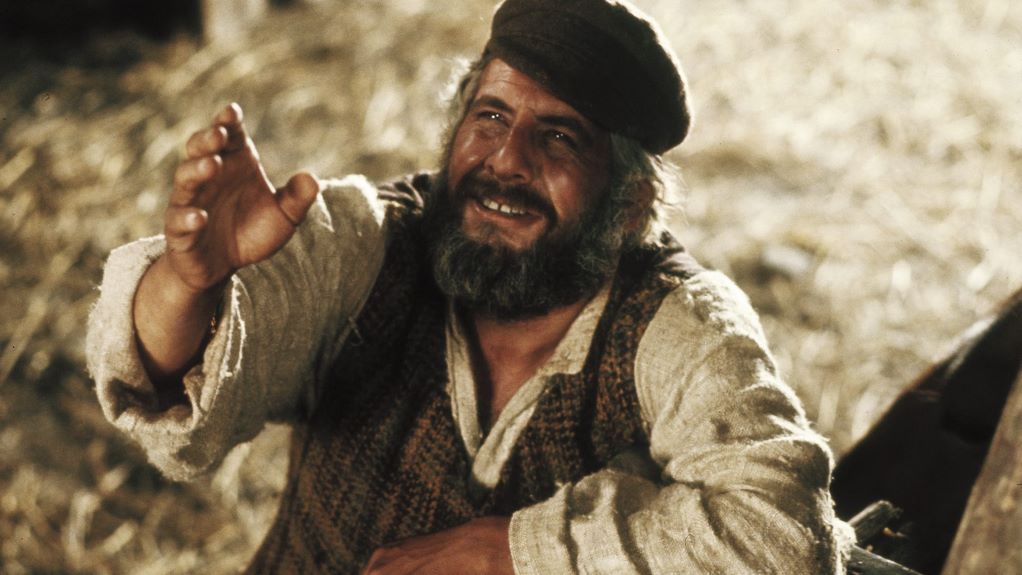
They are ideas initially beyond the ken of Tevye, a firm traditionalist with passing dreams of riches but who wants a world where nothing changes. To make this dyed-in-the-wool conservative a warm and entertaining figure, requires the right casting. In America, the role was associated with its originator Zero Mostel (desperate to play it on film). But Jewison felt Mostel’s personality was too large for cinema, that Mostel’s theatricality would work against the realist film he wanted. Instead, he cast the Israeli actor playing the role in London’s West End, Chaim Topol.

It was a masterstroke (much as it crushed Mostel and outraged fans). Topol, like Yul Brynner in The King and I, would define his career with the role, playing it over 3000 times on stage in a series of productions over almost forty years (eventually Harris would graduate from playing his daughter to his wife!). Astonishingly he was only 35 in 1971 – a brilliant combination of make-up and Topol’s gift for physical acting makes him feel 25 years older – and Fiddler, for a large part, relies on his charisma and charm. Topol is as comfortable with the conversational address to the camera – which dominates much of the film’s opening – as he is with the world-weary sadness and frustrated anger Tevye responds to the changing world around him with.

Topol’s performance works in perfect tandem with Jewison’s aim to ground and avoid flights of whimsy or vaudeville comedy. The harsh conditions don’t dampen the warmth in the community – wonderfully captured in the marvel that greets the arrival of tailor Mostel’s (an endearing, Oscar-nominated, Leonard Frey) sewing machine – and means the Tsarist repression and gangs of Cossacks who ride in, torches in hand, to burn and pillage carry real impact.

Jewison’s film carries foreknowledge of the Holocaust throughout, not dodging the knowledge that communities like this would be destroyed under Nazism. The film’s closing exodus may bring hope for Tevye and family (bound for New York) but also brings death to those who speak of heading to Krakow. It’s part of understands why tradition is so important to Tevye: as the imaginary fiddler follows Tevye’s family on the road, we understand the link to a shared cultural past is what gives identity and hope to a people facing persecution at every turn for thousands of years.

Fiddler on the Roof mines it’s material for emotion and character over showbiz bells and whistles. While it undoubtedly takes too long to explore in depth its slight plot, its length does conversely add even more impact to its closing look to the future. A fine musical adaptation.

For Your Eyes Only (1981)

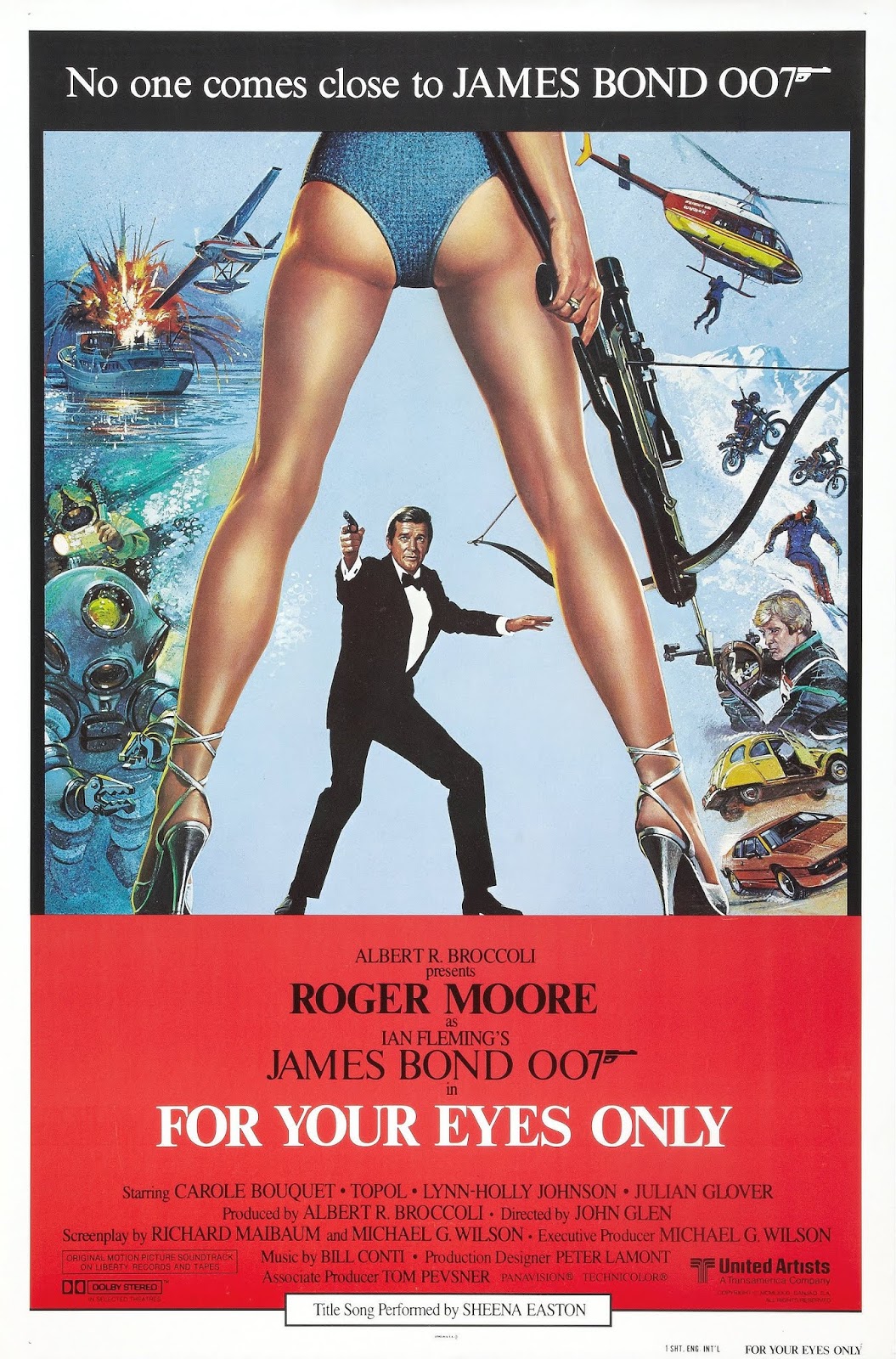
Roger Moore takes aim in this most low-key of his adventures – and one of his best

Director: John Glen

Cast: Roger Moore (James Bond), Carole Bouquet (Melina Havelock), Topol (Milos Columbo), Julian Glover (Aristotle Kristatos), Lynn-Holly Johnson (Bibi Dahl), Michael Gothard (Emile Leopold Locque), Cassandra Harris (Lisl van Schlaf), John Wyman (Erich Kriegler), Desmond Llewelyn (Q), Jill Bennett (Jacoba Brink), James Villiers (Bill Tanner), Geoffrey Keen (Minister of Defence), Walter Gotell (General Gogol), Lois Maxwell (Miss Moneypenny), Jack Hedley (Sir Timothy Havelock)

Where could Bond go after he went to space in Moonraker? Another planet? The future? The producers of Bond decided they couldn’t top that – probably wisely – so for Bond’s next outing they went back to low-key basics. For Your Eyes Only Bond would find himself in an old-school Cold-war game of cross and counter-cross, scrambling for the Russians for ownership of what looks like a cross between a typewriter and child’s cash till toy. 

That toy is the ATAC (though it might as well be called MCGUFFIN) a ministry of defence system used to co-ordinate nuclear subs or some such. When the ship it’s on sinks somewhere off the coast of Greece, MI6 and the KGB swing into gear to be the first claim it from the Ocean depths. So Bond is off to Greece to investigate, not knowing who to trust: should it be MI6 contact and shipping magnet Kristatos (Julian Glover) or playboy smuggler and former resistance man Columbo (Topol)? And how will he deal with Melina Havelock (Carole Bouquet), the long-haired, half-Greek archer intent on revenge on whoever ordered her parents killed while they (without her knowledge) searched for the ATAC? Either way it will involve chases, deadly winter sports, flirtatious teenage ice skaters and a death defying climb up to a monastery at the top of a mountain.

For Your Eyes Only is one of those quiet gems of Bond movies that, because it is about something quite small scale and quiet compared to the films it precedes often gets overlooked. It’s certainly the point where Moore should have stopped making the films – when your turning down the advances of someone because she’s too young (as he does ice skater Bibi) you know it’s time to go – and to be honest Moore was flagging already here, clearly too old for the action and certainly far too old for Carole Bouquet, who looks like she could have him for breakfast (she struggles to muster much sexual interest in him). But it doesn’t really matter because this is an old-school bit of spy cool, mixed with some decent but grounded fights and chases and shot with a loving eye for Switzerland and Greece (with plenty of clichéd visuals and sound cues thrown in from both as you would expect).

The producers wanted to shy away from the gadget filled antics of the previous films. As if to make the point, Bond’s car is destroyed almost immediately, forcing him to make a getaway at one point in a bashed up Citroen 2CV. The long sequence in the film where Bond is chased around a ski resort – which takes in cross-country skiing, a ski jump, a toboggan and several other winter sports is remarkable for nary a gadget in sight, with Bond relying on his wits and native skill with skis. Even when ascending the mountain at the film’s end, he uses nothing more than standard climbing equipment, putting his trust in ropes and hooks. It’s possibly the least tech heavy Bond film since Doctor No. There isn’t even a novelty watch and no humorous Q briefing on the gadgets. The only visit to Q’s lab is to use a cumbersome facial recognition system, that hilariously uses computer disks the size of stone slabs loaded into something that today resembles a dishwasher.

Other than that Bond is on his own, and it’s fairly neat to see him go about an investigation and follow a trail – even if Bond is, as usual, a hopeless undercover agent who largely relies on waiting to see who tries to kill him first. The villains, as always oblige, spending most of the film attempting to off Bond for all sorts of confused ill-defined reasons. Perhaps it has something to do with our main villain – the rather low-key Julian Glover, playing possibly the least colourful Bond villain ever, a guy who just wants to sell the ATAC for some cold hard cash – using so many cut outs for his operations, speechless goons (including an early appearance from Charles Dance) and East German skiing champions who seem motivated to kill Bond purely for larks and the evilz.

The first half of the film though is huge fun, watching Bond blunder around the ski resort dodging hits, fighting people, punching out butch hockey players and the like that it hardly matters that most of the plot is pretty inconsequential. When Bond finally stops mucking around in Switzerland and heads to Greece the ATAC is found in about 5 minutes flat (Havelock helpfully left a map with the downed boat coloured in on it, making his daughter’s ability to translate his cryptic notes pretty much useless), while the villain immediately takes this chance to comprehensively unmask himself.

After a further elaborately sadistic attempt to off Bond involving dragging him across coral in shark infested waters (sharks are always such deadly threats in Bond films), Bond unites with Topol to storm the castle in an actually pretty gripping and vertigo inducing climb sequence, another triumph of John Glen’s mastery of the action sequence. It’s a nice touch as well to introduce the “guest star” of the film not as the antagonist but as a protagonist ally, a neat twist that must have come as quite a shock back in the day. Topol plays his role with realish, cracking nuts, gags and heads with equal glee.

The film also heads into some dark places. For all his charm, gallantry and debonair wit, Moore does his meanest thing in years here when he kicks a heavy’s teetering car off a cliff. But that’s a fair repayment for the brutal running over of his mid-film squeeze (played by Pierce Brosnan’s real life late wife Cassandra Harris) earlier on by the same heavy. The early murder of the Havelock’s is surprisingly graphic (and also gives a great reaction shot for Carole Bouquet as she turns and looks back as the plane carrying her parent’s murderers jets away, her eyes screaming “I shall have my revenge!”) and Carole Bouquet’s Melina is determined figure, who does more than her fair share of the action.

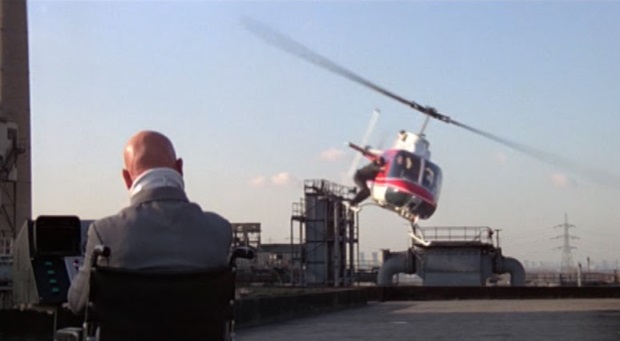
Of course the film can’t endorse too much her need for revenge. “That’s not the way” Bond, like a disapproval uncle, rather prissily tells her several times. Which is a bit rich coming from a man who opens the film by dropping his wife’s murderer down a factory chimney shaft. That opening sequence by the way is a joy, a neat call back to On Her Majesty’s Secret Service (whenever Bond went serious, it referenced Bond’s status as a widower) as well as a the dispatching of a it-could-be-anyone bald, scared, cackling villain with a white cat who makes an ill-advised attempt to kill Bond with a remote controlled helicopter (the film is so anti-Gadgets, only the baddies seem to use them and they don’t even work for them). It’s a neat “fuck you” to Kevin McCloy, at that time in a feud with the producers over the rights to Bond who had refused to allow them to use Blofield or Spectre again in the films. Keen to show they didn’t need Blofield, the producers introduced him in all but name to ignominiously kill him off, his final pathetic words a hilariously meaningless offer to buy Bond a “delicatessen in stainless steel” if only Bond would let him go.

FYEO is a crackingly old-fashioned Bond film that, despite being more grounded, has some great action sequences and a host of actors having a good time. Carole Bouquet is one of Moore’s best Bond girls and Moore himself certainly should have stopped here, this film throwing together one of his best mixes of light comedy, moral uprightedness, playfulness mixed with a dash of cruelty. John Glen did such a good job assembling this one he directed the next four films. It’s not got the smash-and-grab of The Spy Who Loved Me, but it’s an excellent action adventure.

Flash Gordon (1980)


Flash Gordon: Sometimes words fail you

Director: Mike Hodges

Cast: Sam J Jones (Flash Gordon), Melody Anderson (Dale Arden), Max von Sydow (Ming the Merciless), Topol (Hans Zarkov), Ornella Muti (Princess Aura), Timothy Dalton (Prince Barin), Brian Blessed (Prince Vultan), Peter Wyngarde (General Klytus), Mariangela Melato (General Kala), Richard O’Brien (Fico), John Osborne (Arborian Priest), Philip Stone (High Priest Zogo), John Hallam (General Luro)

Well. If almost 40 years on, Flash Gordon is a cult favourite and beloved by millions, then there is hope yet for Jupiter Ascending. By any objective standards, Flash Gordon is a terrible film. But it gets a pass from millions because it’s one people have grown up with. I dread the same reaction to The Phantom Menace from those people whose first exposure to Star Wars was through that film.

Ming the Merciless (Max von Sydow) rules the planet Mongo and decides to destroy the Earth for his own amusement. Disgraced ex-NASA scientist Hans Zharkov (Topol) is the only man on Earth who believes a series of natural disasters are the actions of invaders from space. Zharkov flies a rocket into space to find them – accompanied, for strange reasons, by professional football star “Flash” Gordon (Sam J Jones) and travel agent Dale Arden (Melody Anderson). Arriving at Mongo, they encourage its citizens – especially the forest people led by Prince Barin (Timothy Dalton) and the hawkmen led by Prince Vultan (Brian Blessed) – to unite and rise up against Ming.

Yup you read that right. It’s all as barmy as you might expect. Any film that asks to believe Brian Blessed can fly is always going to be odd. Flash Gordon does at least have its tongue firmly in its cheek. The whole thing is as camp as Christmas. In an age where science fiction and comic books are treated like holy texts, it is at least interesting to see a film that treats its source material with such a breezy lack of respect. The entire film is an exercise in high camp, cheaply put together, that refuses to take anything seriously and actively encourages the respected actors in its cast to take the piss.

So what is Flash Gordon? Is it a big old joke? Yes it probably is. No one is taking it seriously. The actors clearly think it’s a pile of campy rubbish. The producers seem determined to throw as much technicolour cartoon colours at everything as possible. The film is so cartoonish it all but has “Pow!” and “Thwack!” appear on screen as punches land. At a time when Star Wars (and it’s hard to believe it, but George Lucas only made Star Wars because he couldn’t get the rights for this) took its space opera roots rather seriously, this seemed to miss the point completely. It’s a would-be Star Wars rip off that has nothing in common with the tone of the thing its ripping off. Usually that would be a good thing: here I’m not sure it is.

So the dialogue is terrible, the plot line makes no real sense, the film barrels around telling jokes against itself as inopportune moments. Characters shrug off events with no problems at all – at one point a character undergoes brainwashing torture: two scenes later he’s fine (“I just didn’t think about it” he gleefully tells someone. It’s never mentioned again.) The special effects, even for the time, are shockingly bad (the backdrops are sub-Doctor Who. The costumes and design are ludicrously overblown, like an explosion in a campy dressing-up box. It’s a terrible display of excess married with a complete lack of understanding about what made the things it’s trying to rip off successful in the first place. But yet, and yet, and yet it’s still in a terrible, terrible, terrible way quite good fun.

But perhaps the most interesting thing about its campy rubbishness, is how much odd sexual stuff creeps in under the radar. There are also lashings of sadomasochism, incest, orgasms, sex dens, threesomes, swinging, voyeurism – acres of cheeky sexual humour. Ming has a ring that can induce orgasms (it’s so effective on Dale Arden that it’s even commented only Ming’s daughter has had such a response). Ming has a harem, full of opiates to encourage “performance”. There are references to pleasure planets and sex toys. Ming’s daughter is whipped while tied to a bed by Ming’s henchmen (while Ming watches eating some popcorn). The arborians have a bizarre ritual which seems laced with wanking references. It never stops. At least they had some fun.

Some of the actors are also clearly enjoying themselves. Of course Brian Blessed throws himself into it: an actor who never knowingly underplays, Blessed rips through a bizarre role that sees him perform in a jockstrap with some unconvincing wings. Timothy Dalton channels Errol Flynn. Max von Sydow chews the scenery and virtually everything else in sight as a campy, moustachio-twirling Ming. Peter Wyngarde has a great voice and uses it to marvellous effect as pervy security chief Klytus, while Mariangela Melato plays his dominatrix assistant. There are bizarre, eclectic casting choices: so we get Look Back in Anger author John Osborne playing a high priest, Blue Peter’s Peter Duncan as an initiate, and Richard O’Brien (of course!) playing – well to be honest himself.

Sam J Jones is of course simply awful as Flash (wooden, dull and confused). Melody Anderson isn’t a lot better as Dale Arden, while Ornella Muti gets some awful dialogue which she does at least deliver with some conviction (sometimes too much: “Not the BORE WORMS!” sticks in the mind as a bizarre moment of over such over conviction that it simply becomes funny). It’s a bizarre mix of acting styles and overblown, fourth-wall leaning. It’s so bad, I suppose, that to many people it’s good. But actually it gets a little overbearing.

Because nothing is taken seriously at all, the film actually becomes a bit wearing after a while. The writer later regretted playing everything for laughs: it removes any stakes from this ridiculous film. It says a lot that Brian Blessed – the most overblown actor in it – is the only one who really emerges with dignity intact. Blessed at least knows it’s utter crap and plays it like he’s taking the piss in every scene. He commits so fully to the scenery chewing that it sort of works. The rest of the cast can only aspire to his levels of camp. Flash Gordon is a terrible film. But age and fondness have been kind to it, and made it remembered as something better than it is. It’s a misfiring gag with some great Queen songs. It goes on forever, it looks awful but it fails utterly as anything but a joke. But hell maybe that’s enough.