

Kurosawa’s samurai entertainment is overlong but has just enough action and adventure
Director: Akira Kurosawa
Cast: Toshiro Mifune (General Rokurota Makabe), Minoru Chiaki (Tahei), Kamatari Fujiwara (Matashichi), Susumu Fujita (General Hyoe Tadokoro), Takashi Shimura (General Izumi Nagakura), Misa Uehara (Princess Yuki), Eiko Miyoshi (Yuki’s lady-in-waiting), Toshiko Higuchi (Prostitute)
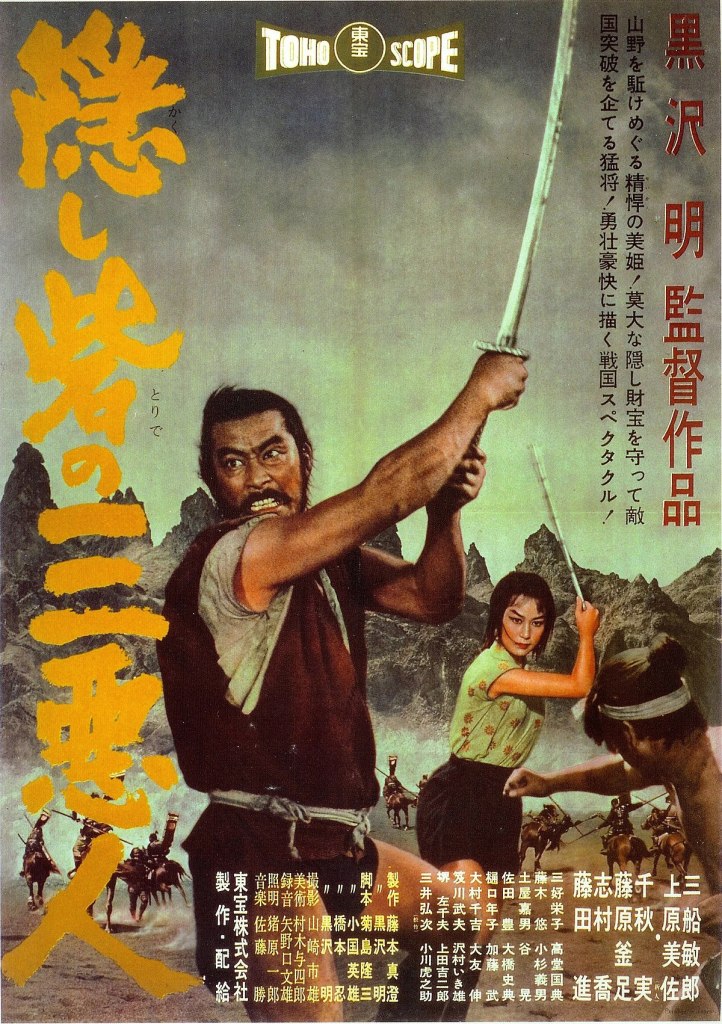
A princess hides in a castle from the wicked forces who have captured her kingdom. Her only hope is a noble general who has concealed the kingdom’s gold in bundles of wood, hidden in a lake at a mysterious castle. The general needs to get the gold and the princess through miles of hostile territory, with only a pair of greedy, incompetent peasants to help. This fairy tale structure is spun by Kurosawa into a samurai action-adventure with Mifune (inevitably) as the general, Misa Uehara as the Princess and Minoru Chiaki and Kamatari Fujiwara as the peasants. It’s good fun, overlong, but an entertaining ride – and one now best known now for its influence over Star Wars.
Kurosawa, after pouring his heart and soul into Throne of Blood, needed to relax. He decided it was time for an entertainment, something to please the crowds. The Hidden Fortress is certainly that, Kurosawa’s first film shot on impressive widescreen Tohoscope, with plenty of horse-bound action and swordplay. It’s really a Kurosawa Westerns, with heroes on the trail on a mission with bad guys to foil. But, as is sometimes the case with Kurosawa, it’s length and scope frequently makes it feel slightly indulgent, while it’s mix of comedy and drama doesn’t always sit comfortably together.
The Hidden Fortress is though highly cinematic. As well as Kurosawa’s enjoyment of the wide-angle lens – soaking up the slopes of Mount Fuji, often rolling in a beautiful mist – it frequently employs Kurosawa’s love of fast-editing tricks, in particular fast wipes to move us seamlessly from one place and time to another (one of many flourishes that influenced George Lucas who made these Kurosawa wipes internationally famous). A horse charge, where General Makabe chases down the samurai hunting them, is a grippingly frenetic with its pace and energy.
Kurosawa mixes this with comedy, though his unusual POV characters. In another move cited by Lucas’ as the inspiration for C3PO and R2D2, much of The Hidden Fortress takes place from the perspective of its peasant sidekicks. But, unlike the genial droids, Tahei and Matashichi are greedy, cowardly and selfish, frequently proving themselves untrustworthy. But, then in a touch of social commentary, perhaps they don’t owe anything to a general who treats them as slaves and (initially) plans to kill them once they are no longer useful. They are played with energetic larger-than-life force by Minoru Chiaki and Kamatari Fujiwara that contrasts neatly with the gruff authority of Mifune.
It’s them we follow from the start, feuding over robbing the body of a slain samurai before being flung into the slave mines of the Princess’ former kingdom. One of Hidden Fortress’ gently played themes is the class difference between these two sons-of-the-soil and the upper-classes they (reluctantly) serve. For starters, that service comes with no choice – it never occurs to Makabe that they have a say in the matter – and they are told almost nothing about the purpose of their journey. They are instead tools for a higher purpose, just as the Princess’ similar-looking maid is sent to town to be captured and executed, to help protect the bloodline of the royal family.
It’s an attitude the Princess – well played by Misa Uehara as a stubborn young woman, full of righteous indignation at her restrictive office – comes to deplore. She, unlike anyone else among the elite, questions the idea of the poor as unimportant puppets for their betters, and it is she who is drawn to protect people, including a mis-treated prostitute who she insists Makabe buys the freedom of. It’s also she – more than anyone else, including the two peasants – drawn towards the anarchic Fire Festival they encounter, with its dismissal of worldly goods and embracing of enjoying life. But, perhaps Kurosawa’s point is it’s only the wealthy who can afford to indulge themselves with such thoughts: peasants have far fewer options and no choice but to scrabble in the dirt for coins.
This social commentary would perhaps be more widely discussed if the film had kept Kurosawa’s original title, Three Bad Men in a Hidden Fortress: a title that tips Tahei, Matashichi and Makabe into the same morally ambiguous pot, all obsessed with worldly needs (money or the continuation of the royal house) over any concerns about those around them. But, somehow, it’s easier to focus on the wheedling greed of the peasants, and overlook the lofty cold distance of the general, because he’s a noble guy, brave and daring who spares his opponent after a fair duel.
It’s also because The Hidden Fortress is less focused on these elements – Seven Samurai did the snobbery of the samurai class and the mixed motives of the working classes more effectively in any case – and more on being a rollicking, road-movie entertainment. It’s Western-style (in both ways) misfit band adventures, features expertly filmed action set-pieces. Best of all the previously mentioned chase, and a gripping one-on-one duel between Rakabe and his rival General Tadokoro (a fine performance of quiet dignity from Susumu Fujita), that is edge-of-the-seat in its mix of graceful camera work and exciting sword play.
The Hidden Fortress is entertaining, but it’s hard to escape the feeling there is too much of it. Despite not being as long as Seven Samurai, it feels less forceful narratively, largely features less compelling characters and is less well balanced between depth and action. Its plot feels almost deliberately lightweight and the resolution feels rushed. The film’s fairy-tale simplicity really needs a relatable hero at its heart – but the focus on the sometimes irritating peasants means we don’t get that. Fundamentally, The Hidden Fortress is an adventure story from a director, taking a rest from more complex work. It entertains, but feels like it lives in the shadow of other films, even before its connection to Star Wars turned it into a footnote in another film’s story.
 Movie Musings