
 |
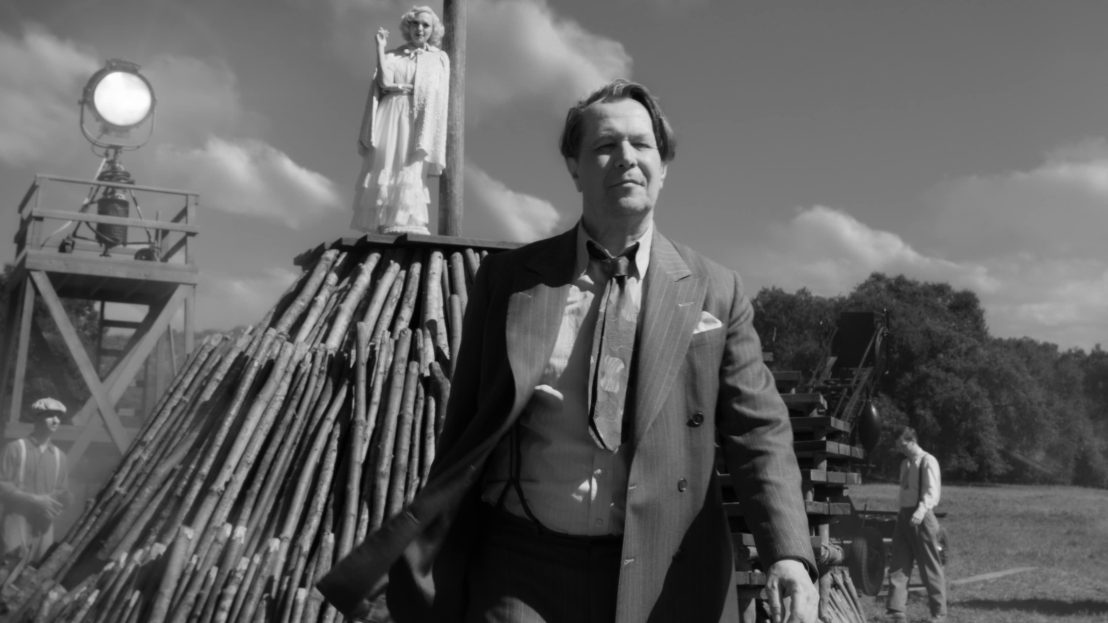
Gary Oldman excels as Herman J Mankiewicz in David Fincher’s bitter Hollywood epic Mank |
Director: David Fincher
Cast: Gary Oldman (Herman J Mankiewicz), Amanda Seyfried (Marion Davies), Lily Collins (Rita Alexander), Arliss Howard (Louis B Mayer), Tom Pelphrey (Joseph L Mankiewicz), Charles Dance (William Randolph Hearst), Sam Troughton (John Houseman), Ferdinand Kingsley (Louis B Mayer), Tuppence Middleton (Sara Mankiewicz), Tom Burke (Orson Welles), Joseph Cross (Charles Lederer), Jamie McShane (Shelly Metcalfe), Toby Leonard Moore (David O Selznick)

It’s 80 years old, but age has not withered Citizen Kane’s mystique, still one of the greatest films ever made. The story of its creation has intrigued generations, a fascination only increased by the larger-than-life personalities involved, from Orson Welles down. David Fincher’s lovingly made, but bitingly shrewd deconstruction of classic Hollywood, explores the creation of the film by focusing on its credited co-writer Herman J Mankiewicz, the film neatly intercutting between the alcoholic Mankiewicz drafting the screenplay while in enforced retreat and his prime years as a writer-for-hire to the major Hollywood studios of the 1930s.
Mankiewicz is played by Gary Oldman (at 62, already seven years older than Mankiewicz was when he died). A noted wit, Mankiewicz makes an excellent living running the writers’ room at Louis B Mayer’s (Arliss Howard) MGM. Mankiewicz views the work of writing films as slightly beneath him, easy money (“Millions are to be grabbed out here and your only competition is idiots” he cables Ben Hecht). Mankiewicz’s sociability eventually finds him an informal role as “court jester” to newspaper tycoon (and MGM bank roller) William Randolph Hearst (Charles Dance) and he builds a warm friendship with Heart’s shrewd mistress, actress Marion Davies (Amanda Seyfried). The relationship sours as Mankiewicz grows disgusted by the dirty tricks campaign MGM and Hearst launch against the left-wing candidate for governor in 1936. In 1939 Mankiewicz works on the script for Citizen Kane, hired by Orson Welles (Tom Burke) with the support of an assistant Rita (Lily Collins) who helps him craft the words and stay sober long enough to type them.
Fincher’s film can easily be seen as a loving homage to old-school Hollywood. Certainly, Fincher fully embraces 30s filming style. From the carefully crafted period credits to the slightly distorted sound that apes the echoey on-set recording of classic Hollywood, this is a technical masterpiece. Beautifully shot in a series of sultry black-and-white images, with several visual references to Citizen Kane, it looks simply marvellous. The musical score is a brilliant mixture of Herrmannesque and classic Hollywood symphonic music with an edge. Even the casting has a slight old-school Hollywood unreality about it, from Oldman being at least 30 years too old to Amanda Seyfried being too young. Fincher embraces every flourish and stylistic tic from the Golden Era of Hollywood.

But the film is about as far as you can get from rose-tinted glasses. Instead this is a vicious, angry, look at Hollywood’s corruption, that owes as much to Billy Wilder’s Sunset Boulevard. Hollywood is a carnival of greed and abuse of power, where art takes a second seat to cold hard cash (“This is a business where the buyer gets nothing for his money but a memory. What he bought still belongs to the man who sold it. That’s the real magic of the movies!” Louis B Mayer exclaims). Power is abused, lies are peddled to the public (Upton Sinclair, the Democratic candidate for governor, is subtly savaged by MGM-propaganda films) and the rich shamelessly steal from the rest.
The film doesn’t give a pass to the “talent” either. Mankiewicz and his writers’ room – a who’s who of greats, from Ben Hecht to George S Kaufman, SJ Perelman and Charles MacArthur – are blasé and spend as much time playing cards and seducing broads as they do scribbling ideas. Mankiewicz sets the tone, a super-smart wordsmith who thinks the movies are a joke and never invests himself in any of his work, happy to simply pick up a pay cheque. Mankiewicz doesn’t care about the quality and completely misses (or doesn’t even understand or care about) the power of movies. Anyway, his judgement is terrible, denouncing The Wizard of Oz as an epic disaster in waiting and never bothering to ensure he receives credit.
Oldman perfectly captures the shambling, slightly rotund and scruffy disdain of Mankiewicz, as well as brilliantly suggesting that the booze and cigarettes are an aid to forget his own disgust and self-loathing. With Oldman’s verbal dexterity triumphant (Mankiewicz actually carries more than a few echoes of his Winston Churchill), Mankiewicz’s real gift (and reason for living) is clubability and a skill at getting on with everyone. He’s the ultimate insider in a profession he thinks is an unworthy joke. It’s what gives him the ability to drop perfectly formed, biting bon mots at the drop of the hat – and this devil-may-care attitude amuses William Randolph Hearst (a chillingly still and powerful Charles Dance who can turn from congenial to menacing in a moment).

It’s also what wins the friendship of Marion Davies, who Mankiewicz recognises as a kindred spirit, a woman of intelligence and sensitivity, playing a role in an industry she holds in uncertain affection. This is career best work from Amanda Seyfried, giving Marion intelligence and a touching vulnerability. However, unlike Mankiewicz, she is happy in the role she has been ‘cast in’. It would never occur to her to launch the sort of scathing attack on this gilded set that Mankiewicz’s script for Citizen Kane becomes.
The film is in fact less interested in the writing of Kane than you might expect.Kan, even with Tom Burke making a wonderfully detailed Orson Welles. It does however make sure to give most of the credit for story and dialogue with Mankiewicz, with Welles reduced to a petulant tantrum (the inspiration for Kane’s room wrecking) when Mankiewicz demands credit. (The film is in effect a dramatisation of Pauline Kael’s Raising Kane essay, which attempted to shift the key creative contribution from Welles to Mankiewicz). But then perhaps Mankiewicz finally realised films can be a vehicle for respectable, worthy work.
That is surely the lesson Mankiewicz learnt from the 1936 Gubernatorial campaign. His offhand remark inspires MGM to refashion its news reel department into a propaganda machine. Mankiewicz is plagued by guilt, self-loathing and disgust for his employers over this cynical and destructive abuse of power – but also his own failure to exploit his skills and talent to really make a difference (in a way his brother Joseph manages to do). Again, Fincher’s intelligent and beautifully crafted film leaves all this lingering in the mind, its initial impact only growing over time as you digest its complexities.

However, it is a film perhaps a little too absorbed in its detail to keep an eye on the heart. There are several scenes that feel missing. The film needs more of Mankiewicz as the court jester at Hearst’s. It needs more space to allow us to understand where Mankiewicz’s rage and bitterness really comes from. It needs more time to tackle his mixed feelings about his work. More exploration of the foundations of Citizen Kane. The pace sometimes flags and it’s a cold and admirable film rather than one that can be love, occasionally feeling a little pleased with itself (with its deliberately scuff-marked film and burned reel marks). I can well imagine some people using the dreaded word “boring” and it’s really a film for the cine-buff rather than the casual viewer.
The main flaw – and it might well be a big one – is that there isn’t enough focus given to what motivates Mankiewicz to turn so completely against the gilded in-crowd. Even when haggling over credit with Welles, Mankiewicz still points out he (unlike Welles) is a Hollywood insider and will win any arbitration. But the motivations of the film are hard to find amongst the skilful recreation of its design. The characters at times seem a little to artificial and lifeless.
But it has a host of other positives, all superbly marshalled by Fincher’s pitch perfect direction. The cast is superbly led by Oldman. Among the rest, Arliss Howard is terrific as the venal and hypocritical Louis B Mayer, Tuppence Middleton very affecting as Mankiewicz’s put-upon wife and Lily Collins charming as Mankiewicz’s assistant Rita Alexander. With its evocation of Hollywood style spot on, Fincher’s film also brilliantly deconstructs the dark, corrupt heart of Hollywood where powerful producers and money men are focused on their own ends. Shown through the eyes of one disaffected insider, it makes for a film-buffs delight and an intriguing if sometimes cold viewing.
 Movie Musings