

Breathtaking, heartfelt and in-the-end deeply moving film which leaves you with a profound sense of hope for humanity
Director: Florian Henckel von Donnersmarck
Cast: Ulrich Mühe (Hauptmann Gerd Wiesler), Sebastian Koch (Georg Dreyman), Martina Gedeck (Christa-Maria Sieland), Ulrich Tukur (Oberstleutnant Anton Grubitz), Thomas Thieme (Minister Bruno Hempf), Hans-Uwe Bauer (Paul Hauser), Volkmar Kleinert (Albert Jerska), Matthias Brenner (Karl Wallner), Herbert Knaup (Gregor Hessenstein), Charly Hübner (Udo Leveh)

For almost half the twentieth century, Germany was a country divided. West Germany was a world we might recognise today. East Germany was one George Orwell would have found eerily familiar, a surveillance state, where neighbour reported on neighbour, conversations and opinions were monitored and controlled, and the Stasi had ultimate power. Everything was designed to undermine personal loyalty, introduce mistrust into every relationship and keep in power apparatchiks who enjoyed privileges beyond the imagination of others. But what happens when humanity comes up against this system? Can the lives of others affect what the system’s agents think and feel?
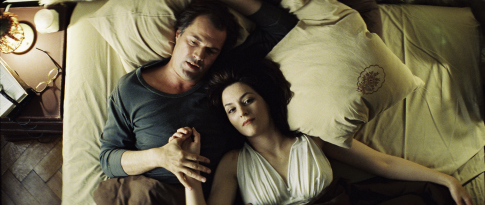
1985, East Berlin. Gerd Wiesler (Ulrich Mühe) is the perfect cog in the Stasi machine. Emotion isn’t an issue when he interrogates dissidents for hours at a time, or sits overnight listening to every word spoken in a suspect’s bugged house. All that starts to change when Wiesler is ordered to carry out an operation against noted playwright Georg Dreyman (Sebastian Koch). Dreyman appears to be the perfect citizen, but is suspected of dissident sympathies. More dangerously for him, he’s having a relationship with famed actor Christa-Maria Sieland (Martina Gedeck) who has attracted the lascivious attentions of the corpulent and corrupt Minister Hempf (Thomas Thieme). As Wiesler listens to Dreyman and Sieland’s lives, he finds himself deeply affected by exposure to art he has never experienced and begin to question the certainties of his world-view.
The Lives of Others is a moving, humane debut from von Donnersmarck, offering a rich and chilling insight into the horror of living in a country where thoughts are not free and words are strictly monitored. It carries such emotional impact because it gives us hope that, no matter the strictures of the world around us, common humanity and decency can break through and change us – even the most mechanical servants of a regime. The Lives of Others does this with realism and a lack of sentiment, showing life and the after-effects of our decisions in non-romantic detail, while also giving us hope that goodness can shine through no matter the cost.
Shot in a series of cold colours reflecting the featureless surroundings of East Germany, The Lives of Others exposes the beige hopelessness of Soviet life. It opens with Weisler’s long interrogation of “Prisoner 227”, cutting between it and a lecture hall, where Weisler plays tapes of it to teach a class. He shows no emotion of any type in either setting for the distressed, exhausted prisoner he’s talking to, and matter-of-factly marks down the name of a student who questions the ethics of what he’s doing. Weisler’s life is one of quiet exactitude: his apartment is featureless, his meals are bland pasta with ketchup, he has no friends and barely seems able to smile.
He contrasts totally with Geog Dreymon. Played with an ebullient innocence by Sebastian Koch, Dreymon has accommodated himself with the regime’s requirements. Does he believe in socialism? It’s one of the film’s mysteries – Dreymon may have an intellectual romanticism but he’s averse to making pointless protests or stands that will only lead to him being silenced. He is willing to accept the shelving of his director friend, for his works to be pushed into a realist factory-setting by plodding directors. His charm sees him befriend the high and mighty (“it was a gift from Frau Honecker” he tells a Stasi officer who questions his possession of a Western book) and he has boyish innocence, like someone who has never known the Orwellian horrors he lives amidst.
His friends however have. His director friend Jerska (Volkmar Kleinert) is an ‘unperson’ whose presence is an embarrassment at parties. Another is a closet radical who feels he should take a stance. Above all, Christa-Marie (a marvellous Martina Gedeck) lives with the abuse of Minister Thieme. This corrupt man – who orders Stasi investigations against people he doesn’t like and is the only character who looks overfed and well-dressed – fondles Christa-Marie at parties and forces her into sexual encounters in his chauffeured car. Corrupt men run this state – similarly Wiesler’s Stasi superior Grubitz (a wonderfully smug Ulrich Tukur), is interested only in promotion.
The system is propped up by men like Wiesler. But all that changes as listening to Dreymon’s life pulls something out of Wiesler he has never thought about before. What pivots this? Perhaps Wiesler truly listening to the warmth and vibrancy of Dreymon’s home life? Perhaps exposure to art? Von Donnersmarck masterfully shows (with complimentary camera moves between two locations) Wiesler teary, spellbound listening to Dreymon’s playing of a piano sonata. It opens up a new world of artistic and cultural understanding to Wiesler, who is drawn to the books in Dreymon’s apartment and begins turning more than a blind eye to Dreymon’s flirtation with dissidents.
In fact, Wiesler morphs from Dreymon’s dark shadow to his protective guardian angel. He awakens in himself a care for people around him, from the son of a neighbour to Dreymon and Christa-Maria. He conceals Dreymon’s involvement in a scheme to smuggle someone across the border (tragically the plan is a fake, designed to test if Dreymon’s apartment is bugged). He does his best to reassure Christa-Maria, “bumping into her” anonymously to provide her a moment of solace with a stranger and subtle counselling on her relationship with Dreymon. As Dreymon carefully writes an article, to be smuggled to the West, critical of the regime, Wiesler fills his reports with imagined plot details and quotes for the Lenin play Dreymon claims to be writing.
Dreymon is actually writing an article about the suicide rate in East Germany. Suicide becomes a heart-wrenching central theme. An oppressive, domineering regime like East Germany offers only one real escape: death. A state designed to make its own people suspect and turn on each other is designed to grind you into a choice between blank conformism or taking your own life. And we see the effects of this on multiple characters, as people are separated from the things that give their life meaning, stripped of their own identity, or made to betray those they love. For some, this is more than they can bear.
In this world, just displaying humanity is the victory. Ulrich Mühe’s breath-taking performance slowly fills with growing doubts, longings and passions under the surface of an impassive, quiet man who suddenly realises the world is larger and more magical than he ever imagined. Like a butterfly emerging from a chrysalis, he starts burrowing in the bowels of Stasi HQ, his eyes fixed only on what is in front of him. The film’s victory is turning this man into one who makes huge, unrewarded, sacrifices to protect another, the very attitude he quietly deconstructed in the film’s opening. Mühe is superb, the film constantly exploring his face for unspoken depths.
von Donnersmarck’s film ends with an extended coda of life after reunification. Some things are not as triumphant as hoped: Wiesler lives in poverty, the streets are lined with graffiti and tramps, cockroaches like Thieme remain in authority. But it is also a place where hope and friendship are possible, where things can be spoken rather than suppressed. It culminates in the sort of free-publishing Dreymon could never dream of and a tribute that could never have been spoken before.
After the crushing misery and suicidal pressures of the East, a world of possibility and freedom is one where we all could change our stars like Wiesler, to find an inner contentment from doing the right thing for no reward. Brilliantly filmed and deeply moving, The Lives of Others is a masterpiece.


 Movie Musings