Tag: Valerie Hobson

Bride of Frankenstein (1935)

Bride of Frankenstein (1935)

Whale’s sequel is a masterclass in how more can sometimes be more, a delightful black-comedy

Director: James Whale

Cast: Boris Karloff (Frankenstein’s monster), Colin Clive (Baron Henry Frankenstein), Valerie Hobson (Elizabeth Frankenstein), Ernest Thesiger (Dr Pretorius), Elsa Lanchester (Mary Shelley/The Bride), OP Heggie (Hermit), Gavin Gordon (Lord Bryon), Douglas Walton (Percy Shelley), Una O’Connor (Minnie), EE Clive (The Burgomaster), Dwight Frye (Karl), Ted Billings (Ludwig), Reginald Barlow (Hans)
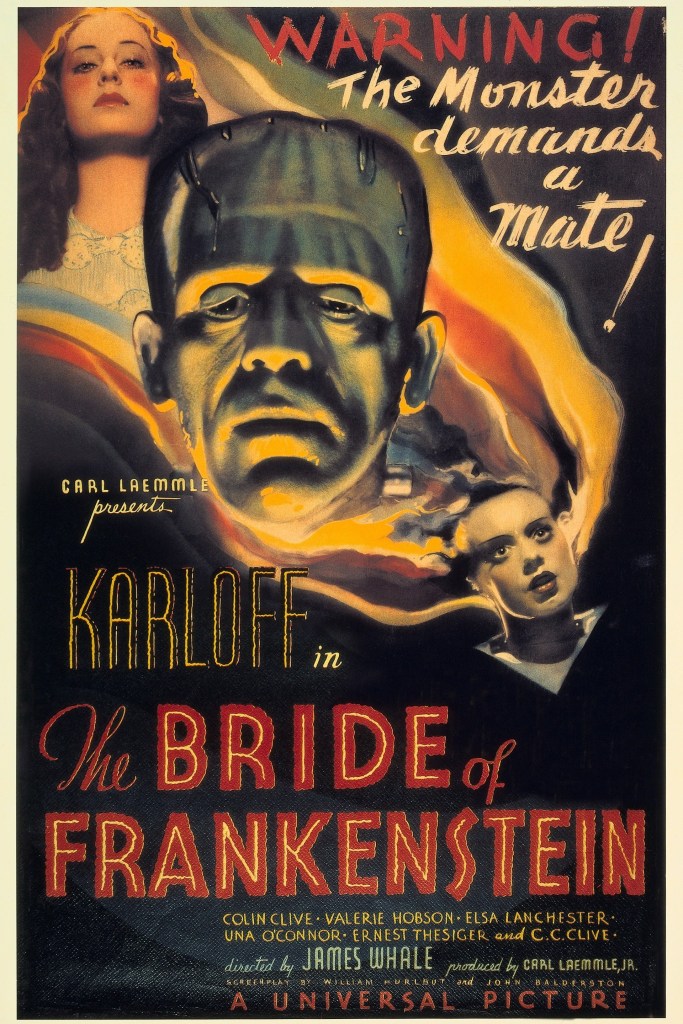
What does every studio want after a mega hit? A sequel of course! Directors are never more powerful then when studios will let them do pretty much whatever they want so long as they get another shot at capturing body-sparking lightening in a bottle one more time. James Whale and gang came back for Bride of Frankenstein and produced a classic, more entertaining than the first film, a barmy, balls-to-the-wall piece of nonsense where logic is thrown out, sly jokes abound and the meter is dialled well up to camp. Bride of Frankenstein is exactly the “memorable hoot” Whale wanted to make, and proof that perhaps he had not “drained the well” after all.

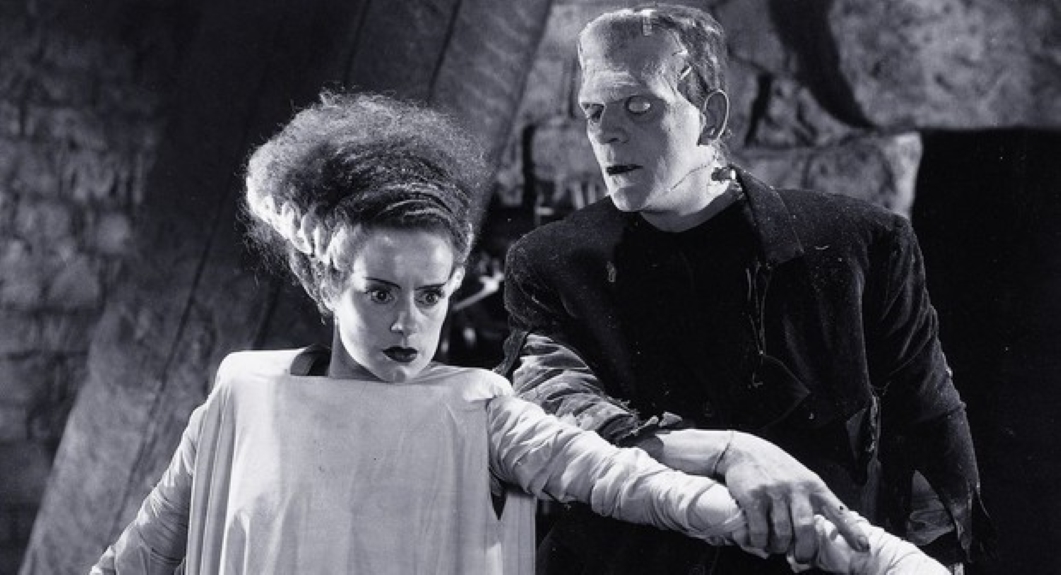
Bride of Frankenstein kicks off pretty much where Frankenstein left off – requiring some fast thinking since the creature (Boris Karloff) ended that film incinerated in a burning windmill. Turns out he actually hid in the water-logged basement, emerging to stumble into violence from villagers terrified at this bolt-necked giant’s existence. Meanwhile, a chastened Henry Frankenstein (Colin Clive) swears he’s out of the reanimation game… only to be dragged back in by his old mentor (presumably a different one to the first film’s Waldmann) the creepy Dr Pretorius (Ernest Thesiger). Pretorius has been experimenting with creating life, and he wants a whole race of these people – so he’ll need a bride for the creature, to get that ball rolling. While the creature fights and flies, Pretorius and Frankenstein fire up the generator and get ready to stitch.

There is more than a little bit of black humour to Bride of Frankenstein, a film Whale clearly never intended to be taken seriously. It’s combined with more than a touch of camp and sprinklings of the absurd with general utter indifference to any rules of time, setting or location. Whale’s gothic world is whatever and whenever he needs it to be at any point. If that means the creature is chucked in a medieval cell one minute and Dr Pretorius is using a telephone to call his underlings the next, that’s fine. Logic is already all over the place, since it opens with Mary Shelley, her husband Percy and Bryon in full period costume recapping the first movie, despite that film being littered with no-end of what would be to them unimaginable technical possibilities.

Whale buttresses his fantasia on Frankenstein by pruning out, probably, the last couple of elements of the book he liked but hadn’t used: the creature’s ability to speak, it’s time out at the secluded hut of a blind man and (of course) the concept of a bride being resurrected. But then Whale also pours all his love into Ernest Thesiger’s sinister and delightfully eccentric Dr Pretorius, the sort of larger-than-life character who leaves all reality behind. Thesiger has a whale of the time, sucking on the sarcastic dialogue like a lemon and delighting in playing the sort of amoral mad man (he even makes Frankenstein look sane) who brings a picnic to a grave-robbing and uses a tomb as a table.

Pretorius’ swiftly brow-beats Frankenstein into saddling back up. Colin Clive – who broke his leg shortly before filming, requiring him to do nearly all his scenes sitting down – is surprisingly restrained, with the old madness only coming to the fore in the Bride’s birthing scene. That birthing scene is a brilliant expansion of the first film, Whale using the increased budget to expert effect to take us up onto the roof of the laboratory, expanding the detail shown of the mechanics of the experiment (Whale uses Dutch angles to dial up the general air of creepy weirdness and clearly was inspired by Metropolis) and launching a creation even odder than the original. As before the design work is exquisite: the Bride – wonderfully played with a ear-piercing screech (based on the swans near her London home) by Elsa Lanchester, her white high-lit hair a masterpiece of memorable, blackly-comic imagery. The Bride makes such a lasting impression, it’s a shock to realise she’s in it for less than five minutes.

Did Whale intend anything to be taken seriously? He tips the wink with Una O’Connor’s opinion-dividing performance of shrieking, Oirish panic as the villager who discovers the surviving creature. Pretorius is introduced showcasing his collection of miniature living people in jars (a bishop, a devil, a mermaid, a queen and a randy Charles Laughton-channelling Henry VIII) the sort of head-turningly bizarre scene that leaves you both delighted and shaking your head in amazement. There is something hilariously odd about the creature being introduced to those human vices, smoking and drinking. Whale was surely chortling to himself at the thought of the creature contentedly blowing smoke circles with the blind hermit or eagerly knocking back a glass with Pretorius.

It’s remarkable that despite this strong leaning into comedy, Bride of Frankenstein still manages to find the humanity in the persecution of the monster. Chased down (once again) by a wild, the creature is tied down to a pole and lifted up, his body unmistakenly in a crucifixion pose. The film’s emotional centrepiece is his sojourn with the blind hermit. It’s impossible not to see more than a touch of Whale’s experience of persecution for his homosexuality in the tender staging of these scenes, two men living contentedly together only to have their partnership condemned the moment the real world intrudes. The gentleness of these scenes becomes very affecting, not least since this is the first (and last) time the creature is treated like a person rather than a monster.

Karloff is, as before, excellent in the lead role – despite his worries about the creature’s mystery being sacrificed on the altar of his fumbling, toddler-like speech. He makes the creature, even more than before, someone reaching out for warmth and connection, disgusted at his own monstrous nature and whose delight at the idea of a bride is strangely touching. (Bride of Frankenstein – a title even name checked at one point by Pretorius – cemented the popular confusion about whether the creature or his creator is ‘Frankenstein’). It’s the monster who also emerges at the film’s conclusion as the closest thing we have to a moral force.

Really Bride of Frankenstein shouldn’t work as half as well as it does. It’s part horror, part black comedy, part farce with scenes that shift from tragedy to knock-about satire. But it’s superbly assembled by Whale – at the top of his game here – and barrels along at such speed (sustained by superb performances, in particular from Karloff, Lanchester and Thesiger creating a portrait of monstrously soft-spoken camp for the ages) and with such full-blooded commitment at every moment that the film never once sinks. It is such a gloriously entertaining, wildly committed piece of pulpy film-making that it’s hard to imagine it could have been done better. And it certainly was the last word in what to do with the monster on-screen, that saw him embrace fear, love, comedy and tragedy all in one go. He probably should have stayed with the dead.

Kinds Hearts and Coronets (1949)

Kinds Hearts and Coronets (1949)

Murder and amorality abound in the darkest (and perhaps Greatest) Ealing comedy ever

Director: Robert Hamer

Cast: Dennis Price (Louis Mazzini), Alec Guinness (The nine members of the d’Ascoyne family), Valerie Hobson (Edith), Joan Greenwood (Sibella), Audrey Fildes (Mama), Miles Malleson (Hangman), Clive Morton (Prison Governor), John Penrose (Lionel), Hugh Griffith (Lord High Steward)

Imagine you’re Louis Mazzini (Dennis Price). Your mother is the outcast daughter of the d’Ascoyne family (all of whom, male or female, bear a striking resemblance to Alec Guinness), Dukes of Chalfort. These vindictive snobs won’t even allow his mother to be buried in the family mausoleum. However, in the event of a series of unlikely deaths, Louis is the eventual heir to the dukedom. That couldn’t happen, could it? Even if they’re all such stuffy, tedious bores that the suave, sophisticated, urbane and witty Louis feels a lot more like what a duke should be.

What to do? Well, it’s obvious really: Louis will have to murder them. Because Louis wants nothing more than the thing he can’t have. It’s the same with the ladies in his life: his childhood sweetheart Sibella (Joan Greenwood), sensual and manipulative, seems all the more tempting when he’s with the refined and austere Edith (Valerie Hobson) and vice versa. We know that the charming Louis’ murderous career will eventually end at the gallows – the film opens with him writing his memoirs and eating his last meal in prison – but what crime will find him there?

Kind Hearts and Coronets is one of the first of the Ealing comedies. It’s also pretty much the one that sets the Gold Standard. I’ll confess I’ve been sceptical in the past, but rewatching it again, its black comic humour, shrewd psychology and delightful amorality delighted me as never before. Kind Hearts is a very, very funny movie: perfectly constructed, gorgeously scripted and supremely sharp, knowing and scintillating. It’s a miraculously marvellous film.

Is there a comedy sharper and more heartless than Kind Hearts? Our hero is, at best, a sociopath who kills without the slightest regret. Murders are frequent punchlines. One of its leading ladies is as selfish, conniving and ruthless as the hero. D’Ascoynes bite the dust regardless of their decency (and some of them are genuinely quite nice). But we don’t care – largely because Louis is such a smoothly charming and amusing person.

Brilliantly played by Dennis Price, even when poverty forces him into the role of draper’s assistant Louis is the genteel duke to his fingertips. His sociopathic focus on his own desires is delivered with such dry wit (“It is so difficult to make a neat job of killing people with whom one is not on friendly terms”) we can’t help but like him, even though he is a remorseless killer. Dispatching one d’Ascoyne and his mistress in a river “accident” he only sighs “I was sorry about the girl, but found some relief in the reflection that she had presumably during the weekend already undergone a fate worse than death.”

Some critics have attempted to position Louis as some sort of class warrior, pruning the nobility. Would that were so, eh? The biggest snob in the film is clearly Louis (compared to him the worst of the d’Ascoynes are more rude and boorish), a man so convinced of his own intellectual and hereditary superiority that even his lowly roots don’t concern him.

Louis really matches our expectations of a duke. He’s refined in voice and manner, dignified in physicality and has the sort of arch wit no one else can compete with (when Sibella tells him her husband wishes to go to Europe to expand his mind, Louis replies “He certainly has room to do so”). He is a million miles from a class warrior: he wants nothing more than to take his place on the velvet cushions of the House of Lords (so much so he insists on being tried there). He’s so convinced of his own superiority, the dispatch of legions of d’Ascoynes cause him to lose not a second of sleep.

He’s also charming, funny and ingenious: we like him. It’s the same reason we like Joan Greenwood’s scheming, sexy and selfish Sibella: what’s more fun than an unashamed baddy? It’s easier to like her more than Valerie Hobson’s staid Edith – though Hobson’s generous performance is spot on for creating the ideal upper-class wife, exactly the sort of refined status symbol Louis would long for.

Hamer’s perfectly paced comedy is largely a triumph of dialogue and characterisation. He shoots much of it in carefully positioned mid-shot. But there are wonderful moments of visual comedy. Who can forget Admiral d’Ascoyne slowly submerging, going down with his sinking ship? Or, best of all, Louis and Edith’s gentle garden conversation about her husband Henry d’Ascoyne’s future while, in the background, over a wall, the small explosion that has just killed him smokes away (“I could hardly point out that Henry now had no time left for any kind of activity, so I continued to discuss his future” Louis observes). But above all, Hamer doesn’t skim on the cold amorality of Louis. While we are never invited to judge him, there are no attempts to hide his sociopathic blankness.

Confronted with real emotion and situations outside his control, Louis is helpless. When his mother dies, he can only mourn her with a flourish straight out of the cheap melodrama he despises. When Sibella’s husband, the dull Lionel, insults his background, he’s reduced to punching him. Caught off guard in his trial, his articulate wit absolutely deserts him. Louis slips on  personae like the fine suits he wears, but his ambitious mind can only travel on his pre-planned route, no others.

But that makes him more than match for the d’Ascoynes. In a masterstroke, all members of this family are played by Alec Guinness, the sort of impish, playful trick Guinness loved. It’s a series of eight distinct comic sketches – to be honest none of them a challenge to Guinness, who is such a great actor that playing these pencil-sketch eccentrics was no-problem-at-all – but still a delightful running gag. His d’Ascoynes include a bumbling vicar, a windbag general forever banging on about his Boer (Bore?) war, a sneering playboy scion, bumbling amateur-photographer Henry (the most sympathetic by a mile), a stuffy banker, an austere suffragette and a bullying duke with a capacity for violence.

Seeing each of these Guinnesses is a neat running joke (not to mention, a little gag at the in-breeding of the upper classes). Price gets in on the act as well, doubling up as Louis’ Italian Tenor father (who dies of shock on Louis’ birth – our hero’s first murder?). But it’s also part of the film’s comedic commentary on construction, duality and falseness. Is it a surprise that the d’Ascoynes are all facets of the same actor, when Louis himself is an entirely self-constructed man, part bitter by-blow, part natural duke? Nothing is ever quite what it seems. Louis lies to everyone he meets, pretends affections he never feels and presents a front to the world totally different from his real self. Even the reason Louis is on death row turns out to be radically different from what we expect.

Kind Hearts and Coronets is a perfect display of arch Wildean front, redirected into sociopathic irritation (I can’t call Louis furious – he’s not got enough depth to him for real anger). It’s a jet-black comedy, crammed with superb lines and brilliantly acted, above all by Price whose tortured unknowability behind his Cowardian suaveness is perfect. Guinness went into film legend, Greenwood is fascinatingly vicious and Hobson the embodiment of polite class. Every scene has a great line and the humour is as dark as it comes. It’s one of the greatest of all Ealing’s comedies –certainly the darkest and most vicious – with a hero who looks, acts and talks like a villain.

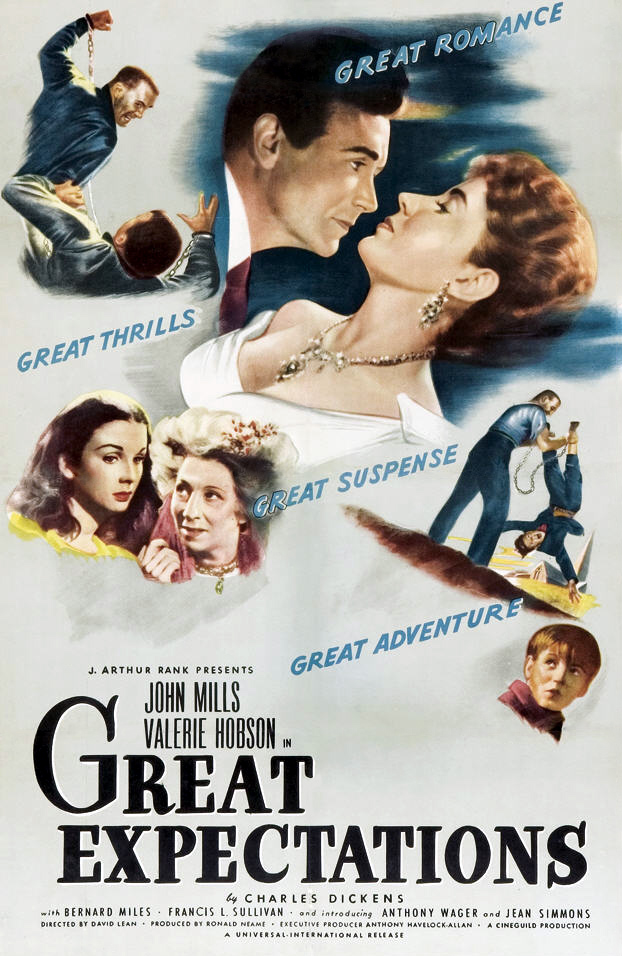
Great Expectations (1946)

Great Expectations (1946)

Lean’s masterful adaptation is still one of the finest examples of Dickens on screen

Director: David Lean

Cast: John Mills (Pip), Valerie Hobson (Estella), Bernard Miles (Joe Gargery), Francis L Sullivan (Jaggers), Finlay Currie (Abel Magwich), Martita Hunt (Miss Havisham), Alec Guinness (Herbert Pocket), Jean Simmons (Young Estella), Anthony Wagner (Young Pip), Ivor Barnard (Wemmick), Freda Jackson (Mrs Joe Gargery), Eileen Erskine (Biddy), Torin Thatcher (Bentley Drummle)

Of all Dicken’s books there is perhaps none so popular as Great Expectations – and no Dickens adaptations are more highly regarded than David Lean’s 1946 film. Of course, just under two hours is only time to tell a simplified version of Dicken’s original. But no-one’s taking the book away. What Lean’s film did triumphantly was turn Dicken’s prose into a clear cinematic language and style, without losing the uniqueness of the author’s voice. Lean’s visual mastery is perfectly matched with his experience as an editor of telling a story to produce an endlessly entertaining film.

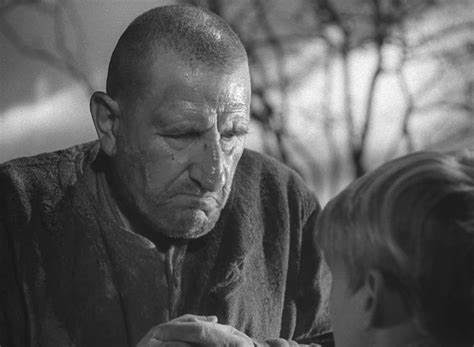
As a young boy Pip (Anthony Wagner) encounters an escaped convict (Finlay Currie) in a graveyard. Intimidated, Pip brings the convict food and tools to escape his chains – acts which the convict clears him of when he is caught later that day. Weeks later, Pip is invited to the home of rich spinster Miss Havisham (Martita Hunt) to provide her and her adopted daughter Estella (Jean Simmons) with company. The visits continue until Pip’s apprenticeship as a blacksmith to his brother-in-law Joe (Bernard Miles) begins. Imagine Pip’s (now John Mills) surprise six years later when he is informed by lawyer Jaggers (Francis L. Sullivan) that he has come into money – that he has become a gentlemen of “great expectations”. Assuming it is the work of Miss Havisham – and that he is destined to marry Estella (now Valerie Hobson) – he is horrified to discover his life is more complex than he believed.

The film repackages Great Expectations a bit more into a romance. While the relationship between Pip and Estella, and the bond between them, is clear in the novel – and a large part of its plot – its but one thread masterfully woven together into the final storyline. Here this thread is given prominence, at the cost of several others. It’s not a complaint as such, but it makes Great Expectations into a more traditional story: a feeling added to by the film’s more conventional “feel-good” ending (very different from the much more uncertain ending of the novel, that Dicken’s edited back and forth in different editions to increase or decrease its hopefulness). However, it works for creating a film story, even if it loses some of the depth of the novel.

Its also more than balanced by how much the film gets right. Lean brilliantly captures the novel’s atmosphere, its gothic sense of impending dread, the burden of the past and the paranoia of persecution. For decades the opening scenes of the film, with its masterfully shot and edited mist covered graveyard (simultaneously a place of peace and a place of unsettling unknowability ) bursting into life through the grasping hands of Magwich, were practically used as a textbook example of cinematic language. Lean’s work is intensely cinematic. The mis en scene of Expectations is masterful – everything from casting, to camera angles to score comes together to bring Dickens world to life. This is exactly his London as he wrote it. It’s a wonderful expression of a particular author’s style, told using a mastery of cinematic language – from camera angles to editing cuts.

The characters have that perfect sense of eccentricity laced with menace that Dickens invests them with. Francis L Sullivan’s Jaggers is an unknowable legal machine who is part man of business, part fearsome fixer. Alec Guinness (in his film debut) is good-natured kindness to a T as Pip’s faithful friend Herbert (in one lovely scene he politely and gently corrects Pip’s primitive table manners). Finlay Currie’s Magwich captures the sense of danger and threat in the book’s opening that will become a fatherly meekness in the story’s later acts.

Largest of all, Martita Hunt’s gothic Miss Havisham sits like a giant spider at the centre of a decaying web. The design of Satis House – with its rotting wedding cake, sprawling cobwebbed dinner service, the heavy curtains and lack of light – is just one of the many perfect touches in the film. Hunt herself is superb as this outwardly eccentric aunt, who in fact has been nursing a core of bile and hatred that ends up only hurting those closest to her. There is something hugely dreamlike about Miss Havisham’s home – you suspect Lean may have watched some Cocteau – with its strangely angled table and mix of intimate framing and wide-angle crane shots.

Perhaps because we only see, not read, Pip’s actions in this film it’s impossible not notice what an arrogant snob he becomes. John Mills does decent work in the part, but (much as in the book) Pip ends up feeling like a slightly colourless figure. The film doesn’t always explore in detail the negative sides of his character meaning moments like his patronising dismissal of the kindly Joe (a perfectly judged Bernard Miles), don’t do the character much favours. Mills does however make a larger impression than Valerie Hobson, left slightly adrift as Estella. She’s not helped by how outstanding Jean Simmons is as the young and preciously flirtatious Estella, the perfect picture of the little cruelties teenagers inflict on each other. (A braver film might have had her play the role throughout – but then Mills would look even older than he does!)

The film is very strong on the pain caused to these two characters – and that they cause for each other. More than any other version, we get a sense here of how Miss Havisham’s misguided aim to use Estella as a weapon of revenge on all men only manages to hurt Estella herself and Pip (her one true love as presented here). Just as a Pip’s snobbish dismissal of Joe stings. And Lean’s brilliant sense of pace and rhythm means that this plays hand-in-hand with Pip’s ever more desperate attempts in the second half to save Magwich from doom.

Many of the complexities of the plot (from Estella’s parents to Herbert’s marriage to several key characters) are cut out, but it’s striking how the film still manages to feel so faithful to the book. Lean’s understanding of Dickens mix of eccentricity and darkness is communicated in every frame. The major moments and characters from the book are beautifully bought to life, from that opening scene to Satis House. But also because small moments, like Wemmick’s “Aged P” remain in the film. Sure, the canvas has been reduced – and refocused into a love story of sorts – but the picture that emerges is still very much in the style of Dickens.

That’s what makes it one of the greatest adaptations of all time: it’s both an interpretation of the original and a beautifully judged capturing of its spirit and tone. An adaptation twice the length may have caught more plot, but would not have been such a fine movie. Because so much of this film’s imagery and drama sticks in the mind long after it is finished. Lean’s masterstroke here was to understand completely the heart of the book, and to focus the film on that. Brilliantly assembled, designed, shot and acted, it’s still one of the best literary adaptations ever made.