
Tag: Van Heflin

Airport (1970)

Airport (1970)

Disaster awaits in the sky in this ridiculous soap that is less exciting than Airplane!

Director: George Seaton

Cast: Burt Lancaster (Mel Bakersfied), Dean Martin (Captain Vernon Demerest), Jean Seberg (Tanya Livingston), Jacqueline Bisset (Gwen Meighen), George Kennedy (Joe Patroni), Helen Hayes (Ada Quonsett), Van Heflin (DO Guerrero), Maureen Stapleton (Inez Guerrero), Barry Nelson (Captain Anson Harris), Dana Wynter (Cindy Bakersfeld), Lloyd Nolan (Harry Standish), Barbara Hale (Sarah Demarest), Gary Collins (Cy Jordan)
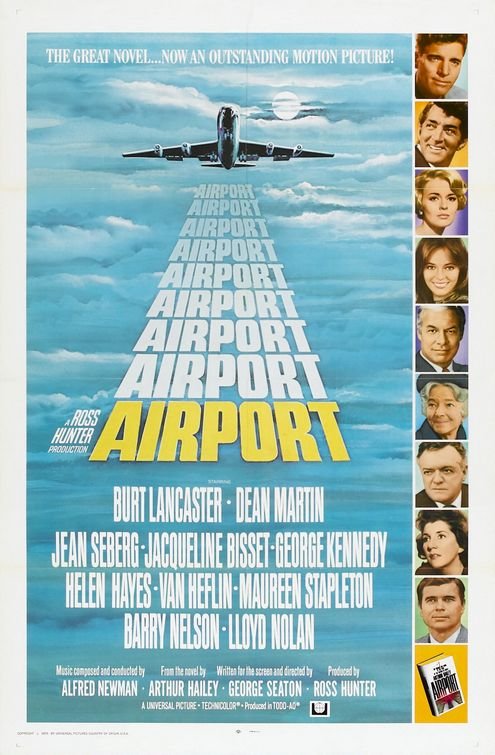
A busy Chicago airport in the middle of a snowstorm. Workaholic Mel Bakersfeld (Burt Lancaster) doesn’t have time to prop up his failing marriage to his humourless wife: he’s got to keep the flights moving, clear the runways and solve the problems other people can’t. He’s not dissimilar to his brother-in-law Vernon Demerest (Dean Martin), who hasn’t got time for his plain-Jane wife at home when he’s got a flight to Rome to run and a saintly pregnant air hostess girlfriend Gwen (Jacqueline Bisset), to deal with. Tensions will come to a head when depressed former construction worker Guerrero (Van Heflin) joins Demerest’s flight, planning to blow himself up so his wife can profit from his life insurance. Disaster awaits!

“A piece of junk”. That was Burt Lancaster’s pithy review of this box-office smash that was garlanded with no fewer than ten Oscar nominations. He’s pretty much spot on. Airport is a dreadful picture, a puffed-up, wooden soap opera that never takes flight, stapled together with a brief disaster plotline that only really kicks in during the final act of the film and is solved with relative ease. Other than that, it’s all hands to the pumps to coat the film in soapy suds, which can be stirred up by the strips of wooden dialogue that fall from the actors’ mouths.

Seaton adapted the script from a popular low-brow novel, though it feels as if precious little effort went into it. It’s corny, predictable dialogue does very little to freshen up the bog-standard domestic drama we’re watching in a novel setting. Both lead actors juggle loveless marriages with far prettier (and much younger) girlfriends. Those girlfriends – Jean Seberg for Burt and Jacqueline Bisset for Dean – play thankless roles, happily accepting of their place as no more than a potential bit-on-the-side and very respectful of the fact that the job damn it is the most important thing.

The film bends over backwards so that we find Burt and Dean admirable, despite the fact that objectively their behaviour is awful. Burt treats his home like a stopover, barely sees his kids and seems affronted that his wife objects he doesn’t attend her important charity functions and doesn’t want the cushy job he’s being offered by her father. Just in case we sympathise with her, she’s a cold, frigid, mean and demanding shrew who – just to put the tin lid on it – is carrying on behind Burt’s back. We, meanwhile, applaud Burt for showing restraint around the besotted Jean Seberg, merely kissing, hugging and chatting with her about how he’d love to but he can’t because of the kids at home damn it!

He looks like a prince though compared to Dean. Only in the 1970s surely would we be expected to find it admirable that a pregnant girlfriend happily takes all the blame – the contraceptive pills made her fat and she knows the deal – begs her boyfriend not to leave his wife and then urges him to not worry about her. Dean’s wife doesn’t even seem that bad, other than the fact she’s a mumsy type who can’t hold a candle to Bisset’s sensuality. That sensuality is overpowering for Dean, who at one point pleads with her to stay in their hotel room because the taxi “can wait another 15 minutes”. Like a gentleman his reaction to finding out Bisset is pregnant, is to offer to fly her to Norway for a classy abortion (rather than the backstreet offerings at home?).

This soapy nonsense, with its stink of Mad Men-ish sexual politics (where men are hard-working, hard-playing types, and women accept that when they age out, he has the right to look elsewhere) is counterbalanced by some laboriously-pleased-with-itself looks at airport operations. Baggage handling. Customer check-in. Customs control checks. Airport maintenance. All get trotted through with a curious eye by Seaton. Just enough to make parts of the film feel briefly like a dull fly-on-the-wall drama rather than a turgid soap.

Soap is where its heart is though. Helen Hayes won an Oscar for a crowd-pleasing turn (from which she wrings the maximum amount of charm) as a seemingly sweet old woman who is in fact an expert stowaway. Van Heflin and Maureen Stapleton play with maximum commitment (Stapleton in particular goes for it as if this was an O’Neil play rather than trash) a married couple whose finances are in the doldrums, leading the husband to take drastic steps.

It’s all marshalled together with a personality-free lack of pizzaz by Seaton, who simply points the camera and lets the actors go through their paces, with a few shots of humour here and there. There are some interesting split-screen effects, but that’s about the last touch of invention in the piece. It’s mostly played with po-faced seriousness – something that feels almost impossible to take seriously today, seeing as the structure, tone and airport observational style of the film was spoofed so successfully in Airplane (a much better film than this on every single level, from humour, to drama even to tension – how damning is that, that a pisstake is a more exciting disaster thriller?)

It smashed the box office in 1970 and got nominated for Best Picture. But its dryness, dullness and lack of pace mean it has hardly been watched since. Although it can claim to be the first all-star disaster movie, it’s not even fit to lace the flippers of The Poseidon Adventure, which far more successfully kickstarted the cliches that would become standard for the genre (and is a tonne more fun as well as being a disaster movie – this has a disaster epilogue at best). An overlong, soapy, dull mess.

Shane (1953)

Alan Ladd as the mysterious gunslinger Shane

Director: George Stevens

Cast: Alan Ladd (Shane), Jean Arthur (Marian Starrett), Van Heflin (Joe Starrett), Brandon de Wilde (Joey Starrett), Jack Palance (Jack Wilson), Ben Johnson (Chris Calloway), Edgar Buchanan (Fred Lewis), Emile Meyer (Rufus Ryker), Elisha Cook Jnr (“Stonewall” Torrey), Douglas Spencer (“Swede” Shipstead), John Dierkes (Morgan Ryker), Ellen Corby (Liz Torrey)

On the surface Shane is pretty much the definitive “white-hat-black-hat” Western. Crikey, Jack Palance’s vicious gunslinger Wilson practically wears nothing but black. Alan Ladd’s heroic Shane does what needs to be done, and the kid loves him to bits. But Steven’s film is more complex and intriguing than that. Because Shane is in fact only a few degrees away from Wilson. When he rides into the homestead, he is already weighted down by the memory of all the people he’s killed. Shane is no saint. He’s a tired man whose shed too much of other people’s blood to ever feel anything but an outsider.

Shane arrives at the Starrett farm. Joey (Brandon de Wilde), the boy-of-the-house immediately hero-worships this mysterious stranger with the distinctive guns. Joe Starrett (Van Heflin) is at first hostile but takes Shane in as a farm worker and he and his wife Marian (Jean Arthur) – maybe particularly Marian – are drawn towards this reserved but good-natured man. Starrett and the other homesteaders are in the middle of a feud with local cattle rancher Rufus Ryker (Emile Meyer), who wants to drive them off the land so he can use it for his cattle. Violence seems inevitable – but how long can Shane keep his unspoken pact to himself to put down his guns and try a life of normality?

Shane is one of Steven’s finest films, beautifully filmed with Oscar-winning photography and told with a lavishly poetic sense. It works so well because it juggles both a simple story, with a deep poetic understanding of humanity. You can see why this is “a Western for those who don’t like Westerns”. It’s got a beautiful, understated sense of struggle to it – the homesteaders against the bullying of Ryker – beautifully mixed with a sense of the dangerous glamour of violence. Match that with some wonderfully hissable villains and the honesty and decency of the Starretts and Shane’s quiet dignity, and you’ve got a perfectly judged morality play.

But the film works because there is so much operating on multiple levels. Which brings us back to Shane himself. Sure, he’s a decent guy. We expect him to be the hero. He fulfils much of that function in the plot. He’s kind and loving with the kid. He holds his cool and never seems to get angry. But why is this? The film makes clear that Shane has a past. A past of gun-slinging violence. And if Shane is still standing at the end of a life like that, he must have been good. And ruthless.

What was it that made Shane so desperate for a change? To try a life of normality, chopping down stumps and putting up fences on a farm? I suspect Shane in his prime wasn’t that different from the calm, cool and ruthless Wilson. You can see the guilt in his eyes when he finally shoots his weapon (at a rock!) two thirds into the film. This is a man who knows that killing carries a terrible burden – and he clearly knows all too well after sending so many to their graves. At the end of the film, with his emotional pean to Joey (“There’s no living with killing”) he’s speaking from the heart. And only someone who has killed many, many people – who doesn’t look remotely worried when facing off with Wilson and Ryker – could really know that.

It’s an idea that you could miss in the film, but it’s there all the way through. The casting of Alan Ladd – who was never better – is crucial to the success of this. Imagine the strength and power a Wayne or Cooper or Stewart would have given Shane. They would never have felt so slight, or beaten down by a life of violence. But Ladd’s smallness, his sadness and his reluctance works for the part. Stevens continually shoots him as an outsider, on the edge of scenes or even isolated in crowds. He can fade into the background in the way other stars couldn’t have done. He feels like a man who knows he has been a moral failure, who isn’t redeemed by star quality.

Stevens plays with our expectations of Shane through the reactions of the Starretts. Joe is (tellingly) instinctively hostile to him at first, before Shane wins him over. Marian’s reaction is however fascinating. She is both slightly repelled by what she can see as Shane’s past violence, but also increasingly drawn towards him. Is this because Shane’s internal knowledge, his worldliness, his depths of sadness make him more of a thoughtful kindred spirit than her husband can be? Joe is a simple man, decent beyond words, but not a thinker. Shane is more – for all his danger – and Marian feels like a woman who has accepted her place but perhaps dreamed of more. She would never act on this, but Shane to her seems to represent a path not taken.

And Joey? Shane is everything a boy could dream of in a hero. The man with few words who appears over the horizon with nothing but a six shooter. Stevens camera cuts back again and again to Joey’s adoring, worshipping face – and it’s an excellent performance from (the Oscar-nominated) Brandon de Wilde, as a young boy on the edge of becoming a teenager who wants to be a man, but still looks with the eyes of a child. Stevens throughout places the audience on the same level with Joey. Like him we want to believe in Shane, to see him play the hero. It’s part of the films skilful construction that it finishes before it occurs to you that the character the audience most closely related to was the uncritical, unknowing child. On first viewing we stare at Shane with the same hero worship as Joey.

Shane wants a life of normality. Shane isn’t a million miles away from Eastwood’s revisionist Unforgiven. In fact, Munny’s life in that film is basically Shane’s, without Ladd’s humbleness. The brutal killer who wants to leave it all behind, but is dragged back in. Who finally faces off and guns down a horde of enemies in a saloon bar before riding off into legend. Sure, Shane will be remembed with more fondness by those he leaves behind – and he saves the homesteaders – but just like Munny he does it by leaving a trail of bodies behind him.

Steven’s beautiful film is both a compelling narrative of goodies and baddies, but also a profound, fascinating and challenging film. It’s wonderfully made and has a host of reliable actors at the top of their game. Ladd is superb, Jean Arthur brings great depth to Marian, Van Heflin’s Joe is a the sort of simple, decent, salt-of-the-Earth type the West was made of. Facing them, Jack Palance makes the most of limited screentime (and got an Oscar nomination) as the sneering, bad-to-the-bone Wilson. It’s a perfect mixture of small, intimate scale that seems to be taking place in an epic environment. It’s influence has been so profound it’s virtually an archetype. An American classic.