
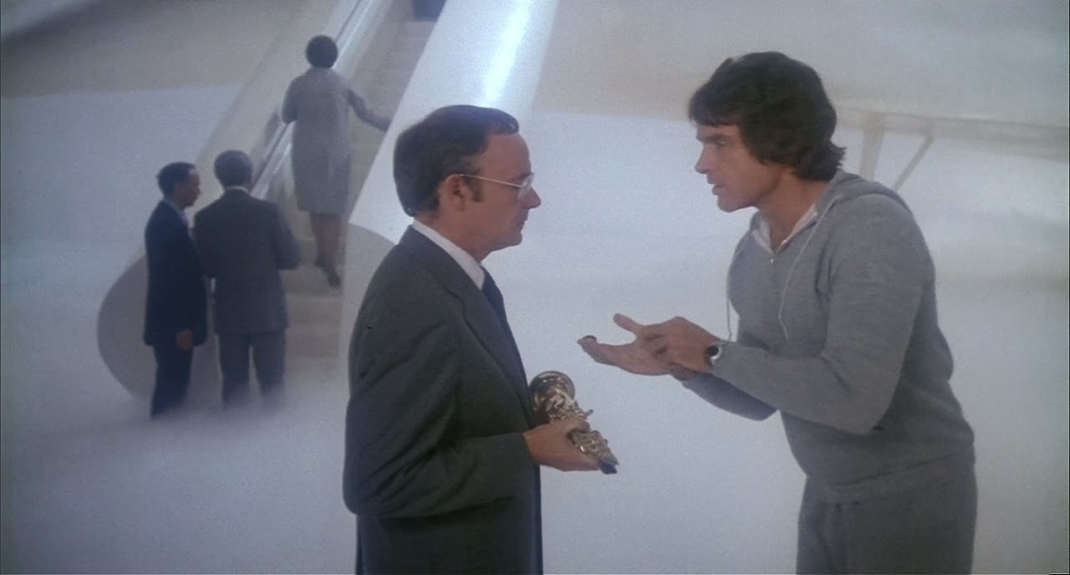
Tag: Vincent Gardenia

Heaven Can Wait (1978)

Heaven Can Wait (1978)

Deliberately old-fashioned and comforting drama, probably why it was a big hit when released

Director: Warren Beatty, Buck Henry

Cast: Warren Beatty (Joe Pendleton), Julie Christie (Betty Logan), James Mason (Mr Jordan), Jack Warden (Max Corkle), Charles Grodin (Tony Abbott), Dyan Cannon (Julia Farnsworth), Buck Henry (The Escort), Vincent Gardenia (Inspector Krim), Joseph Maher (Sisk), Hamilton Camp (Bentley), Arthur Malet (Everett)
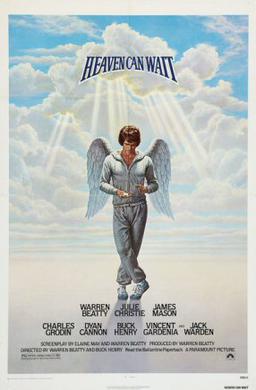
Beatty’s cosily old-fashioned directorial debut – in which, Welles like, he celebrated Oscar nominations for producing, directing, writing and acting – might well be the reason for its financial success. Perhaps a world in turmoil needed a remake of the smooth 1941 studio film Here Comes Mr Jordan, becoming the third adaptation of Harry Segall’s 1938 play. Heaven Can Wait reshuffles a few bits and pieces here and there, while aiming to capture as much of the tone of the original as possible.

Beatty is Joe Pendleton, promising quarterback for the Los Angeles Rams… until, facing certain death in a road accident he is plucked to Heaven by his guardian angel (Buck Henry). But the angel was overzealous, as supervisor Mr Jordan (James Mason) reveals Joe had 50 years to live. With his body cremated, Jordan arranges for Joe to take the body of billionaire Leo Farnsworth, recently murdered by his gold digger wife Julia (Dyan Cannon) and her lover, Farnsworth’s secretary, Tony Abbott (Charles Grodin). In his new body, Joe, inspired by environmentalist Betty Logan (Julie Christie), tries to make his company care while buying the Rams and persuading old coach Max (Jack Warden) that it’s really Joe and he needs his help to train his new body for the Super Bowl.

Heaven Can Wait shifts Here Comes Mr Jordan from the world of boxing to the world of football – possibly when original casting choice, Muhammad Ali, turned it down and Beatty’s high school football experience was a better fit. Ali wasn’t the only sought after legend – Beatty offered the sun and moon to Cary Grant to play Mr Jordan, but not even the presence of Grant’s wife Dyan Cannon could tempt him from retirement.

There are the odd tweaks here and there – the plane to Heaven is now a proto-Concorde for starters – but honestly Heaven Can Wait would have been made almost identically in the 1940s, with its dry wit, gentle romance and the Capraesque idea that the little guy can fix the world’s problems with a little bit of honesty, decency and common sense. There is almost nothing of the cynicism of the 1970s at all. It’s a gently reassuring throwback. Nothing wrong with that, but nothing inventive or original either.

Beatty does a decent job of directing things with a classical gentleness, and he’s also pretty good as the good-natured Joe, a sort of sweetly dim guy obsessed with health food and dodgy saxophone playing (roughly in that order). He’s got an endearing simplicity, the sort of guy who takes ages to work out he’s in a way-station for heaven, bounds into his new life with a chattiness that confuses his army of staff (used to an austere employer) and tries to corral his board of directors with a winningly earnest speech crammed with football metaphors, so intently well-meant it even manages to convince (some of) the crusty bean-counters sitting around the table.

Fish-out-of-water comedy emerges rather nicely out of how bemused both Beatty’s character is at the life he finds himself in, and how politely his staff and employees turn a blind eye to what must be a juddering change in personality of their boss. After all, Beatty and Elaine May’s script lands more than a few subtle digs suggesting Farnsworth must have been quite the dick. His wardrobe is a mix of ludicrous sailor and polo outfits and garish mock military uniforms. He had the staff raise a flag and fire a cannon every day. And his company is mercilessly gutting the environment.

Must be a shock for the staff then, that their new boss keeps popping into a cleaning cupboard on the stairs for surreptitious chats with invisible angels. Or that he corrals them en masse for a good-natured football training session in the grounds. The dry, carefully reserved reactions of these servants – led by Joseph Maher’s perfectly straight-faced butler – is consistently funny.

Also consistently funny are Dyan Cannon (Oscar-nominated) and Charles Grodin as a pair of conniving schemers, trying everything they can think of to pocket Farnsworth’s money. Cannon is hilarious, consistently oscillating between hysterical shock and resigned confusion at the unexpected appearances of ‘Farnsworth’. Grodin is perfect as the dry Abbott, a master of the micro-reaction, loathing his boss while also being pathetically deferential to him and wheedling a parade of schemes to try and dispatch his boss. These two are the film’s stand-out performers and funniest characters.

Not that there isn’t merit elsewhere. James Mason is perhaps the perfect substitute for Claude Rains, dry and suave as Head Angel Jordan and forming a good double act with co-director Buck Henry’s harassed junior angel. Jack Warden gained an Oscar nomination for a warmer, gentler version of his distracted coach from 12 Angry Men. Julie Christie’s chemistry with Beatty is not surprisingly on point, although the script gives her very little to play with for the film’s least developed role.

What is surprising though is the sudden bleak note Heaven Can Wait ends on: Joe will eventually lose all memories of his previous lives. It’s so sudden, I had to remind myself the same thing happens in the original (but with a bit more forewarning). Here, it emerges out of left-field and feels unbearably harsh, as if Heaven is cleaning up a clerical error by wiping Joe from existence. The film fails to prep us for this possibility – in the way the original did – as if it was felt the danger of being wiped from existence would spoil all that apeing of 40’s lightness (in which case why not just change it?).

Heaven Can Wait was garlanded by Oscar nominations (including those four for Beatty) but won only one for its admittedly clever set design which plays up the grandiose nonsense of Farnsworth’s mansion (I enjoyed Cannon’s bedroom with its matching fabric covering every wall and surface). Was that because it was so gently reassuringly, old fashioned, but fundamentally a very close remake? It’s a sentimental, charming little crowd-pleaser the sort of thing that perhaps made everyone feel better at the time, a decent, inoffensive film.

Moonstruck (1987)

Moonstruck (1987)

Charmingly romantic comedy with little touches of Shakespeare in its celebration of family love

Director: Norman Jewison

Cast: Cher (Loretta Castorini), Nicolas Cage (Ronny Cammareri), Olympia Dukakis (Rose Castorini), Vincent Gardenia (Cosmo Castorini), Danny Aiello (Johnny Cammareri), Julie Bovasso (Rita Cappomagi), Louis Goss (Raymond Cappomagi), John Mahoney (Perry), Feodor Chaliapin (Old man), Antia Gilette (Mona)

People do strange things all the time. We don’t always understand why, so why not say it’s a midsummer madness caused by the moon. Moonstruck seizes that old superstition of blaming the position of our nearest celestial neighbour for sending us all a bit barmy, and weaves it into a film that’s both a playfully eccentric romantic comedy and a sweet tribute to the power of a family’s loving bonds. John Patrick Shanley’s (Oscar-winning) script pulls these strings together so well, it’s not a surprise it’s the sort of a film that frequently ends up on people’s ‘favourite film’ lists.

Loretta Castorini (Cher) is an Italian-American widow, living with her parents, who is starting to wonder if she is cursed with spinsterhood. As the moon reaches its bright zenith, she agrees to marry her terminally dull, utterly unromantic boyfriend Johnny (Danny Aiello), because anything’s better than nothing (despite the fact he seems to see her as much a substitute for his mother as a romantic partner). She agrees to mend the bad blood between him and his younger brother Ronny (Nicolas Cage). Ronny is a picture-postcard of an eccentric, a one-handed baker (blaming his brother for that) prone to melodramatic fits of rage and outbursts of Operatic passion. Loretta and Ronny – blame that moon – are instantly smitten with each other. Who is going to sort that out?

It all pulls together into a sort of modern fairy tale, where everything has an air of gently heightened reality. It’s also the sort of thing that wouldn’t seem out-of-place in Shakespeare’s lightest comedies: people fall in love on a sixpence, feuds are fixed in minutes, cheating spouses instantly return to their wives and jilted suitors smile and join in the celebratory drinks. In this world of theatrical, fairy-tale comedy, it’s quite easy to buy that an exceptionally bright moon is sending everyone a little bit crazy (like Shakespeare’s Dream lovers in the forests outside Athens, going through one crazy doped-up night before settling suddenly into two loving couples) and eventually you just run with it in Jewison’s charming film.

With a script full of witty lines and theatrical bits of bombast (which Cage in particular, inevitably, rips through), Moonstruck is also one of those endlessly charming, relaxing and pleasant films where fundamentally everyone is at-heart decent. Sure, mistakes are made throughout; harsh words and truths are spoken, but within a film where everyone cares for each other. Ronny may (rather unjustly) blame his brother for briefly distracting him at work into losing his hand, but deep down he’s just waiting for an excuse to forgive his brother. Loretta may have a prickly relationship with her mother, but it’s roots are really firm and based around both protecting the other from knowledge of the knee-jerk philandering of her father. It takes the influence of the moon to suddenly spark these people into a few days of crazy behavior that changes their lives and leads them to re-address their relationships with each other.

It also makes Loretta, in an Oscar-winning comedic turn from Cher, face up to the fears about where her life is going. In a performance that is remarkably unglamourous – Cher plays every inch of the reliable window settling into spinsterhood and the film never falsely ‘transforms’ her – Cher invests Loretta with a deep fear and resignation below her surface of reliability and unflappability. Loretta is so used to being practical and dependable, organising the lives of everyone (even patiently instructing the confused Johnny on how to propose marriage), part of her romantic relief with Ronny is being able to let rip a more sensual and vulnerable part of herself. Cher lets the mask slip, as if having had love potion dripped into her eyes, letting her express her deeper feelings.

It makes sense then that she should fall in love with someone as self-willed and resistant to being mothered as Ronny. In an early role that straight away captures Nicolas Cage’s willingness to rip into a scene (what other actor would feel like such a natural fit for a lovably blow-hard, one-handed, baker melodramatically prone to threatening no end of harm on himself?), Ronny has all the sort of wildness and uncontrolled energy and excitement the rest of Loretta’s life doesn’t have. And he doesn’t want her to fill a surrogate role for another family member – he wants her to be part of an equal relationship on her own terms with him.

It’s probably the sort of relationship Loretta’s parents had at one point. Before her mother Rose (another Oscar-winner, Olympia Dukakis) become cynical and shut-off from her husband Cosmo (Vincent Gardenia). Cosmo has let his decency get squashed under a fear of growing old, clinging to a younger girlfriend (Anita Gillette) who he conducts an affair more out of habit more anything. No wonder Rose considers flirting with John Mahoney’s constantly-jilted professor (in a touch that hasn’t aged well, he keeps trying to date his students), but not going the whole hog, while Cosmo tries to feel young again by doubling-down on his quietly dying affair.

What’s surprising then is that Moonstruck bubbles all this romantic back-and-forth into a warm celebration of familial love. While romantic bonds are firey, they are transient – the bonds of family last. Moonstruck culminates in the family putting the sort of romantic divisions that have kept them apart aside to come together in a warm celebration: like Shakespeare’s lovers they have woken up and found out everything is in fact fine. There’s something really reassuring and hopeful about this – that our feuds and divisions can bring us together as much as they can tear us apart.

It’s another reason as well why this is a popular film. It’s helped of course by John Patrick Shanley’s well-crafted script, and the terrific playing of the actors. Cher and Cage both have great chemistry and get the tone of the eccentric but touchingly tender unlikely romance just right. Dukakis and Gardenia are both funny and sweet as their parents, Aiello gives a very generous performance as a dutiful-boy-who-never-grew-up and there’s a scene-stealing cameo from Feodor Chalipin as Loretta’s eccentric grandfather. Above all, Moonstruck is a playful, feel-good film that doesn’t take itself too seriously and lives you feeling hopeful that everything can work itself out – even when the magic of the moon sends us a little crazy.