Tag: Vladek Sheybal

Kanał (1957)

Kanał (1957)

Wajda’s war-epic is a brilliantly filmed, unsettling critique of the truth behind national myths

Director: Andrzej Wajda

Cast: Teresa Iżewska (Daisy), Tadeusz Janczar (Jacek “Korab”), Wieńczysław Gliński (Lt. Zadra), Tadeusz Gwiazdowski (Sgt. Kula), Stanisław Mikulski (Smukły), Emil Karewicz (Lt. Mądry), Maciej Maciejewski (Gustaw), Vladek Sheybal (Michał, the composer), Teresa Berezowska (Halinka)
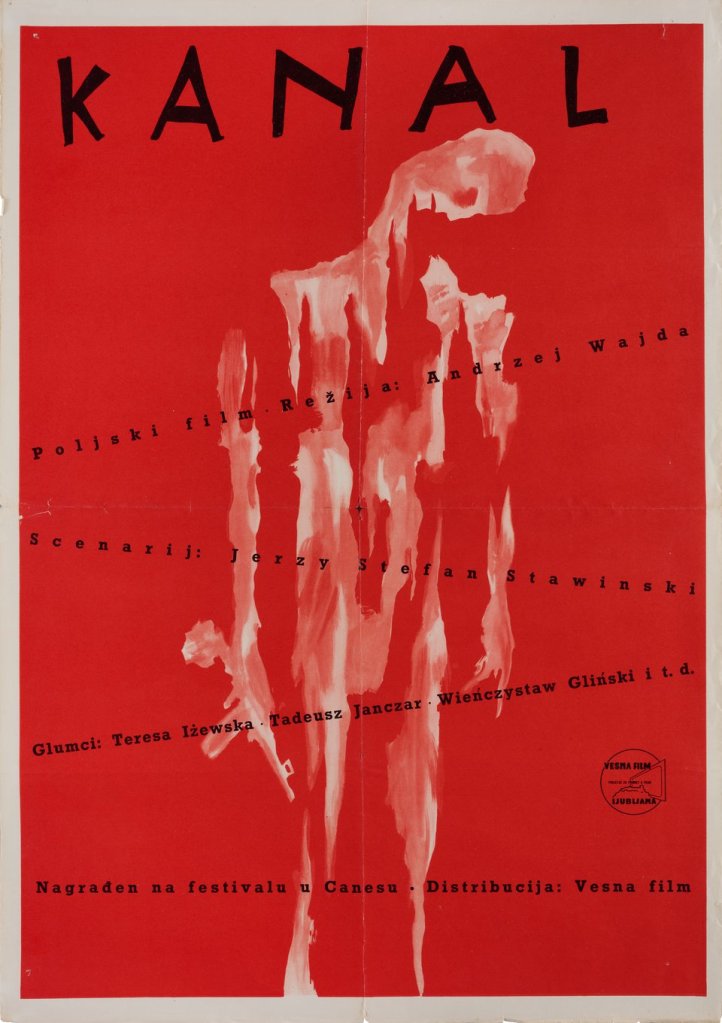
By 1957, Wajda was working under a very different Polish government from the one in place for his debut feature A Generation. With the fall of Stalinism came an easing on restrictions and controls. Wajda could address themes he couldn’t touch before, helping make Kanał perhaps even more controversial than A Generation, as it explored Polish sacrifices during the Second World War and, by implication, asked what the point might have been. Focusing on the final days of the 1944 Warsaw Uprising – a revolt against the German occupiers which the Soviets effectively stood by and watched the Wehrmacht crush – Kanał gives a Polish National myth a tragic human face of futile effort.

Not quite what Wajda’s bosses in the Polish Film Industry expected. Perhaps the title should have tipped them off: Kanał translates as Sewer, hardly suggesting a heroic tribute to national sacrifice. Starting on the 54th day of the Warsaw Uprising, the Home Army forces are beaten, clinging to a few streets. Introducing a unit commanded by Lt Zadra (Wieńczysław Gliński) in a long tracking shot through a devastated city, an unseen narrator bluntly tells us in the opening moments everyone we see is about to die. But not in a last charge against the Germans: instead it will be in the sewers, while attempting to escape, waist deep in shit, lost in the dark and stumbling into dead ends, madness, exhaustion and booby traps.

For many Poles this didn’t fit with the idea of the Warsaw Uprising being a heroic, necessary battle for the nation. It’s rather like in the 1950s, a British film studio had made a film about the Battle of Britain in which the pilots got tanked up on booze then took to the skies to be pointlessly shot down by the Luftwaffe over the channel. At least Wajda this time could present the Home Army – who, following the government line, A Generation had condemned as bourgeoise, fusspot cowards – as heroes. And Kanał is mercifully free of blunt political messaging: no one has time for any of that when they are simply desperate to survive.

What it’s also free of though is any tangible achievements from the Polish Resistance forces. Zadra’s unit holds onto a trashed district, under heavy fire, taking more and more casualties for about a day before being ordered to withdraw through a city pounded by shells through desperate civilians. During the entire course of Kanał the Poles inflict three casualties on the Germans: one tank is hit (but not destroyed), one unmanned motorised mine is stopped and one German soldier who falls into a defensive trench is beaten to death with a stone. Other than that, this is a one-sided curb-stomp where the Germans are hardly even seen and the Poles take huge casualties without even the most basic, morale boosting minor victory.

Kanał’s first half, which covers the war up-top is gritty, immediate and a truly scintillating piece of brutal combat. Wajda’s cinematic confidence is clear from the start with that long Wellesian tracking shot introducing all the characters as they move from one ruined district to another. His combat scenes take place on a wasteland of smashed buildings and have a panicked pointlessness to them – confused and desperate soldiers responding rather than planning anything proactive. The one undeniably heroic act we see – Jacek’s (Tadeusz Janczar, once again Wajda’s complex sacrificial lamb) taking down of the motorized mine – sees him near-fatally wounded, reducing him to a limping, slowly dying passenger for the rest of the film.

The atmosphere behind the lines is already tipping into desperation: number two soldier Mądry (a swaggering Emil Karewicz) is bedding young fighter Halinka (a fragile Teresa Berezowska) openly, while composer Michal (Vladek Sheybal, excellent as a haunted outsider) attempts to call through to his wife and children on the other side of the city, only to listen in on their deaths over a phone line. Any sense of chain of command is crumbling, and the soldiers are already hardened to death and destruction: retreating through the city, none of them can muster even a flicker of interest in a desperate mother begging for news of her lost child.

That’s nothing though compared to the bleakness of the film’s second half as the unit piles into the sewer. Here, time and space start to lose all meaning. The film’s timeline becomes as unclear for us as it does for the characters as they trudge through this Dantean sludge (Wajda makes sure we don’t miss the point, in a slightly clumsy touch, by having Michal quote the poet at length). With limited light, no real idea where they are going, low motivation and toxic gases being stirred up from the excrement they are crushing under their feet, slowly sanity slips, people revert to their worst instincts and selfish, unheroic decisions are made.

There is little to build a national myth on here. An incoherent colonel is left to die in the mire. Mądry and record keeper Sgt. Kula (a comradely Tadeusz Gwiazdowski) decide their own lives are more important than those of the company. Zadra clings to his duty, but lost and confused utterly fails to maintain any duty of care to his men. Michal, teetering already with the loss of his family, disappears into his own world. Their guide Daisy (a brilliantly humane Teresa Iżewska) abandons her duty in what we already know is going to be a futile attempt to keep Jacek alive. There is no dignity or final heroic act of death, with people meeting the end with stunned silence, clumsy tiredness or panic.

And over it all is the statement Wajda implies: since the Uprising achieved nothing but the massacre of its fighters, to a Wehrmacht driven out months later with ease by the Soviet forces, what was the point? That, however much the Communist state chose to praise the bravery of the soldiers, was it brave or foolhardy to single themselves out as targets in a one-sided battle that achieved nothing? Watching the fighters of the Uprising wade through excrement towards a lonely, uncelebrated death with nothing to show for it, makes you consider the complex feelings that lie behind National myths of sacrifice. And it’s a powerful and haunting message for this mesmerising sophomore effort.
Women in Love (1969)

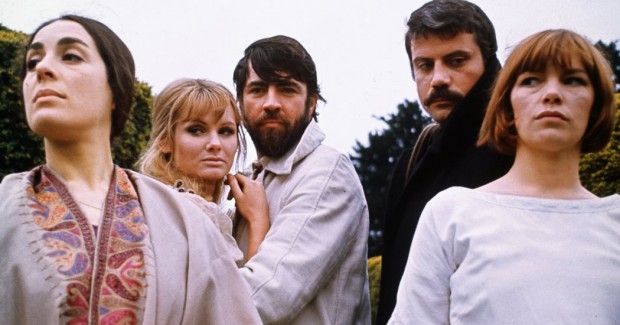
The stars of Women in Love: this publicity still gives only a hint of the simmering (and slightly strange) heightened passions you find therein

Director: Ken Russell

Cast: Alan Bates (Rupert Birkin), Oliver Reed (Gerald Crich), Glenda Jackson (Gudrun Brangwen), Jennie Linden (Ursula Brangwen), Eleanor Bron (Hermione Roddice), Alan Webb (Thomas Crich), Vladek Sheybal (Loerke), Catherine Wilmer (Christina Crich), Phoebe Nicholls (Winifred Crich), Sharon Gurney (Laura Crich), Christopher Gable (Tibby), Michael Gough (Tom Brangwen), Norma Shebbeare (Mrs Brangwen)

DH Lawrence is an acquired taste. While his writing is undoubtedly brilliant, reading his novels today it’s hard to shake off their sometimes histrionic melodrama – their revelling in all that (at the time) shockingly frank discussion of sex and all that Freudian analysis of fractured personalities against an alien industrial world. So perhaps there is a reason why one of the best interpreters of his work for the screen has been someone as melodramatic and envelope-pushing as Ken Russell.

Women in Love is Russell and Lawrence to the max. In a 1920s mining town, two sisters, Gudrun (an Oscar-winning Glenda Jackson) and Ursula (Jennie Linden) want to make their own way in the world. Local school inspector Robert Birkin (Alan Bates) wants to find perfect love and fulfilment. Alpha-male son-of-the-local-mine-owner Gerald Crich (Oliver Reed) isn’t quite sure what he wants, other than to reinvigorate his father’s business. Naturally all four of these characters come together in romantic, intellectual and sexual tangles that lead to a lot more misery than happiness.

Wow this is a difficult picture to write about. How so? Because it is about two-thirds masterpiece to one-third pretentious, hyperbolical nonsense. That’s quite some tight-rope. Russell walks it pretty well, but his problem has always been he loves being a sort of enfant terrible of British cinema too much. Too often he succumbs to temptation and pushes things a little further, to go for the demented camera or editing trick, or to push the sexual content a little bit further. The whole film has a hint of a cocky teenager, jumping up and down to look cool and catch your attention. 

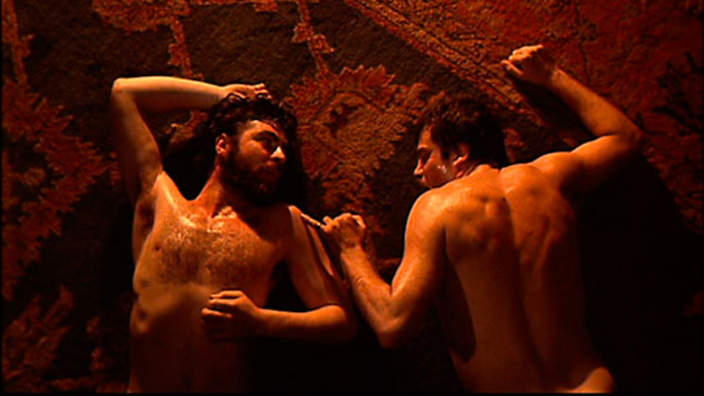
But then on the flipside, sometimes this excess really works (or if you like, sometimes more really is more). Nowhere is this clearer than in the famous naked wrestling scene between Oliver Reed and Alan Bates. It’s a high-blown, tightly edited, single-camera, increasingly artistic sequence that leaves little to the imagination as we wonder how far this nude, willy-waggling, sweaty wrestling turned intimate clinch will go (the final shot sees the characters roll off each other and lie exhausted on a carpet, breathless, in front of a roaring fire). But it works so well because the amped up shooting and content really tells us something about these two characters, their relationship, feelings, viewpoints on life, sexuality – everything. It’s a great scene and it’s a sign of how good this film can be.

And then you get other moments where you sigh and roll your eyes and almost want to say “yeah Ken we get it…”.  As Robert and Ursula roll off each other after an intense sexual encounter in the woods, we cut immediately to two bodies found drowned in a lake, their bodies locked together in exactly the same position. Yup sex ‘n’ death. Gerald and Gudrun have sex, intercut with shots of Gerald’s mother. Other moments ape up stuff that was already pretty ridiculous in the book to the max: Birkin, after a bash on the head, runs naked into the countryside and smears himself with grass and mud and rolls in the dirt. For about three minutes.

But then this is the sort of film where Glenda Jackson tames some bulls by performing a bizarre dance. Why does she do this? Who knows (certainly not the characters). But then the film is full of moments like this. But what kind of makes it work, even when it is so ridiculously over-the-top and dated in its filming, is that there is a smartness in it. It is a film that does, underneath it all, have some profound thoughts about love and relationships.

It manages to bring together the themes that intrigued Lawrence with a bit of coherence. What do we want from life? It focuses overwhelmingly on the men of the story, and in particular Alan Bates (excellent) as Birkin. Made up to look like Lawrence, Birkin also carries a lot of the prose of the novel debating what makes us happy, whether we need equally strong bonds in our life with men and women, and what constitutes our completeness as human beings. 

The film does this to a certain extent with the female characters as well – although we see them almost completely from the perspective of the men (which is interesting – maybe they were worried about making a film called Men in Love…). That’s possibly why Gudrun’s confused desires for Gerald never quite come into focus. Marvellous as Glenda Jackson is – surely an actress born to play this sort of part, marvellously passionate but strangely unknowable, vulnerable but harsh and even a little cruel – it’s hard to understand how Gudrun’s feelings change for Gerald. Maybe she doesn’t know herself. 

Gerald and Gudrun seem to be characters who don’t understand what they want (Gerald even expressly says it). That’s part of the point of the film (and Lawrence’s book) – a yearning, like both these characters have, for freedom and something different from previous generations, but unable to really put their finger on what this is. Gudrun wants a strong, dynamic man – but she also wants freedom and artistic fulfilment, and can’t find this with Gerald.

The film juggles these themes, of people struggling to reach an expression of (or to understand) their desires. Russell understands this – and for all the highblown eccentricity of some of the shooting, he sticks with a brilliant understanding of these personalities and themes. It remains a very caring movie that understands and relates to its characters. It has a lot of heart under the madness of Russell’s shooting.

And it’s superbly acted. Bates and Jackson are both marvellous, as is Jennie Linden in a (to be honest) rather thankless part as the second sister. But it’s a revelation of what a fine actor Oliver Reed could have been, if he had not decided to become a professional drunk. Reed drips charisma and intensity and he gives Gerald a real frustrated, sensual depth – a confused sexual fear mixed with a determined machismo. It’s a brilliant performance. The rest of the cast are also good, even if Eleanor Bron is (partly deliberately) overdone as Birkin’s first lover.

Women in Love is very dated in its style, but still a fascinating and intelligent piece of filmmaking that engages with and juggles with ideas. Despite all its overblown Russell excess, I actually really liked it, it stuck with me and I’ve been thinking about it since it finished. I’d actually like to see it again and see if it unlocks even more for me – and blimey it even makes me want to read Lawrence again, which after The Rainbow I never thought I’d say…