Tag: W. Earl Brown

Wild (2014)

Wild (2014)

Reese Witherspoon finds herself in a film that is more than just Eat, Pray, Hike

Director: Jean-Marc Vallée

Cast: Reese Witherspoon (Cheryl Strayed), Laura Dern (“Bobbie” Grey), Thomas Sadoski (Paul), Michel Huisman (Jonathan), Gaby Hoffmann (Aimee), Kevin Rankin (Greg), W. Earl Brown (Frank), Mo McRae (Jimmy Carter), Keene McRae (Leif)

Ever thought tackling a 1,100 mile hike would be a fun adventure? The opening of Wild might change your mind. Gasp as Reese Witherspoon rips out a bleeding toe nail and then throws her ill-fitting hiking boots down a mountain, screaming abuse at them all the way! Want to grab that back-pack now?

In this adaptation of a memoir about loss and self-discovery, Witherspoon plays Cheryl Strayed who (fairly impulsively) decided to hike the Pacific Crest Trail in 1995 to try to find in herself the woman her late mother “Bobbie” (Laura Dern) believed she could be. After Bobbie’s early death from cancer at 45, Cheryl had collapsed – ruining her marriage to Paul (Thomas Sadoski) in an orgy of anonymous sex and heroin addiction. Now she wants to make a new start.

Adapted by Nick Hornby with a good deal of skill and emotional intelligence, Jean-Marc Vallée’s film is an interesting character study via the survivalist genre, mixed with a touching exploration of grief, loss and self-loathing. After throwing us into Day 26 with that bloodied toe-nail, the film rolls back to follow Cheryl’s walk: intercut with powerful memories of her relationship with her mother, each memory activated by different encounters along the way and bubbling into her mind along with a distinctive soundtrack (most especially Simon and Garfunkal’s El Condor Pasa) that reflects the music that reminds Cheryl of her mother.

It could have been a sentimental finding-yourself movie – Eat, Pray, Hike anyone? (I also rather like Reese Witherspoon Finds Herself in a Backpack) – and I won’t lie, there are elements of that. But maybe it caught me in the right mood, maybe because I’ve always fancied testing myself with an epic hike, but I actually found it intelligent, sensitive and just the right side of sentimental.

Wild carefully avoids simple points. It’s a film not about a long journey leading to revelation, but a journey that helps you accept all your past decisions, right or wrong. There is a pointed lack of emotional breakdowns, tearful confessions or flare ups of self-anger and revelation. Instead, it’s about the long grind of starting an internal journey towards contentment. Because trekking 1,100 miles is the long haul: there ain’t any easy ways out or short cuts on this trek.

The film’s principal asset is Reese Witherspoon. Also serving as producer, Witherspoon is in almost every single frame and delivers an under-played but very emotionally satisfying performance. She plays Cheryl as quietly determined, having already hit rock bottom and knowing every step she takes from now is upwards. She meets adversity – aside from the odd flash of frustration – with a stoic will and finds an increasing spiritual freedom in the wild that serves as an escape from the horrific wilderness of her self-destructive years. But she never lets us forget the pain that underpins this journey for Cheryl. It’s a very impressive performance.

The reminders of that pain are distributed through the film, which unflinchingly chronicles Cheryl’s escape from grief in the arms of a parade of sleazy men, anonymous hotel sex and (finally) shooting up heroin on the streets of San Francisco. It ends her marriage to Paul – but not their friendship, in the sort of adult emotional reaction you hardly ever see in a movie. Paul – played with warmth by Thomas Sadoski – may not be able to continue his marriage after discovering his wife’s parade of trust-breaking, but it doesn’t stop him from helping a person he loves who is in need.

All of this is nicely counterpointed by the hike itself. Naturally it’s all slightly episodic, as Cheryl moves from location to location, but Hornby’s script makes these vignettes really work. Vallée’s direction also does a fantastic job of intercutting between the long walk of 1995, and Cheryl’s memories of both her mother (played with a vibrancy that makes a huge impression from limited screen time by an Oscar-nominated Laura Dern) and her own emotional collapse after her death.

I also appreciated that Wild doesn’t shirk from showing the vulnerability of an attractive young woman hiking alone. Some potential predators are revealed to be the opposite: others are exactly what they appear to be. But not every encounter is one of potential danger: far from it.

Cheryl is met time and again by people who only appear to support, share their expertise and help her in her quest. At an early station, a man talks her through the huge amount of equipment she’s bought and advises what she can leave behind (Vallée opens the film with the strenuous effort, including rolling around on the floor, Cheryl has to go through just to put this backpack on). She finds a touch of romance with a handsome musician (a charming Michel Huisman). There’s also comedy, most of all with Cheryl’s encounter with a self-important journalist (Mo McRae), who won’t be convinced that she isn’t a female hobo.

This is all packaged together in a quiet, un-pretentious way that culminates in a thought-provoking monologue about the value of self-acceptance and putting aside regrets. Others would have layered on the sentiment, but here the balance is just right. With Witherspoon at the top of her game, Wild is a well-made and involving road trip that also makes you think.

Being John Malkovich (1999)

A portal into the head of a famous actor? What better way to find out what it’s like Being John Malkovich

Director: Spike Jonze

Cast: John Cusack (Craig Schwartz), Cameron Diaz (Lotte Schwartz), Catherine Keener (Maxine Lund), John Malkovich (John Horatio Malkovich), Orson Bean (Dr Lester), Mary Kay Place (Floris), Charlie Sheen (Himself), W Earl Brown (JM Inc Customer)

Is there a more consciously eccentric film ever made than Being John Malkovich? Can you imagine the pitch to the Hollywood suits? 

Our hero, Craig Schwartz (John Cusack) is a weedy, bitter puppeteer (as well as creep and potential stalker), whose wife Lotte (Cameron Diaz) fills their house with rescue animals, from talkative parrots to a chimp with PTSD. Needing to make ends meet, Schwartz takes a filing job at a company based on floor 7½ of an office block (it’s a low ceilinged floor built between the other two floors – it’s cheaper on the rent obviously) where he becomes obsessed with his sexy co-worker Maxine Lund (Catherine Keener), who is resolutely not interested. But all this changes one day when Schwartz finds a fleshy, dark tunnel behind a filming cabinet that takes someone into the mind of actor John Malkovich (John Malkovich) – for 15 minutes, before expelling you onto the New Jersey turnpike. Sounds like a business interest for Schwartz and Maxine (spend 15 minutes in someone else’s body!), but the experience of being in someone’s body slowly begins to change Schwartz, Lotte and Maxine – and having his brain invaded has a terrible impact on Malkovich himself.

If that’s not the oddest plot you’ve ever heard, then I don’t know what films you’ve been watching. The film was the brainchild of Charlie Kaufman, who developed from this into one of the most distinctively gifted screenwriters in Hollywood, a master of the quirky and weird, the off-the-wall and the science fiction tinged everyday fantasy, blessed with the ability to mix in genuine human emotion amongst the oddness. 

Being John Malkovich is an inspired idea and Kaufman’s script is ingenious in its structure and progression. Never once does the film settle for the expected narrative development or the conventional structure. It’s a livewire of a film that constantly leaves you guessing, switching tone and throwing logical but unexpected plot twists at every turn. There are plenty of moments where you could expect events to take a conventional turn, but the film never settles for the obvious.

Kaufman’s inspired script was lucky enough to find a quirky visual stylist who was willing to embrace it as much as Spike Jonze did. Jonze’s direction is a masterclass in small detail, slight twists and little touches of invention that never draw excessive attention to themselves but combine to make a thrillingly off-the-wall final picture. 

Jonze knows that the jokes and surrealism of Kaufman’s script are so effective that they don’t need a firm directorial hand to lean the humour on – they work absolutely fine presented almost as written, and make for terrific entertainment. He shoots the low ceiling of floor 7½ with such straightforward confidence that each scene becomes hilarious for its stooped actors and crammed rooms. Jonze can therefore concentrate the flourishes on core moments, from the puppetry that Schwartz and later a Schwartz-controlled Malkovich make their life’s work, to assorted training and educational videos that pepper the film at key moments.

Like Kaufman as well, Jonze’s storytelling works because he inherently understands human emotion and isn’t afraid to throw it into the film alongside the humour. Plenty of directors would have been happy to have all the principals settle into being comic stereotypes, or overplayed pantomime figures. Jonze encouraged the actors to find the depth – and sometimes the darkness – in their characters, to ground the film effectively with touches of real life tragedy and human flaws that give weight to the surreal sci-fi elements – so much so that they start to feel as real as the rest.

John Cusack’s Schwartz is a bitter, increasingly twisted fantasist and dreamer – the sort of guy who believes that his lack of willingness to compromise his art in any way is a strength (his puppetry shows are highly complex, sexualised, high-blown, poetry-inspired hilarious puffs of pretension). Schwartz could have become a joke or a guy with a big dream – but the film increasingly shows him to be a dark, obsessive, cruel even dangerous outsider, who has no problem with harming other people to get what he wants, his moral compass is driven by his self-assessment of himself as a man treated badly by others, so doing what he wants is somehow deserved. It’s an increasingly dark portrait of a man who has more than hint of danger to him.

Keener, as the focus of his obsession, also does extraordinary work as a woman the film is not afraid to present as unpleasant in her selfishness, casual cruelty and greed – but a woman who slowly allows herself to open up and reveal an emotional openness and romanticism someone watching the start of the film would never expect. Similarly Diaz’s downtrodden, sad wife at home flourishes and grows as a person, as she finds in herself a new comfort and ease with who she is, from inhabiting the mind of another person. Both are excellent.

The film explores fascinating ideas of identity – Lotte and Maxine find a freedom and an exciting otherness in being a passenger in another person’s body, and use it as voyages of self discovery for themselves. Schwartz on the other hand sees this body – just as he sees all human beings – as just another puppet for him to control, another way of adjusting the world to match his requirements, rather than change anything about himself. While some lose themselves in Malkovich’s body and find the experience rewarding, Schwartz can only find happiness when bending the body to his own will.

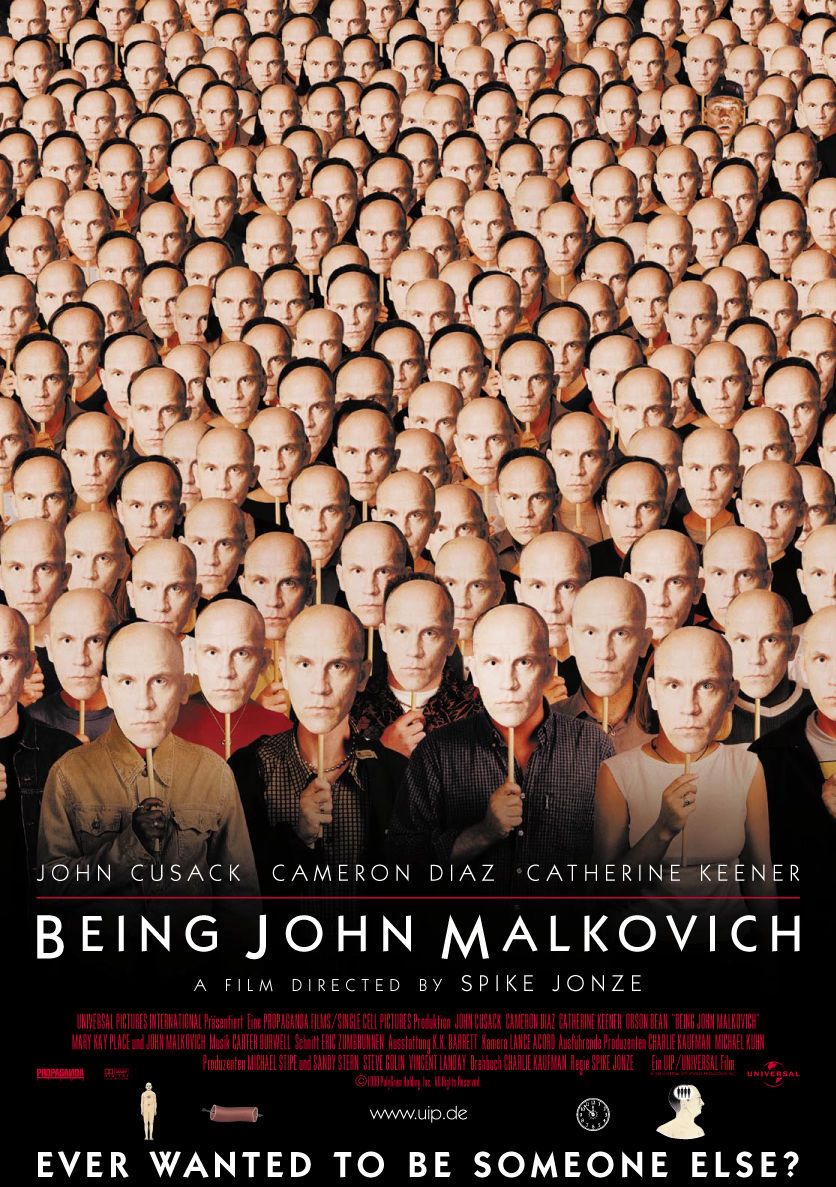
And what of Malkovich himself?  Well has there ever been a braver performance in film? Malkovich is superb as an arch portrait of himself as a rather self-important actor, with an unknowable coolness about him, an intellectualism that makes him a man easy to respect but strangely hard to relate to, a face that is distinctive but a strangely unrelatable style that makes him hard to remember (it’s really an extraordinarily funny and brave performance). As Malkovich realises what is happening to him, the film plays with real beats of tragedy and even horror – what would it be like to be forced into being a passenger in your own head? This is nothing compared to the horror Malkovich encounters when he enters the tunnel himself – to find himself in a world where everyone looks like Malkovich and can only speak using the word “Malkovich”.

Being John Malkovich uses its surreal ideas to explore profound – and even chilling – ideas of control, destiny, personality and identity. With several superb performances, a brilliant script and controlled and intelligent direction, it’s a film unlike any other – and continues to delight and surprise twenty years on from its release.

Black Mass (2015)

Johnny Depp dives into his make-up box in this sup-par wannabe Goodfellas

Director: Scott Cooper

Cast: Johnny Depp (James “Whitey” Bulger), Joel Edgerton (John Connolly), Benedict Cumberbatch (William Bulger), Rory Cochrane (Stephen “The Rifleman” Flemmi), Kevin Bacon (Charles McGuire), Jesse Plemons (Kevin Weeks), Peter Sarsgaard (Brian Halloran), Dakota Johnson (Lindsey Cyr), Corey Stoll (Fred Wyshak), David Harbour (John Morris), Julianne Nicholson (Marianne Connolly), Adam Scott (Robert Fitzpatrick), Brad Carter (John McIntyre), W. Earl Brown (Johnny Martorano)

Well Goodfellas casts a long shadow doesn’t it? Certainly long enough to completely drown Black Mass which, despite some good acting and period detail, never really comes together into something compelling or engrossing or even really that interesting. But you’ve got to admire how often Scott Cooper must have watched Scorsese’s classic. Shame he didn’t bring anything new to the table.

In South Boston in the mid-1970s, James “Whitey” Bulger (Johnny Depp) controls organised crime. With his rule under challenge from rival gangs, Bulger turns informer to the FBI – specifically agent and childhood friend John Connolly (Joel Edgerton) – offering information on his rivals in return for being allowed to take over their business. Inevitably, Bulger exploits the relationship for his own gain – with the increasingly blind-eye of Connolly who becomes more and more embroiled in the underworld. 

So there are good things in this. The period detail is pretty good. There are plenty of good gangster moments, even if they’re the reheated leftovers from everything from The Sopranos to Goodfellas. The low-level gangsters we follow have a slightly different perspective – even if most of their characters are completely interchangeable. It’s interesting that Bulger moved in such legitimate circles as the FBI and his State Senate President brother (well played by Benedict Cumberbatch). But the film never really makes this come together to mean anything. You don’t learn anything, you don’t understand anything new – it’s just a series of events.

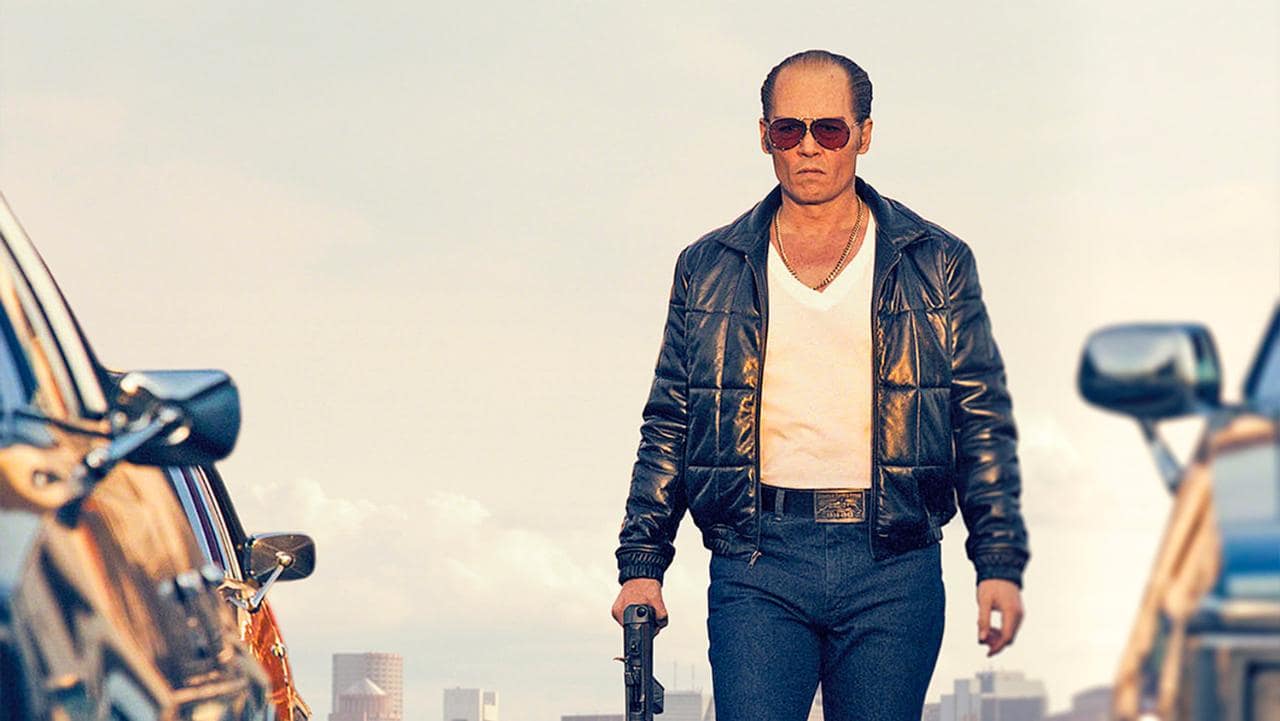
That’s despite, to be fair, a very good performance by Johnny Depp. Sure the part caters to Depp’s Olivier-like love of the dressing-up box – here he sports bad teeth, a bald patch, a paunch and a pair of searing bright-blue contacts that make him look like a Muppet demon – but for all that, he is very good. His natural presence works to make Bulger a leader and he has a swaggering, dry, cruel quality to him that never makes him anything less than unsettling. He also conveys the monstrous moral blankness behind Bulger, using a fig-leaf of loyalty to cover his destruction.

It’s a shame then that he’s not really given anything to do. Too much of the part is reminiscent of other things: from Jack Nicholson in The Departed (to be fair, Bulger was the inspiration for that character), to Joe Pesci’s “Do I amuse you?” speech or his insanity from Casino. Montages as tired as a sleepless night run through the collection of funds and the beating of rivals. It’s just all so predictable. It’s a box ticking exercise. Yawn.

The biggest shame is that, in Connolly, the film has a far more interesting potential lead character. Imagine it repositioned to follow him instead: the semi-chancer, semi-star-struck kid swept up in the glamour of crime. So much more interesting. How far did he turn a blind eye? How far was he essentially an accomplice? Did he feel or know he was doing the wrong thing? Consider Depp’s brilliance in Donnie Brasco and then imagine what he could have made of this Faustian figure: and what an interesting film we could have had.

Instead, good as Edgerton is, the film barely scrapes the surface of his thoughts or motivations. We get beats – and his wife (excellently played by Julianne Nicholson) is clearly disgusted by his gangster friends – but it constantly falls flat as we keep pulling back to Bulger, or internal FBI arguments that tell us nothing. On top of this Bulger’s empire is ham-fistedly explained: it’s never clear what his reach is, what his main crimes are or what his aims are. We see killings but don’t often know why – and a sequence in Miami is so poorly explained I still don’t know what it was about.

The film introduces Bulger’s lieutenants – but reduces them to identikit hangers on. All the flash-back retrospective confessions (a framing device the film uses to very mixed effect) in the world can’t turn them into characters. Even Bulger’s relationship with his patrician brother gets lost in the shuffle – again a film focused on a crime lord and his State Senator brother would have been more interesting.

Black Mass is well made – but its problem is that there is on the edges a far more interesting film that never comes into focus. If they had chosen a different focus we could have had a film worth watching. Instead, like Connolly, the film is seduced away by the dark soul of Bulger. Depp is great – but the film is so in love with him and his transformation that it becomes something completely forgettable.