
Tag: W.S. Van Dyke

The Thin Man (1934)

The Thin Man (1934)

Complex mysteries take a backseat to witty wordplay in this charming, funny comedy

Director: W.S. Van Dyke

Cast: William Powell (Nick Charles), Myrna Loy (Nora Charles), Maureen O’Sullivan (Dorothy Wynant), Nat Pendleton (Lt John Guild), Minna Gombell (Mimi Wynant Jorgenson), Porter Hall (Herbert MacCauley), Henry Wadsworth (Tommy), William Henry (Gilbert Wynant), Harold Huber (Arthur Nunheim), Cesar Romero (Chris Jorgensen), Natalie Moorhead (Julia Woolf), Edward Ellis (Clyde Wynant)

Wealthy businessmen Wynant (Edward Ellis) is missing and his daughter Dorothy (Maureen O’Sullivan) needs someone to find him: particularly as the police suspect Wynant is a killer after his mistress Julia (Natalie Moorhead) is found dead, under suspicion of stealing $25k from him. Can she persuade debonair, playboy detective Nick Charles (William Powell) to put the martinis aside and take a break from his never-ending banter with wife Nora (Myrna Loy) to help unpick this mystery?

But of course she can, in this hugely enjoyable murder mystery. Inspired by a Dashiell Hammett novel (but you feel only loosely). In fact, Albert Hackett and Frances Goodrich’s script (with the encouragement of WS Van Dyke) focused a lot less on the mystery and a lot more on the sparky interplay between Nick and Nora. The Thin Man is really a crackerjack, joke-a-minute screwball comedy with a murder loosely attached. If anything, it feels more like a comedic Agatha Christie Tommy-and-Tuppence yarn – it even has a final scene where Nick gathers the suspects together over dinner to explain exactly what happened.

Not that Nicks’ actor, William Powell, particularly followed the complex plot details. But then I’m not sure anyone making The Thin Man expected anyone else to either. For starters, most viewers came away with the impression that the debonair Powell was the title’s thin man, rather than Wynant (the original crime relied on the victim being thin) – and the producers eagerly embraced that misconception, with a host of sequels following, each titled with a twist on the thin man.

Besides, the viewers were here for the banter not the crime drama. The Thin Man was shot at a lightening pace by Van Dyke (earning his nickname “one-take Woody”) over no more than twelve days. The reason being that was the length of time Myrna Loy was available for, and her chemistry with Powell was second-to-none. And you can tell it in the film, which has a loose, improvisational quality between the two leads who are often essentially fooling around on camera with each other, pulling faces and telling off-the-cuff jokes far more than spending time actually cracking the case.

And that’s where the joy of the picture really is. It’s huge fun to see the two of them playfully mock hit each other before reverting to affectionate hugs when Lt Guild turns to look at them. Or slapstick business around an icebag to the head for a hung-over Nora. The sort of film where we spent several minutes watching Nick playfully shoot balloons off a Christmas tree with an air rifle from ridiculous positions (until he finally hits a window). Both actors capture perfectly the mood of jaunty, cocktail fuelled, archly witty fun that really powers the film, like Noel Coward goes investigating.

Both actors are at the top of their game. Powell’s casual air of permanent intoxication doesn’t dim his razor-sharp cleverness. Somehow, he manages to remain smooth and stylish, even as he pulls a parade of silly faces. It’s a hugely entertaining, charismatic performance that bounces brilliantly off Myrna Loy’s equally fine performance of arch comic skill. Like Powell, Loy matches playful silliness with sexy sensuality and a winning way with a comic line. Van Dyke encourages both of them to carry out as much natural kidding around as possible (there’s even a moment when Powell drops slightly out of frame, the camera not keeping up with his off-the-cuff japery).

The two of them are a perfect fit for a pair constantly in a state of inebriation. Nora even orders six martinis (all to be lined up) alongside Nick’s one when she finds out he’s that many drinks ahead of her. Nick’s first reaction to be woken up in the middle of the night is reaching for a drink. Despite this, the two of them are sublimely cool under fire (literally) as only Golden-era Hollywood types can be. In fact, being held at gun point in the middle of the night feels like only an inconvenience in the way of a nightcap.

In fact, what’s really striking about The Thin Man is how it shows a real marriage of equals. They may bicker at points – and Nick may joke he married Nora for her money – but they work as a fully unified team. If one has a sharp line, the other an equally sharper comeback and if they make decisions they make it as a team. And, of course, they still have the hots for each other (the film ends with a classic cutaway to them climbing into the same bunk, hammering it home with their dog Asta covering her eyes and a cut to a train steaming away on the track). No wonder audiences absolutely soaked up the energy: just years after the end of prohibition, here was a fun-loving couple all about enjoying every inch of the pleasure’s life had to offer.

The whole tone of The Thin Man is about coating murder mystery in fun. From party guests who tip into the comically ridiculous (my favourite being a melancholic businessman who keeps weeping at the Charles’ Christmas Bash because he feels he needs to call his Momma) to an over-enthusiastic dog (Asta, played by celebrity mutt Skippy) whose whims constantly butt into the Charles’ never-ending drinking, flirting and banter. I love William Henry’s Gilbert, who never moves without a large reference book and uses a parade of out-of-context terms he clearly doesn’t understand from Oedipal to thinking sexagenarian is a sex addict to mispronouncing sadist as sad-est.

With all this background colour, no wonder most people didn’t really give a damn who did the thin man in (or even who the hell the thin man was). We were here for the fun, for Powell and Loy and for the jokes and banter. With Van Dyke encouraging a freeform style from start to finish (Powell’s first scene was his first practice, unknowingly filmed, his relaxed comedy so perfect Van Dyke printed it straight away), The Thin Man is wild, entertaining and funny ride which continues to entertain as viewers try to stop giggling to work out its elaborately obscure mystery.
San Francisco (1936)

San Francisco (1936)

Charismatic stars and a well-oiled Hollywood plot lead into an highly effective disaster movie

Director: W.S. Van Dyke

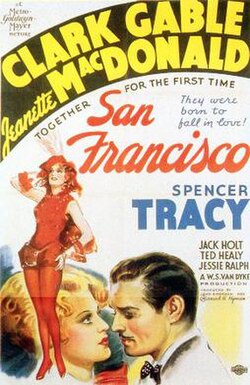
Cast: Clark Gable (“Blackie” Norton) Jeanette MacDonald (Mary Blake), Spencer Tracy (Father Tim Mullin), Jack Holt (Jack Burley), Jessie Ralph (Mrs Burley), Ted Healy (Mat), Shirley Ross (Trixie), Margaret Irving (Della Bailey), Harold Huber (Babe)

With San Francisco, Hollywood stumbled on a formula that was a sure-fire success: a romantic triangle comes to head in the face of a natural disaster with buildings tumbling. Love and disasters – who doesn’t love that? San Francisco is set in the build up to the 1906 earthquake that left over two thirds of the city in ruins and over 3,000 people dead. How’s that for focusing minds onto what really matters: who you really love and, of course, faith in a higher power.

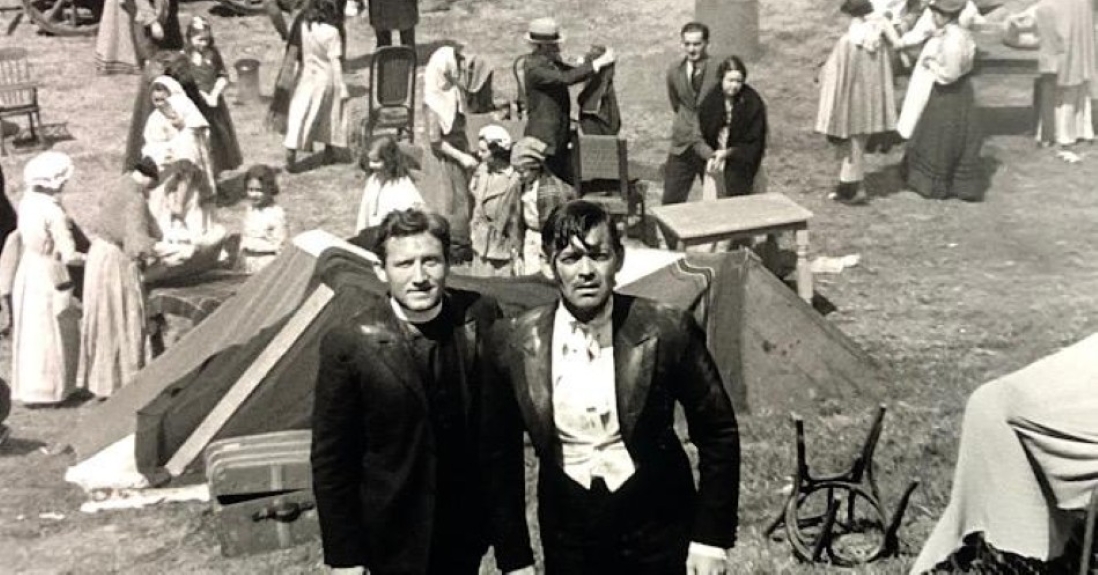
“Blackie” Norton (Clark Gable) is a lovable rogue, a saloon owner on San Francisco’s rough-and-ready Barbary Coast. His love for a good time doesn’t stop him being best friends with Father Tim Mullin (Spencer Tracy), a man’s man whose heart is with the Church. Blackie hires knock-out soprano singer Mary Blake (Jeanette MacDonald) for his saloon, but can’t wrap his head around the fact that she’s meant for classier things (like San Francisco’s opera house) than a life singing for his rowdy crowds. Of course they fall in love. Blackie is holding Mary back (without fully realising it) and she finds a new patron (and suitor) in stuffed-shirt rich-man Jack Burley (Jack Holt). All these romantic problems are suddenly dwarfed by that earthquake.

Like all disaster films, San Francisco starts with a high-blown melodrama before becoming a special effects laden epic. Much of the first 90 minutes revolves around an engagingly played familiar pair of formulas. We have a story of two old rough-and-tumble childhood friends – inevitably one who chose a life of the cloth, the other of rowdy pleasure – whose friendship struggles under the weight of conflicting principles. And we also get a love triangle where a woman is torn between two suitors – one a rogueish chancer who doesn’t understand her dreams, the other a selfish dull rich guy who offers her those dreams at a price. This is classic Hollywood stuff.

To deliver it, three popular stars go through their paces to audience pleasing effect. Clark Gable brings his customary suave charm and naughty grin to make Blackie (who in other hands could come across as a myopic, selfish sleazeball) into someone fairly endearing. Of course, it’s helped that the plot makes clear Blackie may appear to be a boozy saloon owner, but actually he has a heart of pure gold: he buys an organ for the local church, gives money to orphans and is running for office to improve the city’s fire safety. He’s easily the most polite, decent and upstanding bad boy you’ll see – and he’s even completely faithful to the woman he loves. He may say God is for ‘suckers’, but it’s not going to be a long journey to reform him into someone worthy of a good woman.

And he’s also honest in his love for Jeanette MacDonald’s Mary, trying to give her what he thinks she wants. Blinded by his three ‘Chicken Ball’ trophies for ‘artistic achievement’, he genuinely can’t see the difference between Mary performing Faust and dressing her up in the shortest skirt imaginable (as he tells her, good legs sell) to sing for hundreds of drunken punters. Poor Mary feels obliged to give up her dream to return for this nonsense, until good old Father Tim points out Blackie is accidentally behaving like a cad. Enter Jack Burley as alternative: just to make sure we know it’s the wrong choice, he’s played as un-charismatically as possible by Jack Holt and uses his money to get everyone to follow his orders, exactly the sort of ‘Nob Hill’ crook Blackie rails against.

With Jeanette MacDonald – who is perhaps a little too coy and bashful for today’s taste – we also get an awful lot of singing, from opera to hymns to several renditions of ‘San Francisco’. This went down like a storm at the time, but is probably a bit too much to take now. MacDonald actually has the duller, less engaging role, constantly changing her mind between her various career and romantic options, although she does a nice line in awkward uncomfortableness when accommodating herself to Blackie’s wishes rather than her own (not least in her body language when dressed up in that slutty showgirl costume that Blackie thinks is a compliment).

Surprisingly Spencer Tracy then landed an Oscar nomination (the shortest ever leading performance nominated), but he nails the muscular Christianity of Tim, the boxing priest. Tracy’s main role is dispensing advice and guidance to Gable and MacDonald, full of shrewd wisdom mixed with firm stares of moral judgement. Tracy plays the role very lightly, never making Tim priggish even at his most righteous. A confrontation which sees a frustrated Gable smack him in the mouth, is a classic Tracy moment: a steely eyed glare dripping with disappointment, but still he refuses to react (the film throws in an early boxing scene between the two, where Tracy easily bests Gable, to confirm he certainly ain’t scared of his co-lead!)

The various smoothly handled formula leads perfectly into the earthquake. You can’t deny this is hugely impressive sequence. The scale, using super-imposition and enormous sets, is truly stunning: buildings topple in flames, fires rip through houses, crowds run in panic through debris-packed streets. A ballroom crumbles before our eyes: the roof cracking, the wall falling down (Gable is nearly crushed by a wall), a staircase balcony collapsing.

Clearly someone on the MGM lot spent a bit of time watching Battleship Potemkin. The first wave takes Soviet cinematic montage inspiration to the max. Tight reaction cuts to horrified faces are intermixed with tumbling walls and buildings. A statue is seen, seemingly starring down in horror, before a cut to it cracking and then a shot of the head roiling downwards on the floor. A carriage wheel spins in the streets in close-up as debris falls around it. This sequence feels visceral and intense, a real stand-out moment. A second wave picks up the baton with a street literally tearing itself in two, flames licking up from a burst gas main. Buildings are dynamited as fire breaks. And through the aftermath, Gable stumbles blooded and torn and genuinely looking lost and afraid, terrified that he has lost the woman he loves in the conflagration.

It brings a real energy and punch to an entertaining plot-boiler relying on the chemistry and charisma of its stars. San Francisco ends with a tribute to the endurance of the American Spirit (not to mention, of course, Gable completing his reformation into a man of God), as all races and creeds are bought together with the ‘Battle Hymn of the Republic’ as they march towards a city reborn in superimposed imagery. With all that is it any wonder it was a box office smash?