
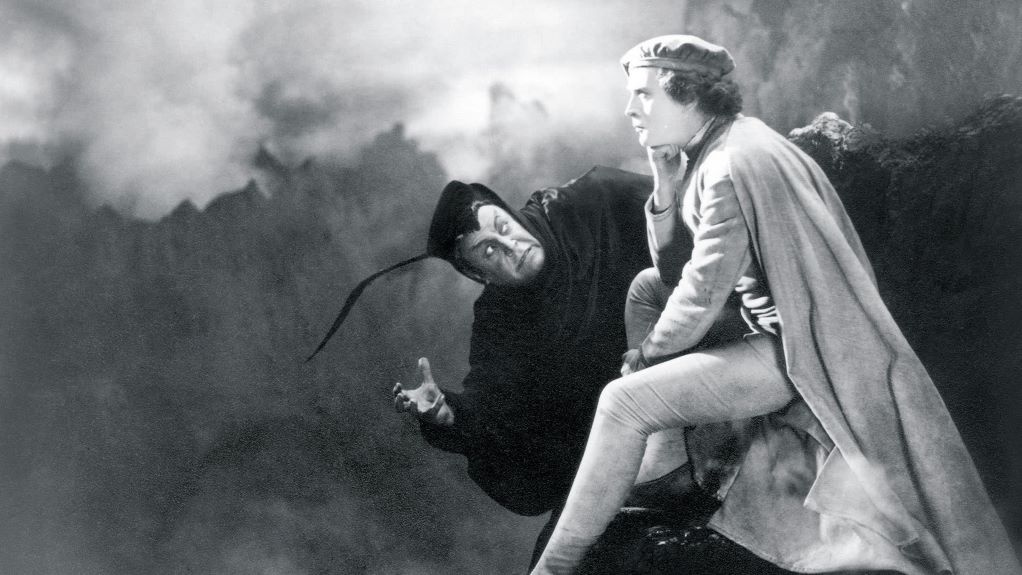
Murnau’s gorgeous masterpiece is a technical wonder and a painterly visual treat
Director: FW Murnau
Cast: Gösta Ekman (Faust), Emil Jannings (Mephisto), Camilla Horn (Gretchen), Frida Richard (Gretchen’s mother), William Dieterle (Valentin), Yvette Guilbert (Marthe Schwerdtlein), Eric Barclay (Duke of Parma), Hanna Ralph (Duchess of Parma), Werner Fuetterer (Archangel)

It’s a story that has fascinated for generations: is any deal worth your soul? Murnau’s breath-taking Faust myth throws in an extra wager: can evil corrupt a man so absolutely that not a single trace of good can be left? That’s the opening deal Mephisto (Emil Jannings) makes with his Archangel (Werner Fuetterer) counterpart. Their battleground? Faust (Gösta Ekman), an elderly alchemist, who has lived a life of faith and good works.
Faust was (until Metropolis) the most expensive German film ever made. Like Metropolis it was designed to help Weimar challenge Hollywood as the centre of the filmic universe. Murnau had direct control and several versions were made for distribution to key markets around the world. Faust was filmed over a huge period, partly for the all the multiple re-takes needed for those different versions, but also due to Murnau’s quest for perfection. Throw in cutting-edge special effects and luscious sets and you had Murnau’s own Faustian pact for success.
The film – as carefully restored today – that emerged is a work of expressionist genius jammed, particularly in its opening and closing acts, with a series of striking images balanced between fantasy and horror. Murnau used models, double exposure and transitional editing tricks to gorgeous, revelatory effect and crafted stunning images of supernatural horrors. Faust’s opening shot shows the horsemen of the Apocalypse riding through the clouds before a confrontation between a giant, satyr-like Jannings with huge wings and a similarly winged Archangel with flaming sword (the actors were strapped into stunning giant wings and Janning’s porcine like make-up is particularly demonic).

From there Murnau plays the first of his games of scale by showing Mephisto towering, mountainous, over Faust’s town, unleashing a black cloud of plague. Mephisto’s powers are demonstrated with a host of cinematic tricks: circular light then fire engulfs Faust when he summons him, Mephisto’s eyes are pinpricks of burning light (created by damaging the negative), he appears at every turn Faust makes and later shifts size, appearance and even duplicates himself while performing magic (always with gusts of terrible smoke).
The cinematic tricks continue as Faust is taken on a sort of magic carpet ride across Europe, Murnau’s camera dizzyingly flying over a series of highly realistic models of towns, forests, mountains and storming seas. The launch of this flying carpet is achieved by a miraculous double exposure shot that shows Mephisto and Faust flying out of a small window (standing upright on a cape) in one uninterrupted shot. The dizzying array of effects and visual imagination help us immediately understand why Faust is so tempted to harness the powers of this seemingly scruffy beggar (though Mephisto soon translates himself into a sharply dressed courtier).
It also ties in with extraordinary beauty of Murnau’s expert use of light and shadow. Faust is introduced as an old man, lecturing on astronomy to a room full of rapt students, lit by the glow of his astrolabe. Faust’s rooms are a light tunnel of instruments and books. His town turns from a thriving market, to a towering collection of shadowy buildings, holding a mass of swarming, panicked humanity, running in fear of the plague. Pools of light frame action: twice in the film, Murnau captures dying figures in perfectly composed outlines of light against a sea of black, the first (a priest) lying dead at his altar while smoke drifts up past the light he rests in.

Faust could almost be seen as a film about light. Murnau’s camera is continually artfully framed around painterly compositions with streaks of shadow and light. But it is also a thematic issue. Mephisto uses fog and smoke to power his magic, as if trying to obscure the light that represents the good. In Murnau’s world, light is frequently offers the possibility of hope – even the film’s closing fire offers a chance of redemption. Smoke becomes an obstruction, allowing evil to flourish.
Faust frames its hero initially as man using evil in desperation for the greater good against the plague. Faust is played Gösta Ekman, a Swedish actor in his thirties flawlessly made-up (the make-up is extraordinarily convincing) as the wizened alchemist before Mephisto restores his youth. Ekman is equally convincing in both roles, his angry rejection by the townspeople driving his descent into gred. Opposite him Jannings is a viciously cruel ball of scheming greed, under a surface of joviality.
Needless to say – after all this is a morality tale – it is the allure of sex that eventually brings Faust down. He surrenders his virtue for a night of passion with the beautiful Duchess of Parma. (The cruel Mephisto, having given Faust the sort of entrance to the court of Parma that inspired Disney’s Aladdin’s entry into Agahbar, maliciously murders the Duke after stealing his wife). Murnau’s Faust is all about the awful temptations of worldly pleasures over the hard graft of good works.
Faust also understands that temptation can come in reclaiming the moments we have lost. Faust longs for the sort of excitements he never had as a young man – too many books not enough bonks – but also for the simplicity of youth, where the possibilities of the future and happiness of home were everything. Faust’s middle section – and its weakest, an oddly farce-tinged dark-romantic-comedy – revolves around Faust’s courtship of Gretchen (Camilla Horn – in a part originally intended for Lillian Gish). Murnau raises the possibility that Gretchen’s feelings for Faust are controlled by Mephisto – via a magic necklace – but this idea is largely forgotten, possibly because Murnau’s film needed something uncorrupted by the Devil.
That incorruptible is what powers the final act of Faust as consequences – many caused by Mephisto, who cheats and abuses Faust’s trust and subtly works to destroy the lovers while bringing them together – come home to roost for its characters. Murnau’s film is very strong on the brutality of medieval justice – burnings and public executions are only moments away – but also on the spiritual strength from true love. Love is of course the answer, in Faust’s sentimental resolution, but there are worse answers to the question of what makes us human.
Faust returns to its heights in the torch-lit terror of its final section and the raw emotionalism of Ekman’s desperate, guilt-ridden performance, forcing his way through an enraged crowd hoping-against-hope that he can save the day. Faust is at its finest when centring Murnau’s extraordinary technique, a series of technical and visual marvels that makes you fall in love with cinema. At times it works best as a collection of extraordinary visuals and concepts – and I could do without some of that long middle act between Faust and Gretchen – and some of the acting is sometimes a little too broad. But it’s an extraordinary and unique piece of cinema – and a startling visual expression of the power and temptation of evil.
 Movie Musings