
Fabulously made film, a brilliant merging of half-a-dozen genres is one Andersons’s finest
Director: Paul Thomas Anderson
Cast: Leonardo DiCaprio (Pat Calhoun/Bob Ferguson), Sean Penn (Colonel Steven J Lockjaw), Benicio del Toro (Sergio St Carlos), Regina Hall (Deandra), Teyana Taylor (Perfidia Beverly Hills), Chase Infiniti (Willa Ferguson), Wood Harris (Laredo), Alan Haima (Mae West), Paul Grimstad (Howard Sommerville), Shayna McHayle (Junglepussy), Tony Goldwyn (Virgil Throckmorton), John Hoogenakker (Tim Smith)

What is revolution – changing the world or just the relentless grind of One Battle After Another? It’s as hard to define as it is to define Paul Thomas Anderson’s incredibly striking Thomas Pynchon adaptation. Look at it one angle, and it’s a sharp political commentary on America; from another it’s a satire on the insular, self-defeating rules of secret societies; from a third it’s a pulpy chase-thriller; from a fourth a touching coming-of-age story of a daughter growing closer to her dad. Anderson’s skill here is that it’s basically all these and more at the same time, an electric, frequently laugh-out loud funny, hugely eccentric film that defies all categorisation.
Pynchon’s novel Vineland saw the radicals of the 1960s pulled, clumsily, back to life in the 90s. Anderson keeps the time skip, but moves the start to the late 00s and the destination to today. Pat (Leonardo DiCaprio) is a dishevelled, but true-believing, junior member of The French 75, a radical Atifa-style organisation on a wave of armed anti-government action. He’s in love with Perfidia (Teyana Taylor), an adrenalin-fuelled militant whose radicalism is often secondary to the rush she gets from guns and bombs. She’s the source of perverted sexual obsession for bottled-up, socially-striving US army officer Stephen Lockjaw (Sean Penn). After Perfidia makes a terrible choice, 16-years later the disillusioned, frequently doped-out, Pat (now living under the alias of Bob Ferguson) is raising their teenage daughter Willa (Chase Infiniti) when Lockjaw explodes back into their life, desperate to clean up his past indiscretions in case they imperil his acceptance into a secretive Neo-Nazi organisation of wealthy American, ‘the Christmas Adventures Club’. Cue a wild and crazy chase.
Anderson’s film bowls along with a whipper-cracker pace, over-flowing with confidence that it doesn’t need to spoon-feed us timelines, details or locations but trusts us to go with narrative flow. Which I for one really did. It’s a film that throws you straight into the mix – a French 75 raid on an immigration detainment facility – and barely lets up from there. Within the first half an hour we’ve seen a wave of direct action events from blowing up campaign offices (after warning phone calls) to sabotaging a city’s electricity supply – alongside Pat and Perfidia overcome with giddy, sexual thrills at thumbing their nose at the system. It’s a great way of grasping what an addictive rush fighting the man can be, something that’s all too-clear in the excited whooping, cheering and bombastic speechifying of many of its members.
These good times can’t last, but Perfidia wants to enjoy them as long as she can. In a blistering, force-of-nature performance from Teyana Taylor, Perfidia acts completely on impulse, thrilled with her life of action, pulling the naïve Bob in her slipstream. Danger of all sorts is addictive, from bombs to risky liaisons. She’ll spontaneously attempt to sexually humiliate Lockjaw on their first encounter (essentially ordering him to ‘stand to attention’ for her), then throw herself into an off-the-books sexual relationship with him (after he obsessively tracks her down for more humiliation) seemingly for kicks. She embodies the risky, thrilling excitement of the revolutionary world.
She’s also what leads to its destruction (her fellow revolutionaries are reduced to frightened shadows of themselves when, during a bank raid. Perfidia actually uses the lethal force everyone else has just talked about). Anderson’s film, after its propulsive start (assembled like an extended montage across an entire act), jumps to a very different future, where the thrills and spills of the underworld are subtly undermined, firstly by the hilarious dark comedy of all communication being managed through obsessive codeword rules and then by comparison with a far more quiet, but far more effective, underground railroad for migrants run by Benecio del Toro’s (underplaying brilliantly, his natural charisma flowing off the screen) Latin community leader and Taekwondo-sensei.

It’s also clear how hard it is to keep the revolutionary fire-burning. One Battle After Another superbly exploits the vulnerability and anxiety that underpins many of DiCaprio’s best performances. For all his involvement with radical violence, Pat/Bob is a sensitive, true believer starry-eyed, but with an appreciation for every-day duties that his fellow revolutionaries lack. It’s him who believes family and their daughter should come first (Perfidia, in the midst of post-natal depression, even admits she’s jealous of her daughter for absorbing so much of Pat’s love and attention).
DiCaprio brilliantly finds in Bob a good heart, whose desire to do the right thing is undermined by his own incompetence. In disappointment, he’s become a paranoid grouch, grumbling about pronouns, like any other middle-aged man adrift in the modern world. DiCaprio burns through the desperate energy of the part, but mixes it with a rich vein of black comedy at Bob’s frequent inability to cope with his situation. It’s a perfectly judged performance of loyalty and love, mixed with exasperation, panic and frequent well-meaning poor judgement.
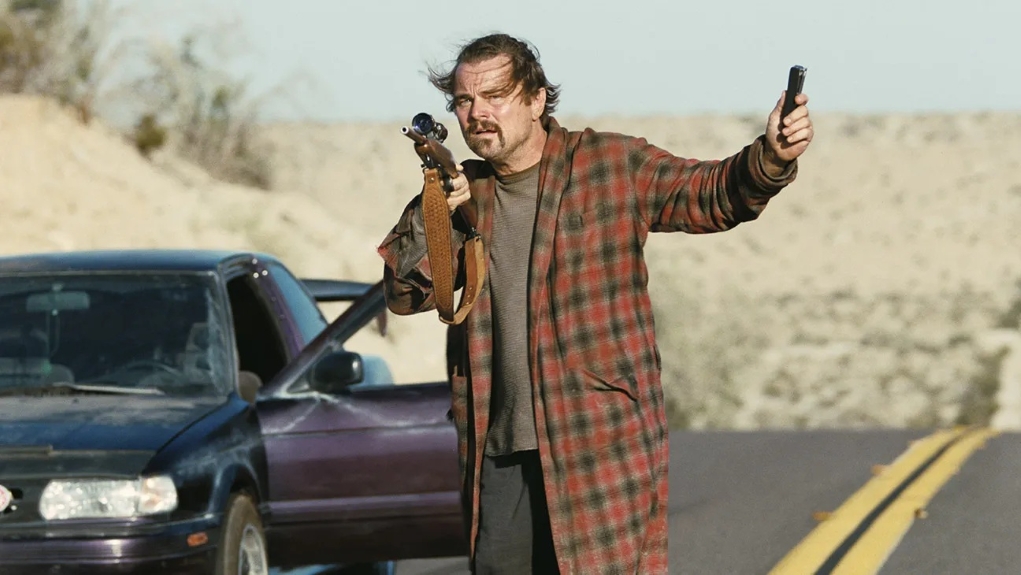
The second-act leans into the satirical comedy of these middle-aged revolutionaries, bought crashingly to life. In a neat comic touch, Bob spends most of the film on the run, desperately trying to find Willa, while dressed, Arthur Dent-style, in the same scuzzy dressing-gown he was wearing before Lockjaw’s raid. Time-and-time again, he’s reduced to swearing impotently down a phone-line like any other middle-aged consumer fed-up with unhelpful customer service, as he repeatedly fails to dredge vital codewords up from his stoned memory. During his escape, he’ll fall off a roof while evading the law, blanch at jumping from a moving car and spectacularly bungle a shoot-out. But what never waivers is his determination to help his daughter. One Battle After Another plays at times like a version of Taken where Neeson’s character had let himself get out of shape but still threw himself into the chase.
Anderson has fun with the bombastic self-importance of revolutionaries and the intricate insularity of their world. But he also has respect for their underlying desire to change the world for the better, even if the film suggests that the carefully, unflashy work being carried out by del Toro’s railroad is a better approach. Among the revolutionaries, there is a genuine warmth and feeling, embodied by Regina Hall’s loyal and humane Deandra (another superb performance in a film packed with them). There is a loyalty and protectiveness among the revolutionaries that bonds them together. And Sergio – del Toro outstanding as a never-fazed Sensei, a performance bubbling with dry wit – has built a community founded on mutual respect and looking out for each other.
And One Battle After Another has no respect at all for the alternative. The Christmas Adventures Club, the bizarre neo-Nazi group Lockjaw dreams of joining, shares the ridiculous language of secret knocks, handshakes and codewords. But it’s repellent in its instinctive racism and treats its members not as allies to be protected, but assets to be exploited and disposed of as needed. And their insidious extremism of its powerful white guys, with their hands on the gears of power, poses a far more dangerous threat.
Lockjaw is superbly played by Sean Penn as a ball of righteous, inadequate anger – from his ludicrous hair (which he frequently combs into an aggressive thrust), his tight t-shirts to accentuate his muscles to the lifts in his shoes to make him taller. Lockjaw is desperate to be a somebody, after a lifetime of social insecurity. Lacking any sense of imagination, with the emotional maturity of a disgruntled teen, Penn makes Lockjaw the embodiment of angry male entitlement trying to grab what power they can.

Anderson fuses all these elements into a film that takes us through several propulsive acts, from it’s French 75 prologue, to Bob’s desperate attempt to evade Lockjaw’s troops to a dusty road-chase that superbly carries an air of Mad Max. But Anderson does this, while never letting the film’s focus slip from the twisted family relationships at its centre: from Bob’s genuine, protective fatherly love, to Lockjaw’s incel jealousy and their twisted struggle for Willa (beautifully played by Chase Infiniti, in a star-making turn, as young woman finding a strength and idealism within herself that surprises her). It finds space for a genuinely moving series of personal relationships, just as it also skilfully shows Willa’s self-belief and social imagination flourishing under insane circumstances.
It’s part of a compelling, exciting, blackly comic and compelling film, which is not afraid to go to extreme, satirical lengths one moment and then pull you up with a scene that is gentle, earnest and heartfelt the next. It also avoids the trap of too directly preaching about America today, while asking several searching (and uncomfortable questions) about where we are now. Superbly acted across the board, it again shows Anderson is one of the finest directors working.
 Movie Musings