Tag: World War Two

Lifeboat (1944)

The survivors face the weather, the sea and their own suspicions in Hitchcock’s Lifeboat

Director: Alfred Hitchcock

Cast: Tallulah Bankhead (Constance Porter), William Bendix (Gus Smith), Walter Slezak (Willi), Mary Anderson (Alice MacKenzie), John Hodiak (John Kovac), Henry Hull (Charles J Rittenhouse), Heather Angel (Mrs Higley), Hume Cronyn (“Sparks” Garrett), Canada Lee (Joe Spencer)

Spoilers: If you can spoil a film made 76 years ago… but the ending will be discussed

The middle of the Atlantic at wartime. A ship has been sunk by a German U-boat, which was itself sunk in the exchange. A single lifeboat picks up survivors, a mixture of passengers, crewmen – and a German sailor from the U-Boat. Low on food and water, with only a faint idea of where they are, can they survive long enough to find either land or another ship? That’s even before we can overcome questions of trust – or not.

Taken from a scenario written by John Steinbeck, Alfred Hitchcock was originally attracted to Lifeboat because he fancied the idea of directing a film that was set in only one location. And a tiny one at that! Needless to say, such is the imagination and skill the film has been made with that you will soon forgot that it all takes place effectively in one tiny room. Instead, as the camera skilfully cuts and moves through the boat, finding intriguing angles and never once let the pace slip, you’ll be sucked in this intriguing story of survival and morality.

Lifeboat was attacked at the time precisely because of these difficult questions of morality. Unlike many other war films of the time, it wasn’t just interested in propaganda. Instead the German here – later revealed to be the captain of the U-Boat – is not only the films most charming and engaging character, brilliantly played by Walter Slezak, he’s also the only one that has any real idea about how to survive. Need a sailor? He’s best qualified. A navigator? The only man with a clue. Need to lop a gangrenous leg off? Willie can do it with a pen knife. His resourcefulness needs to be weighed in the balance though with his lies, manipulations and hording of supplies.

But the fact the film presents us with a Falstaffianly rogueish German, rather than a monster – and also makes him the most effective of the survivors – was a problem at the time. Combined with the fact that the representatives of the allies are a mixed and divided back. A chippy socialist sailor. A decent but ineffective radio operator. A jobsworth nurse, possibly carrying someone else’s husband’s child. An ambitious gossip columnist. An industrialist who assumes he should call the shots. And a black steward who even needs to take a moment to think about before they decide to treat him as an equal, or even use his real name. A unified and decisive group of allies, this ain’t.

The events of the film then develop in a host of challenging ways. Sure, our heroes eventually come together – but its in a murderous fury that sees them lynch Willie, beat him to death and throw him overboard. Willie saves their lives – but he also hordes water and then persuades the delirious Gus (whose leg he amputated) to throw himself overboard when Gus spies his secret water stash.

This lynching scene is the heart of the film – indeed most of the action is a slow, tension-filled, build towards it. And, for all that Willie is a seemingly unrepentant Nazi (dropping broad hints about having spent some time in Paris) who we are told ordered the shooting of survivors in the water, its hard not to feel some sympathy for him as Hitchcock cuts to a close up of his horrified eyes as he realises what the passengers are about to do. Just as the passengers, waking to find Gus gone and Willie assuring them it was for the best, take a on a monstrous inhumanity as they murder him.

Hitchcock described them later as a pack of dogs. Of the passengers, alarmingly it’s the two most decent (Hume Cronyn’s gentle radio operator and Mary Anderson’s nurse) who turn the most savage in the onslaught. Only Joe – perhaps remembering other lynchings he may have witnessed? – keeps a horrified distance from the slaughter. In a traditional propaganda film, as many critics wanted at the time, this would be a moment of triumph. The allies coming together to vanquish their common foe.

Instead, it intentionally leads a queezy and unsettling taste in the mouth. Hitchcock seems to be challenging us to ask just how we feel about this. Willie has done terrible, greedy, awful things. He’s got a lot of blood on his hands. But do we feel its right for these guys to murder him – and as brutally as they do here? (Hitchcock shoots the lynching at a distance, the passengers descending on Willie like a mob, his bloodied face emerging at one point before being dragged back in). There is nothing really triumphant about this. And, after the deed, no one seems sure how to process it. Rittenhouse even suggests Willie deserved his fate for his ingratitude after they hauled him from the water.

As safety is finally found near the end, it’s not clear what anyone has learned. The whole ghastly cycle looks like it might be repeated when a young German sailor is hauled onboard after another supply ship is sunk. Some passengers are ready to butcher him immediately – the sailor fortunately is armed. Sanity just about prevails, but already the passengers are beginning to revert, right down to starting to address Joe by the common short-hand name for a black steward, George.

But then at the same time, it’s not as simple as that. After all, these German sailors sunk a ship killing hundreds of people. During the first night on the boat a baby dies in his mother’s arms – the mother then throws herself overboard the next night, despite the passengers attempt to restrain her. Those deaths are discussed again at the end when the passengers obliquely wonder if they did the right thing. The film won’t say for sure, but leave it to you to decide. And it’s that rich sense of unease that helps make this a rather overlooked masterpiece for Hitchcock. A lot more than just a technical triumph, it’s a searching and questioning film.
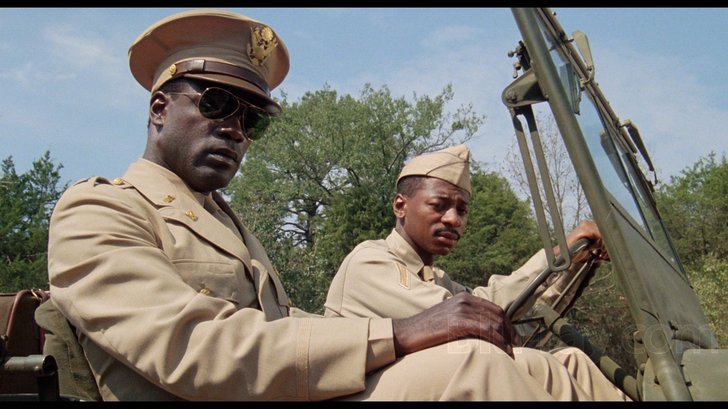
A Soldier's Story (1984)

Howard E Rollins Jnr investigates a racially motivated murder with a difference in A Soldier’s Story

Director: Norman Jewison

Cast: Howard E Rollins Jnr (Captain Davenport), Adolph Caesar (Sergeant Waters), Art Evans (Pvt Wilkie), David Alan Grier (Cpl Cobb), David Harris (Pvt Smalls), Dennis Lipscomb (Captain Taylor), Larry Riley (CJ Memphis), Robert Townsend (Cpl Ellis), Denzel Washington (Pfc Peterson), William Allen Young (Pvt Henson)

A Louisiana military base, 1944. A company of black soldiers prep for Europe to fight for Uncle Sam. All that is put on hold when hard taskmaster Vernon Waters (Adolph Caesar), their sergeant, is shot outside the base. Black JAG officer Captain Richard Davenport (Howard E Rollins Jnr) arrives to investigate the murder – to the hostility of his fellow officers, who are unused to saluting a black man as the common soldiers are. But is Waters murder the result of racism from the town? Or is it due to the tensions within the platoon?

Jewison’s adaptation of a notable stage success by Charles Fuller is a professionally mounted, sharp film – nominated for Best Picture in 1984, but largely forgotten since – that while never quite inspired, does provide plenty of insightful racial commentary on America. It never quite manages to come together as a film – and at times its pace is still better suited to the theatre than the movies –but it counterbalances this with its strength of good acting and an underplayed anger at divisions in America.

Racism is at the heart of the film. Many types of it. Jewison’s opening sequence – depicting Davenport’s arrival on the bus – provides us plenty of sightings of America’s apartheid, segregation being clearly visible in shops, benches and the bus itself. Davenport is addressed as “boy” and instinctive racial unease and disgust is in the eyes of every townsperson we meet. The officers range from paternalistic to patronisingly contemptuous of their men. Every element of the base is designed to remind the soldiers of their second-class status. Davenport is only with great reluctance allowed the trappings of his fellow officers. The film ends with a march of the soldiers towards war – a war they are volunteering to fight in, to protect a country that sees them as less-than-human.

But at its heart this is a film about the real insidious horror of racism. How it can turn someone against themselves. Because the real racial villain, it becomes clear, was actually Sergeant Walters himself. Played with a tightly-wound, self-loathing resentfulness by Adolph Caesar (repeating his stage role and Oscar nominated), Walters loathes the black men under his charge. He sees them as embodying the elements of black culture that (he believes) has led to them being treated so poorly by the whites. He hates their choices in music, in food, the way their talk. Most of all he hates the late Private CJ Memphis (Larry Riley), a good-natured, music-playing, sweet soldier who he believes embodies all the casualness and simplicity that he believes his people need to put them behind them to gain respect.

It’s Fuller’s brilliant insight that the most insidious thing about racism is that it is about creating barriers and hatreds – and it can lead to a black man loathing himself and his own people for not being white. Bad enough that the rest of society is against black people: worse that it is also secretly encouraging them to turn on each other. The tensions in the company all stem from Walters barely concealed unease at his colour, and his fury that his men don’t feel the same way.

Unwrapping in a series of flashbacks as Davenport investigates, the film reveals a fascinating series of tableau that demonstrates the confusion in Walters’ psyche and the impact it has on others. In a society where everything is all against them – as Jewison’s film is at pains to show – these are people who should be sticking together. Instead Walters crusade is to turn them against themselves and each other – to deny who they are in an attempt to become their oppressors. The quest for an acceptance that Walters eventually realises will never happen.

Because, as he bitterly states, no matter how much blood a black man sheds for America, no matter what sacrifices he makes – to many he will still be an “other”. Someone who the people of Louisiana are happy to have fight for them, but wouldn’t share a park bench with. These destructive attitudes are there as well in Davenport’s attempts to investigate, butting up against resentment from junior officers who can’t stomach being spoken to like this by a black man. Howard E Rollins Jnr plays the role with a terrific cool underneath which lies a tightly-controlled fury (he rather effectively channels Poitier in In the Heat of the Night).

A Soldier’s Story is crammed with some wonderful and challenging insights into race. It has a wonderful cast – Art Evans and a young Denzel Washington also stand-out – and a real sense of moral outrage at the evil of racism. What it sometimes lacks is the energy and dynamism the story needs to carry more immediate impact. Too often the film feels a little too safe, a little too conventional to really grip. It wraps up things with a rather conventional feel-good position (with Davenport and Dennis Lipscomb’s Captain Taylor coming to a soapy ‘mutual respect’ position). With the pace slightly off, it can drag at times. However, it’s insight can’t be doubted: it will certainly make you consider that the impact of racism can be even deeper and more damaging than the obvious, initial signs.

Judgment at Nuremberg (1961)

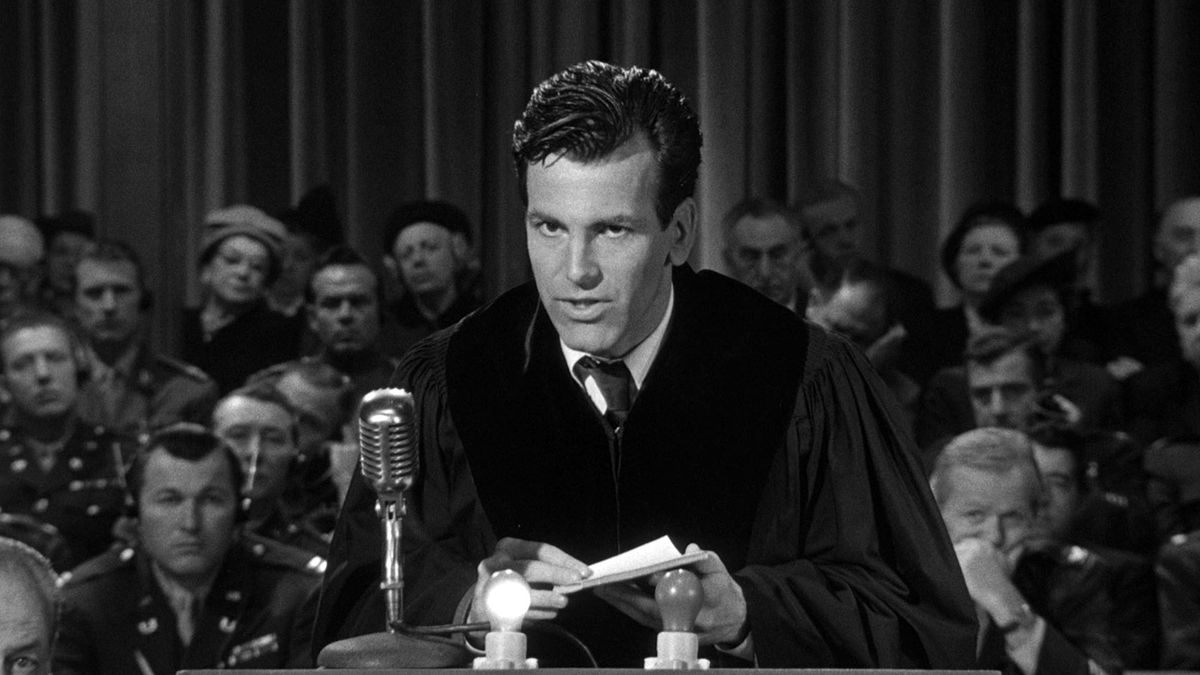
Maximilian Schell on a misguided attempt to salvage his country’s dignity in Judgment at Nuremberg

Director: Stanley Kramer

Cast: Spencer Tracy (Judge Dan Haywood), Burt Lancaster (Dr Ernst Janning), Richard Widmark (Colonel Ted Lawson), Maximilian Schell (Hans Rolfe), Marlene Dietrich (Frau Bertholt), Montgomery Clift (Rudolph Peterson), Judy Garland (Irene Hoffmann), William Shatner (Captain Harrison Byers), Howard Caine (Hugo Wallner), Werner Klemperer (Emil Hahn), Joh Wengraf (Dr Karl Wieck), Karl Swenson (Dr Heinrich Geuter), Ben Wright (Herr Halbestadt), Virginia Christine (Mrs Halbestadt), Edward Binns (Senator Burkette)

“I was just following orders”. It’s a statement you instantly associate with people who know they are doing the wrong thing, but cling to the idea it’s not their responsibility because they’ve been told to do it. The Nuremberg trials – which started with the major surviving war criminals, but then investigated every level of German society from the army to industry to doctors to the judiciary – exploded this as an excuse. But the trials also raised wider questions, ones that Judgment at Nuremberg explores: how do you make judgments for individuals when, arguably, nearly everyone in the country holds some sort of moral responsibility? What happens when justice collides with political reality? What price is put on getting justice for the few against the need to move on?

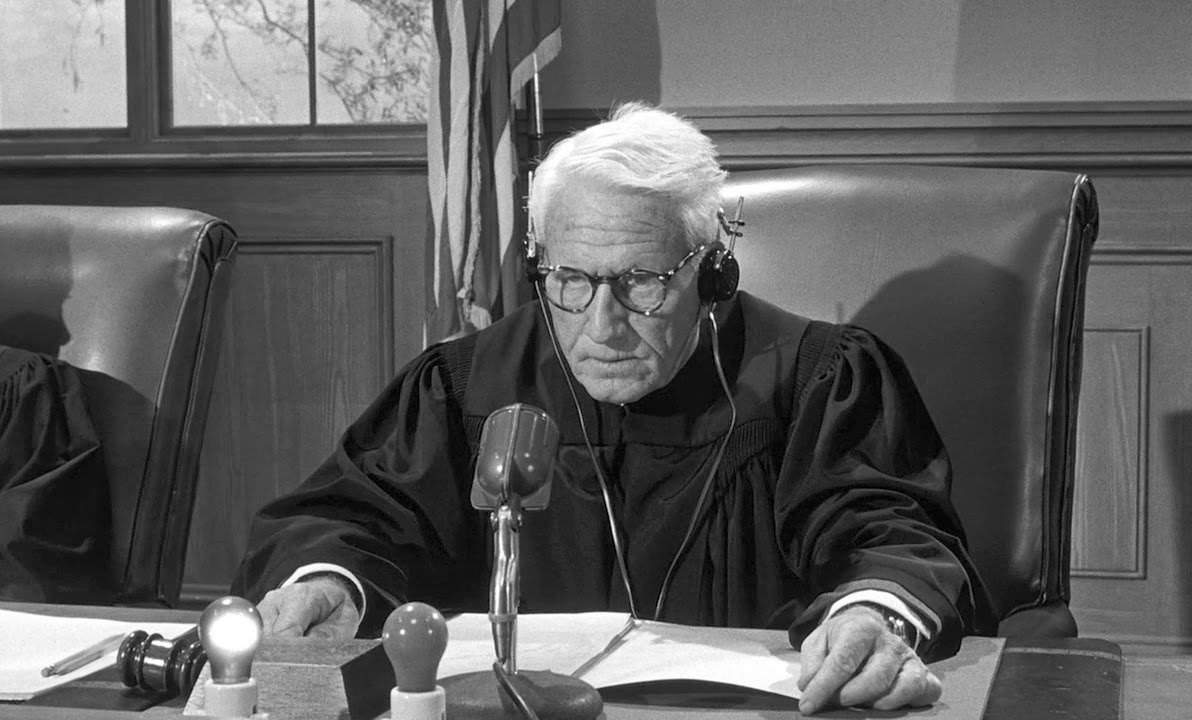
These, among others, are fascinating questions explored in Stanley Kramer’s engrossing – if at times a little dry and on-the-nose – film. In 1948 Judge Dan Hayward (Spencer Tracy) arrives in war-torn Nuremberg to judge the trial of four senior German judges. The most prominent of the accused is internationally renowned Dr Ernst Janning (Burt Lancaster). Janning’s passionate advocate Hans Rolfe (Maximilian Schell) believes the trial is about the Allies punishing the Germans and wants to show “we were not all like them”. Prosecuting laywer Colonel Ted Lawson (Richard Widmark) wants the trials to continue until all the guilty have been punished. But with Cold War tensions rising – and Berlin already under blockade by the Soviets – the politicians back home want the trials to wind down, particularly as the Germans could be key allies against the USSR. How will Hayward balance these pressures as the trial progresses?

Kramer’s film is a brilliant reconstruction of the detail of the trials. He had wanted to film the entire thing on location – but, when the trial room was unavailable, Kramer had the trial room rebuilt in exact detail in the studio (the production design is absolutely spot-on by Rudolph Sternard). The film stages all the issues of simultaneous translation, headphones and trial procedure in loving detail. His technical direction is well managed – even if the camera perhaps once too often pans around those involved in the trial while they speak. The trial drama is structured around three key witnesses (rather than documents), and brings out impressive performances from the entire cast.

Abby Mann’s screenplay wisely focuses in, not on the primary Nuremberg trials, but one of the many sub-trials. Little known, this works so well dramatically, because they both delve deeper into how every facet of German life was corrupted by Nazism – that in this case, leading judges condemned those they knew were innocent to death – and also allow an exploration around the purpose of the Nuremberg trials themselves. Were these trials crucially about justice at all costs and should continue indefinitely – as some characters clearly believe? Or were they meant as representative affairs, demonstrating the guilt of a selected few, at which point their purpose was done?

Kramer’s film is an educative piece, which explores this. Crucially several German characters are introduced, each of them unsure as to how much the national guilt should apply to them. Should Hayward’s household staff consider themselves guilty? As Hayward points out, Dachau was only about 20 miles away: not to know of its existence at all, was surely be wilful ignorance. Marlene Dietrich (excellent as an austere widow), is bitter that she has lost everything after her husband (a German general) was executed (an execution that many of the characters feel was harsh). He never liked Hitler, and he wasn’t a Nazi: how bad could he have been? He only did his duty right?

Meanwhile, firebrand lawyer Hans Rolfe believes that he must salvage some sense of German identity from the trial: he needs to show that “we were not all like that”. And rescuing the reputation of Dr Janning as “the Good German” is crucial to that. An Oscar-winning Schell (the part is perfect for his grandiose style) superbly captures the agonised guilt that has transformed into anger in this man: the desperation to protect his country that leads him to undertake the same brutal interrogations of witnesses during the trial that his clients are accused of doing. Repeating the same actions of the past that he hates, with a misguided goal of restoring pride to his country.

And why does Dr Janning become the focus of this desire to show not everyone was bad? One of the interesting things the film raises is questions of class. Rolfe sees him as the model Good German and Hayward struggles to see why he was involved in miscarriages of justice, because he is very much “one of us”. Ramrod straight, he’s no fanatic (like one of his fellow accused), he’s a noble, world-renowned lawyer. Lancaster’s Janning, with his rigid physicality, clearly thinks himself a world above his fellow accused. He has touched pitch, but feels he’s not really been defiled at heart: that there were clear reasons why he did the things he did. He has no sympathy for the crudity of Nazism, but still feel ashamed that he allowed himself to get tied up with it. He starts the trial trying to be above the entire process, as if not engaging will somehow stop him from feeling corrupted, even while his haunted face drips with shame.

It’s a nobility that many on the US side find appealing. It appeals to the same minds that deems Richard Widmark’s combatative Colonel Lawson as not quite gentlemanly, but vindictive. Never mind that Widmark’s lawyer wants justice done, regardless of the cost. It’s the same sympathy many now feel for Dietrich’s dignified widow, who feels so classy and noble that she can’t really be implicated in any nastiness. Janning unnerves Hayward and others, because if he can fall so can they. It also makes him a perfect candidate for rehabilitation. And, with the Soviets closing in on Berlin, many among the Americans want such a fate as much as Rolfe does, so that Germany can be rebuilt as a bulwark against Communism. But are we kidding ourselves? Janning may be the face of decency, but how decent can he be when he decided justice was an optional extra in his courtroom?

The film carefully explores these questions of politics being the art of compromise: of the need perhaps to end one era in order to start another. They’re attitudes I think the film acknowledges as legitimate, but also questions: “What was the war for?” Widmark’s character asks. When you have horrors such as those in the camps – and the film plays one of the key films to powerful effect during the trial – surely politics as normal can’t be allowed to continue? (Interestingly the film allows Dietrich and Schell’s characters to both, legitimately, question the inclusion of this evidence as too emotive and not relevant to the actual crimes of the accused.) Hayward himself comes under pressure to deliver light sentences which will be better for the country. Will he do so?

How can he when the evidence of suffering is so clear to him. The two key witnesses bought into the film are a man with learning difficulties and a woman who had been accused (falsely) of being seduced by a Jewish neighbour. The roles are played by Montgomery Clift and Judy Garland – and a lot of the emotion of these scenes partly comes from the tortured vulnerability of these two actors. These are people whose lives have been shattered – unjustly – and have paid terrible personal prices. Yes it might be expedient for us to look past these stories, but is it right?

Yes, you can argue Judgment at Nuremberg is a little preachy, but I think there are many more interesting ideas thrown up here than Kramer (usually denounced as a simple right-and-wrong director) gets credit for. The performances are superb: Schell is of course marvellous, but Spencer Tracy perfectly channels his ability to project morality as the unsettled judge who finds his easy assumptions challenged. And the film finally boils down perhaps to the simple question of right and wrong.

Even at the end Janning, while admitting the justice of his sentence, and the wrongness of his actions, is still desperate for everyone to know he wasn’t really one of them. That he never knew it would come to those horrors. As Hayward says “It came to that the first time you sentenced a man to death who you knew to be innocent”. Perhaps that the message of the film: justice is complex but needs to be done – and it doesn’t matter about your motives or thoughts, only the things you do.

Summerland (2020)

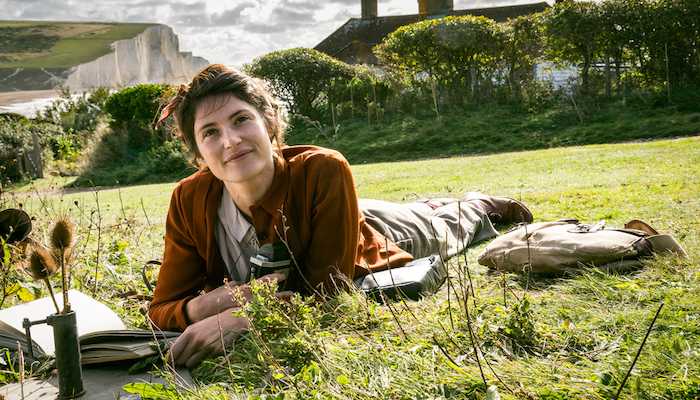
Gemma Arterton is a misanthrope with a buried heart of gold in Summerland

Director: Jessica Swale

Cast: Gemma Arterton (Alice Lamb), Gugu Mbatha-Raw (Vera), Penelope Wilton (Older Alice), Tom Courtenay (Mr Sullivan), Lucas Bond (Frank)

As London is suffering under the Blitz, in a sunny village in Kent reclusive writer Alice Lamb (Gemma Arterton) has her world turned upside down when she is forced to take in young evacuee Frank (Lucas Bond). Depressed and lonely after the collapse of her relationship with the glamourous Vera (Gugu Mbatha-Raw) at college, Alice has shut herself off and leads a solitary life. So it surprises her when she finds her heart thawing for Frank – though not as much as she will be by other revelations.

Jessica Swale has a successful career as a playwright. Several of her plays look at the place of women in history. Blue Stockings was a fascinating (and highly popular) story of female undergraduates in the late Victorian era, smart enough to excel academically but seen as second-class citizens in Cambridge. Nell Gwyn rehabilitated Charles II’s mistress as an intelligent and caring woman and a talented writer and actress. Summerland follows some of these themes – focusing on a lonely lesbian in the 1940s who, with her unconventional interests and academic leanings, is out of touch with her time. But Summerland softens this up by covering the whole story in a dreamy, luscious warmth where everything works out fine and acceptance and reconciliation is the name of the game. It’s both far less interesting than Swale’s stage work and also just as enjoyable.

Not there’s anything wrong with a a bit of cosiness in film. But Summerland is so relentlessly feel-good you end up missing a little bit of bite. Could there not be one character who questions Alice’s sexuality (which even by the 1970s, where Penelope Wilton plays an older version of the character, was hardly welcomed with open arms)? Surely in this seaside town of Kent there would be whisperings of a sort around the village’s multicultural population? Would the colour of Vera’s skin cause no comment from anyone at Cambridge or elsewhere? There are darker societal issues that could have been explored here that just aren’t touched on. I suspect the film is going for a “colour blind” casting, which works in theatre and with older time periods, but seems a bit more awkward when applied to a time period when race was a very real issue. You’d get a ton more social commentary from an episode of Call the Midwife which somehow feels a bit wrong.

But then the film isn’t trying to make a social comment, but is trying to be a bit of escapism. On that score it works very well indeed. With gorgeous Kent scenery, wartime Britain looks like the sort of idyllic Sunday tea-time drama-land you’d love to live in. The fundamental decency of everyone is somehow rather reassuring – even town gossip and busybody Sian Phillips has a heart of gold – and the film bubbles along through a series of events that are both utterly predictable (and at times hugely implausible) and also strangely reassuring. Because you could figure out most of the film early on, you never need worry.

It’s given a great deal of energy by Gemma Arterton’s performance of bad-tempered misanthropy, which of course hides great reservoirs of love and warmth for humanity. Arterton has some beautiful comic timing (an early scene where it appears she is using a ration coupon to buy chocolate for a child without coupons, only to trouser it herself is perfectly done, and probably the film’s highpoint) but also really succeeds in demonstrating the emotional trauma and pain Alice is experiencing. There is a beautiful lightness about how she opens up to Frank (scenes that are of course hugely predictable but still delivered with a genuineness and sweetness that really works).

The flashbacks allow a sun-kissed romance between Alice and Vera to play out, and leave enough questions to keep us guessing (for a bit) as to how this relationship failed to flower. (Needless to say, despite a brief line about flying in the face of society, we never see for a fraction of a second that anyone has any problem with this completely public relationship). Vera is warmly played by Gugu Mbatha-Raw, who brings a radiant life to the part. (A fun moment for Swale watchers – Arterton and Mbatha-Raw both played Nell Gwyn in Swale’s play.)

Summerland throws in a bit of thematic depth around a hunt for Fata Morgana mirages – the focus of Alice’s latest book – and the possibility that these cloud-based mirages of castles carry some sort of spiritual message from the afterlife. But this also serves as part of the film’s easy solving of problems. Any obstructions to the characters’ happiness are swept aside, either by not being mentioned or by the narrative swooping in (one offscreen “character” is easily dispatched, so that we feel no conflicted guilt at their existence getting in the way of the resolution). But this is a film that is offering a light, simple, gentle, escapist story. Nothing remotely challenging – or even really hugely dynamic – happens in it, but for those looking for Covid escape, Swale’s escapist, sweet film debut is worth a look.

Life is Beautiful (1998)

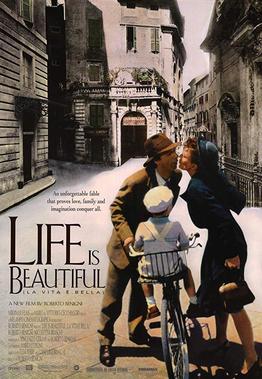
Roberto Benigni uses humour to hide the horrors of the Holocaust from his son in Life is Beautiful

Director: Roberto Benigni

Cast: Roberto Benigni (Guido Orefice), Nicoletta Braschi (Dora Orefice), Giorgio Cantarini (Giosue Orefice), Giustino Durano (Uncle Eliseo), Horst Buchhoolz (Dr Lessing), Marisa Paredes (Dora’s mother), Sergio Bustric (Ferruccio)

How can we confront the dark facts of our past? It’s a question that perhaps feels more relevant with each passing day. History is full of horrors and terrible deeds. And it’s easy to think of those who lived through terrible events as merely victims, a single homogenous mass of the suffering. Life is Beautiful however tries to look at perhaps the most terrible of events, the Holocaust, with an eye that acknowledges the terror but also suggests that love and hope can exist alongside the worst parts of humanity.

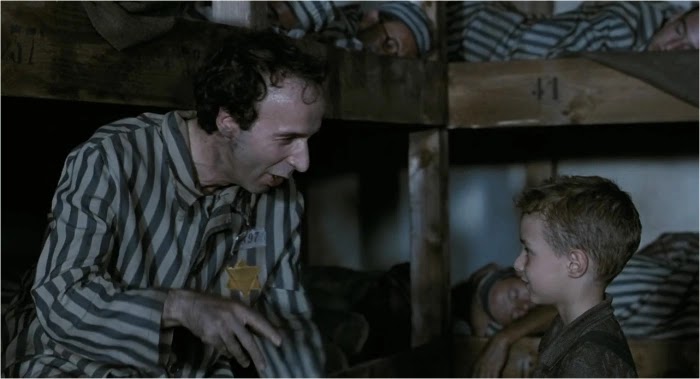
In Tuscany in 1939, Guido Orefice (Roberto Benigni) is a sharp-witted, if accident-prone, waiter who dreams of setting himself up as a bookshop owner. He falls in love with Dora (Nicoletta Braschi) and, after a courtship involving “accidental” meetings, comic interludes and finally Dora leaving her engagement party (where she is due to marry a brutish bully), they marry. A few years later they have a son, Giosue (Giogio Cantarini). But the war has gone against Italy, and now Guido and Giosue, as Jews, are arrested and sent to a concentration camp. There Guido does everything he can to try and protect his son from the horrors around him, by pretending the camp is an elaborate game to win a tank, with points won if he can hide from the guards and not cry. Guido spins his own forced labour, and danger of execution, to Giosue as part of the same game.

Directed by and starring Roberto Benigni, Life is Beautiful was Benigni’s statement that events as terrible as the Holocaust cannot drive hope and love from a father’s heart, and that both tears and laughter can come from the same beautiful place in the human spirit. It’s been called a comedy about the Holocaust, but that’s unfair. Guido may use comedy and try to turn everything that happens to them into a camp an elaborate game for his son – but that’s to stop a 5-year-old child from being traumatised. For us watching, we know the terrible place Guido and his son are in – and we know the appalling things that are happening around them.

Life is Beautiful is really two films, and only one of them is a comedy. The first half is a Chaplain-esque love story, a clumsy but good-hearted and comic scruff-pot winning the heart of a decent and loving woman. It’s full of the sort of slapstick and comic routines you could expect from the masters of classic American silent comedy. It hits every expected beat, from our hero being the sort of wily but honest and kind little guy we can root for, to all his opponents being sharp-suited bullies while his love is charming and tender. For the first half of the film there is little that, really, stands this film out from the ordinary. Benigni is a charming performer – with just the right mix of bashfulness and bombast – but it’s nothing you’ve not seen before.

But then that half of the film exists to give the second half of the film its power. As soon as the time-jump happens, it’s like watching the Little Tramp wander into a horrific tragedy. From the moment Guido closes the shutters on his shop – to reveal the words “Jewish Store” graffitied across it – the sunny Tuscan world around our heroes grows darker and darker. 

Benigni deliberately avoided a sense of realism to his Holocaust imagery – he felt only documentary could really do it justice, so avoided making his death camp look or feel anything like a real camp – but the audience is more than capable of filling in the blanks. The second half of the film, with Guido and his son in the camp, is not funny at all. But that doesn’t stop Guido busting a gut to entertain his son at every moment – or prevent us building a deep emotional connection with a father who is suppressing his own pain and fear in order to try and protect his son. The father who knows the business of this camp is death, who knows that Dora has also been arrested and placed in the women’s camp. Who knows their only hope is to pray the war ends before they die. It’s bleak stuff, and the fact that Guido keeps up a front of humour doesn’t make the film a comedy.

It’s why it the second half of the film carries such impact. Not only have we invested in the comedic warmth of these characters in the first half, but seeing them trying to keep hope alive in their own way in the bleakest of situations is completely moving. Sure there are funny moments – the most notable being Guido’s improvised interpretation of the guard’s explanation of the camp rules into an explanation of the rules of the game he is trying to get his son to believe in – but really it’s not a comedy because we know too well the dangers that surround them.

Sure the film is sentimental and in many ways manipulative. It would be hard pressed to not create emotional moments from such material, and from the sacrifices of Benigni’s character. But it still works and the film has a few shrewd moments of personal insight, not least from the introduction of Horst Buchholz’s German doctor. Dr Lessing knows Guido from his days as a waiter in Tuscany – but encountering him in the camp waiting tables at the officers’ mess, it doesn’t even begin to occur to him that Guido’s position has changed or his family’s lives are in mortal danger. The dehumanising of this extermination system doesn’t just turn people into murderers, it turns decent people into thoughtless observers.

Life is Beautiful does carry a real emotion wallop towards its end. It was famous as “the Holocaust comedy”, but it uses comedy and the conventions of Hollywood romance to build our empathy for characters who then find themselves in a Holocaust movie. And it treats the Holocaust itself with a deep reverence and respect, never making the deaths of millions anything like a joke. Sure, you could argue that it still downplays the terrors of the Holocaust – but then we know the background so well, do we need the gaps all filled in? And while you might say hope from such a terrible setting is not the message that should come out, sometimes it feels like the message we need.

The Train (1964)

Burt Lancaster takes on the Nazis and the schedule in The Train

Director: John Frankenheimer

Cast: Burt Lancaster (Labiche), Paul Scofield (Colonel von Waldheim), Jeanne Moreau (Christine), Suzanne Flon (Miss Villard), Michel Simon (Pape Boule), Wolfgang Priess (Major Herren), Albert Rémy (Didont), Charles Millot (Presquet)

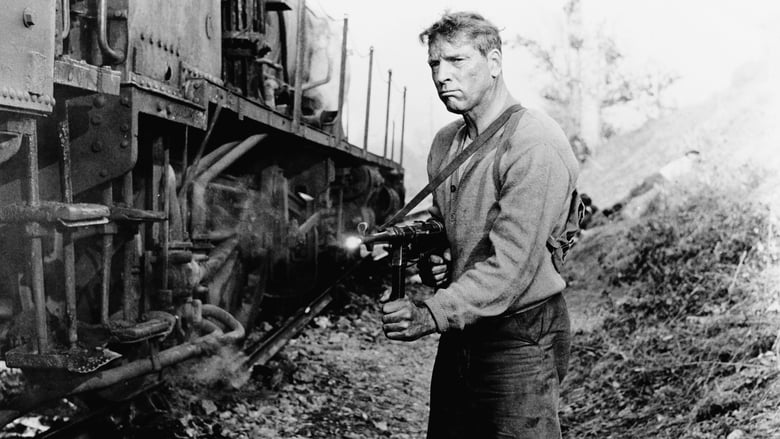
The German occupation of France draws to its close. Paris will fall in days to the Allies. As the Germans evacuate, Colonel von Waldheim (Paul Scofield) has other plans. All that fabulous modern art – all that stuff the Nazis call degenerate, the likes of Cezanne, Renoir and Monet –  that he has kept jealously guarded and locked up for years would be worth a tidy packet if he can get it back to Germany. Or is it that von Waldheim just loves the paintings so much he can’t let them go? Either way, he’s determined to load these priceless masterpieces onto a train and take them back into Germany – with rail network manager (and secret resistance fighter) Labiche (Burt Lancaster) bought in to lay on and then run the train. But will Labiche be willing to risk resistance and railway lives to prevent this looting of France’s cultural heritage?

John Frankenheimer’s rollicking, dark-edged war film mixes in serious questions amongst its compelling explosions and train wrecks. Namely – is any human life worth the cost of protecting a nation’s artistic heritage? Or in other words, what are we fighting for when we protect the nation – the people who live in it, or the ideas that underpin what a nation is? Because what von Waldheim is pinching here is a large chunk of France’s heritage – and it would be irreplaceable – and for many in the resistance it’s risks are acceptable to stop that. Even as the bodies start to pile up.

The Train is a slightly nihilistic war film, in which the vast majority of the cast wind up dead, leaving the survivors to wonder if those paintings were worth the dozens of lives lost to protect them. Frankenheimer even hammers it home in the conclusion by cross cutting between the bodies of the victims with the packing crates (each carefully labelled with an artist’s name), making the paintings seem even more like chilling tombstones. The Germans, rarely thinking for more than a second before gunning down resistance fighters or anyone caught working with them.

In this they take their lead from von Waldheim. Played with glacial chilliness by Paul Scofield, von Waldheim at first appears a reasonable, even decent man. But it becomes clear that this well-spoken, polite man has a mono-mania for art that trumps all considerations of human life. Von Waldheim believes art should belong only to those who can understand it, and clearly cares nothing for human lives around him, all of whom are disposable should he choose. Under his gaze, civilians are put against the wall without a second thought and soldiers instructed to meet all attempts at slowing the train with lethal force. Frankenheimer carefully builds over the course of the film von Waldheim’s unhinged amorality, culminating in a series of Dutch angles as he finally goes further than even his own soldiers will follow.

As his counterpoints we have the muscular humanity of Burt Lancaster. Focusing all his experience as an acrobat and circus performer in his youth, the film is a tribute to Lancaster’s athleticism. With Frankenheimer using a series of tracking shots and uninterrupted long shots, we are shown that without doubt it’s Lancaster jumping from moving trains, rolling down hills, jumping walls and bounding across roofs. Lancaster’s commitment also stretched to mastering many train engineering tasks with such success that he was able to perform them (uncut!) on film. 

Performance-wise the part falls carefully into Lancaster’s strengths as a tough-guy with a heart. And while at times he feels like what he is – a Hollywood star parachuted into the French countryside to do battle with the Germans – he nevertheless carries the film with a charismatic ease. His emoting – particularly in several speeches decrying the human cost of the operation – verges on the overly emphatic, but few other actors could have carried the near wordless final half an hour with such aplomb. Lancaster’s moral certainty and enraged humanity also makes a perfect contrast with Scofield’s distant amorality and coldness.

The action then takes place on a series of trains that have even greater impact because you know, unlike today, everything was done for real. Each of the crashes, explosions, de-railings and train-based stunt has the freshness and excitement of reality behind it. The real events that inspired the film saw the French Resistance prevent the art train leaving Paris through drowning it in red tape. But that’s a lot less exciting than an ingenious “wrong stations” routine or a desperate chase across the French countryside (and very few Hollywood directors shot France as well as Frankenheimer).

It all makes for an exciting cocktail, even if the central ideas of art vs. life are not explored as well as they could be. It captures that 1960s feeling of “war is hell” as bodies pile up, and Jeanne Moreau’s hotel owner gets a speech on the emptiness of men killing each other. Sometimes you feel The Train wants to delve deeper into the psychology and cost of its events – but then it slaps another train into a collision  and decides to be as much a “man on a mission” film. Either way, it adds enough depth to make it a rewarding watch. 

Jojo Rabbit (2019)

Taika Waititi directs and is an imaginary Hitler in his coming-of-age/Nazi Germany satire Jojo Rabbit

Director: Taika Waititi

Cast: Roman Griffin Davis (Johannes “Jojo Rabbit” Betzler), Thomasin McKenzie (Elsa Korr), Scarlett Johansson (Rosie Betzler), Taika Waititi (Adolf Hitler), Sam Rockwell (Captain Klenzendorf), Rebel Wilson (Fraulain Rahm), Alfie Allen (Lt Finkel), Stephen Merchant (Deertz), Archie Yates (Yorki)

A comedy set in Nazi Germany? Well if there is one thing you need to get right, it’s the tone. Taika Waititi’s comedy about a boy with an imaginary friend who just happens to be a version of Adolf Hitler more or less does so – although I’d argue it’s less a comedy and more of a terrifying condemnation of the horrific powers of indoctrination. But that sells a lot less well in trailers doesn’t it?

Set in late 1944, the boy in question is Johannes (Roman Griffin Davis – a revelatory performance) a ten-year old who wants to be a passionate Nazi but is undone by his own underlying sweetness. Not that it stops him believing everything he’s told by the regime and its theories around Jews, re-enforced by his imaginary best friend, a childishly stroppy version of Adolf Hitler (played by Waititi himself). Nicknamed Jojo Rabbit after his failure to kill a rabbit on a Hitler Youth indoctrination camp, then later blowing himself with a grenade meaning he can no longer qualify for military service, Jojo sees his dreams of becoming the ultimate Aryan fading away. Things become even more conflicted when he discovers his secretly anti-Nazi mother Rosie (Scarlett Johansson) is hiding a teenage Jewish girl Elsa (Thomasin McKenzie) in the walls of his late sister’s bedroom.

Waititi’s film returns to his affectionate roots of coming-of-age stories but in an entirely different setting – here the child must grow up by learning to reject the vile ideologies that have been hammered into him by the system. Waititi shoots the entire film from the perspective of the child’s view of the world, meaning the horrors of the war are kept largely at a distance from us (until a sudden and terrible event brings them overwhelmingly into frame). The Nazi world around Jojo looks like some glorious Enid Blyton summer, the colour of which only gradually disappears from the film as event proceed. It’s a neat visual way of capturing the child’s innocence.

This also means many of the characters are seen from Jojo’s perspective. Most obviously Adolf Hitler (the imaginary one), played with gleeful comic gusto by Waititi, is far from the actual dictator but is a sort of ten-year-old’s idea of what he might be like, childish, oddly innocent in places, prone to strops – but also has enough darkness in him (which emerges more and more as the film goes on) to show that he is still part of the hateful ideology the real Hitler promoted. Similarly, Jojo’s first impression of Elsa is shot and framed like some sort of creepy horror film – matching the ideas that have been indoctrinated into him by the regime that the Jews are a near-Satanic threat.

That indoctrination is a big part of the film’s primary themes. An early sequence at a Hitler Youth camp is less funny – even if it does have moments of brash comedy and some good jokes – more horrifying for the mantra of violence, race hate and slaughter that the regime is preaching almost every second that its representatives appear on screen. It’s actually chilling seeing this group of impressionable kids succumbing so completely to the excitement of this relentless onslaught of propaganda. The passion that the Nazis inspire is wonderfully caught by Waititi in the credits, with Leni Reifenstahl footage beautifully recut to the Beatles singing in German – it’s hard to miss the parallels. (The film makes some neat use of modern music, with David Bowie also popping up).

Jojo however is still a sweet, kind, generous boy under the surface – however much he has swallowed the constant message from his government that he should aspire to being a cold eyed killer. Waititi’s message is that there is still hope in the roots of next generation, however much the current generation does it’s best to mess that up. It’s something that his mother – exquisitely played by an Oscar-nominated Scarlett Johansson with a wonderful sense of playfulness hiding an intense sadness – clings to desperately, knowing the sweet boy she loves is still largely there, however twisted he is by a cruel ideology.

It’s the relationship with Elsa that helps bring that out, with Thomasin McKenzie wonderful as an initially hostile young girl, determined to never be a victim, who softens and thaws as she senses the kindness in this boy. Her hiding is all part of Rosie’s own defiance of the regime and its oppression, the horrors of which – from random searches to executions – slowly begin to creep into the film. 

If there is a problem with the film, it is that the darker elements of this film – and there are many – often play a little awkwardly against the more comedic and even farcical elements. Waititi as an actor gets the tone right – but others, particularly Rebel Wilson as an oppressive Nazi – head too far into unfunny, tonally flat farce. Sam Rockwell does a decent job as a German army officer, even if his obvious bitterness for the war effort and contempt for Nazism makes him an unlikely candidate to be running an indoctrination camp, but even he veers sometimes too far onto the side of flat farce. Other than Waititi, only Stephen Merchant as an officious Nazi official – including a running joke of continuous Heil Hitler greetings – gets the balance right between comedy and darkness.

It’s a balance the film doesn’t always make very successfully – but it’s balanced by the warmth that it feels for Jojo, the excellence of Griffin Davis and McKenzie’s performances, and the moments of genuine shock and trauma that surprise the viewers and head the film openly into very darker territory. Less a comedy and more a plea to allow children to be children, not victims of the views and desires of adults, it’s a thought provoking film.

Unbroken (2016)

Jack O’Connell does fine work in the middlingly impactful Unbroken

Director: Angelina Jolie

Cast: Jack O’Connell (Captain Louis Zamperini), Domhnall Gleeson (Lt Russell Phillips), Garrett Hedlund (Lt Commander John Fitzgerald), Miyavi (Sgt Mutsuhiro “The Bird” Watanabe), Finn Wittrock (Sgt Francis McNamara), Jai Courtenay (Lt Charlton Cupernell), Luke Treadaway (Miller), Spencer Lofranco (Harry Brooks)

Angelina Jolie’s directing work doesn’t get the acknowledgement it perhaps deserve and it’s easy to think, watching the confident and imaginative framing of much of the film, that if, say, Brad Pitt had directed the film it might have got a more positive reaction from people. Anyway, perhaps part of the problem might be for all the extraordinary courage of Louis Zamperini’s life story, the general ideas behind the film are now so common in film-making that – and it feels terrible to say it – perhaps we are at last too familiar with these stories for them to have a real lasting impact. 

Louis Zamperini (Jack O’Connell) was an Olympic athlete, who set a world record for the fastest lap in his final lap of the 1936 Olympics 5000 metres final (despite finishing 8th overall). Signing up for service in the war, his bomber crashes and (after surviving 47 days in an open lifeboat in the Pacific) he is captured by the Japanese. There he experiences the brutality of the POW camps – and earns the enmity of Mutsuhrio Watanabe (Miyavi) one of the camp’s officers, who beats him mercilessly. But through it all his determination never wavers, neither does his humanity. He remains Unbroken.

The attraction of the resilience of the human spirit never wavers – and many of us suspect we would break, making our admiration and respect for those that don’t all the greater. That admiration is easily bound up in O’Connell’s wonderful performance as Zamperini, dripping charisma powered by kindness, humanity, decency and self-respect. O’Connell dominates the film, and is also the key to its successful moments – the camera always comes back to him, and his eyes wind up telling much of the story. Without him the film would struggle to make a real impact.

Which is part of the problem with it – it doesn’t make the impact you feel it should. Jolie’s direction is technically accomplished and very skilful, and the film is beautifully shot and filmed by Roger Deakins. There is barely a foot wrong anywhere in its make-up – but for some reason it doesn’t come together into something that carries real force. Maybe this is overfamiliarity with these stories, maybe this is too much professionalism and expertise crowding the emotion out, maybe it’s just that there isn’t enough story here for it to really work. But for whatever reason, this is a film that winds up leaving you colder than it should.

Its finest sequence coves the isolation on the boat, the struggle with sun and sea, without sufficient food or water, a marathon endurance test that claims the life of one of the three men who undergo it. Jolie’s film captures the strange claustrophobia of a tiny world – one lifeboat – in a huge expanse of nothingness. These scenes are compelling in a way the later prison camp scenes just aren’t. 

The camp scenes are of course tough and brutal in a way (although some have – perhaps justly –  complained that they are so beautifully and elegantly filmed that their impact is dramatically reduced, with every shot of the camp turned into some sort of renaissance-lit masterpiece) but they don’t hit like they should. Yes what Zamperini and the soldiers go through is dreadful and awful beyond measure, but nothing here seems to really capture that. It’s sort of something we understand but don’t wind up feeling from the film. 

Perhaps that’s because the one thing the film does capture really well is the powerless drift of POW life. The soldiers have no control over their fates and no way of escaping it, This all gets captured in the brutal bullying of Watanabe – but the film never manages to make either him or his rivalry with Zamperini compelling, leaving me unsure whether he was intended as a representative cipher of the appalling system rather than a real character.

Unbroken won’t exactly disappoint but it won’t exactly thrill either. While I do feel not enough credit is given to Jolie – and a male star would have got more praise – this is also a film that feels too much like a Hollywood prestige picture, too much like an important film straining for those Oscars. It forgets the heart and doesn’t engage our feelings.

The Dam Busters (1955)

Richard Todd leads the most famous bombing raid ever in The Dam Busters

Director: Michael Anderson

Cast: Richard Todd (Wing Commander Guy Gibson), Michael Redgrave (Barnes Wallis), Ursula Jeans (Mrs Molly Wallis), Basil Sydney (Air Chief Marshal Sir Arthur Harris), Patrick Barr (Captain Joseph “Mutt” Summers), Ernest Clark (Air Vice-Marshal Ralph Cochrane), Derek Farr (Group Captain John Whitworth)

It’s famous for its stirring theme. Those bouncing bombs. The fact that George Lucas, while still completing the special effects, spliced in the final bombing runs into his first cut of Star Wars. But where does The Dam Busters sit today as a film? 

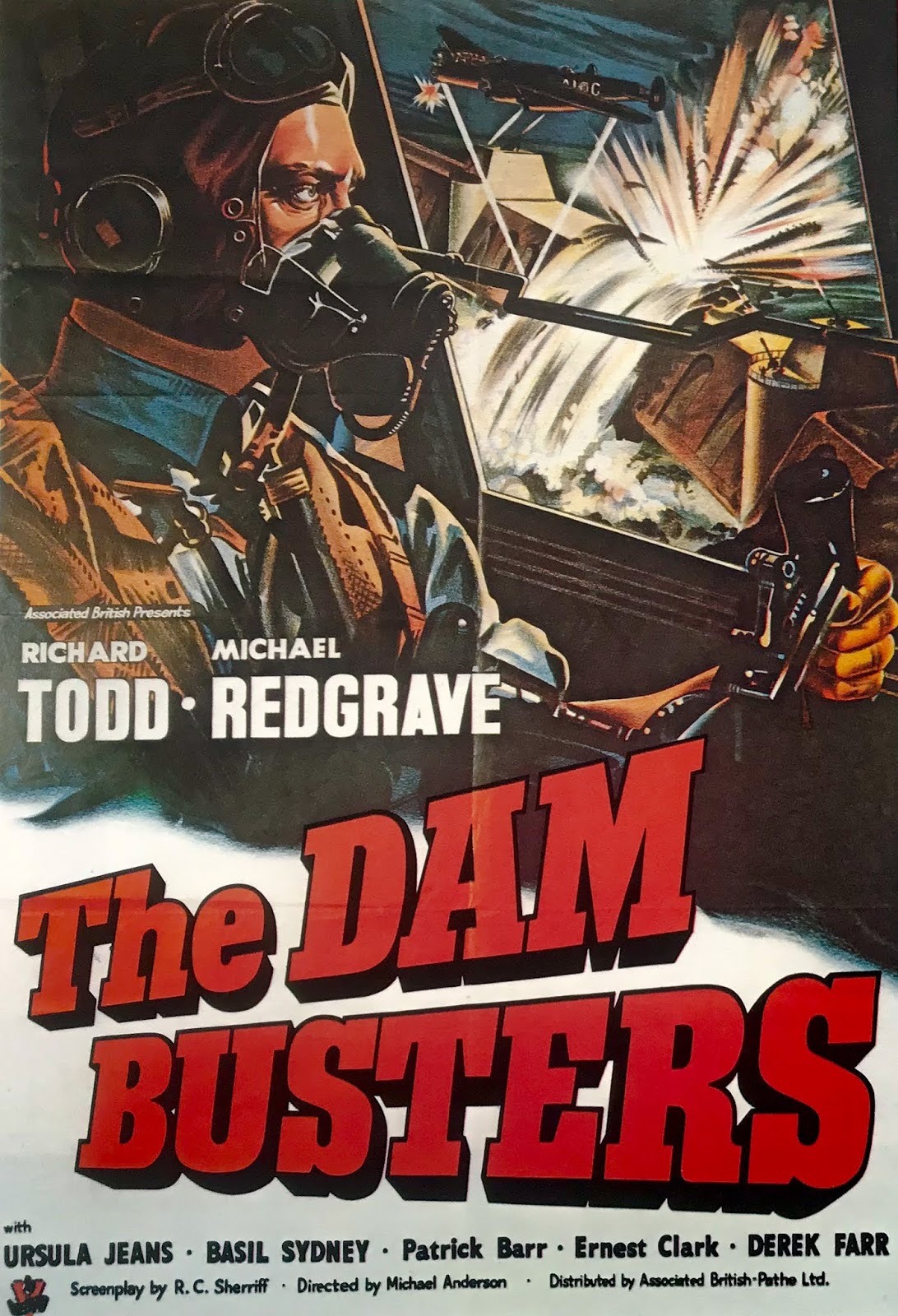
In 1942, aeronautical engineer Barnes Wallis (Michael Redgrave) is working on a plan to take out the German dams on the Ruhr, a strike that could cripple German heavy industry. Conventional bombs can never cause enough damage, and the dams are protected from torpedo attack. So Wallis has a crazy idea – to build a bouncing bomb that will skim the top of the water, hitting the dam, with its top spin taking it down to the base of the dam for detonation. It’s a crazy idea – but it finally wins favour, with Wing Commander Guy Gibson (played by real-life World War II paratroop veteran Richard Todd) given command over an operation that promises to be risky and dangerous beyond belief.

The Dam Busters doesn’t really have much in the way of plot, being instead a rather straight-forward, even dry in places, run through of the mechanics involved in planning the operation and overcoming the engineering difficulties that stood in the way of the operation. Throw into that our heroes overcoming the various barriers and administrative hiccups put in the way by the authorities and you have a pretty standard story of British pluck and ingenuity coming up with a left-field solution that saves the day. (Though Barnes Wallis denied he faced any bureaucratic opposition like the type his fictional counterpart struggled with for most of the first forty minutes).

Of course, the film is also yet another advert for the “special nature” of the British under fire, a national sense of inherent destiny and ingenuity that has frequently done as much harm as good. Made in co-operation with the RAF, it’s also a striking tribute to the stiff-upper-lipped bravery of the RAF during the war, and the sense of sacrifice involved in flying these deadly missions.  

In fact it’s striking that the film’s final few notes are not of triumph after the completion of the operation, and the destruction of the two dams, but instead the grim burden of surviving. After 56 men have been killed on the mission, Barnes Wallis regrets even coming up with the idea. The final action we see Gibson performing is walking quietly back to his office to write letters to the families. Anderson’s camera pans over the empty breakfast table, set for pilots who have not returned, and then over the abandoned belongings of the dead still left exactly where they last placed them. It’s sombre, sad and reflective – and probably the most adult moment of the film.

Because other than that, it’s a jolly charge around solving problems with a combination of Blue Peter invention, mixed with a sort of Top Gear can-do spirit. Michael Redgrave is very good as the calm, professorial, dedicated Barnes Wallis, constantly returning to the drawing board with a reserved, eccentric resignation to fix yet another prototype. The sequences showing the engineering problems being met and overcome are interesting and told with a quirky charm that makes them perhaps one of the best examples of such things made in film. 

The material covering the building of the flight team is far duller by comparison, despite a vast array of soon-to-be-more-famous actors (George Baker, Nigel Stock, Robert Shaw etc.) doing their very best “the few” performances. Basically, generally watching a series of pilots working out the altitude they need to fly at in training situations is just not as interesting as watching the boffins figure out how to make the impossible possible.

The flight parts of the film really come into their own in the final act that covers the operation itself. An impressive display of special effects at the time (even if they look a bit dated now), the attack is dramatic, stirring and also costly (the film allows beats of tragedy as assorted crews are killed over the course of the mission). The attack is brilliantly constructed and shot by Michael Anderson, and very accurate to the process of the actual operation, in a way that fits in with the air of tribute that hangs around the whole film.

All this reverence to those carrying means that we overlook completely the lasting impact of the mission. “Bomber” Harris (here played with a solid gruffness by Basil Sydney) later considered the entire operation a waste of time, money and resources. Barnes Wallis begged for a follow-up to hammer home the advantage, but it never happened. The Germans soon restored their economic capability in the Ruhr. Similarly, today it’s more acknowledged the attack killed over 600 civilians and over 1000 Russian POWs working as slave labour in the Ruhr. Such things are of course ignored – the film even throws in a moment of watching German workers flee to safety from a flooding factory floor, to avoid showing any deaths on the ground.

And of course, the film is also (unluckily) infamous for the name of Gibson’s dog. I won’t mention the name, but when I say the dog is black and ask you to think of the worst possible word to use as its name and you’ve got it. It does mean the word gets bandied about a fair bit, not least when it is used as a code-word for a successful strike against the dam. Try and tune it out.

The Dam Busters is a solid and impressive piece of film-making, even if it is low on plot and more high on documentary ticking-off of facts. But it’s also reverential, a little dry and dated and avoids looking at anything involved in the mission with anything approaching a critical eye. With its unquestioning praise for “the British way”, it’s also a film that reassures those watching it that there is no need for real analysis and insight into the state of our nation, but instead that we should buckle down and trust in the divine guiding hand that always pulls Britain’s irons out of the fire.

The Railway Man (2013)

Colin Firth is haunted by the past in The Railway Man

Director: Jonathan Teplitzky

Cast: Colin Firth (Eric Lomax), Nicole Kidman (Patricia Lomax), Stellan Skarsgård (Finlay), Hiroyuki Sanada (Takashi Nagase), Jeremy Irvine (Young Eric Lomax), Sam Reid (Young Finlay), Tanroh Ishida (Young Takashi Nagase)

There is perhaps nothing harder to do in life than to put the past behind you and forgive. We all seem to be hot wired to want revenge and to seek it against all odds. It’s rare indeed the man who learns to put the rage against the past behind him and to extend the hand of friendship.

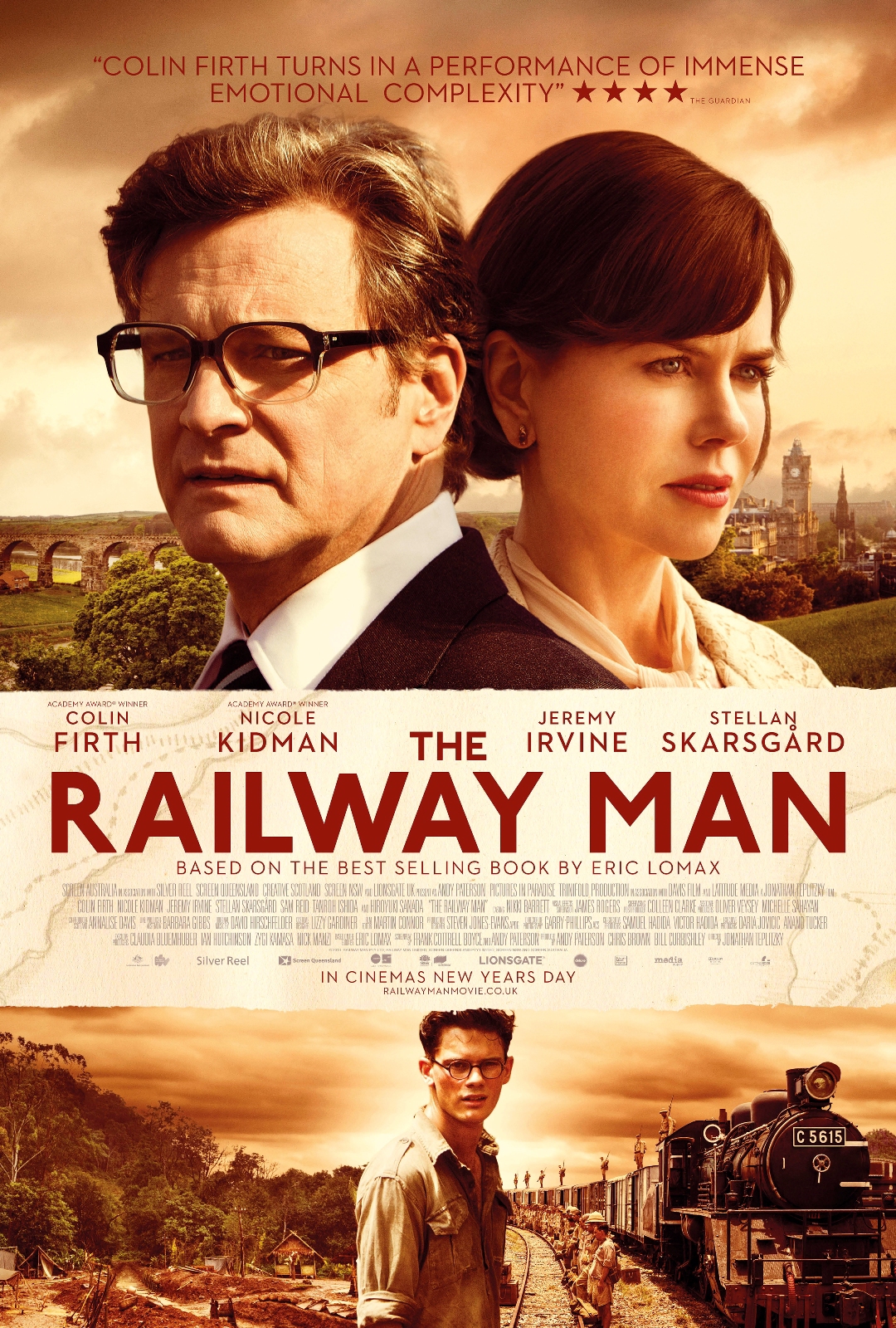
Such a man was Eric Lomax (played here by Colin Firth). In the 1970s Eric meets and falls in love with Patricia (Nicole Kidman). The two are married, but Patricia soon discovers Eric is still plagued by memories of his imprisonment as a young man (played by Jeremy Irvine) by the Japanese during the Second World War, and in particular a prolonged period he spent being tortured by the Japanese secret police for building a radio. Lomax is unable to begin to talk about his experiences, even as trauma causes his life to deteriorate. Fellow ex-POW Finlay (Stellan Skarsgård – very good in a small but vital role) is the only one who has even the faintest idea of his experience, but cannot persuade him to even speak about his past or try and move on. After discovering his torturer Takashi Nagase (Hiroyuki Sanada) is alive and well and working as a tourist guide in the very camp where Lomax was tortured, he travels to Japan, torn about what he should do.

Teplitzy’s film is powered by several marvellous performances, not least Colin Firth who is excellent in the lead role as the deeply repressed, tormented Lomax who in his heart has never left the prison where he suffered unbelievable torment. The film is a carefully structured, and deeply moving, character study of how atrocious and inhumane actions trap us all – both the victims and perpetrators – in patterns of suffering where we feel our own humanity drain away. Even handed, honest and generous, like Lomax’s book, it’s an engaging and moving tribute to the strength of the human spirit and our capacity for generosity.

Not least because when we finally meet the aged Nagase, he is far from the monster we expected. Like Lomax he too is haunted by the past, but where Lomax cannot escape the horrors he suffered, Nagase is plagued by guilt and disgust as he realises his actions as a young man were far from those of a righteous soldier, but rather a brainwashed pawn in a brutal army. Nagase, like Lomax, is desperate to purge himself of memories of this past, and has worked his whole life to try and make amends for the suffering he has caused. No simple good guys and bad guys here – both torturer and tortured are dehumanised, scarred and traumatised by the actions they have carried out. 

Teplitzky films that torture with an unflinching honesty, that leaves you in no doubt about why it has had such impact on Lomax. Jeremy Irvine is very good as the young Lomax, scared, vulnerable but brave and self-sacrificing who puts himself in the way of danger to try and protect his friends and then goes through savage beatings, interrogations and water boarding for information he doesn’t have. It’s difficult to watch, but never sensationalised and the traumatic pointlessness of these methods is abundantly clear. 

These memories, slowly revealed, are all too apparent in any case in Firth’s blasted face.  The film slowly reveals his psychological damage, with the opening sequence in fact suggesting a far lighter film ahead. The opening follows the meeting of Lomax and Patricia on a chance train journey. Playful and charming, these scenes work so well due to the wonderful chemistry between Firth and Kidman. It plays off in spadeas the plot gets darker and more disturbing. Kidman is very easy to overlook here in the “wife” role, but she invests it with an emotional honesty, a supportive woman eventually driven to the edge of her capabilities.

After the lightness of the opening, Terplitzky introduces the past literally like ghosts, with Lomax caught in a sudden delusion of himself being dragged through the hotel on his honeymoon, screaming in panic, to be carried to his torture danger. Throughout the film, the image of his torturer as a young man appears at various points (including at one point in a field as a train passes behind him), a constant reminder of how the past is here and now for Lomax.

It builds towards a sensational series of scenes as Lomax confronts Nagase, powered by two exceptional performances from Firth (barely able to control his anger, rage and pain) and a beaten down, distressed performance of shame from Hiroyuki Sanada, who matches him step for step. Sanada is superb as a man who confronts his nightmare – a man from his past – but also overwhelmed with the opportunity this gives him for amends. 

That’s what the film captures so well. This tension between past and present encapsulates the universal theme of our desire for revenge and our human need to connect coming together. Lomax and Nagase had every reason to kill each other, but their reaction to seeing each other is surprising, moving and a deep tribute to the human capacity to connect and move on. Grief and the past will destroy us all if we let it. The heroic examples of both Lomax and Nagase show us this doesn’t need to be the case.