

Exploitative biopic of Marilyn Monroe that doubles down on misery, discomfort and leaves you feeling rather like a Peeping Tom
Director: Andrew Dominik
Cast: Ana de Armas (Norma Jeane Mortenson/Marilyn Monroe), Adrien Brody (The Playwright), Bobby Cannavale (Ex-Athlete), Xavier Samuel (Cass Chaplin), Julianne Nicholson (Gladys Pearl Baker), Evan Williams (Edward G Robinson Jnr), Toby Huss (Whitey), David Warshofsky (Mr Z), Caspar Phillipson (Mr President), Dan Butler (IE Shinn), Sara Paxton (Miss Flynn)
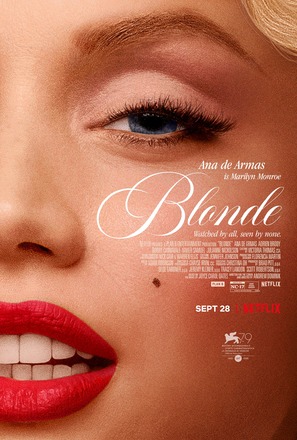
Few icons had such cultural impact in the 20th century as Marilyn Monroe. Maybe Elvis – coincidentally also the subject of a 2022 biopic. Even people who have never seen a Monroe film can impersonate her or knows about that dress being blown up around her. It’s also pretty widely know she had a difficult life, troubled family and some disastrous marriages culminating in her tragically early death from an overdose. Blonde, based on a novel by Joyce Carol Oates, dives into a heavily fictionalised account of Monroe’s life, focusing overwhelmingly on anything that could be seen as miserable, shocking and traumatic to the exclusion of almost everything else.
In doing so it’s hard not to think that, for all its attempts to shine a light on the difficulties of Monroe’s life, it’s not also partly exploiting her as well, turning her into a sort of misery porn entertainment. Over the course of nearly three hours, we see her raped at least three times, beaten, fall victim to elaborate revenge plots, forced through two blood-soaked abortions, pumped full of drugs to get her through film shoots and constantly at the centre of slavering piles of male filmgoers who scream for her attention and call her a whore the second she walks past. To say Blonde is a miserable film that’s tough to watch is putting it lightly.
Why does Marilyn put herself through it? The film offers no real answers, beyond the simplest, crudest flashes of pop-psychology possible: Daddy issues. Growing up not knowing who her father is, Marilyn’s life is a quest to find either her father or an acceptable substitute. That could be the audience, the husbands she calls “Daddy” or the hope that the person claiming to be her father who sends her a letters, might one day meet her. This is about as far as the insight goes. How issues influenced her choices and decisions is left frustratingly untold.
The film skims over the creative control she gained over her movies, the production company she set up and her skill as comic actor (it focuses much more on her dramatic Actor’s Studio work). It never once tries to understand why she continues in a career she hates so much – she had plenty of chances, even in this film, to back out – or what lured her to the silver screen and a quest for superstardom in the first place. It’s as if acknowledging Monroe worked hard to get her career would undermine the victimhood the film is determined to define her with.
The film suggests “Marilyn Monroe” is a persona put on by Norma Jean. This is another crude piece of psychology. We completely skip the years Norma Jean must have spent creating this persona and we never learn what influences it or get an understanding of “who” this Marilyn is. I suppose it’s “Marilyn” who smiles at film premieres or appears on screen: but we get little sense of how Norma Jean might have used this alternative persona to get her through the day. For all the time we spend with her, we never understand her beyond someone desperate for love with severe Daddy issues.
The film is so clumsily mishandled, its makers were reduced to stating it was not intended as an anti-abortion movie. This despite both abortions being horrifying experiences (one with a drugged Marilyn begging that she’s changed her mind, the other a late blood-soaked possible-fantasy where Marilyn is kidnapped has an implied Kennedy baby removed). Worse than this, the film Marilyn hammers home Marilyn’s sense of guilt. During her first abortion she imagines herself in a house burning down around her and later imagines a conversation with a giant foetus, which asks “Mummy why did you kill me?” and begs her not to do the same for her future babies. Not exactly the sort of messaging you expect from a #metoo film.
On top of this, Blonde is a film almost unbearably pleased with itself. This is Art with a capital A, R and T. Dominik shifts from colour to black-and-white, changes film stock and constantly shifts and changes the aspect ratio from shot-to-shot. In almost three hours, only once could I see any logic in this: as Marilyn agrees to marry Joe DiMaggio, the frame closes in on her from 2.35:1 to 4:3, a neat visual metaphor for the constricting marriage she has signed up for. Other than that, there is no rhyme or reason for any of these visual changes in the film. It doesn’t comment on the action, reflect emotional beats, delineate between reality or fantasy… it just smacks of an overindulged director using all the flashy tools for the sake of it. It becomes intensely irritating.
There is a committed lead performance from Ana de Armas (even if her Cuban accent does sneak through), who captures beautifully Monroe’s physical and vocal traits and sells what emotional titbits she is given in the salacious, muck-raking framing of the film. Her traumatic relationship with her disturbed mother, a sex-filled thruple with Hollywood princes Cass Chaplin and Eddy Robinson Jnr, raped by Darryl F Zanuck and a surprisingly-vile John Kennedy (while a TV in the background shows missiles rising – boom boom), knocked about by a jealous Joe DiMaggio (in real life he remined close to her and organised her funeral, but hey ho)… it’s all meant to be shocking but it’s all dialled up with glee of a two-bit muck-rag, flogging the hot goss.
That’s standard for the whole film, a flashy, pleased-with-itself epic that focuses on misery and pain for its subject at the cost of everything else and ends up telling us very little about her or her inner life, instead leaving us feel slightly like peeping toms for watching.
 Movie Musings