Tag: Yaphet Kotto

The Running Man (1988)

The Running Man (1988)

Gloriously stupid Arnie vehicle, sort of satire but really a chance for violence and wise-cracks

Director: Paul Michael Glaser

Cast: Arnold Schwarzenegger (Ben Richards), María Conchita Alonso (Amber Mendez), Richard Dawson (Damon Killian), Yaphet Kotto (William Laughlin), Jesse Ventura (Captain Freedom), Jim Brown (Fireball), Erland Van Lidth (Dynamo), Marvin J. McIntyre (Harold Weiss), Gus Rethwisch (Buzzsaw), Professor Toru Tanaka (Professor Subzero), Mick Fleetwood (Mick)

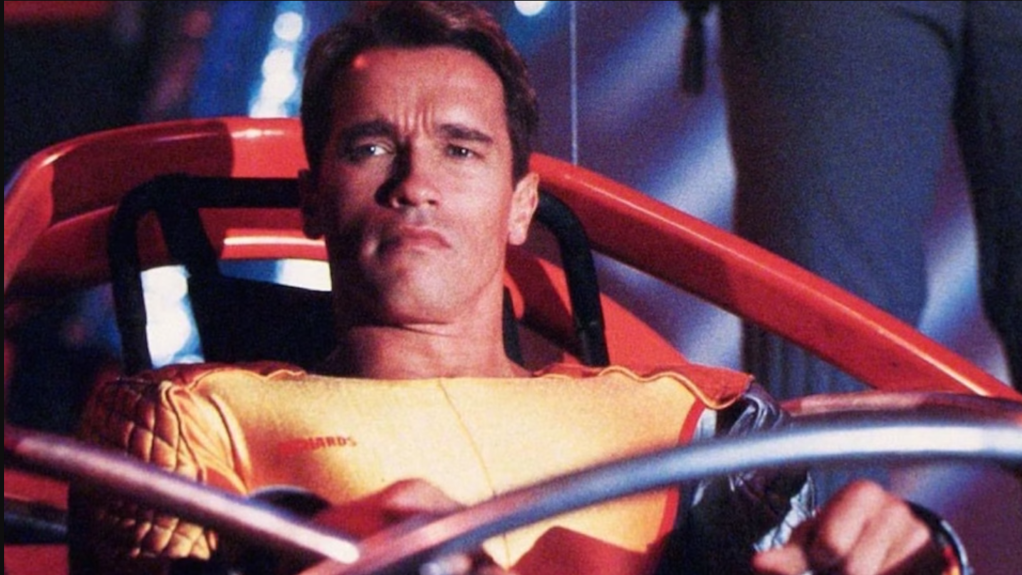
It’s 2017 and the USA has fallen apart (they were more right than they thought…) with a dictatorial government keeping the population in their place and distracting them from their lost freedoms with the violent TV show The Running Man, where criminals fight to the death in gladiatorial contests. The latest contestant? Ben Richards (Arnold Schwarzenegger), a former cop who everyone believes massacred civilians from his helicopter gunship but who we know is actually the hero who tried to stop it. Running Man host Dawson (Damon Killian) thinks Richards is the guy for a ratings slamdunk. But guess what? Arnie is as tough as he looks and might just bring down the system in prime time.

The Running Man makes an interesting contrast with Rollerball. In fact, it’s really just a souped-up 80s version of the same idea, of corporations using violent entertainment to keep the masses in line. The main difference being Rollerball is a sort-of lingering existentialist character study which mixes ambiguity with high-octane sports action, played out with Kubrick-inspired classical music and lingering slow-mo. The Running Man is a loud, brash, hyper-violent film that allows Arnie to flex both his muscles and his wise-cracking wit. Leaving its roots as a Stephen King adaptation far behind, it’s both a lot more stupid and a whole lot more fun than Rollerball.

The Running Man is a bizarre mix of Cronenbergish media satire and ludicrous camp comedy. It’s in-universe TV show has a parade of killers on it, laughable in their cartoonish violent silliness, with methods of killing so elaborate that they would put Bond villains to shame. Subzero is an ice-skating wrestler with a razor-sharp hockey stick! Buzzsaw dispatches opponents using (you guessed it) a chainsaw that can cut through anything! Dynamo dresses up in an electric suit, sings opera and electrocutes people! Fireball burns everything with his gas-filled flame-thrower!

You think that sounds silly? Well don’t worry because Arnie will (surprise, surprise) send them all to their maker with a karmic death (you have one guess as to how they all die) and an apt pun (“He had to split!” he grins slicing Buzzsaw in half with his own chainsaw). This is Arnie at his eighties height, expanding his brand and transforming The Running Man into his very own star vehicle. (He even squeezes in his “I’ll be back!” catchphrase). Ben is the perfect Arnie character: he’s noble but cool, muscular but witty, makes bad-ass threats and delivers on them, smokes stogies like they’re going out of fashion and waltzes off with the girl at the end after saving the world.

Arnie is sort of working alongside a resistance movement, but they don’t get in the way of his manly independence. The principle function of his resistance movement buddies Laughlin (Yaphet Kotto) and Weiss (Michael J McIntyre) is to symbolically lay down their lives to give Arnie even more moral high-ground – The Running Man makes very clear he doesn’t enter this sadistic blood-sport to protect himself (oddly in this totalitarian dictatorship, criminals still have enough rights to choose not to sacrificed on national television) but to save the lives of his Red Shirt pals. Their deaths also serve to justify the ruthless violence Arnie hands out (though of course he refuses to kill an unarmed, injured opponent just so we know all the other bodies he dropped must have deserved it).

It’s all set in a charmingly quaint 80s view of the future: power-suits for the rich and jump-suits for the convicts, with clunky TVs and worn-out urban environments. The Running Man throws in its odd surreal, camp and bizarre touch, not least the sight of Mick Fleetwood (buried under prosthetics) playing himself as the resistance leader. Its pumped-up TV show is packaged like a hyper-violent 80s mega-smash, hosted by real-life actor-turned-quiz-show-host Richard Dawson, gleefully embracing self-parody as a venal, heartless bully full of two-faced smarm with the audience while treating his staff like dirt.

Dawson, in all his larger-than-life awfulness, actually makes a pretty good foil for the muscle-bound Arnie, not least because he understands exactly what the Austrian Oak wanted from this film. Because Arnie knew people didn’t really want social commentary or satire – they wanted a black-and-white world where the ex-Terminator could smack, punch and shoot things with gleeful abandon while testing out a host of potentially quotable catch-phrases. Essentially The Running Man is a sort of Tom-and-Jerry cartoon with a sheen of social commentary, that panders shamelessly for our love of watching outré villains suffer grim and painful ironic deaths.

And you know what? Arnie was right. Because, however stupid (and its very, very stupid) The Running Man is, no matter how cookie-cutter, uninspired and predictable every single second of it is – it’s perfect, brain-dead, beer-in-hand, Friday night fun. And while the progression of Rollerball to this is a perfect example of how lobotomized Hollywood had become, at least this is fun.
Alien (1979)

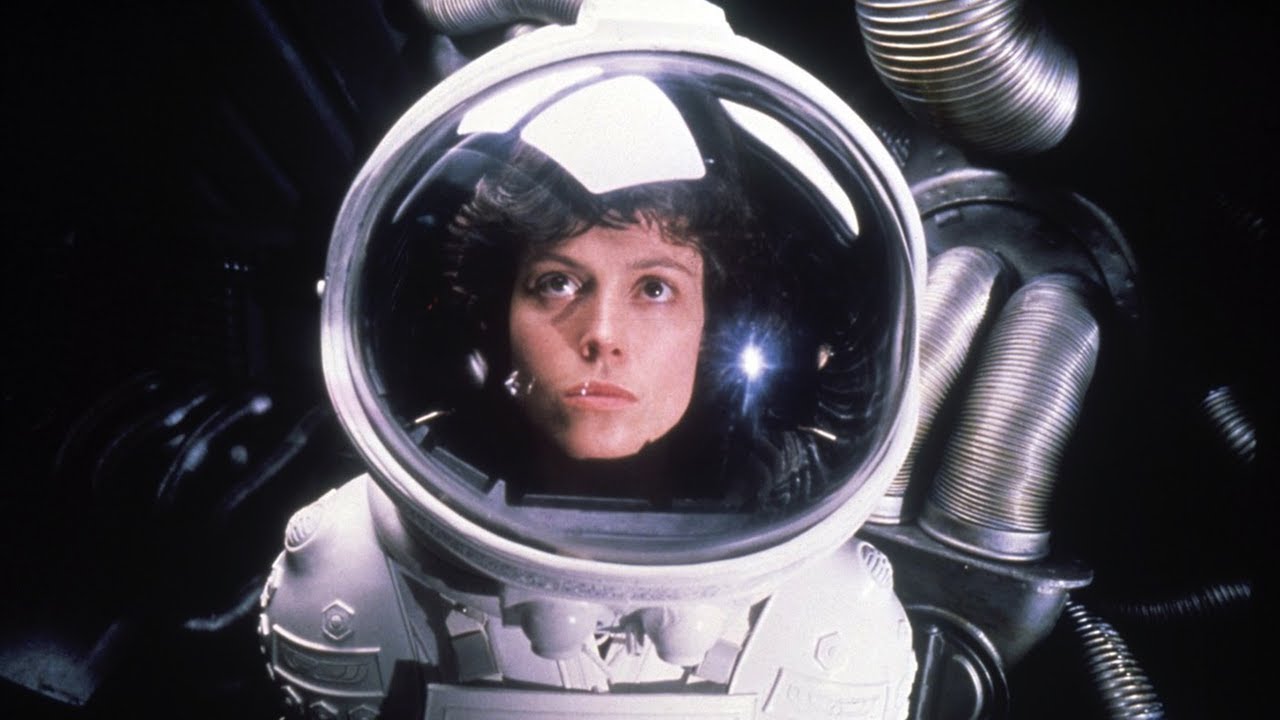
Sigourney Weaver is last woman standing in Alien

Director: Ridley Scott

Cast: Tom Skerritt (Dallas), Sigourney Weaver (Ripley), John Hurt (Kane), Ian Holm (Ash), Yaphet Kotto (Parker), Harry Dean Stanton (Brett), Veronica Cartwright (Lambert)

For decades, space was seen as a place of wonder. But Alien reminded us it was also a place where no one can hear you scream. We dream the vast void out there contains life: but what if the life we found was a relentless killing machine, a seemingly invulnerable monster literally having humanity for breakfast? Ridley Scott’s Alien took science fiction and ran it through the blender of horror, turning its space ship into a terrifying haunted house with an alien straight out of slasher films. It’s still a landmark today.

In deep space, the Nostromo’s crew is pulled out of hypersleep early – long before arriving back in our solar system. A strange distress call from an unidentified vessel needs to be investigated, on standing orders from “the company”. The seven-strong crew lands their ship and a party heads out – only to return with third officer Kane (John Hurt) with a strange alien creature attached to his face. The creature can’t be removed until it detaches itself of its own accord. All seems well until an unfortunate dinner party – at which point the crew finds itself being hunted one-by-one by a relentless alien monster.

Scott’s film is so famous today it’s very hard not to forget your foreknowledge of what’s going to happen and to experience it as its original viewers did. But it still works brilliantly – even if almost everyone watching knows only Ripley is getting out of this alive. The film is a masterpiece of slow-burn tension punctuated by moments of shocking horror. The final Alien itself doesn’t appear until almost an hour into the picture – but before then we’ve had our nerves more than jangled by the unsettling disquiet of the film’s mood. From the Nostromo, to the storm-laden planet they land on, and the vast alien ship – now a tomb of dismembered corpses with an unsettling organic look, like a giant carcass – everything in the film is designed to put us ill-at-ease. You can’t watch this film and expect anything to turn out for the best.

The camera prowls around the dank, grimy and run-down ship – space travel has rarely looked this unglamorous – like the predator that will hunt the crew. It’s slow, stately lingering on the crew, their faces, the eerily unsettling sounds and score, all serve to act like an advance funeral. Every single beat of the film stresses claustrophobia and dirt. It looks like a horrible trap already, and the film embraces a sense of grim inevitability. The observational style of the editing and shooting as we follow the characters, overhearing their bickering and functional work-based conversations, also helps add to this mounting sense of unease. It’s a surprisingly quiet film for much of its opening act, ambient noise and unsettingly lingering music dominating.

There is a poetical eeriness about the whole film. This is also partly from the sense of the ship being a society in microcosm. Much of the bickering is around bonus pay shares, the working-class engineers of the ship (one of whom is also black) bemoaning their smaller shares. The officers sit at the top, a mixture of entitled, distant, officious and daring. They have their own feuds over status, professional boundaries and personal rivalries. The captain is a laissez-faire professional, who offers only a general guidance and could really be just another member of the crew. The ship is like a giant oil-rig in space, with the crew basically a group of “truckers”. The film is as much about interpersonal tensions as it is about an alien monster who hunts people down.

But it is mainly about an alien monster that tears people apart. After almost an hour of deeply unsettling and unnerving build-up, when the monster (literally) rears its head, it’s a terrifying sight. We usually only see it briefly for small shots, but what we see is pure nightmare fuel. The creature is terrifying in its violence and power. It is partly human but also completely revolting. Covered in slime, it looks like a bizarre mix of a man, a giant penis and a vagina (its designer, HR Giger, reasoned nothing would be more unsettling and disturbing to us than seeing a beast that’s partly inspired by our own sexual organs). It creeps in corners, embraces the many shadows of Scott’s set and its capacity for violence seems unstoppable. Sharp editing and suggestion elaborates the visceral horror of its extending jaws punching through bone and flesh. It moves like an interpretative dancer and leaves a trail of blood. It’s unstoppable and infinitely cunning. It looks like your worst nightmare.

It’s all washed down with body horror. An alien that smothers its victims and shoves an egg down their throat which hatches through their chest becoming a slaughtering beast. There is an uneasy sexuality about this, right down to the “birth” of the creature being a grotesque parody of childbirth. The “birthing scene” is a masterpiece, the first moment in the film when the tension between the crew has eased – and the film itself seems to have relaxed for a moment from the knot of tension – that turns into one of the most memorable moments of body horror ever. The actors were allegedly told what would happen – but not how graphic it would be – and their horror-struck disgust (Veronica Cartwright was nearly knocked over by a powerful jetstream of mock blood and guts) and and shock gives the film a priceless realism.

Watching the film, it’s striking to me how much John Hurt’s Kane is shot as the hero early in the film. It’s he who wakes first from hypersleep. It’s Kane we follow the most for the early part of the film – he’s the one piloting the ship, volunteering to answer the distress call, urging his crew mates on as they investigate the alien vessel – it’s Kane who seems to be the hero. Making his brutal demise even more of a subconscious shock. On the other hand, Ripley is introduced as an officious, unpopular, by-the-book officer who it seems few other members of the crew like (Sigourney Weaver’s praetorian attitude helps a lot with this) – if you had to bet on someone to bite it early on, you’d pick her. The film continues to defy expectations. Characters who seem like they might be invulnerable are slaughtered early. Those who looked vulnerable survive until late on.

It’s a very strong cast. Weaver magnificently grows in authority as the film progresses, turning her abrasiveness into strength of character and moral determination. Hurt is very good as the unknowing victim-in-waiting. Kotto, chippy and defiant, is another stand-out. The finest performance through might well come from Ian Holm as science-officer Ash. Precise, cold, distant – but always hiding his own secret agenda – it’s an unsettlingly controlled performance that leads to a pay-off reveal that still works brilliantly today (and the character would have one of the most memorable death scenes in film, if he wasn’t in the same film as the most memorable death scene).

Scott’s filmmaking is brilliantly controlled, and the film is a horrifying masterpiece of tension and terror. The monster is skilfully shown at its worst (you’d never even guess in actuality it’s little more than a Doctor Who man-in-a-rubber-suit) and its design is faultless perfection. It’s not completely perfect – its build up might be ten minutes too long, and a late sequence that sees Weaver wearing little more than her undies looks hideously dated today – but it’s pretty close. Science fiction has never been scarier than it is here – hell the movies have rarely been scarer. In space no-one really can hear you scream.

Blue Collar (1978)

Yaphet Kotto, Harvey Keitel and Richard Pryor are working joes who want to stick it to the man in Blue Collar

Director: Paul Schrader

Cast: Richard Pryor (Zeke Brown), Harvey Keitel (Jerry Bartowski), Yaphet Kotto (Smokey James), Ed Begley Jnr (Bobby Joe), Harry Bellaver (Eddie Johnson), George Memmoli (Jenkins), Lane Smith (Calrence Hill), Cliff DeYoung (John Burrows), Lucy Saroyan (Arlene Bartowski), Chip Fields (Caroline Brown)

America doesn’t really have a director like Ken Loach. It’s one of the points raised on Indicator’s excellent (and essential) blu-ray release of Paul Schrader’s near Marxist drama about blue-collar car workers in Detriot. There aren’t many (or indeed nearly any) American films I can think of that take the stance of the working man like this one – or as angry, pissed off, furious and, in the end, as lacking in hope as this one. Which makes it sound like the sort of film you’d run a mile from actually seeing. Well you’d be wrong: this is a blistering, intelligent, witty drama crammed with brilliant scenes and great performances. On so many levels it’s something really quite special. It’s a shame no one saw it (I blame the publicity campaign – I mean look at that rubbish poster that basically suggests you are in for Pryor stand up routine).

In a car factory in Detriot, our heroes work in varying jobs on the production line. All of them are unhappy with their lot and feel they get precious little support (or concern) from the union that runs the shop floor. Zeke (Richard Pryor) is furious at the lack of equality and opportunity, as well as defrauding the inland revenue with a (literally) childish scheme to try and make ends meet. Jerry (Harvey Keitel) is drifting through his life, unable to afford the dentistry bills to give his daughter the braces she needs. “Smokey” (Yaphet Kotto) is an angry proto-anarchist who just wants to stick it to the man. When the three of them realise there is a safe (probably) full of cash in the union office, they decide to steal it. However, rather than cash, they find the safe full of accountancy records of the union’s dodgy money laundering arrangements with organised crime. The men decide to offer to sell it back to the union – and open up for themselves a world of trouble…

Blue Collar is a hard to categorise film. It’s a brilliant hotch-potch of several genres. It opens like a workers film, crammed with an angry wit (the opening half hour is very funny) with several scenes that acutely skewer the petty clashes of working life as well as the corner-cutting financial desperation of men trying to make ends meet. The opening scenes have the edge of a raw black comedy to them, mixed with observational realism. Then the film subtly changes over, becoming first through near-caper (the hilariously bungled attempt to steal the safe), into politics as the union and the men begin to shift alliances, into a straight classic 1970s conspiracy thriller (complete with late car chase and an outre death for one of the characters) before finally wheeling back round into a tub-thumbing condemnation of the “divide and conquer” plans of the ruling classes. 

That’s a lot for any one film to try and squeeze into a less-than-two-hour runtime, but Schrader manages it with aplomb, juggling this mix of styles and genres with such effective skill that you almost don’t even notice as the film grows increasingly darker and more dangerous as it progresses. The eye it has for the rhythms of factory life seems perfectly judged, and the mixture of hacks, place men, agitators and uncaring union men feels absolutely perfect. It also brilliantly captures, in his dialogue, the natural force (and crudeness!) of working men’s conversation, with a brilliant ear for the semi-articulate astuteness and poetry it can reveal. 

Schrader builds the pressures up in the film subtly and brilliantly, so that it seems both sudden and perfectly natural as the three men begin to buckle and turn on each other. This is where the Marxist message of the film starts to come in: even when working men have the whip-hand, their superiors will find a way to make them turn on each other, to make them unable to throw off the shackles that bind them as they are unable to work together. On top of this Schrader throws in a brilliant analysis of everyday racism and racial tension (all the union reps and their foremen are of course white), and there is an unspoken edge of racial divide in every conversation – indeed racism is just one of many weapons, the film argues, used to turn working men against each other. This really comes out in the film’s final scene, where two characters who had only warmth and affection for each other at the start are driven to turn on each other with an onslaught of racist fury.

Of course that clash probably carries a lot of its force from the fact that the three leads couldn’t stand each other on set. Pryor, Keitel and Kotto were each told that they were effectively playing the lead in the film and were unaware until signing on of the presence of the other actors. This billing tension was fuelled by their incompatible working methods: in particular Keitel, a theatre trained actor, preferred multiple rehearsals before takes while Pryor, a stand up comedian, preferred minimal or no rehearsal – and usually peaked on the second or third take. Throw in the drugs (that Pryor certainly was indulging in) on set and the three actors reached the point where they could barely stand to be in the same room together (one of the film’s best sequences, a single shot where they sit on the sofa for a long take and plan their next move, was only filmed because the three actors arrived separately, didn’t speak until the camera rolled, and then immediately left).

Did this edgy fury boil over into their performances and give them an extra fire? Certainly I don’t think any of them were better than they were here. Kotto has such an electric, bubbling fury to him, an anarchist’s delight at danger, that he feels like a force of nature. Keitel hadn’t been so gentle, reserved and bemused by the world for years, as an oppressed everyman. But the real electricity comes from Richard Pryor is a goddamn revelation as Zeke. What Schrader did so brilliantly here was to capture all the fire, energy and angry of a typical Pryor stand-up performance and channel it into a dramatic structure. An early Zeke rant against the unions is essentially a Pryor stand-up performance, and Pryor’s whole performance buzzes with an improvisational energy.

Zeke is the film’s key character. At first he seems the weakest and most desperate of the three men, the one most likely to fall into the role of victim. But as the events take hold of the three men, his character deepens and develops to reveal a shrewdness, a realism and even a coldness that the other men don’t possess. Unlike them, he sees events not as a chance to make a quick buck but as a genuine moment to change his life for the long term. And, underneath this, an understanding that as a black man opportunities for him are going to be few and far between. An electric confrontation between him and Jerry late in the film on Zeke’s porch hums with his fury driven realpolitik, Zeke’s understanding that opportunities are there to be seized and that sometimes the price paid is high.

Blue Collar gave Schrader a break-down when he made it. But its’ a masterpiece of political cinema, largely because it never really feels like a political film. Instead it feels above all like a domestic drama of friendship marred that explodes into a thriller., But it’s the understanding of the social situation of these men, of the reasons behind their actions and the intelligent analysis behind it, that makes it really work. It also gives you characters who feel real and in whom you invest, blessed as well (for all their clashes) with three career-best performances from the leads. It’s a brilliant film and in a just world should be seen as a landmark piece of film making.

Midnight Run (1988)


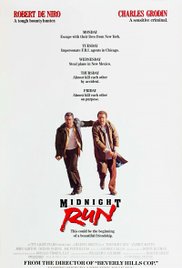
Robert De Niro and Charles Grodin go on the road in terrific buddy-movie action comedy Midnight Run

Director: Martin Brest

Cast: Robert De Niro (Jack Walsh), Charles Grodin (Jonathan “The Duke” Mardukas), Yaphet Kotto (Special Agent Alonzo Mosely), John Ashton (Marvin Dorfler), Dennis Farina (Jimmy Serrano), Joe Pantoliano (Eddie Moscone), Richard Foronjy (Tony), Robert Miranda (Joey), Jack Kehoe (Jerry Geisler), Wendy Phillips (Gail), Danielle DuClos (Denise Walsh), Philip Baker Hall (Sidney)

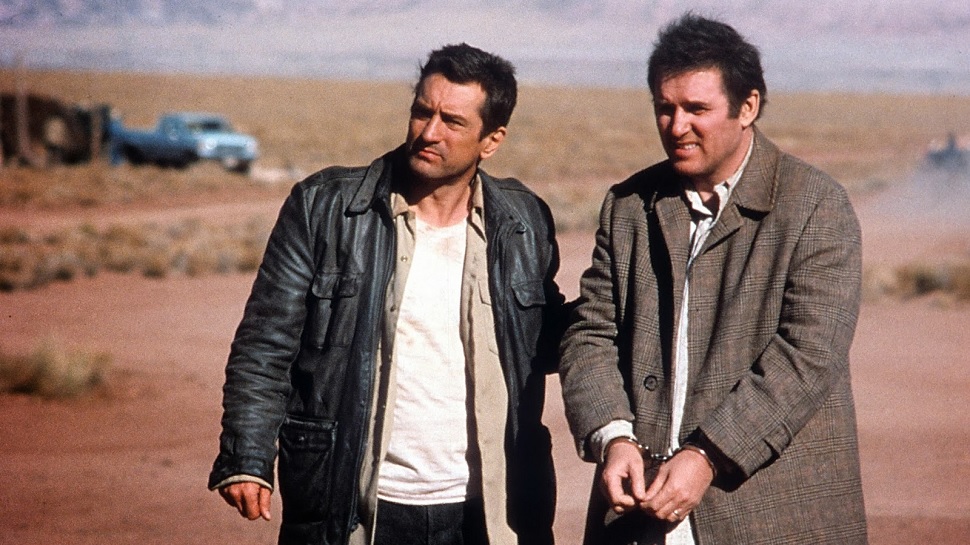
There are few comic set-ups you can get better mileage from than an “odd couple” – they meet, they argue, they grow closer, they fight again, they reconcile. It’s a standard formula. Midnight Run throws this together with a road trip formula (two people have to get from A to B but via every other letter of the alphabet). Really it should be hugely predictable. But Midnight Run is well written, very well acted and hugely fun – it manages to feel both light and frothy, but also sufficiently real and dangerous. It’s a great comic movie.

Jack Walsh (Robert De Niro) is a down-on-his-luck bounty hunter. Having been run out of the Chicago police force years ago for not taking a bribe, he’s skilled at his job but fundamentally unlucky and disenchanted. He’s looking for one big job to get him out: and it comes when mob accountant Jonathan “The Duke” Mardukas (Charles Grodin) skips bail. Hired by bail bondsman Eddie Moscone (Joe Pantoliano), Walsh has four days to find the Duke bring him back to LA before his bail is forfeit – manage it and he’ll get a cool $100k. But the Duke has stolen millions from the mob – so they want him dead, the FBI want him to testify, rival bounty hunters want to take him in – it’s all working out into a very long week for Walsh.

I really enjoyed Midnight Run when I first watched it years ago – and it’s been years since I’ve seen it – so it’s a delight to find it is as good as I remember. In fact, if anything, I think it might be better. It’s very funny – without anyone playing the material for overt or obvious laughs – but it’s also got a lot of soul. It never loses sight of the characters at its heart, in particular the loneliness, sadness and regret at the heart of Walsh, who presents a chip-on-his-shoulder stance to the world, to hide a decent and honourable man who can’t believe his principles are rewarded.

De Niro took on Midnight Run because he wanted to try comedy (he had just played Satan and Al Capone, so probably had earned a rest). Walsh is probably one of his best comedic performances, because he treats it with the investment he gave his greatest roles. He makes Walsh a real person – and he’s willing to downplay the comedy. He doesn’t mug or play to the camera (as he has more recently), he just plays the role with a slight wryness, a touch of lightness from the actor, while the role itself is kept real. His increasing frustration and world-weary resignation matches up perfectly with the hint of sadness he keeps under the surface. It’s a very effective performance.

It helps as well that De Niro allows Charles Grodin to carry the bulk of the comedy. Grodin was cast over the wishes of the studio – but it was an inspired move as the chemistry between the two actors is fantastic. They play off each other brilliantly, Grodin the more worldly, urbane and dry accountant, opposite the stressed out Walsh. Grodin is very funny, and very genuine – and he’s as whippersmart as the Duke himself, constantly keeping us on our toes as to when the Duke is telling the truth, and when he is pulling the wool over our (and Walsh’s) eyes. 

The film throws these two into a series of increasingly hilarious events – from a panic-attack on a plane, to a sneaky piece of con-man work in a back-district town – but mixes it up with genuine moments where the two open up to each other (there is a wonderful scene where Walsh, under the Duke’s gentle probing, final opens up about his past). Each of these moments is wonderfully played, and works so well because the two actors have a genuine connection between them. Both lift the other: Grodin clearly helps De Niro relax and loosen up, De Niro encourages Grodin to bring a greater depth to his acting than ever before.

The contrivances and competing parties they take on also throw in plenty of fun problems. My recording from the BBC from years ago was somewhat sanitised, so it’s a surprise to hear how many times De Niro uses the f-word in this film! Martin Brest films all this with a controlled restraint – perhaps a little too much control (Yaphet Kotto has talked of his misery of performing endless takes of even the simplest scenes). But the dangers Walsh has to take on walk just the right line between feeling real, and feeling comedic.

So we have a sinister gang-boss (played with lip-smacking relish by Dennis Farina), but his underlings on the ground are realistic-feeling, but non-too-bright gangsters (sharp enough to keep track of Walsh, dull enough to constantly say the dumbest things). The Feds are led by a tensely wound-up Yaphet Kotto, but the comedy comes from his cold stares at his underlings, who are prone to state the obvious. John Ashton is good value as a rival bounty hunter, a regular joe not-as-smart-as-he-thinks, but more than smart enough to win the odd hand. Joe Pantoliano gives possibly one of his most Pantoliano-performances of weasily whininess as Walsh’s bail bondsman boss.

Midnight Run rattles along brilliantly. It’s hugely entertaining, with a series of surprisingly high-blown action set-pieces (all met with a dry reaction from the Duke – “I’m sure we’re completely safe” when a pursing gun-laden helicopter temporarily drops out of view – and in turn a furious “Will you shut the fuck up!” from Walsh). Martin Brest gets the balance just right between comedy and drama, and creates a very funny movie where you end up caring a great deal for the characters. It’s a road-movie, buddy comedy that feels fresh and really works because it manages not to feel like it’s trying too hard. And of course it has a great closing scene – and one of my favourite end-lines to a movie ever: “Looks like I’m walking”. Check it out. You’ll like it.