
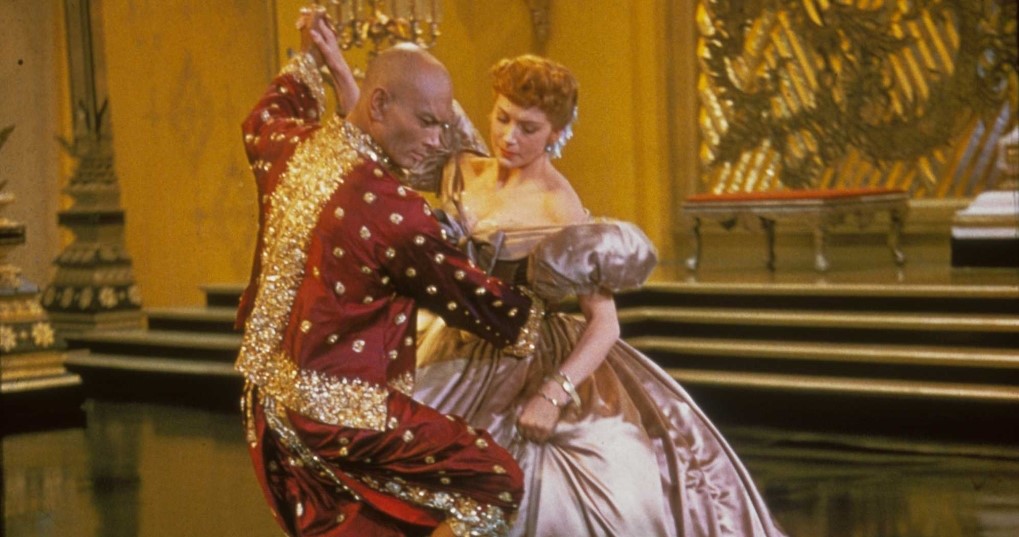
Deliberately artificial adaptation, powered by star performers and sumptuous set-design
Director: Walter Lang
Cast: Deborah Kerr (Anna Leonowens), Yul Brynner (King Mongkut), Rita Moreno (Tuptim), Terry Saunders (Lady Thiang), Martin Benson (Kralahome), Rex Thompson (Louis Leonowens), Patrick Adiarte (Prince Chulalongkom), Carlos Rivas (Lun Tha), Alan Mowbray (Sir John Hay), Geoffrey Toone (Sir Edward Ramsey)

In its glistening, stagy exactness The King and I is the most traditional adaptation of Rodger and Hammerstein to hit the screen. A (questionably accurate) memoir by Anna Leonowens (Deborah Kerr) about her experiences as a tutor to the children of King Mongkut of Siam (Yul Brynner) in the 1860s, was repackaged by the musical hit-machine duo into a charming culture clash, with a garland of unspoken romance across the top. Anna wants to help the king improve and develop his kingdom – but also clashes with his ideas about his antiquated ideas and (above all) his treatment of concubine Tuptim (Rita Moreno), who is in love with servant Lun Tha (Carlos Rivas). Can the King and Anna reach an understanding?
The King and I is one of the grandest, most artificial looking films you will see. No attempt has been made by anyone to even pretend we are not watching events play out on a series of massive, elaborately decorated soundstages. It all looks gorgeous of course, brightly coloured sets filling the frame. Even the scenes ‘outside’ – on Anna’s ship or the palace grounds – drip with ostentatious artificiality.
This impression is only increased by the mediocre direction of Walter Lang. A reliable studio B-movie hack, Lang sets the camera up in the equivalent of the front row of the stalls. While he can frame a scene efficiently (his centring in the final shot of the king’s hand is neatly done), Lang provides no originality, flair or real visual interest, all that supplied solely by the sets. He either misses beats or misunderstands jokes (the accidental flashing of the English ambassador is crying out for a beat of titillation from the old guy). It’s quintessential widescreen hackwork of the 50s, where the focus is on wowing the people with the money, bright colours and massive sets they couldn’t get from the little box in the corner. On that basis, a director who sets the camera up to get as much of that seen as possible all the time, fits the bill.
Besides, the film’s two most distinctive features didn’t really rely on Lang anyway. The King and I’s grand Thai-style ballet based on Uncle Tom’s Cabin was visualised and choreographed by Jerome Robbins (with Lang setting the camera stationary in mid-shot to capture it all). This ballet is, by the way, a masterclass of expressive visual originality (with its swirling use of masks, sheets and banners) that sticks out like a sore thumb in a film as visually flat as this one.
The other was of course Yul Brynner’s star-turn as the King. Brynner’s performance of the role on Broadway had transformed his career and years of honing it on stage meant he was the master of every beat of its eccentric energy. Brynner is magnificent, bombastic, proud, grand but also subtly playful, surprisingly timid and strangely shy. Brynner’s performance with its theatrical touches (the striking pose and the “et ceteras”) could be seen as overplaying, but actually fits perfectly with a man constantly, deliberately, putting on a show.
Brynner really shows the more thoughtful, quiet man under the surface, worried about his kingdom’s future. The earnest autodidact, who lies on the floor reading books. The eager-to-impress man who swots up on topics of conversation to impress the English ambassadors and hands a prompt sheet to Anna to work them into conversation. The careful flirt who only allows flashes of his romantic interest in Anna show. It’s a clever, grand but very human performance. Brynner had wanted to direct (and, rumour has it, partially did so) but settled for a Best Actor Oscar instead.
He also sparks extremely well off Deborah Kerr, buried under some truly might dresses (so heavy, that Kerr allegedly lost twelve pounds over the course of filming). Kerr turns a potentially stodgy part into a woman who is independent but not judgemental, forward-looking but diplomatic and very careful about allowing any expression for romantic feelings. Although her singing is dubbed by Marnie Nixon, it’s Kerr’s engaging sprightliness that carries a lot of the drama. She and Brynner’s chemistry also ensures the scenes between the two of them are by far the film’s highlights.
Most of the faults of The King and I can be traced to the musical itself. There isn’t much in the way of plot. The quiet will-they-won’t-they bond between Anna and the King is partly because that’s the nature of these things, but partly because the musical doesn’t really give them much material to work with. Virtually every character other than these two feels like either a sketch, a plot function or a stereotype, with the actors given almost nothing to work with. Impressive as the ballet is, it essentially takes up almost 15 minutes of screentime without advancing the plot or the themes of the film at all. Thematically the film explores very little, either on social progress in Siam or its place in the world. The film rushes towards a conclusion that feels like it comes out of the blue.
But then people aren’t watching The King and I for its social commentary or thematic depth. They are watching it for some hit songs, impressive production values and charismatic performers. You certainly get that and if the overall shape of the film feels rather loosely plotted and doesn’t go anywhere, that’s neither here or there. And of course, it’s a triumph for Brynner (who, late in life, dedicated his final years to performing the role, racking up over 4,600 performances), whose confidence and star-quality carries thing. Pretty, fun, not deep but pleasant – but then that’s Rodgers and Hammerstein for you and if that’s for you, this is the film for you.




 Movie Musings