

Wartime heroics get bogged down in bland love-triangles and tedious inventions
Director: John Madden
Cast: Colin Firth (Ewen Montagu), Matthew Macfadyen (Charles Cholmondeley), Kelly Macdonald (Jean Leslie), Penelope Wilton (Hester Leggett), Johnny Flynn (Ian Fleming), Jason Isaacs (Admiral John Godfrey), Simon Russell Beale (Winston Churchill), Paul Ritter (Bentley Purchase), Mark Gatiss (Ivor Montagu), Nicholas Rowe (Captain David Ainsworth), Alex Jennings (John Masterman)
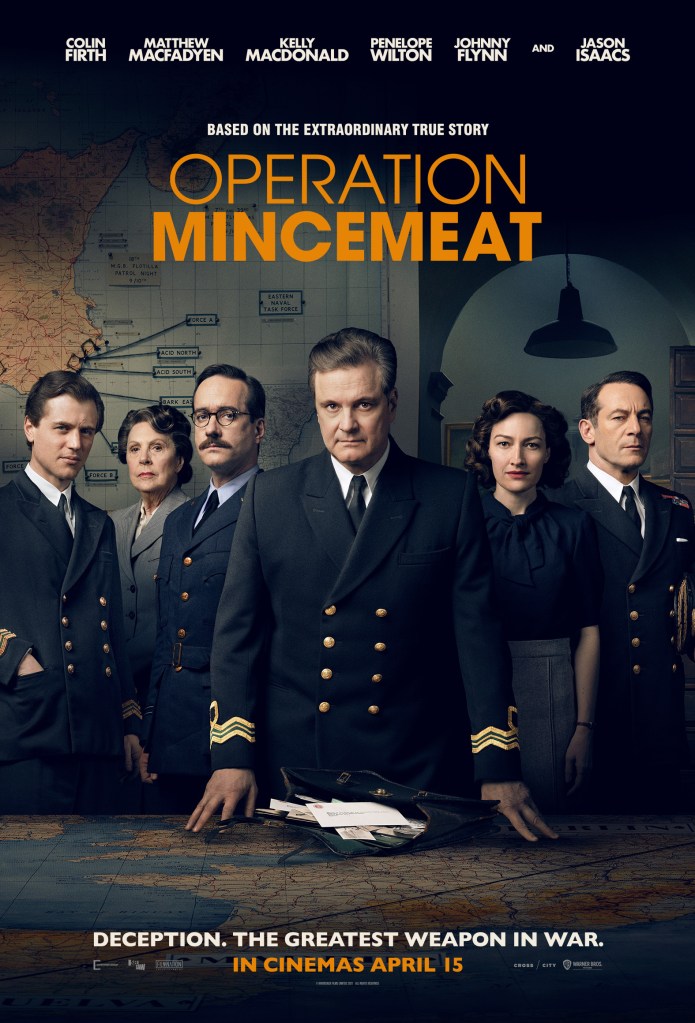
In April 1943 a body washed up on the shore of neutral Spain. It was a Major William Martin, carrying Allied plans to launch a massive invasion of Greece in July 1943. German agents intercepted these plans before they could be returned to the British and the Germans shifted their troops to counter this invasion. Problem for them was, Major Martin wasn’t real, the plans he carried were inventions and the Allies were planning to attack Sicily. Welcome to Operation Mincemeat.
Adapted from an entertainingly written and well researched book by Ben MacIntyre, Operation Mincemeat is about one of the most successful wartime deception plans ever launched. The film is a bit of a deception operation itself. Although it looks like a Boys-Own caper film, with eccentric boffins solving problems and running circles around the Nazis, it’s actually a dry, slow, sombre film that seems embarrassed at even the faintest idea of flag-waving Wartime heroism. Instead, everything is glum, depressing and bogged down in invented details that never convince.
Which is a real shame, because when the film focuses on the things that actually happened it’s both entertaining and informative. To create Major Martin, MI6 needed a body – specifically a military-age male who drowned. That was almost impossible to find in London at the time – and the final ‘candidate’ had to be kept as ’fresh’ as possible for months. The letters he carried included ‘private correspondence’ from one British General to another – a letter that went through almost twenty drafts as the British authorities squabbled about how blunt its ‘personal’ views could be. When the body washed up, a helpful Spanish officer tried to return the papers immediately. When the film is on this material it’s good.
But it feels embarrassed by the idea of enjoying this stuff. After all, war is hell and the idea that we could even for a moment think these eccentrics (nearly all of whom spend their time penning spy stories) might find part of this subterfuge fun is disgraceful to it. So, we are constantly reminded of the horrors of war: the moral quandaries of using a person’s body for an operation, the troubling “wilderness of mirrors” of espionage. All this means that lighter moments – or moments where we could enjoy the ingenuity of the characters – are rushed over as soon as possible.
The other thing the film is embarrassed about are the lack of female characters. As such Kelly MacDonald’s Jean Leslie – who contributed a vital photograph of herself as ‘Major Martin’s’ paramour and the background of this fictional relationship – is elevated to third wheel in the planning. But, in a move that feels bizarrely more sexist and conservative, she also becomes the apex of a love triangle between herself and Firth and MacFadyen’s characters. This tedious triangle takes up a huge amount of time in an overlong film and is fatally scuppered by the total lack of chemistry between any of the participants.
It also means our heroes are forced to spend a lot of time running around like love-sick, horny teenagers, following each other and passing notes in class. At one point Cholmondeley tells Jean about Montagu’s wife with all the subtlety of “I saw X kissing Y behind the bike sheds”. This also means that the matey “all in this together” feeling essential to these sort of caper films (which is what this story really is) is undermined. This ends up feeling rather like a group of people who learn to dislike each other but vaguely put personal feelings aside for the greater good.
The real exciting history clearly isn’t exciting enough. Instead, ludicrous, artificial “improvements” littered through the story. I get that Jason Isaacs’ Admiral Godfrey is turned into a moronic, obstructive bureaucrat for narrative reasons. But the ridiculous shoe-horning in of a link between the Operation and the Anti-Nazi resistance in Germany in the second half of the film feels blatantly untrue even while it’s happening. By the time one of our heroes is being confronted by a German agent in their own home, the film has checked out of reality.
Truth is, this is a bad film, over-long, overly dry and crammed with artificial flourishes. Partially narrated by Ian Fleming (a woefully flat performance by Johnny Flynn, sounding oddly like Alex Jennings), the film attempts to draw links between this and the formation of James Bond but these fall as flat as everything else. MacFadyen gives probably the best performance among some wasted Brit stars. The truth is, a one-hour straight-to-camera lecture from Ben MacIntyre would have been twice as entertaining and interesting and half as long. A chronic misfire.
 Movie Musings
There are so many epic espionage films and TV shows on now. There’s the Ipcress File whether vintage Michael Caine or newcomer Joe Cole, Mick Herron’s Slow Horses from the Slough House stables, The Courier about Greville Wynne played by Benedict Cumberbatch who looks astonishingly just like Wynne did in real life, Colin Firth in Operation Mincemeat, Olen Steinhauer’s All the Old Knives and let’s not forget Kaley Cuoco in the Flight Attendant.
Indeed, ignoring the fact based Courier, there’s almost too much fictional espionage on the menu to cope with so why not try reading instead. If you liked Deighton, Herron or Wynne, we suggest a raw noir fact based espionage masterpiece could do the trick. Three compelling thrillers spring to mind. They are all down to earth, often curious real life Cold War novels you’ll never put down.
Try Bill Browder’s Red Notice, Bill Fairclough’s Beyond Enkription in The Burlington Files series and Ben Macintyre’s The Spy and the Traitor about KGB Colonel Oleg Gordievsky. If you haven’t read all of these by now it’s time to make up for the errors of your ways.
Talking of Col Oleg, he knew MI6’s Col Mac (aka Col Alan Pemberton in real life) who was Edward Burlington’s handler in The Burlington Files. Bill Fairclough (aka Edward Burlington) came across John le Carré (aka David Cornwell) long after the latter’s MI6 career ended thanks to Kim Philby. The novelist Graham Greene used to work in MI6 reporting to Philby and Bill Fairclough actually stayed in Hôtel Oloffson during a covert op in Haiti which was at the heart of Graham Greene’s spy novel The Comedians. Funny it’s such a small world!
LikeLiked by 1 person