
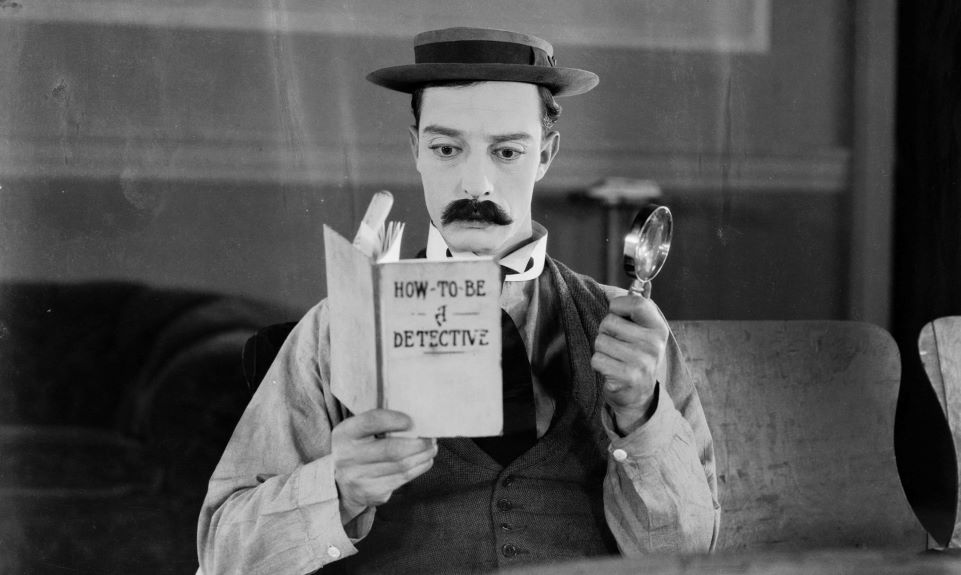
Keaton invents Looney Tunes in this master-class in both cinema and comedy
Director: Buster Keaton
Cast: Buster Keaton (Projectionist/Sherlock Jr), Kathryn McGuire (The Girl), Joe Keaton (The Girl’s Father), Erwin Connelly (The Hired Man/The Butler), Ward Crane (The Local Sheik/The Villain), Ford West (Theatre Manager/Gillette)

If there is one thing you learn from watching Keaton’s masterpiece, Sherlock Jr, it’s this: all Looney Tunes cartoons are Buster Keaton films. The level of astounding, frantic, comic genius in Sherlock Jr hits new heights and its mix of slapstick, improbable stunts, chases and poker-faced reactions basically makes it resemble nothing less than the world’s greatest cartoon made real. There is something either delightful or double-takingly how-did-they-do-that impressive in every scene and the entire film is assembled and designed with invention dripping from every pore.
Buster is an absent-minded, day-dreaming projectionist in a local theatre. But what he really wants to be is a detective. He gets his chance when he discovers that the father (Joe Keaton) of the girl (Kathyn McGuire) he’s in love with has had his watch stolen. We know it’s her villainous suitor (Ward Crane), but Buster’s clumsy investigation only ends up getting himself framed, with only the Girl to clear his name. Back in the theatre, Buster daydreams himself into the film he’s projecting, where he is the famed Sherlock Jr, master-detective besting scheming villains and winning the heart of the Girl, all of whom now look like the people he encountered in the real world.
Sherlock Jnr resolves almost its entire plot in the opening fifteen minutes after Buster fails to prove his mettle as a detective. Bless, he goes about his investigation with a robotic lack of imagination, slavishly following the steps in his How to be a Detective book right down to following his suspect by almost literally dogging his footsteps (requiring a parade of sudden jerks, turns and dodges to avoid being seen). Fortunately, the Girl solves the crime for him, clears his name and heads to the theatre to tell him while he drifts off to sleep. What this means is that we can enjoy Buster’s day-dream of the movies without ever worrying about how he will solve the pickle he is in in real life.
Sherlock Jr can focus on its delightful fantasy sequence. In an oft-imitated stroke of double exposure shooting, the dream Buster emerges from the body of the sleeping Buster, picks up his (dream) hat and walks out of the projection room to the theatre where he is flabbergasted to see people he knows playing roles in the film. Why shouldn’t he be tempted to walk down the aisle and try to climb into the picture? Of course, the villain responds by tossing him out of the frame and back into the auditorium (just to reassure us again, Keaton cuts to the sleeping Buster in the projection room).
Keaton’s film has hugely inventive, creative fun with the medium as Buster re-enters the movie only to find – with the power of editing – his location changing with dizzying speed, without his position changing from shot-to-shot. He steps down a flight of stairs to find it turn immediately into a bench. He tries to sit on the bench but lands in a busy road. He walks down the road to find himself on a cliff edge. He peers off the edge to find himself among lions, then crawling through the desert, sitting on the shore, diving into a snow drift. This whole sequence is effortlessly, brilliantly assembled with Keaton’s position seemingly never changing but the location changing almost a dozen times. Think that cartoon when Daffy Duck goes to war with the cartoonist. No one before had understood the comic potential of editing, shifting locations and changed perspectives.
It’s perhaps the stroke of defining genius in a film crammed with moments from here to the end that leave you breathless with their chutzpah, daring and invention. From here, Sherlock Jr is full to the brim with hilarious comic stunts that Keaton makes look effortless but required such complex planning (and endless repetition on set to get right) that your admiration for their humour is matched only by the wonder at the dedication and sweat it took to deliver them.
In the dream-film, Sherlock Jr has just enough of Keaton’s comic clumsiness to be amusingly recognisable, but every detecting trick he plays turns up trumps. He tails suspects successfully, locates stolen jewels, unmasks criminals and he is never outwitted by the criminals (saying that he can also ride on the handlebars of a motorbike for miles not noticing that the driver has long since fallen off). Through it all, Keaton gives every set-piece the sort of physical commitment Hollywood wouldn’t see again until Tom Cruise started to embark on Impossible Missions.
All of this needed time. Imagine, if you will, the innumerable takes Keaton needed to execute a deluge of seemingly impossible trick shots in a game of pool, where every ball is pocketed except the number 13 (which has been replaced by a bomb). This is the sort of Newtonian logic of a Bugs Bunny cartoon but done for real. It’s doubly funny later when you realise Sherlock Jr wasn’t being phenomenally lucky but was in fact aware the ball was a bomb and was missing deliberately. Even without that knowledge, watching balls bend round the number 13 or divide perfectly so that two balls pass by without contact is breath-taking.
Equally so a stunt which sees Keaton fold up a disguise dress in a window, head into the room, then dive out of the window, straight into the dress, and walk away. The stunt is so incredible, Keaton even dissolves part of the wall of the building so we can see it done in one take. If that’s not enough, moments later he will seemingly dive into a wall through the chest of an accomplice who will then walk away – all in one take. Keaton wanted these magic tricks to seem impossible, to leave the audience helplessly trying to work out what they have seen. The answer, in every case, was endless attempts and vaudeville expertise. Just as Keaton worked out the comic potential of editing could transport him, in a single step, hundreds of miles – so he also worked out it could make impossible events look effortless by removing all the failed attempts.
The film culminates in a chase scene the Looney Tunes cartoons would riff on endlessly (the entire Wile-E-Coyote/Road Runner series is effectively a long version of the end of Sherlock Jr). Sherlock Jr races to rescue a girl, on the handles of a rider-less motorbike, racing over roads, blockages, train tracks and all sorts then switches with her to a car, that similarly does a series of improbably manoeuvres before it crashes into a lake and turns into a slowly sinking boat. All hilarious, all directed and played with a super abundant energy.
And then he wakes into a romantic reconciliation where our hero, slavishly, follows the romantic gestures of the man in the movie he is watching to win a kiss from the Girl. We knew the happy ending was coming – that’s why we enjoyed, pressure-free, the fantasy sequence where nothing was at stake. Sherlock Jr delivers a comic tour-de-force so packed with delightful tricks, committed stunts and joyous invention that it feels like it sails by even quicker than its 45 minutes. It’s a perfectly sustained and balanced series of gags all wrapped up in something that uses the medium perfectly. It’s the first and best Looney Tunes cartoon ever made.
Watch it now!
 Movie Musings