
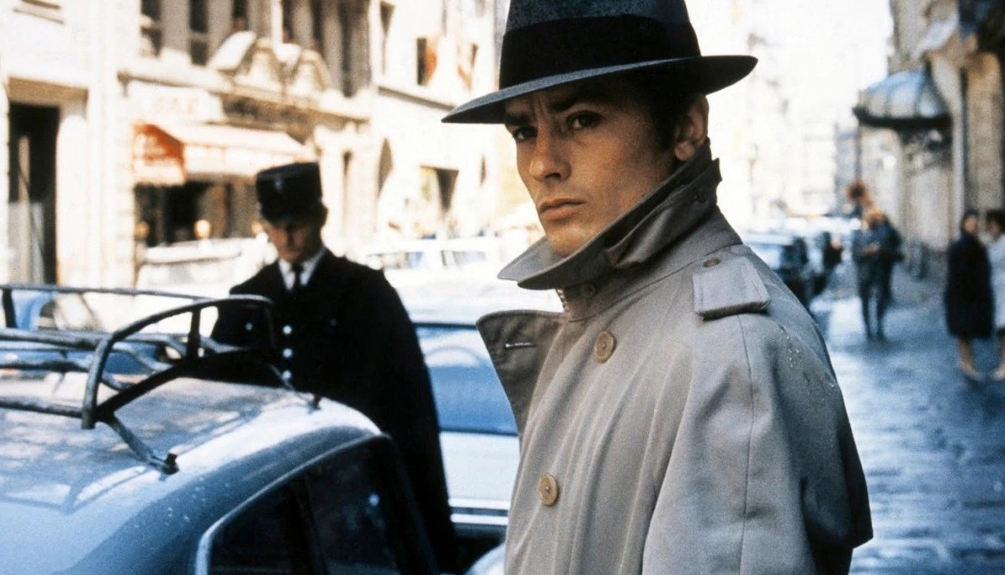
Melville’s iconic and enigmatic hitman film is the epitome of stripped-back cool
Director: Jean-Pierre Melville
Cast: Alain Delon (Jef Costello), François Périer (Superintendent), Nathalie Delon (Jane Lagrange), Cathy Rosier (Valérie), Jacques Leroy (Man in the passageway), Michel Boisrand (Bartender), Jean-Pierre Posier (Olivier Rey), Catherine Jourdain (Hatcheck girl), André Salgues (Mechanic)
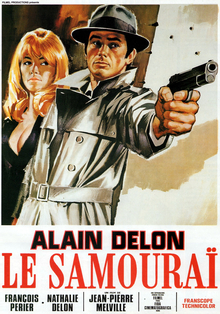
Every professional has his own code, his way of going about business. Why should a hired killer be any different? Jef Costello (Alain Delon) kills for money, but follows his own samurai-inspired code, going about his assignments with methodical preparation and ritualistic regularity, with his hands always covered with white gloves and his fedora at just the right angle. Le Samouraï is partly about how far Costello will go to follow his self-appointed rules. What about when a nightclub hit goes wrong, the piano-playing witness Valérie (Cathy Rosier) may or may not be protecting him, the investigating Superintendent (François Périer) is sure it’s him and the man who hired Jef decides he’s a loose end that needs tying up?
All this comes together in Melville’s stripped back, effortlessly cool mix of Hollywood noir and French New-Wave existentialism shot in a series of chilled greys that makes the film feel like a slice of monochrome 40s throwback. It’s Melville’s mix of the observational, forensic cinema of the likes of Bresson, told with the poetry of Cocteau and with more than a splash of Hawks. It makes for a film quite unlike many others, which sometimes has the logic of a dream, where the hero dresses like he’s stumbled in from Raymond Chandler and lives by a code encapsulated by an opening Bushido quote that Melville made up. It also cemented the filmic idea of the hitman as a mix of sociopath and poet, a consummate professional endlessly attractive in his unflappability sticking loyally to his personal code that shaped everything from Forsyth’s Day of the Jackal right up to John Wick.
Melville’s direction is pin-point perfect, every moment perfectly framed to bring just the right measure of cool and chill. It could almost be a silent – there is no dialogue for the first ten minutes and the dénouement returns to silence as we attempt to fathom Jef’s final cryptic motives – and Melville shoots the careful, forensic detail of Jef’s life with hypnotic mastery. Watching Jef go about, with (mostly) unflappable calm, the preparatory steps for a killing is gripping: stealing a car with a huge ring of possible ignition keys, buying weapons, dressing to perfection, scouting out the territory. It’s a film that’s endlessly fascinated with procedure: it gives almost the same time to the police’s less successful attempts to bug Jef’s apartment, in what becomes a game of move and counter-move.
It’s also a film that builds suspense through the gradual accumulation of facts and events. Jef’s hit in the club sees is no wham-bam affair, but filmed like a prowling tiger in its terrain, with Jef move from room-to-room mapping out his escape route. Two confrontations with a rival hitman, sent by his employers, masterfully feature slow build-ups to sudden bursts of action. An attempt by the police to trail Jef on the Metro cuts superbly back and forth from the police control room, the policemen following Jef to Jef himself, small moments shifting the advantage in the chase here and there.
In a superb performance of unreadable motives and feelings, Alain Delon creates a character who would leave a profound influence on every film hitman to follow. Jef is a man as distant, featureless and anonymous as his apartment (which is grey, contains only the most basic furniture and no possessions at all beyond his caged bird which is as much as an early warning system as pet). He buries himself in his role, keeps all other people distant (his girlfriend, played by Delon’s then wife Nathalie seems to mean little to him other than as an unshakable alibi source via her jealous fiancée) and seems devoid of emotion. It’s hard to imagine him expressing attachment for anyone or anything else (does he really feed that bird?). He’s cool though, because very few characters are as seemingly certain of who or what they are than Jef.
Which is going to be shaken when employers, witnesses and others start to break the expectations of his code. How far does Jef’s personal code of honour, loyalty to contracts and refusal to create collateral damage stretch? His killings are conducted in person – with paid targets greeted with an almost polite apology. But when his employers break the deal, targeting him – it seems nothing will shake him from extracting retribution. The only person who attracts anything approaching his anger is his mysterious employer – witnesses of his crime, other hitmen, the police are all just doing their job like him: but for the boss who broke his word, no threat or bribe will stop Jef. Sticking to the letter of his word is behind the film’s enigmatic ending and you could see the film’s conclusion as the perverse logical end of a philosophy of absolute honour.

Melville’s film drips in classic Americana cool, alongside it’s very Parisian locations. Jef can chew hard-bitten dialogue like a gumshoe and treat his girlfriend with a high-handed dismissiveness that fit him into a host of noirs. Really of course, Jef would be easily caught: despite the struggles of witnesses to identity him, could he look more distinctive in his fedora and Bogart raincoat? Not to mention those attention drawing gloves, that he whips off on completion of the killing to leave fingerprints everywhere? That sort of logic doesn’t matter in a film where it feels like the world is moving forward with the grim, inescapable inevitability of a dream.
There is, among the detailed realism a real sense of the unreal about Le Samouraï right from the start with Melville’s distinctive sharp zoom-in-then-out on Jef’s bed as he sits blowing cigarette smoke in the air. The witness, Valérie, has an unreal, ethereal quality about her, unshaken by seeing Jef at work and drawing him deeper into a situation full of traps and danger like some sort of angel of death. (There is a fair bit of Orphée in Le Samouraï, with an enigmatic hero drawn tighter and tighter into a world of strange rules and hard to predict outcomes). Melville’s film casts such a hypnotic magic that you even forget no real adherent to a Samurai code would ever kill for money.
It comes together in a super-cool, cut-back film of strikingly beautiful noirish images in a world seemingly with no colour at all. But also, a film that is surprisingly complex, considering its enigmatic hero, whose actions and decisions remain open to interpretation and discussion. It’s a film of fascinating contradictions, shot with observational realism but with the logic and unreality of a dream, mixing pulpy thrills with existential pondering. Its absorbing, magisterial and quite unlike almost anything else you could name.
 Movie Musings
I always felt like this was ahead of its time – an inspiration for the “super cool” trend of the 90s to be celebrated by Tarantino.
LikeLiked by 1 person