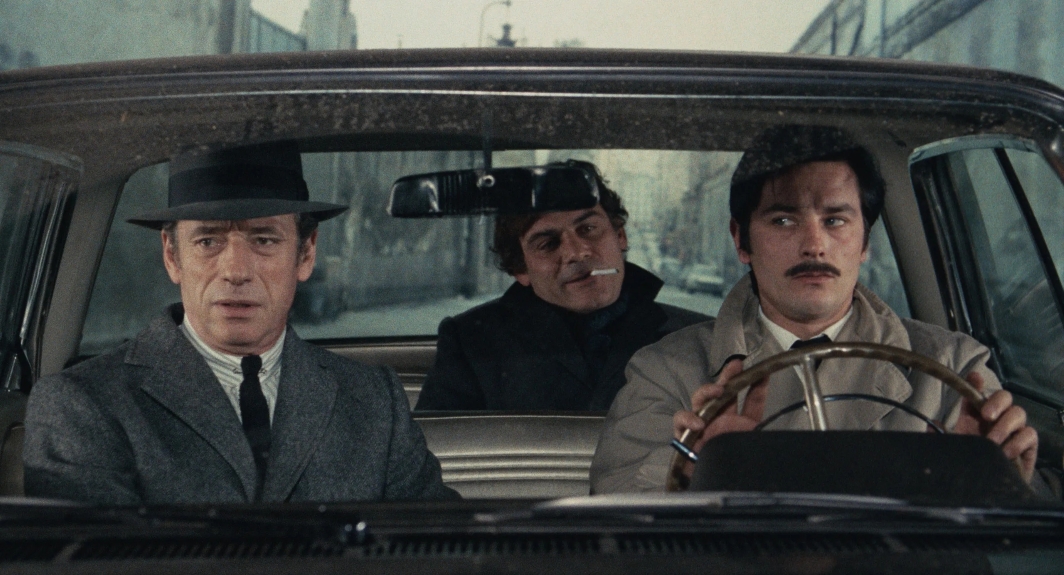
Melville delivers one of his patented, stripped-back, gangster films full of monochromatic Bogart-like cool
Director: Jean-Pierre Melville
Cast: Alain Delon (Corey), André Bourvil (Inspector Mattei), Gian Maria Volonté (Vogel), Yves Montand (Jansen), Paul Crauchet (The receiver), Paul Amiot (Chief of Police), Pierre Collet (Prison guard), André Ekyan (Rico), Jean-Pierre Posier (Mattei’s assistant), François Périer (Santi)
Can you have honour among thieves? Perhaps only when all of you sink or swim together. Three men need a big score and will stick together to get it. Corey (Alain Delon) has the tip-off about a high-end jewellery store, ripe for turning over. He needs the money, as he’s earned the enmity of gang boss Rico (André Ekyan), who repaid Corey’s years of jail-time silence by shacking up with Corey’s girl. Vogel (Gian Maria Volonté) is on-the-run after a daring train escape from dedicated Inspector Mattei (André Bourvil). And retired police sharp-shooter Jansen (Yves Montand) just needs a reason to stop hitting the bottle. All of them will come together for a heist.
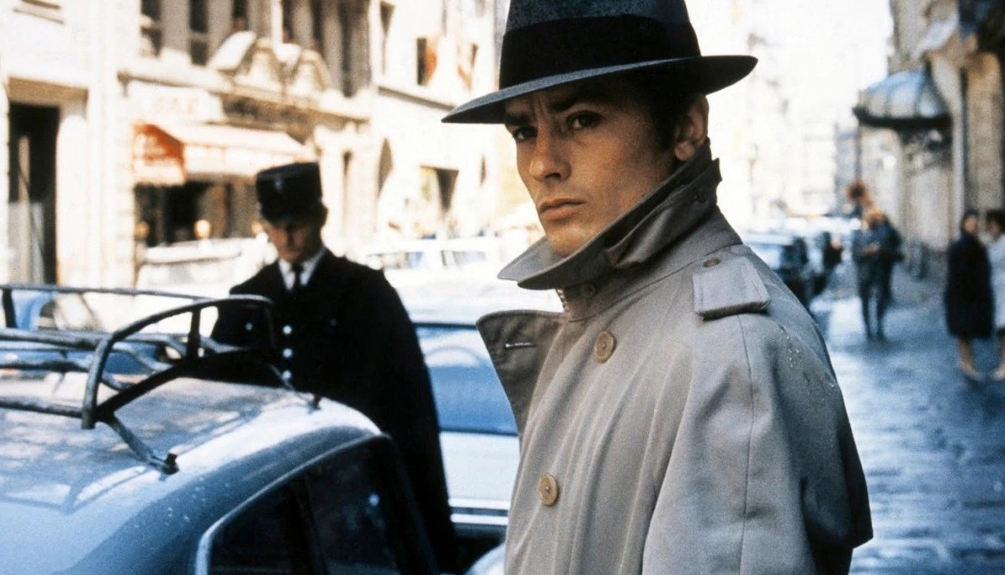
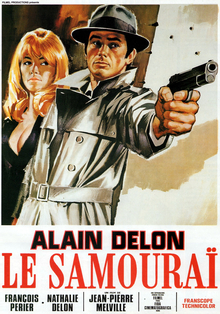
It’s a classic journey for Melville, another exploration of the director’s love for stripped-back cool with a bunch of broodingly silent 40s throwback crooks in Bogartian-rain-jackets puffing cigarettes and going about their dirty-but-strangely-honourable business in a monochromatic world of nightclubs and hideouts. So far, in fact, so Le Samouraï, Melville’s previous Delon starrer, with Le Cercle Rouge echoing that film’s mix of stripped-back Bresson simplicity with French New Wave existentialism. Like that film, this also starts with an import-filled opening quote (claiming to be from the Buddha) which in fact, Melville actually made-up.
Le Cercle Rouge was a film Melville had planned to make years earlier – only for Rififi to come along and execute (flawlessly) his central conceit of a heist conducted in deadly-cool silence. (“They’re not much for talking” Mattei drily observes here when watching the surveillance footage.) But enough time had gone by for the idea to feel fresh again and the heist is another masterfully forensic piece of Melville-magic, that soaks itself in the detail of carefully executed timing, pin-point marksmanship, just a touch of ruthless violence and unflappable cool. (He even speeds us over the duller parts of the prep with skilfully executed wipes). Montand even gets a kick-ass moment of marksmanship that nearly raises a cheer.
The thieves go about much of their work with ice-cold professionalism. We’ve already had Corey’s anti-authoritarian cool well-established, as he effortlessly disarms and steals a bundle of cash from the furious (and humiliated) Rico before casually besting in a pool-hall punch-up two of Rico’s heavies (Corey doesn’t hesitate to take down the first man in seconds with a pool cue). He’s similarly unphased by taking his new car through a police road-block – neither is he anything more than wryly amused when he spots (naturally, while supping an expresso and cigarette) Vogel climbing into the boot of said car to avoid the cops. Its Delon to a tee, here playing to the hilt the casual, confident cool of a guy who knows he’s pretty much tougher than anyone else in the room.
He’s meets a match of sort in Vogel – in what Melville develops into his idea of bromance, where the bros are two hoods who bound over popping a couple of hitmen. Vogel’s escape from the police has a wildness to it that’s almost missing in the rest of the film until its end, a desperate dive through a window and a helter-skelter run through the forest dodging bullets. There is more twitch in Gian Maria Volonté, but when he decides to trust Corey – and Melville captures this moment with a striking fourth-wall-breaking stare in turn from both actors straight down the camera – he’s all in. So much so, Corey is confident that when Rico’s thugs catch up with him moments later, Vogel will be on hand to dispatch the pair of them, and the two remain inseparable (Corey even loaning Vogel his spare pyjamas) throughout the rest of the movie.
It’s these bonds of loyalty that are an underlying theme to Le Cercle Rouge. In a crime world full of bounders who constantly betray those around them – from Rico’s betrayal of Corey to François Périer’s excellently grimy boss Santi only slightly reluctantly turning informer to make his life easier – these men stand out. The cops seem little better: Melville’s policemen are frequently heavy-handed (Mattei frustratedly has to slap down one cop for pushing Santi’s kid almost to breaking point in a manufactured case set up as a light bit of quid-pro-quo with the gangster), have little loyalty for each other and reach for their guns at every opportunity. Corey’s prison guard is on the take and ex-sharp-shooter Jansen left the force because the corruption was sinking into his soul.
Probably why Jansen is now a drunk, Melville introducing him with a strikingly surreal Buñuel-inspired nightmare, where the sweating Montand imagines jerky, giant spiders, then rats and snakes crawling over him in his gin-soaked bedsit. Nevertheless, Montand has his own code of honour: the job is not about the money, but the chance to chuck the demon drink. And he’s got as much contempt for the police’s corruption as anyone, despite that proudly framed police pistol on his wall. Montand’s nervy attempts to hide his booze dependency are well-done, and Melville executes some fine tension by not showing us the results of Jansen’s pre-heist shooting practice, showing us only Montand’s ambiguous face as he inspects the target.
Arrayed against them, André Bourvil brings a Maigret-like quality to Inspector Mattei – the guy who goes home to his classically-named cats, who he dotes on like a loving dad – but when action comes, he’s just as ruthless as anyone, for all his softly spoken professionalism. He’ll lie, cheat and steal to get evidence or witness co-operation and is as quick to pull his gun (and as deadly with it) as the most hardened criminal. In this cruel, winner-takes-all game of cops-and-robbers (and it’s hard not to spot Michael Mann’s Heat owes a huge debt to Le Cercle Rouge, right down to matching his cooly monochrome visuals) he’s as determined to win as anyone.
Le Cercle Rouge has an odd ending, all characters converging almost with a sense of magical realism in one place, at one time. Of course, this echoes the words of Melville’s opening words of men coming together, on a said day, in the red circle – but then you remember that this quote is just some bollocks Melville made up and it was probably written to add a little bit of philosophical justification to what would otherwise be a very sudden and shallowly plotted, fortuitously unlikely, arrival of every character in a key location at the same time. With the expected deadly results.
Le Cercle Rouge though is taut, chilled and cool Melville at his best, with a dark air of danger throughout and a host of characters playing metaphorical chess while puffing cigarettes and looking unflustered. And, when it comes to that sort of thing, few did it better than Melville.