
Stagey Broadway adaptation, a little too in love with its lead character’s rather tiresome whimsy
Director: Fred Coe
Cast: Jason Robards (Murray Burns), Barbara Harris (Dr Sandra Markowitz), Martin Balsam (Arnold Burns), Barry Gordon (Nick Burns), William Daniels (Albert Amundson), Gene Saks (Leo Herman ‘Chuckles the Chipmunk’)
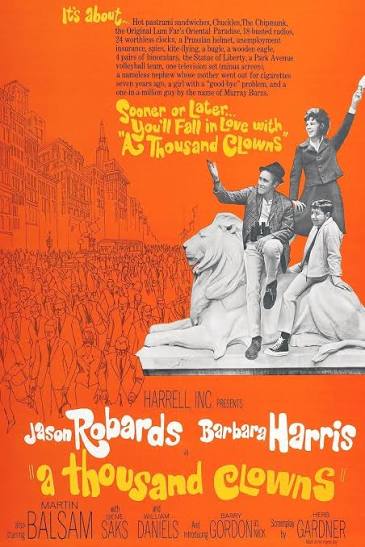
Everyone has dreamed of leaving the rat race behind, but not many of us actually try it. But that’s the life mission of Murray Burns (Jason Robards), a former script writer for charmless TV entertainer Leo Herman (Gene Saks), who refuses to join the clowns carrying suitcases for a day on the New York treadmill. No, he’ll go where he pleases, when he pleases and live a life that means he’s a man not a chair! That’s under threat when social workers Albert Amundson (William Daniels) and Dr Sandra Markowitz (Barbara Harris) investigate whether this is the right environment for Murray to be the carer of his precocious nephew Nick (Barry Gordon). Will Murray listen to sense – and the entreaties of Sandra, who falls for him, and his brother Martin Arnold (Martin Balsam) – knuckle down and find a job?
Your level of enjoyment of A Thousand Clowns will probably really depend on whether you think Murray sounds like admirably free spirited or smackably smug. Many at the time probably inclined towards the latter. A Thousand Clowns had been a Broadway smash for playwright Herb Gardner, translating to the screen with nearly all the original cast (only Balsam and Harris were newbies) and Fred Coe returning to direct. It was singing the song for many in the 60s who rejected the 9-5 – although since many of its viewers became the Reaganites of the 80s perhaps they got over it.
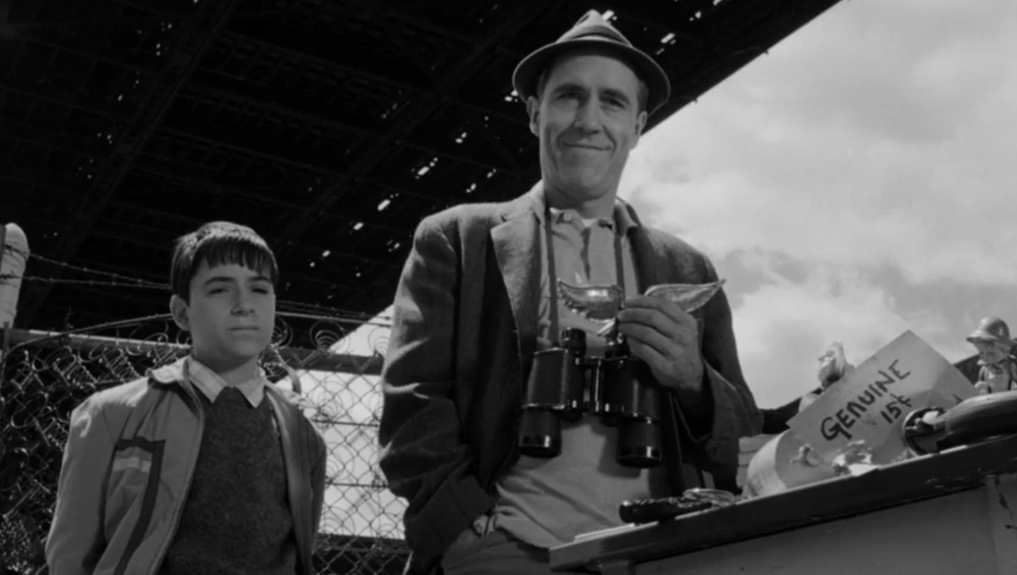
It probably won’t surprise you to hear I inclined towards the latter view. Murray is the sort of man who can seem whimsically charming on film but would probably infuriate anyone who met him in real life (as anyone who has ever had neighbours who make a point of shouting ‘witty’ things in the street at all hours can attest). Bouncing around New York with his surrogate son in tow, spending the day waving at departing ships, cycling through parks or playing long imaginative games with unwitting passers-by, is the sort of roguish eccentricity that gets tired pretty quickly. Also, despite 426 performances on stage, on screen Robards feels too abrasive and confrontational an actor for a part that really needs lovable charm and innocence to work.
But then perhaps this is a sign of A Thousand Clowns wanting to have its cake and eat it. A big part of this film loves the bohemian free spirit, and apartment full of whimsical clutter and Murray’s refusal to be a cog in the world’s machine. But another part does acknowledge Murray feels like a man in the grip of a mid-life crisis, taking a love for independence and free-living to ridiculous extremes. Because the film wants to simultaneously suggest his way of living is both an admirable dream but also an irresponsible way to carry the burdens of parenthood. But suggest it softly, so that Murray’s (inevitable) return to a more conventional working life doesn’t feel like a downer.
Nick is the sort of precociously articulate and emotionally intelligent child who only exists in the world of fiction. Murray’s lifestyle isn’t particularly shown to have hampered Nick, played with feisty energy by Barry Gordon (whose bond with Robards after a year of working on stage together is clear), who is smart, confident and (in some ways) more grown up than his surrogate dad. The two alternate the roles of parent and child, with Nick at times urging Murray to knuckle down and find a job, and Murray trying to teach Nick (who he even allows to change his name at will, until he finds one he’s happy with – one of the film’s better gags) the value of thinking for yourself.
Against this, the film largely throws up a parade of strawman – none more straw than William Daniels (who makes a lot of some poor material) as the sort of pen-pushing, accountancy-minded social worker who is a fixture in dramas like this, seeing the cost of everything and the value of nothing. Even the more sympathetic Sandra is presented as a mildly negative force.
Starting a relationship with Murray, her first act is to start turning his bohemian apartment into the sort of bourgeois curtain-and-lace suburban nightmare Murray is running away from. There is the faint whiff of sexism, that this woman of course dreams of conventional homely life and is determined to pull down (however nicely) the happy-lads home. A feeling that’s not helped by Barbara Harris playing her as almost permanently on the edge of hysterical tears. Although both characters make valid points, their presentation is designed to make us side with the unconventional.
That continues with Murray’s old boss, a pompous, unpleasant egotist, well played by Gene Saks. Only Martin Balsam – who won an Oscar, largely for a well-delivered set-piece speech – is given any argument of merit around the cold hard reality of finding your place in the regular world. Mind you , it could be argued Murray has never actually had to work in the office grind. When he reluctantly heads out into the job market, literally the first offer he gets is as co-host of his own TV show(!) followed by a gig writing for a ratings-winning comedy show. I get it’s a bit more work than throwing confetti at a cruise ship, but we’re hardly talking soul-crushing drudgery here.
A Thousand Clowns pulls all this together into what feels at times an overlong two hours, nearly all of it set in Murray’s apartment. The film would have felt even more stage-bound without a late decision (which Herb Gardner sacrificed a share of his salary to pay for) to throw in a series of French nouveaux inspired montages of Robards, Gordon and Harris to jauntily crash around New York (soundtracked with a mix of band themes and jazz). But it can’t compensate for the rather mixed messages or the general feeling that it’s hard to sympathise with a judgemental man-child who refuses to do the sort of job most people would give an arm-and-leg for.

