
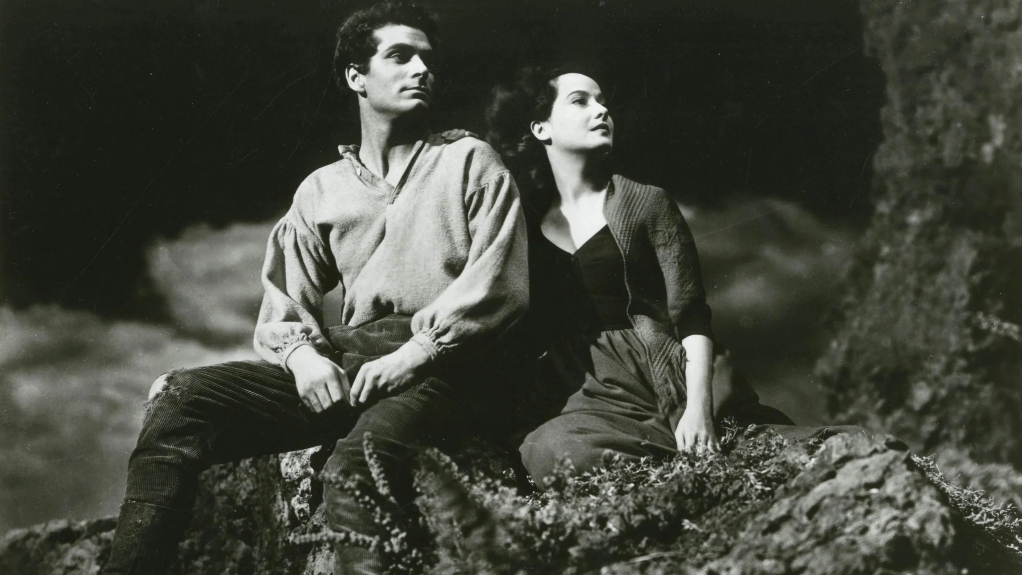
Defining the public image of the novel, a sweeping romance that continues to win admirers
Director: William Wyler
Cast: Laurence Olivier (Heathcliff), Merle Oberon (Catherine Earnshaw), David Niven (Edgar Linton), Geraldine Fitzgerald (Isabella Linton), Flora Robson (Ellen Dean), Hugh Williams (Hindley Earnshaw), Donald Crisp (Dr Kenneth), Leo G Carroll (Joseph), Miles Mander (Mr Lockwood), Cecil Kellaway (Earnshaw), Cecil Humphreys (Judge Linton)
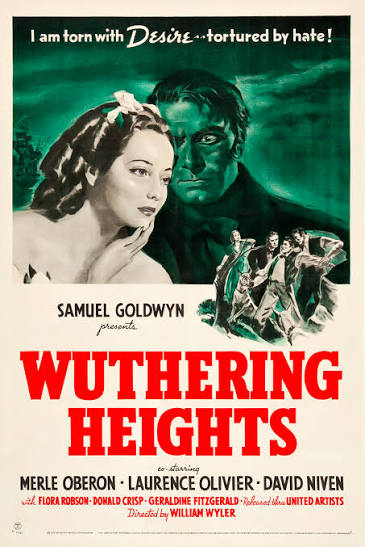
If there is a reason why Emily Brontë’s dark, Gothic revenge novel is now chiefly remembered as a sort of definitive Great Romance, it’s probably because of this movie. Wuthering Heights takes the bitter fury of the original novel and quite brilliantly boils it down into a frustrated, denied romance between two people who cannot be together rather than charting the self-destructive passion of two fundamentally selfish people. That caught on so much, nearly every adaptation that followed essentially copied this film, and many still dream of being swept up by Heathcliff.
Wuthering Heights achieves this by significantly hacking back Brontë’s novel. In fact, it pretty much only adapts half the book, scrapping all together the second volume charting the damaging impact on the characters children from their parents obsession. Instead, the focus is resolutely on the young orphan Heathcliff (Laurence Oliver), growing up in the home of the Earnshaws where is he hated by the jealous Hindley (Hugh Williams) but adored by Hindley’s sister Cathy (Merle Oberon). Humiliated once too often, and heartbroken after he mistakenly overhears Cathy feels he would be a disgrace as a husband compared to the wealthy Edgar Linton (David Niven), Heathcliff disappears. He returns, years later, wealthy and determined on revenge on those who wronged him while also claiming Cathy for his own.
This is the entrée to a romantic obsession Wyler’s film successfully dials up on a convincingly windswept reconstruction of the Yorkshire moors (actually California). It’s a film that works hard to smooth down its lead characters less sympathetic qualities – helped enormously by jettisoning that second half of the novel – and get us rooting for this lovestruck Romeo and Juliet, despite the obstacles put before them. Those obstacles are of course principally class-based, with the posh hats of Yorkshire (defined by David Niven’s suavely polite but relentlessly superior Linton) firmly glancing down their noses at Heathcliff’s tearaway qualities and poor background.
Mind you, Cathy seems rather torn as well. Merle Oberon’s version of Brontë’s heroine swerves between longing for the fiery romance Heathcliff promises and the security and comfort in the Linton’s home. The film’s attempt to make Cathy more sympathetic than her literary roots, is to stress this tearing between her heart and her head. Ironically, this actually tends to make her slightly less sympathetic today. Oberon frequently has to yo-yo between different emotional states, as Cathy juggles her longings and desires. What Oberon most comfortably takes on is the wind-swept passion of Cathy, her wild lack of common-sense that can frequently tip into blistering, jealous bitterness. Clearly, her unhappiness at love denied is what the film wants us to focus on, but Oberon can’t quite capture the inner pain that drives these actions here, making Cathy feel more selfish then intended.
Similarly, Heathcliff’s considerable rough edges (his original ruthless, malevolent force) are sanded down (the jettisoning of the second half of the novel is even better for him) to become a Byronic romantic hero. It’s further helped that Olivier is excellent, able to deliver both the romantic middle-distance starring, but also giving a real emotional weight to the turmoil and vulnerability in Heathcliff. Olivier can stare down the disapproving posh-nobs with calm defiance but also be driven into distraught shame and pain when he feels Cathy’s contempt. Few actors could do haughty coldness and arrogance as well as Olivier, but would have also made Heathcliff seem like a little-boy-lost, out-of-his-depth with the emotions around him.
Much is made to make Heathcliff sympathetic, in contrast with other characters. Linton – and Donald Crisp’s dismissively smug doctor – treat him with haughty contempt and don’t hesitate to label him as a force of evil for his treatment of the drunken Hindley. Something we can’t blame him for, after we’ve seen the casual meanness of Hugh William’s pathetic drunk or his snivelling cowardice when finally challenged by Heathcliff. To be fair, the film presents Linton surprisingly sympathetically – he adores Cathy and treats his servants well, it’s only Heathcliff’s awkward outsider status that riles him, like Niven’s gentlemanliness can’t process a man who doesn’t fit.
Flora Robson’s Nelly Dean – in the novel a far more critical figure of – is here a sympathetic ally. Wuthering Heights re-frames the vital Heathcliff overhearing scene – that motivates his departure and grievance – not as Nelly allowing him to hear the worst, but instead an accident she feels too embarrassed to prevent. At every point, the audience are invited excuse Heathcliff – to the extent we don’t even feel bad when Isabella Linton (a very fine performance by Geraldine Fitzgerald) insists she be allowed to marry him, despite Heathcliff’s clear using of her to provoke jealousy in Cathy. Poor Isabella seems only dimly aware of how much Heathcliff only has eyes for Cathy – and for that matter that Cathy’s protestations of indifference are far from convincing – but so powerfully faithful are our lovers presented, for all their betrayals of each other, it’s hard to berate them.
Wuthering Heights is also helped a great deal in its romantic mission by Wyler’s superbly atmospheric direction and the wonderfully brooding photography by Gregg Toland. Brontëland here is a place of looming shadows, with a real sense of the windswept coldness of the moor contrasted with the blazing passions of the leads. Alfred Newman’s score is full of luscious, rich themes adding to this effect. Wyler’s direction is pacey and draws excellent performances from the cast, while his superb framing and cutting adds tension throughout. The idea of the moor as somewhere outside societies rules, where Cathy and Heathcliff can live out a fantasy of full equality and romance, comes across so powerfully it’s now nearly the defining image of the novel.
Nearly. But for its lasting impact, it’s hard not to disagree with producer Sam Goldwyn’s claim that, while Wyler directed Wuthering Heights, Goldwyn made it. It was Goldwyn who pushed the development of the script towards romance and passion away from obsession and revenge. And it was Goldwyn who insisted on the final shot, a ghostly image of Heathcliff and Cathy walking away into the mist (a pair of extras with their backs to us, as Olivier and Oberon had moved on to other projects) that has had more impact than any other in cementing the idea this novel was about a love so strong it outreached death. It’s a far cry from Brontë’s view of a destructive obsession that ruined lives for generations– but then that would never have sold as many tickets would it?

