
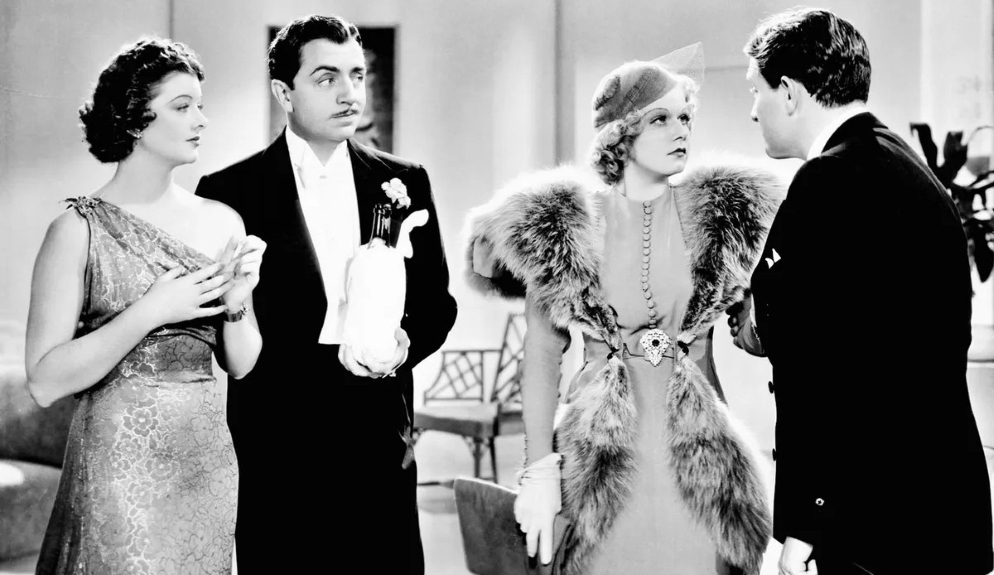
Conventional screwball that stands out from four star-turns and a few striking scenes
Director: Jack Conway
Cast: Jean Harlow (Gladys Benton), William Powell (Bill Chandler), Myrna Loy (Connie Allenbury), Spencer Tracy (Warren Haggerty), Walter Connolly (James B Allenby), Charley Grapewin (Hollis Bane), Cora Witherspook (Mrs Burns-Norvell), EE Clive (Evans)
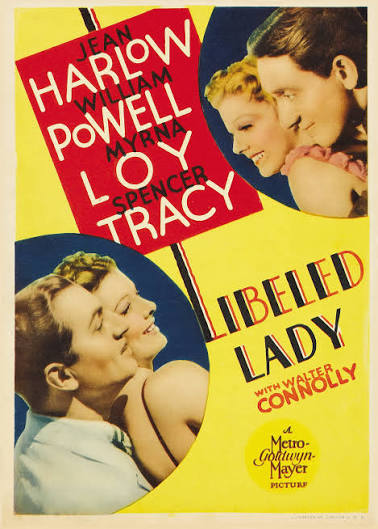
“She may be his wife, but she’s my fiancée!” That richly comic line from Spencer Tracy in Libeled Lady sums up this overlooked screwball comedy, a tangled web of romantic complications giving excellent opportunities for its four talented leads to let rip. Libeled Lady may not be the most accomplished screwball, but it packs a great deal of comic punch in the natural chemistry between its leads (comic gold in any combination).
Tracy is Warren Haggerty, editor of the New York Evening Star, in hot water after running a false story accusing Connie Allenbury (Myrna Loy), daughter of a wealthy business magnate (Walter Connolly), of breaking up another woman’s marriage. She sues the paper for $5 million. Haggerty is desperate to discredit the case by tricking her into breaking up a marriage for real. So naturally, he marries off his fiancée (on the day of their wedding no less!) Gladys Benton (Jean Harlow) to suave former reporter Bill Chandler (William Powell) and then instructs Bill to seduce Connie so Gladys can “catch her” in the act. Naturally it all gets chaotic when Connie falls for Bill, Bill falls for Connie and (to her surprise) Gladys falls for Bill. How are they going to sort that out?
Libeled Lady opens with the thundering roll of newspaper printing and ends with our four leads in a confused romantic scrap in a hotel room. Along the way – bar one stand-out sequence down the river (of which more later), it’s a smoothly assembled four-way star vehicle that lets the actors do their thing. And their thing they most surely do. This romantic screwball is be lifted from the pack purely on the back of the charisma of the stars themselves. In lesser hands, its fairly familiar set-up and funny-but-not-inspired wit might have raised only the odd grin: with these four pros firing on all cylinders, it makes for genuine belly laughs.
Jean Harlow originally intended it as a vehicle for her and beau William Powell. The studio had other ideas – after all, they argued, all cinema goers know Powell and Loy go together like booze and The Thin Man – so Harlow was shifted to the role of ‘other lady’ and Tracy bought in as her romantic intended. It may not have been her choice, but Harlow brings a feisty determination and confidence to a woman who, in other hands, might have been a flighty showgirl. From storming into Tracy’s editorial room in full bridal gear, demanding to know why he hasn’t turned up at their wedding, to throwing herself into a series of pretend clinches with Powell followed by wearied complaining about what arrant husband-to-be asks of her, she’s keeps Gladys a woman who knows her own mind won’t tolerate nonsense. The fact she shifts naturally into someone won over by Chandler’s suave charm and likeable self-deprecation speaks wonders for Harlow’s under-exploited comic skills.
Loy’s archly dry delivery however is perfect for the society heiress who starts the film barely deigning to acknowledge Chandler at dinner (she constantly asks him questions, only to turn to talk to her father before he can answer). However, she’s as smart, worldly-wise and quick off the mark as Chandler, certain she can unmask him as the gold-digging scoundrel she assumes he is and deftly spinning Haggerty’s pleas to think of the newspaper staff (who will lose their jobs) by stating that but of course she’ll set up a trust for them, meaning she’s even more determined to win the $5 million. Like Harlow, Loy has the deft touch to shift this very naturally into classic screwball romance, exchanging longing looks and quick witted barbs with Powell.
It helps that Powell is at his absolute best here, his suave wit and debonair charm absolutely perfect in making someone who arguably starts the film as a conscience-free part-grifter-part-reporter into a deeply likeable rogue with a line for everything. Needless to say, his playful ease and comfort with both leading ladies goes some way to making it perfectly natural they fall for him, and he has an effortless grace and humour while bouncing through a series of awkward situations guaranteed to bring a smile to the face.
He’s equally well contrasted with Tracy’s bull-in-a-china-shop (as Chandler calls it) energy as a fiercely determined newspaper editor with flexible morals. Tracy has complete control over the rat-a-tat pace of the dialogue while his skill at reacting is put to superb effect as a series of ever-more out-of-control situations threaten to overwhelm him. From opening the film nearly rushing out of the door without his trousers, to ending it clutching a hankee to his nose, it’s a sublime comic turn.
These four stars bring their best to what is mostly a series of drawing room set-ups, shot with a functional professionalism by Conway. Most of its scenes, excellently played as they are, would fit nicely into half a dozen other screwballs, bar possibly one. Whoever decided that suavity itself William Powell, should be roped into awkward looking fishing gear and made to wade into a river to do pratfall filled battle with a large fish on the end of the line probably deserves some sort of award for comic invention. Powell doing slapstick farce is the film’s one true stand-out sequence, probably worth the price of admission alone. Otherwise it’s a very enjoyable screwball which, while it doesn’t reinvent the wheel, gives its four leads rich material to showcase their talents.

