

Kubrick’s enigmatic masterpiece will open your mind in the same way as its mysterious monoliths
Director: Stanley Kubrick
Cast: Keir Dullea (Dr. Dave Bowman), Gary Lockwood (Dr. Frank Poole), William Sylvester (Dr. Floyd Heywod), Douglas Rain (HAL 900), Daniel Richter (Moon-Watcher), Leonard Rossiter (Dr. Andrei Smyslov), Margaret Tyzack (Elena), Robert Beatty (Dr. Ralph Halvorsen), Sean Sullivan (Dr. Bill Michaels)

When I first sat down to watch 2001: A Space Odyssey I was a teenager. It quickly became clear I had no idea what I was getting into. Somewhere in my mind I pictured an experience a bit like Star Wars. What I wasn’t ready for was the enigma wrapped in a mystery Kubrick actually made. Watching it was rather like a teenager chugging back a fine red wine as their first drink: I spat it out and reached for a can of Fosters. Appreciation for that sort of stuff has to grow with age. Today, for all Kubrick can be self-important, this is visionary, individualistic, ground-breaking film-making. A truly unique piece of film artistry and a masterclass in sound and vision, presenting something unanswerably different. No wonder its impact has stretched through film, like the monolith’s on mankind.
2001 could arguably be about everything and nothing. It was developed by Kubrick and Arthur C Clarke, working in tandem to produce both script and Clarke’s novel. But Kubrick flew in a radically different direction. While he and Clarke populated the novel treatment with greater context, Kubrick felt (as the film reached its conclusion) that explanations weakened the film. Its power lay in maintain the mystery. Kubrick cut a voiceover, trimmed out characters, sliced out dialogue and removed all references to aliens behind events: he left the film itself as a mysterious artifact, the viewer could touch it and experience their own unique odyssey into the unknown.
Split into four chapters, we are taken from the dawn of our civilisation to (perhaps) the dawn of our next civilisation. A prologue shows the arrival of a mysterious monolith on prehistoric Earth, where a group of ape-like humanoids encounter it and learn to use tools (namely to hunt and kill). Millions of years later, mankind’s early colonisation of space discovers another mysterious monolith, buried millions of years earlier. A mission is sent to Jupiter years to find out more about its origins. On that mission, all the crew bar Dr Dave Bowman (Kier Dullea) are killed when on-board computer HAL seems to malfunction. Bowman is left alone to encounter a monolith circling Jupiter which takes him into the infinite, a whole lifetime lived in minutes in a dream-like French drawing room, before his rebirth into a giant space baby.
What’s extraordinary about all this, is that Kubrick does nothing to place any of this into an understandable context. 2001 is a sort of Last Year at Marienbad in Space, a journey into a series of questions with no answers – but yet somehow never feels unsatisfying. It’s also fascinating as a work that feels profoundly philosophical, but with very little actual philosophy or insight in it. Instead, what the film supplies is a sort of raw, elemental power that makes you tremble to your very bones. You can feel it worming inside you, its unfathomable imagery, haunting audioscape and sometimes impenetrable logic making it even more engrossing.

It’s often been said the only character in 2001 Kubrick related to was HAL, the emotionless but sinister computer. In fact, I’d say the character Kubrick most relates to is the Monolith. For, essentially, what is it but a film director: a master manipulator holding all the cards, knowing all the answers and choosing what to share with us? We understand nothing in a film without the director’s guiding hand. Like the Monolith, 2001 has such overwhelming awe and majesty that people are drawn to it while barely understanding it. That’s a Godlike power I feel Kubrick relates to.
2001 is a master-class of the director’s art. The visionary beauty of its imagery is breath-taking. From its sweepingly empty vistas of the barren rocks of pre-historic Earth to the serene majesty of space, this is a film filled with indelible images. There is a true power in the geometrical perfect, bottomlessly black Monoliths that make them something you instantly can’t look away from. And don’t forget that 2001 has one of the two greatest jump cuts in history (the other, of course, being in Lawrence of Arabia), as an ape celebrates victory by flinging a bone into the air that cuts suddenly into a similarly shaped space craft as it falls.
Kubrick’s imagery of planets in mysterious line-ups, or the sun emerging over the top of the Moon have helped define how we think of space. His vision of mankind’s future, full of pristine surfaces, corridors that curve and rotate to create gravity has a power behind the simplicity of its design. So mind-bending is Kubrick’s vision of entering the Monolith – a kaleidoscope of colours hurtling towards the camera – that only the knowledge of his control freak self would let you believe that he (unlike many of the film’s viewers) never once dropped acid.
But the real genius Kubrick used was to match the stately, patient beauty of his images – and you can’t deny that 2001 is a film that frequently takes its time – with striking, perfectly selected classical music. You can argue what Kubrick does here is piggy-back emotional and spiritual effect from the work of others. But his choice of musical score is unfailingly, undeniably perfect: there is no chance Alex North’s rejected score could have had the same power. The deep rumblings of Richard Strauss’ Also sprach Zarathustra so perfectly captures the endlessly, unknowable power of space, time and the Monolith itself that it’s now become a landmark piece. The scenes of the ships in space are given a balletic beauty by being perfectly cut to Johan Strauss’ The Blue Danube. Could the Monolith have had both the power and unsettling sense of the unknowable without the sound of Ligeti’s Reqiuem? There is not a single decision to combine sound and visuals in 2001 that isn’t perfect.
And it only adds to the mysterious power of a film that can be deeply unsettling. If there is a transparent philosophical idea in 2001, it’s that mankind uses tools for conquest; the Monolith at first inspires a progression from the empty posturing of rival ape-tribes, into head-smashing violence. And, millions of years later, mankind is still two tribes (East and West), with weapons that could blow each other out of existence. But, whether that was the aim of the Monolith we never know. Just as we never really know what’s going on with Bowman’s fast track life through his neoclassical hotel (though I find something terrifying at Bowman encountering increasingly older versions of himself in silent trepidation).
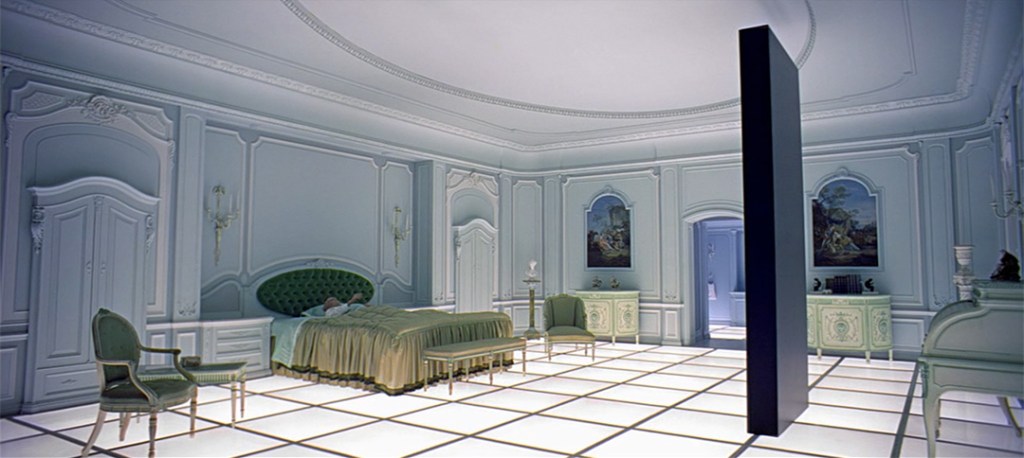
Is 2001 optimistic or pessimistic about the future? I think Kubrick is aiming for letting us make up our in mind – after all this is our own private communion with his monolith. It matches his own natural inclination for distance. The humans in 2001 are almost impossibly stoic: space travel is no more exciting to them than a plane trip to a frequent flyer (the curved space station is basically an airport, which the character’s treat with the same time-killing blaseness as we do at a terminal). Messages from family members are twice watched by different figures with impassiveness. HAL’s control of the ship is so total, you wonder what the crew is for. Has the Monolith-inspired technology stunted mankind – now we are so dependent on machine that we just cogs in their workings, has progress stalled? 2001 could really be about mankind’s rebirth for a new life.
The HAL sequence – a precursor in many ways to The Shining in its unsettlingly invasive atmosphere – sticks in the mind as it has easily the most dialogue, plot and overt drama. HAL is a brilliant creation – Douglas Rain’s emotionless voice subtly shifting from strangely sweet to terrifyingly relentless to surprisingly sympathetic when he meets his end – and the sheer terror of these technological marvels turning against us (a space probe that shifts into a sort of monster, followed by a jump cut to HAL’s glowing red eye is just breathtakingly brilliant).
But if 2001 is short of narrative drive, surely that was Kubrick’s point? To keep 2001 as a mysterious encounter with no real answers. It opens and closes with two thirty-minute sequences devoid of any dialogue (the last word we here is “mystery”) and gives us such a blast of the senses that it feels more like being flung into a void of unanswerable questions. I was certainly not ready for that when I first watched it. But now, I just have to bow before Kubrick’s mastery. This inspired so many, its power is felt in thousands of works of art since. And it does this because it balances awe, wonder and mystery in a masterful way few other films can. You learn nothing in 2001. It has no real message, argument, or philosophical points, But yet it leaves you utterly satisfied, bursting at the seams with the power of your own imagination. That’s masterful film-making.
 Movie Musings