
Pabst’s very earnest plea for brotherhood is also a gripping underground disaster epic
Director: GW Pabst
Cast: Alexander Granach (Kasper), Fritz Kampers (Wilderer), Daniel Mendaille (Jean Leclerc), Ernst Busch (Wittkopp), Elisabeth Wendt (Anna Wittkopp), Gustav Püttjer (Kaplan), Oskar Höcker (Mine foreman), Héléna Manson (Rose), Andrée Ducret (Françoise Leclerc), Alex Bernard (Grandfather Jacques), Pierre-Louis (Georges)
Pabst’s Kamerdschaft was his second sound film after Westfront 1918 and follows on from that film’s politics. Kamerdscaft is a heartfelt plea that, deep down, we are all comrades, who should be working together not tearing at each other. It’s based on a real 1906 mine disaster in Courrières where a coal dust explosion left thousands of French miners trapped underground, relying on teams of French and German (from Westphalia) miners to save them. Pabst shifts this to 1919 and the location to the French-German border (so new, it even runs through the mine itself with both sides literally walled off from each other). It’s straight after the war, and never have tensions been higher.
Pabst argues though that this lethal squabbling between nations distracts us from the ties that bind us. He opens with two children – one French, one German – arguing over a game of marbles both claim to have won, demanding the other hands over all the marbles. They even literally draw a border in the dirt to make their point. Pabst’s symbolism here is not exactly subtle, but it makes the point swiftly and clearly. Whenever we encounter the border officers, they are rules-bound and small-minded. A French border guard almost fires on a truck of German miners offering their help. Bosses from both sides put obstructions in the way of the effort to free the miners. The film closes with military forces from both sides solemnly re-building the underground border wall knocked down during the rescue.
It’s carried over into tensions between both communities. The French are generally encouraged to look down on the Germans. Life on the French side seems more secure and comfortable – with rows of workers houses, bars and plentiful jobs – with the Germans frequently crossing over to try and find work and relaxation in the French side. A trio of jolly Germans nearly get into a bar fight when a French girl declines to dance with one of them: a loud atmosphere in the bar disappearing, as Pabst’s camera pans past a row of faces suddenly turned confrontation and hostile.
This tension is increased by the language barrier. Kameradschaft was a French-German co-production and the actors used their native language. This allowed for a strong cast, with Alexander Granach particularly notable as the jolly Kasper. It’s fascinating to watch Kameradschaft with only one language translated, plunging you into trying to follow the stumbling French of the Germans and vice versa. Misunderstandings frequently arise. That bar near-fight is started when Fritz Kamper’s German miner assumes Héléna Manson’s Rose doesn’t want to dance with him because he’s German, when actually she says its only because she’s tired.
Misunderstandings continue throughout the film. The German’s underground struggle to make themselves understood, using a range of physical gestures and pigeon-French; the French stumble through basic German. While subtleties are missed, it’s striking how Pabst demonstrates in the big things, meaning is always clear: emotions and actions convey a universal meaning we all understand. In the aftermath, a French miner makes an impassioned speech about brotherhood: his German counterpoint responds with a heartfelt speech that he didn’t understand a word but he agrees they are all brothers.
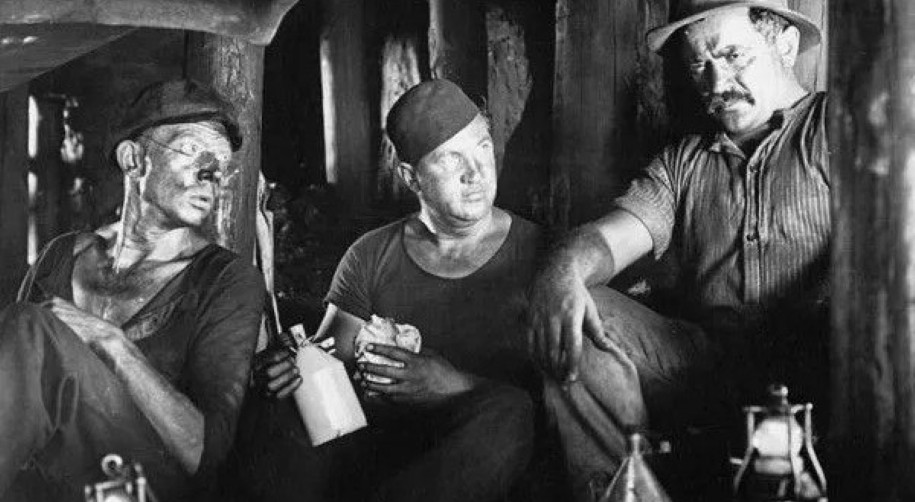
“A miner is a miner” says Ernst Busch’s Wittkopp who insists on the rescue mission. (Busch was a veteran of Brecht and an impassioned Socialist). You can see why they feel this when you see the conditions below ground. Claustrophobic, dark, sooty and terrifyingly confined, the mines quickly become intimidating traps as support beams buckle and crumble. It’s even more impressive when you realise these extraordinarily convincing sets were indeed sets, build in a studio by Ernő Metzner and Karl Vollbrecht. It’s honestly hard to believe that the crew didn’t go underground when you watch, giving the film a strong steak of realism.
It’s a realism mixed with a moody expressionism in the lighting. When the explosion comes, the fire rolls through the smoke and steam filled rooms and then seems to continue, consuming everything in its path. Pabst uses a tracking camera to keep us just ahead of these advancing flames. He stages brilliantly the collapse of the mine, showing miners trapped or crushed as roofs cave in and rocks tumble down. Kameradschaft is just as strong in showing the panic above ground, as the families of those trapped race through the streets to gather at the mine’s locked gates, howling to be allowed in and help with the rescue of their nearest and dearest.
As in Westfront 1918, Pabst employs the same sound-proof casing to his camera to give it as much flexibility as possible while still capturing sound. Kameradshaft is full of the audio hustle and bustle of a town in torment, and he’s equally effective with sound below ground. Not only the collapse of the mine, but the sounds that come with being trapped: heavy breathing of rescuers in their breathing equipment, metallic tapping on pipes to attract attention, desperate scurrying of trapped miners to find a ringing phone in a ruined engine room. All of this is executed to perfection.
Pabst’s finest sound use comes when one trapped French worker succumbs to delusion under the pressure as a German rescuer approaches. As he sweats in panic, the tapping on pipes shifts to the rat-a-tat of machine guns. From his POV we see the approaching German in breathing transform from a miner into an infantryman. In a series of cuts, the French miner imagines himself in the trenches, launching himself in desperate self-defence against his would-be saviour. It’s a beautifully done moment that hammers home Pabst’s message that when nations turn natural friends into enemies, we are all left weaker.
Kameradschaft isn’t always subtle in saying this. You could frequently call it naïve. Pabst stresses the point with a zoom into the shaking hands of German and French rescuers meeting for the first time under-ground (holding the shot for longer than necessary). But it’s an earnest and decent message. But sadly, not one people were going to listen to. The film was, of course, banned in Nazi Germany almost immediately – and they would have approved of Pabst’s more cynical coda of the underground border being re-built (a scene cut from some prints, as being too glum). We may dream of brotherhood and peace, but sometimes it is just a dream. But Kameradschaft is a fine enough film to persuade us its worth dreaming.
 Movie Musings