
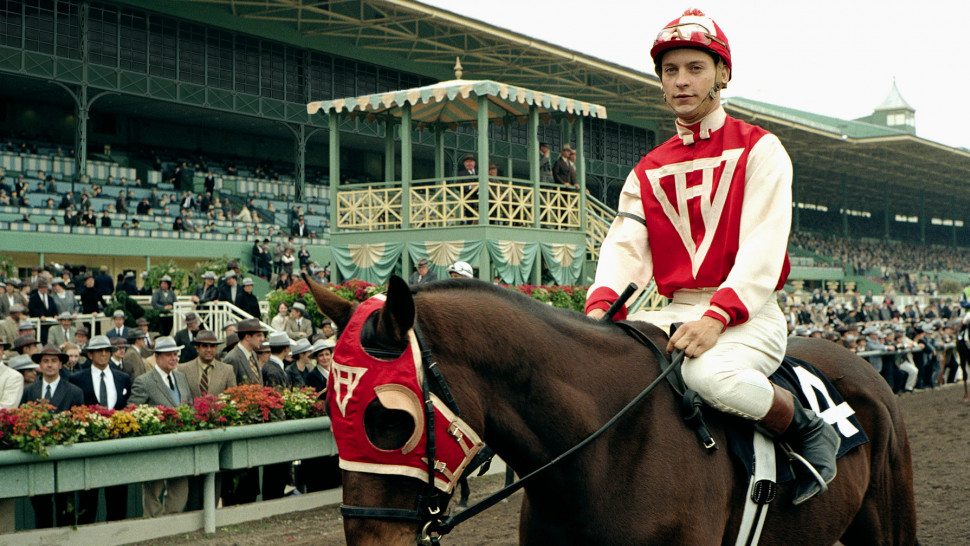
Earnest and decent crowd-pleaser, that wears it’s emotional messages a little too heavily
Director: Gary Ross
Cast: Tobey Maguire (John ‘Red’ Pollard), Jeff Bridges (Charles S Howard), Chris Cooper (Tom Smith), Elizabeth Banks (Marcela Zabala-Howard), Gary Stevens (George Woolf), William H. Macy (‘Tick Tock’ McLaughlin), Eddie Jones (Samuel Riddle), Michael O’Neil (Mr Pollard), David McCullough (Narrator)
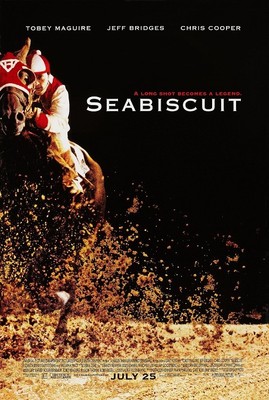
In the aftermath of the Great Depression, so many people felt lost and powerless, that anything that gave them even a smidgen of hope had great power. Which is why perhaps, on 1 November 1938 40 million people tuned into the radio to listen to the ‘Race of the Century’, as Seabiscuit (the little horse that could) took on War Admiral (mighty champion of the track). This forms the background to a sentimental crowd-pleaser from Gary Ross, a people’s champ rather like the horse itself.
Seabiscuit is framed around the impact this plucky, temperamental but never-say-die horse had on three damaged men who pulled together as an unlikely trio to pull him towards success. First is his owner, automobile empire owner Charles Howard (Jeff Bridges) who is mourning the loss of his son. Second, grizzled trainer Tom Smith (Chris Cooper) whose purpose is vanishing with the Wild West. Third, jockey John ‘Red’ Pollard (Tobey Maguire), a never-say-die fighter himself (literally) who has never got over his resentment about being left by his bankrupt parents. All three will find the success they meet with Seabiscuit helps to re-build their lives.
This personal story does rather overwhelm the Depression-era background, with Seabiscuit playing the “we fixed him and he fixed us” card rather heavily. Much of the film’s dialogue plays up this link between man and beast and the context of the wider impact of this horse’s success doesn’t always come across – perhaps correctly Ross calculated that a personal story brings a greater emotional bond than a piece of social issue. As such, much of the social background is deposited into a Ken-Burns style series of stills and voiceover (so Ken Burns inspired, his old mucker David McCullough even narrates the thing), which never quite links up with the personal stories unfolding.
These stories are presented with mixed success. The death of Howard’s young son – the pre-teen driving a truck to the fishing point cutting to a toy truck lying sideways – is told with a level of restraint that tugs the heartstrings. Ross’ cut from the accident, to a toy car, its wheels spinning, carries impact. Bridges plays the quiet pain and hurt Howard carries with him throughout with an effective level of subtlety. He further gives a neat sense of a page heavily turning in his life, from this shining optimism of his early years as a prodigious car salesman to his quietly more reserved later life as a man who has carefully buttoned up his pain and found solace in a happy marriage (to Marcela, played with genuine warmth and charm by Elizabeth Banks).
It’s a shame the film feels the need to constantly take opportunities to relentless hammer home for us the surrogate parent feelings he starts to feel towards Red (in real life, Howard had several children, but that wouldn’t have made as good drama, would it?). It’s as if Ross worried we might not notice the possibility by ourselves. A relationship where there is more than enough on the page for us to work out for ourselves, is instead often pummelled into us, never allowing us to doubt for a moment than when Bridges worries about Maguire being injured, it is his own son he’s thinking about.
It’s a similar blight that affects even more Red’s resentment at being abandoned by his parents. It’s possible the quietly distraught performance of Michael O’Neil unbalances things here: it’s so painfully obvious his parents don’t want to leave him, you wonder why Red hasn’t worked that out. The film needs to hammer the point home for him, and insist his parents never wrote to him again (something that feels massively out-of-kilter with the emotional sympathy Ross frames them with early in the film). It feels like Seabiscuit didn’t want to lose any possible emotional moment, even if presenting his father as distant and uncaring may well have been far more effective for the story. As it is, Red’s inner pain is also relentlessly telegraphed to us.
Maguire looks the part of the jockey (he lost several bulky Spider-man muscles for the role), but the film keeps needing him to whack the button of anger and self-destructive aggression to re-enforce his broken nature. It’s a good performance, even if it’s hard to see the faultlessly polite Maguire as a rough-and-tumble wild-boy who never met a fight he doesn’t want to throw himself into. Like Bridges, Maguire has a lot of emotional heavy-lifting to carry (as well as parental abandonment, he gets blinded in one eye and goes through a crippling accident that threatens to end his career) and the burden of it eventually rather overwhelms a thinly written character.
More successful is Chris Cooper, who gives a fine performance of avuncular dedication as a horse trainer worried that fences and modern technology are rendering his old horse-whisperer skills increasingly obsolete. Perhaps it helps that Cooper isn’t given an overly forceful backstory to juggle, and that Cooper’s underplaying gives his gruff old-timer schtick real charm. Interestingly, for all the forceful attention paid to the other’s backstories, it’s Cooper’s gentle thawing to others, his kind attention to animals and his patient balancing of horse racing tactics actually involves the audience more. Just as William H. Macy, shorn of carrying any plot at all, leaves a delightful impression as he has a whale of a time with a quietly-drinking radio commentator, supplying his own audio effects in between breaks in his fast-paced patter.
The other most enjoyable note of the film is its capturing of the high-octane world of horse racing and the way it communicates the huge physical and tactical effort of actually being a jockey. From knowing the right time to break, to controlling a racing animal that wants to follow its instincts to chucking up before a weigh in to reduce your load, being a jockey is far from an easy-ride. The racing footage in Seabiscuit is well-filmed and, like the rest of its period detail, magnificently well-observed and its superb dramatic rendition of the thrills of racing makes these scenes genuinely engaging, as well as selling a lot of the ‘plucky underdog’ story the film flourishes in.
It’s also refreshing that the film resists the temptation to try and endow Seabiscuit himself with human qualities. For all our heroes delight in his company, he is always a horse to them (and to us) with just a horse’s instincts and understandings. It’s a winning note in this story of the “little horse that could”, certainly more so than the occasionally overly-insistent dialogue. It may let its attempt to link a personal story to a wider depression-era perspective fall at an early hurdle, but it’s still an effective crowd pleaser.
 Movie Musings