
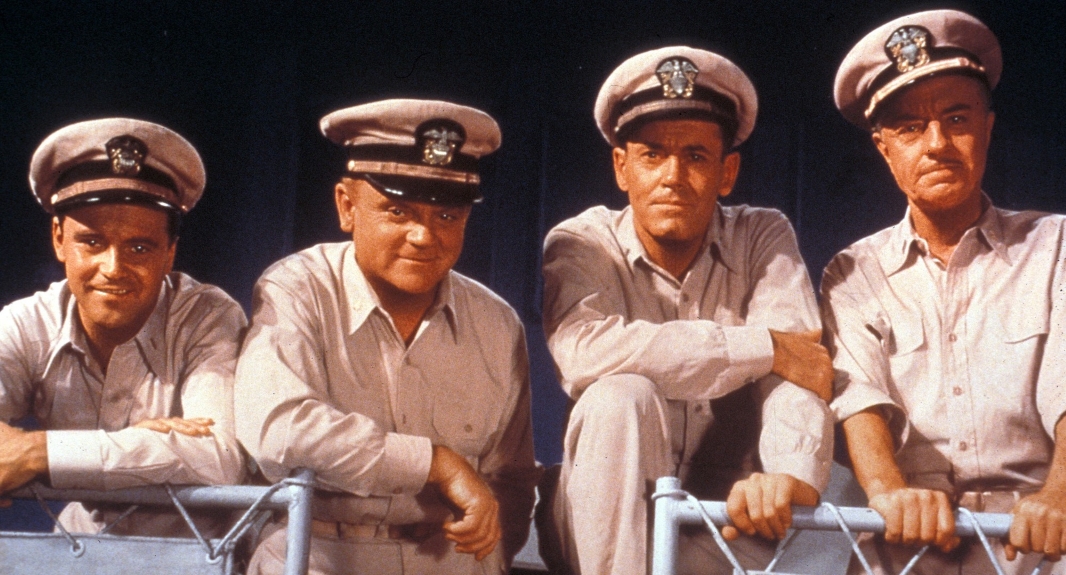
Dry and stagey version of a theatre hit, that never quite comes to life cinematically
Director: John Ford, Mervyn LeRoy (Ward Bond, Joshua Logan)
Cast: Henry Fonda (Lt Jnr Gd Doug Roberts), James Cagney (Lt Cmd Morton), William Powell (Doc), Jack Lemmon (Ensign Frank Pulver), Betsy Palmer (Lt Ann Girard), Ward Bond (CPO Dowdy), Ken Curtis (Dolan), Philip Carey (Mannion), Nick Adams (Reber), Perry Lopez (Rodrigues), Patrick Wayne (Bookser), Harry Carey Jnr (Stefanowski)
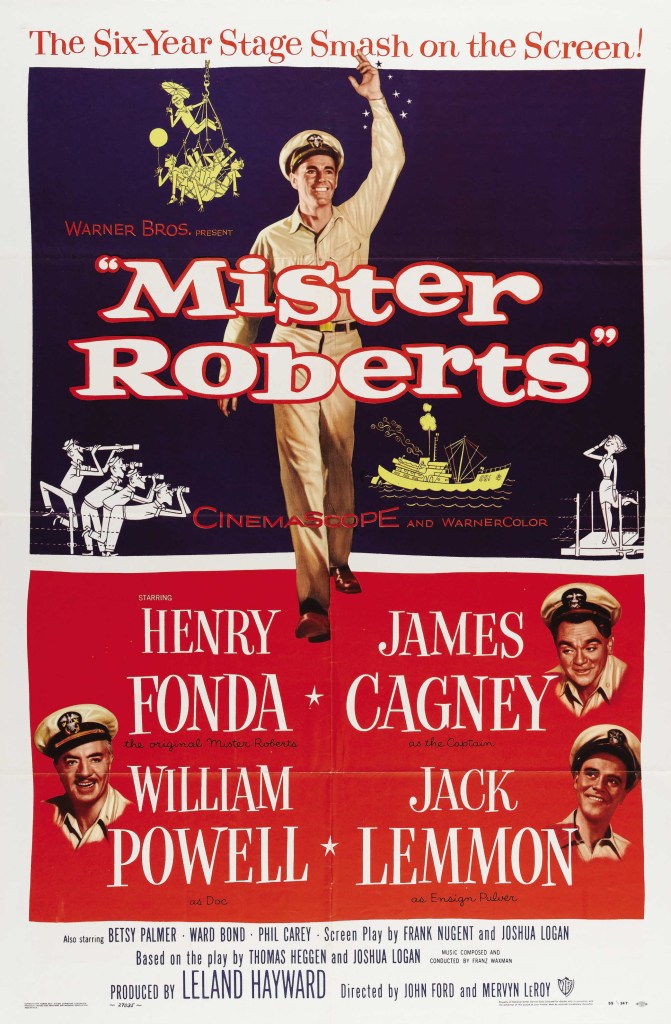
Henry Fonda hadn’t made a film for almost seven years, spending the intervening years collecting garlands on Broadway: and a lot of those were for his over 1,000 performances of Mister Roberts. When the hit play came to the screen, he was the only choice (even if Fonda looked a bit long-the-tooth for a junior lieutenant). Fonda was less than happy with the film – despite its financial success and Oscar nominations – and it’s easy to see why. This is an uneasy mix of awkwardly opened up filmic sweep and stagy set up, with the original’s saltiness watered down to gain Naval co-operation.
Fonda is Lt Jnr Grade Doug Roberts, second-in-command of naval cargo ship Reluctant (known as the Bucket). It’s 1945 and the ship is under the tyrannical command of Lt Commander Morton (James Cagney), a lazy placeman riding Robert’s organised shirttails to career success. That’s why he’s unwilling to grant Roberts’ wish to be transferred to a combat ship so he can do his bit. Roberts is the buffer between Morton and the crew, Morton taking any opportunity he to impose his Bligh-like authority through punishments. How will the power struggle between the two men play out?
The most interesting thing about Mister Roberts is the immense turmoil of its making, burning through no less than four directors. Ford butted heads with Fonda (never the easiest guy in the world), who felt he knew far the material better than Ford. This eventually led to a punch-up and Ford hitting the bottle big-time before he was sent to a sanatorium. Ward Bond took over before Mervyn LeRoy was shipped in. LeRoy claimed to have directed over 90% of the film (allegedly in Ford’s style), before he too was replaced by Logan, the original Broadway director, who only didn’t get the job in the first place because Fonda had also fallen out with him. Logan felt the recut script ripped the heart out of the play and, like Fonda, that the film was not a patch on the original.
This chaos perhaps explains why this feels like such a bland and stagey affair. There is the odd widescreen shot of Reluctant puffing through the seas, or Fonda surveying the panorama. But these are outweighed by static camera set-ups of a sound-stage recreation of the ship. Scenes play out in angles that seem to basically replicate the way they were set on stage (most strikingly, a scene where the crew stare out at the nurses on the island through binoculars – you can almost picture the sailors peering out into the stalls). It’s the worst type of ‘opened-out’ film adaptations, where the opening-out is restricted solely to the odd widescreen shot of a vista while the rest of the film is shot and staged like it’s still in a theatre.
On top of this, Fonda and Logan was probably right that a lot of the play’s energy was lost when its harsher beats were trimmed. It’s not a surprise the saltier dialogue was thrown overboard. But Morton was changed from a Queeg-like bully into a broader, comic character, a ludicrous martinet whose obsession with his palm-tree pot-plant was dialled up to the max. James Cagney gives a broad performance, either frothing at the mouth or fainting away in fury. He’s such an absurd figure, he can’t be seen as a genuine threat, possibly because the Navy could not abide the idea that a bully who placed his own career before his crew’s wellbeing could ever land a command.
It rather mutes the more satirical points about the unpredictability of rigid command structures. You can still see beats of it in the film’s recurrent, slightly bizarre, ‘now hear this’ announcements over the intercom (a surprisingly M*A*S*H-ish touch) or in some of the more mad-cap destructive elements of Lemmon’s slacker Ensign Pulver. Just as the crew’s poor moral and willingness to find ever more obscure reasons to shirk duty might have played more into criticism of the domineering navy regime on stage. Not here.
With a slightly neutered content and flat direction, what Mister Roberts relies on is the strength of its performances. It certainly got a trio of legends and an up-and-comer destined for great things. A very fine Fonda, with that long experience, gives his trademarked decency mixed with a sensitivity for his men and bitterness at his commander. It plays out with an indulgent fatherly regard for his men and a subtle cheek for his captain. His disgust for Morton is tangible as is his emotion at the crew’s regard.
Equally good is William Powell, in his final role, an archly dry commentator on events, as playful forging whisky as he is quietly amused at the crew’s wild attempts to escape their duty. Jack Lemmon Oscar-winning turn as Pulver was an early display of both the manic comic energy, tinged with an adolescent sexual excitement, that he bought to several later roles. But he also manages to find some genuine moments of emotional depth. Cagney blisters in a 2D role, but few do bombast better.
But Mister Roberts frequently feels a little slow and dry, and it’s never quite funny or zany enough for what it’s trying to do. Not surprising, since Ford and LeRoy are hardly anyone’s idea of satirical, screwball directors. When it does go for zany energy, it ends up making its characters look like dicks – the crew’s shore leave (after a year on ship) is clearly meant to be amusing (Fonda gives them a ‘boys-will-by-boys’ smile). But the actions described (trashing an ambassador’s house, ripping clothes off women, turning a dinner party into a brawl) sounds more like drunken louts than charming rogues (hard not to feel Morton isn’t more than a little bit right to be furious).
It says a lot that the broad comedy lands less well than the serious moments – especially as the film’s sudden tragic ending is its most effective moment. The stagy, dry production feels like it has made only the most awkward transition to screen – I suspect Fonda was right to wish more people had seen it on stage than on celluloid.
 Movie Musings