Author: Alistair Nunn

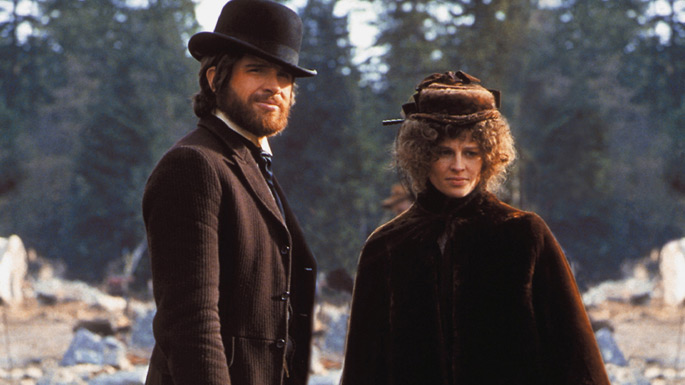
McCabe and Mrs Miller (1971)

Warren Beatty and Julie Christie fail to conquer the Wild West in Altman’s revisionist Western McCabe and Mrs Miller

Director: Robert Altman

Cast: Warren Beatty (John McCabe), Julie Christie (Constance Miller), RenéAuberjonois (Sheehan), Michael Murphy (Eugen Sears), Antony Holland (Ernest Hollander), Bert Ramsen (Bart Coyle), Shelley Duvall (Ida Coyle), Keith Carradine (Cowboy), Hugh Millais (Butler), Corey Fischer (Reverend Elliot), William Devane (Clement Samuels), John Schuck (Smalley)

The Western is such a familiar genre of Hollywood film-making that you can be pretty familiar with nearly all the concepts that  it contains – from the stranger in town through to the final shoot-out. All these familiar tropes were just challenges though for a film-maker like Robert Altman: how do we make a Western that features all these, but then completely twists and subverts it all into something that also feels like a product of the 1970s rather than the 1870s? Well Altman runs with all this in McCabe and Mrs Miller, his successful anti-Western.

In Washington State in 1902, John McCabe (Warren Beatty), a conman and card sharp, rides into Presbyterian Church, a town so small it’s named after its only prominent building. McCabe’s skills at cards quickly make him rich, and as the town’s mining fortunes grow so do his. He sets up a gaming and cat house in the town. Constance Miller (Julie Christie) is a cockney opium addict with experience of running whorehouses and she quickly partners with McCabe, promising that she can raise his profits tenfold. All goes swimmingly – until big business heads into town and makes an offer to buy out McCabe’s holdings (and the whole town) for redevelopment. When McCabe says no he quickly finds himself in over his head.

Altman’s film combines all the techniques that he had been experimenting with throughout his career into a perfect storm of Altmanesque technique. He and Vilmos Zsigmond, his skilled cinematographer, deliberately “flashed” the film to slightly over-expose it, giving the picture a slight sepia hue like a series of old photos. The camera leisurely roves around like curious spectator to the film, letting itself catch moments of interest here and there – sometimes refusing to focus on events that feel, by rights, that they should be centre of the film. It gives the film a real lived in feeling, while also making it look slightly like a historical record of true events. Either way, as the cold hits Washington State, it looks beautiful – candle-lit interiors mixed with coldly blue exteriors of snow and ice-covered surroundings.

But those visuals are as nothing compared to Altman’s experiment with sound. Sticking rigidly to the script was hardly ever Altman’s way and it’s certainly not here. In rehearsals, the actors felt free to experiment with and rework a script that had already been through the hands of several writers. Altman kept this loose, free-flowing, improvisational tone in the final film. As the camera roves round, so does the microphone, picking up snatches of conversation here and there – sometimes giving us a mixture of conversations from which we need to pick out what to listen to. In addition to that, most of the actors deliberately mumble their lines – or happily deliver them from mouths clutching cigars or chewing food. Anarchic is almost the right word for it – Altman doesn’t want to tell you what to listen to, and is more interested in getting across the atmosphere of the scene rather than the facts and figures. It takes some time to get used to – and at points is highly frustrating – but it creates its own mood. 
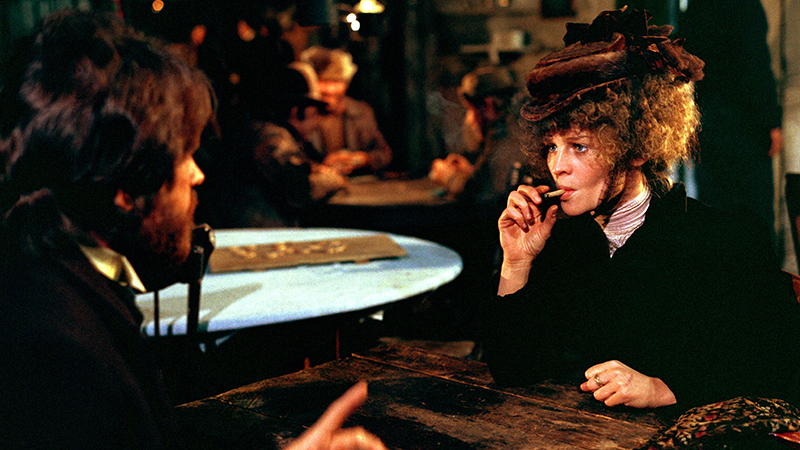
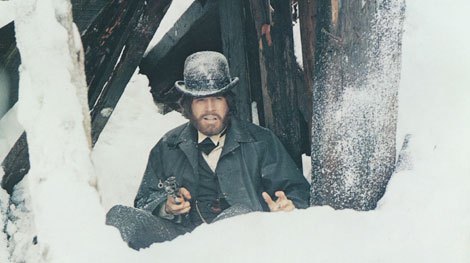
And this mood is very different from what you might expect from a Western. There is a distinct lack of glamour here. This world of Presbyterian Church is dirty, grimy and lacking in any moral fibre or real sense of right and wrong. The church itself is respected but largely ignored by the citizens, who are far more interested in drinking, screwing and gambling. When violence occurs it is ignored as much as possible or – as in the final shoot-out that ends the film – it happens around people so wrapped up in their own concerns (from domestics, to a large fire) that they barely notice it happening. Needless to say, for those in the fire fight, there are no rules to be played by at all. People are shot in the back, shoot down innocent bystanders, and play by no rules whatsoever, stalking and shooting opportunistically.

McCabe is a perfect hero for this very different kind of Western. As played by Beatty, he is a cocksure coward nowhere near as clever, confident or controlled as he thinks he is. Arriving in the town, he seems like the height of glamour in his bearskin coat, and he swiftly masters the simple townsfolk with his tall tales and charisma. However, the more people who intrude on this world, the more quickly it emerges that McCabe has very little clue about what is going on, is easily cowed and has only the barest understanding of how the world works. Meeting with a lawyer, one scene later he is parroting a (completely misunderstood) version of the law that he has heard from there. Meeting with the “muscle” from the corporation, he deflates like a balloon, desperately making offers hand over foot. Beatty is very good as this puffed up coward, confused and constantly living a front but out of his depth in the world.

Julie Christie’s Mrs Miller is far more worldly than him, immediately able to recognise the dangers and understanding exactly the sort of men McCabe is dealing with. Mrs Miller’s opium habit is a quietly understated obsession, one the other characters seem unaware of, but which the viewer alone seems to know about. It raises questions of course – is this meant to imply perhaps some of what we see is a drug induced fantasy? But it doesn’t impact otherwise the relationship she develops with McCabe, part meeting of partners, part a protective relationship with Miller guiding McCabe.
The rest of the cast is stuffed with a series of Altman regulars, all of whom deliver fine performances. The stand-out is Hugh Millais, an English writer making his acting debut, who is simply sublime as the articulate and ruthless chief heavy sent by the company to intimidate McCabe.

For the film itself, your enjoyment of it is largely going to be affected by how easily you plug into its style of storytelling. There is very little story for much of the first half of the film, instead events continue in a loose and undisciplined style, but the second half delivers a more focused story of ambition pushed too far, and culminates in an impressively filmed ruthless shoot out. It is perhaps more of a film that is about the atmosphere and the style than the story, but as a redeveloped Western that carries across the style of the grimy 1970s it works extremely well. At first I thought I would never get into it, but by the end I found myself wrapped up in the story it was telling. Visually and performance-wise it’s superb. Altman is an acquired taste, but acquire it and you will be richly rewarded. 

Coda: Much like The Long Goodbye I watched this film about a week ago at time of posting and I find myself thinking over several sequences in it again and again with ever more admiration. When watching it I felt it had been over promoted by critics. Now I increasingly think it might be something very special indeed.

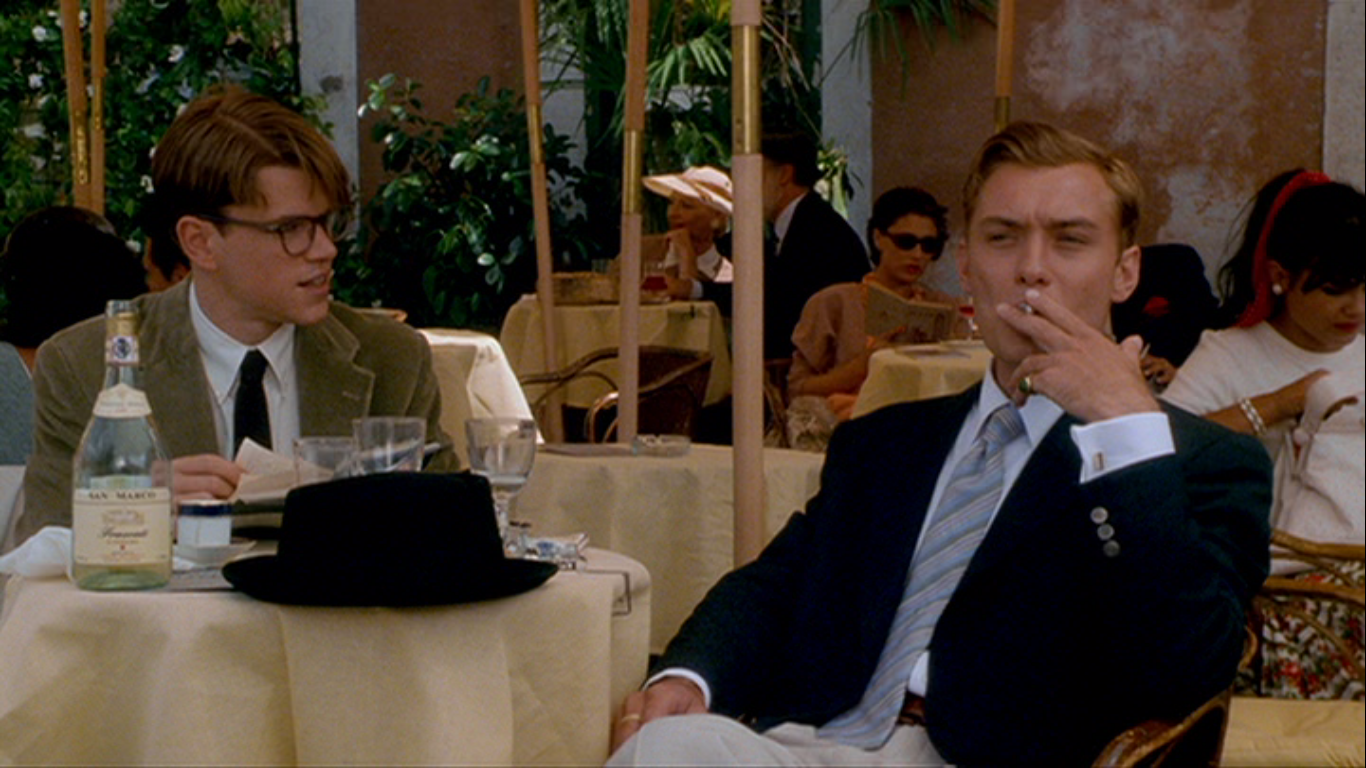
The Talented Mr Ripley (1999)

Matt Damon, Jude Law and Gwyneth Paltrow get wrapped up in murder and mayhem in The Talented Mr Ripley

Director: Anthony Minghella

Cast: Matt Damon (Tom Ripley), Gwyneth Paltrow (Marge Sherwood), Jude Law (Dickie Greenleaf), Cate Blanchett (Meredith Logue), Philip Seymour Hoffman (Freddie Miles), Jack Davenport (Peter Smith-Kingsley), James Rebhorn (Herbert Greenleaf), Sergio Rubini (Inspector Roverini), Philip Baker Hall (Alvin MacCarron), Celia Weston (Aunt Joan)

Patricia Highsmith’s Tom Ripley – sociopath, confidence trickster, human blank piece of paper and murderer – is so unknowable he’s been played on screen by actors as wildly diverse as Alain Delon, Dennis Hopper, John Malkovich, Barry Pepper and, perhaps most famously today, by Matt Damon. Ripley’s complexity – Highsmith described him as “suave, agreeable and utterly amoral” – and his general blankness and ability to adapt to different situations make him a challenging character to bring to the screen. Minghella’s film goes for a dark, Hitchcockian feeling drama that gives a lot of focus to feelings of sexual confusion and inadequacy in Ripley that motivate his actions and increasingly spiral out of control, leaving him isolated and damaged.

Tom Ripley (Matt Damon) allows himself to be mistaken by the owner of a shipping line, Herbert Greenleaf (James Rebhorn), as an old Harvard classmate of his son Dickie (Jude Law). Inveigling his way into Herbert’s trust, he is sent to Italy to persuade Dickie to return to America and take up a job in his father’s company. Happily taking the all-expenses-paid trip, Ripley finds himself besotted with the glamour and easy charm of Dickie, a handsome playboy, and soon positions himself as travelling companion to Dickie and his fiancée Marge Sherwood (Gwyneth Paltrow). But Dickie’s attention is only fleeting, and soon Ripley feels betrayed as Dickie starts to refocus elsewhere – leading eventually to Ripley murdering Dickie in a fit of jealous pique and using his faint resemblance to Dickie’s passport photo to assume his identity and live off his allowance – all the while dodging meeting Marge, friends of Dickie and the police (who are searching for the disappeared Tom Ripley).

Minghella’s film is a complex, psycho-sexual thriller, shot with a sun-kissed warmth that accentuates the glamour and style of the Italian Riviera, while subtly keeping us distant from the characters and their increasingly complex motives. The richness and lushness of these expensive lives look as appealing and seductive to us as Ripley finds them when he arrives. However, its dark undertone is never lost, and the film is edited and assembled with a certain chill and coolness while Gabriel Yared’s score mixes some fun jazz remixes with more a ominous tone as the bodies start to pile up.

I love a lot of Minghella’s work. He’s an intelligent and literate director, and the script he prepared for this film shows that he’s a master of taking complex, multi-layered pieces of fiction and turning them into something impressive and cinematic. But watching The Talented Mr Ripley, with its effective mix of period charm and sixties swing, its clever apeing of sixties filming styles, its riffing on Hitchcockian tropes and its picture book locations around Italy, part of me wonders if this film started pushing him too far down the path of being a “literary” director. His film is intelligent, and alternates between being chilling and fun, but at times it’s also wearing its “important film-making” badge a little heavily. It’s like the film is straining a little too much for prestige, as if the luscious design, complex plotting, sharp dialogue and clever visuals are aiming a little too much for matching The English Patient’s Oscar hoovering.

Maybe that’s why, despite everything that is good here, this film doesn’t have quite the same success as that film. This is, I’ll confess, an odd thing to say in a film that is generally very positive – if a little too long – but there it is. Sometimes these things are intangible in a way. Part of the film’s problem is that very complexity of plotting and motivation that he (arguably) builds on from the book. One of the film’s biggest question marks hangs over Ripley himself.

Imagined here as a slightly diffident, awkward, closeted graduate, he never really convinces as the kind of ruthless opportunist the plot demands him to be. Much as the film – and Damon’s performance – nails the sociopathic blankness of Ripley, his ability to switch smoothly from persona to persona, at the same time Ripley either seems to care too much or too little. Damon never quite convinces as a man so in love with the highlife that he is happy living off the allowance of (and pretending to be) the adored friend he bludgeons to death in a boat. 

This is where the homosexual undertone of the original has been converted into a overtone – and the film’s overplaying of Ripley’s physical, puppy-dog attraction to Dickie make him feel more dependent. The film works really hard to make him as sympathetic and vulnerable as possible, to make him a victim of his own warped circumstances and morality, and it never quite manages to make this make sense, or to carry real consistency. For all you feel Minghella wants us to think we are drilling into what makes a killer, the more we learn about Ripley the less substantial as a character he feels.

Damon, despite this, gives a good and generous performance. Generous because, playing quite a pathetic, indescribably blank man, he really manages to fade into the background of scenes. It does mean that he cedes most of the best work to his co-stars. Jude Law is radiantly cool, fiery, passionate, selfish and hugely attractive in a star-making turn as Dickie. Philip Seymour Hoffman is the epitome of a Bullingdon club bully turned young adult as Dickie’s school friend, seizing scenes with a louche aggressiveness. Cate Blanchett is equally brilliant as a warm, friendly socialite who inadvertently stirs terrible ideas in Ripley.

These actors are all highlights in a superbly mounted production, but one which doesn’t reveal or tell us as much as we might expect. Instead, Minghella gets slightly lost in his own intelligence when adapting the book, pushing the story into deeper, psycho-sexual motivations for its character that end up obscuring and fudging the actions he carries out in the film. It’s a gorgeous looking film, packed with wonderful scenes, but Damon’s Ripley seems too sensitive, too prone to the edge of tears, impossible to see as a man who could become a serial murderer. By giving a greater hinterland to Ripley, Minghella also changes the character fundamentally. It makes for an interesting development – but Ripley’s desperation, his essential weakness, his lack of control make him feel inconsistent with the setting and plot he is in.

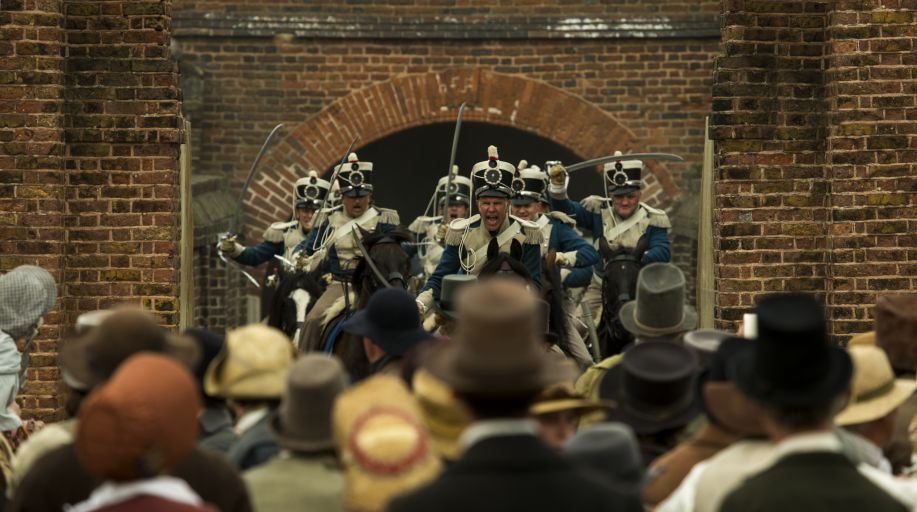
Peterloo (2018)

Mike Leigh’s passionate but dry, overlong film brings the Peterloo massacre to life

Director: Mike Leigh

Cast: Rory Kinnear (Henry Hunt), Maxine Peake (Nellie), Pearce Quigley (Joshua), David Moorst (Joseph), Rachel Finnegan (Mary), Tom Meredith (Robert), Simona Bitmate (Esther), Karl Johnson (Lord Sidmouth), Sam Troughton (Mr Hobhouse), Roger Sloman (Mr Grout), Alastair Mackenzie (General Byng), Neil Bell (Samuel Bamford), Lisa Millet (Jemima Bamford), Philip Jackson (John Knight), John-Paul Hurley (John Thacker Saxton), Tom Gill (Joseph Johnson), Lizzie Frain (Mrs Johnson), Ian Mercer (Dr Joseph Healey), Nico Mirallegro (John Bagguley), Danny Kirrane (Samuel Drummond), Johnny Byron (John Johnston), Tim McInnerny (Prince Regent), Vincent Franklin (Reverend Etlhelstone), Jeff Rawle (Hay), Philip Whitchurch (Colonel Fletcher), Martin Savage (Norris), Al Weaver (Hutton)

Perhaps one of the most pivotal moments in the struggle of the working classes to gain political and social rights was the Peterloo massacre of 16th August 1819, at St Peter’s Field in Manchester. At a meeting of over 60,000 people, officials ordered first the mounted yeomanry and then soldiers to attack and break up the crowd. At least 15 people were killed and hundreds more wounded, either from the indiscriminate sabre blows from the yeomen (probably drunk) and soldiers (unable to control the panic), or crushed in the frantic attempt to escape from the confined square. The immediate reaction from the authorities was praise at breaking up this “Bonapartist” piece of revolutionary nonsense. The lasting effect was condemnation of the brutality shown towards a peaceful demonstration and the massacre becoming a major cause celebre. It was ultimately influential in the passing of the Great Reform Act, which greatly extended the franchise and rebalanced much of Parliament (at this point so unbalanced by age old tradition that while some tiny hamlets returned MPs, the whole of Manchester had no representation).

It’s still an emotive subject for many today, and with this reverent film, overflowing with anger at the hypocrisy and injustice of the ruling classes, you can’t doubt that Mike Leigh and the makers of Peterloo are among them. But however sincere their personal passion about the subject is, what they fail to bring to the film is any real dramatic impetus to make us care. Instead this is an inert, over-long, often (if I am being completely honest) tedious film that takes nearly an hour to get going and then only offers flashes of dramatic interest before culminating in the massacre itself (very well shot and staged, but still itself a rather distant viewing experience).

 A large reason for this is the film is so reverential towards the campaigners for liberty, that the overwhelming majority of their scenes are given over to very good actors giving spirited renditions of actual speeches and pamphlets at a series of political meetings, shot with a reverent simplicity by Leigh. Much as it is can be interesting to hear quotes from things like this, by the time we are onto our twelfth political speech covering similar ground, delivered with another bout of fiery passion, you’ve started to glaze over. What we don’t get from many of these campaigners is any reason to really care about them – either as people or as part of a movement. Instead the film ends up like a cinematic Rushmore, carving their representations into celluloid for us to gaze up at in awe.

A similar fate befalls the working-class characters in the film, who are lacking any real character or story at all and whose main function seems to be to exist so we can experience both their misery and their awakening political awareness. Our main family is a group of mill workers, with Maxine Peake (does anyone do “hard-pressed working class stoicism hiding pain” better than Peake?) as the matriarch, welcoming her son home from Waterloo. These people talk at each other, quoting various current issues and bemoaning the hardness of living at a time of near universal poverty – but other than the fact that they are poor and suffering we are given very little reason to care for them. Like the rest of the working-class characters, they seem more like passengers in the film, meaning when the swords start flying, it’s actually very hard to get worked up as much as we should as members of this family are hacked down. 

The one exception in the entire campaign-side of the narrative comes with the introduction of “Orator” Henry Hunt, a prosperous middle-class man who became a famed agitator for working men’s rights. Wonderfully played, with a an air of arrogant grandiosity mixed with genuine commitment to the cause, by Rory Kinnear, Hunt shakes up the pattern the film settles into over its first hour. Acutely aware of his position as the nominal head of a national movement, Hunt has little patience (and even a touch of class-based distance) from the mostly lower middle-class campaigners he mixes with in Manchester (while never being anything less than scrupulously polite), and his fish-out-of-water awkwardness around them raises several laughs (the only ones of the film). Scenes in which he imposes his own conditions on the internal politics of the Peterloo meeting (who will speak, who will be on the podium, will there be weapons in the ground) not only feel more real than anything else we’ve seen in the film, but they are also far more entertaining and engaging than anything else connected to the massacre’s build-up.

Leigh was perhaps so hidebound by wanting to honour the men who campaigned for liberty that, other than with the larger-than-life Hunt, he seems too restricted dramatically – as if adding too much of that essential for drama, conflict, would somehow undermine them. Ironically he has far greater freedom with the authorities – and the film’s more engaging sequences (outside of those with Hunt) are all based around the arguments, clashes, plots and fury of the various levels of authority in the country, from the corpulent Prince Regent through the Home Office to the local magistrates.

The film gets more juice from its righteous anger at the unfairness, arrogance and hypocrisy of these men than it does from almost everything else. It also gives the actors playing these roles far more to work with. Karl Johnson stands out as a stammering but adamantine Home Secretary Lord Sidmouth, paternalistic but totally unwilling to budge an inch. The real stars, however, are the magistrates we follow in Manchester, each introduced trying a trivial case (drinking an employer’s wine, an argument over a watch, stealing a coat) with ludicrous hard-line punishments (flogging and imprisonment, transportation and execution respectively). Played with a lustful relish by Philip Whitchurch, Jeff Rawle, Martin Savage and most expressively of all Vincent Franklin (who nearly goes too far with the lip smacking, until a scene later we see even the Home Office officials eagerly reading his latest dynamite dispatch with a barely suppressed chuckles at his OTT rhetoric), these characters argue the fine points of law and lustily denounce the working classes with such fire and energy that you conversely get more wrapped up in their scenes than almost anything else in the film. Maybe Leigh felt he had greater freedom to create characters and drama here, but it does feel unbalanced.

All that said, the massacre itself when we reach it is brilliantly staged, immediate, deadly, meticulously reconstructed and filmed with a documentary anger at its brutality. You can sense the creeping tension throughout the film and the explosion of violence afterwards, for all the problems of the film, is genuinely horrifying. In fact it wraps you up so much, I wish the film had dealt more with the aftermath of the clash (there is a very good scene as stunned journalists walk St Peter’s Field with horrified fury) and the impact it had, rather than the film wrapping up swiftly with funeral of one of its working-class characters (it’s not a surprise which one).

But then that’s part of the whole film’s problem. It feels like a missed opportunity. It’s a stately civics lesson, a film that hammers home the importance of what it is presenting to you, but never really gives you a reason to invest in the real stories and passions behind the history. Instead it presents everything as important, because it is, rather than making it important to us. It feels at the same time a film that is preaching to the choir who already know this history back-to-front, and also a dry history lesson introducing it to a new audience. Either way it fails. Despite one or two good scenes, a dull, underwhelming, preachy disappointment.

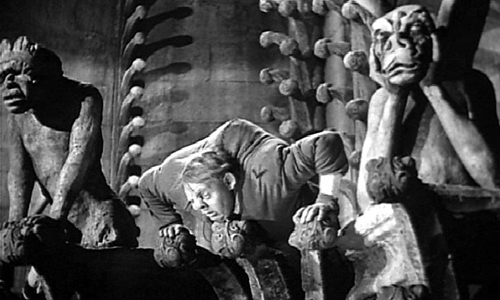
The Hunchback of Notre Dame (1939)

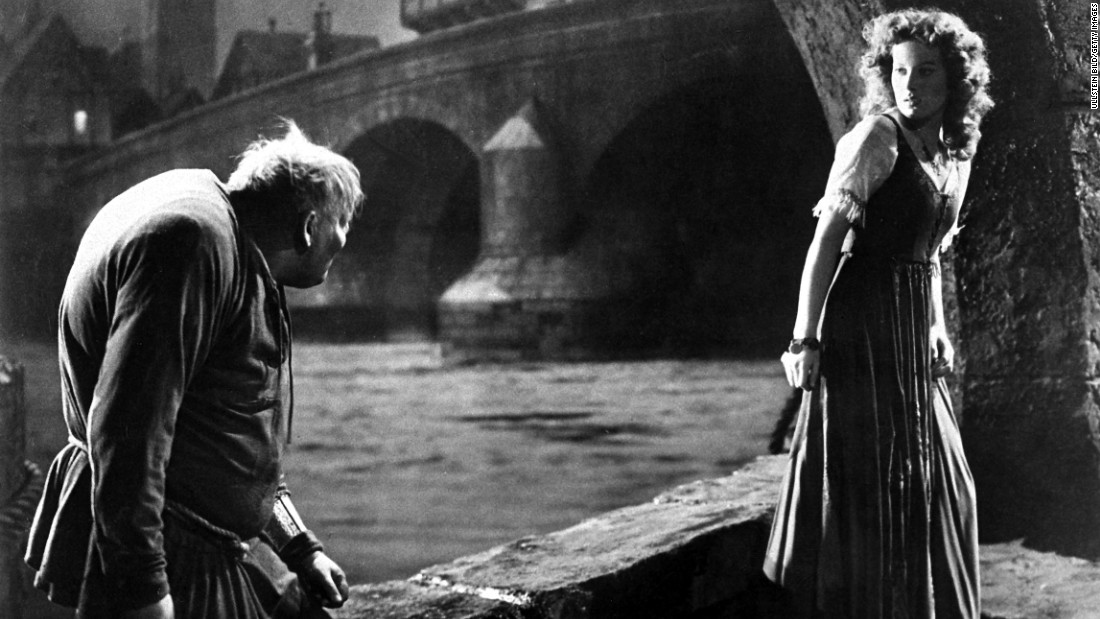
Charles Laughton looks on with longing as The Hunchback of Notre Dame

Director: William Dieterle

Cast: Charles Laughton (Quasimodo), Cedric Hardwicke (Jean Frollo), Thomas Mitchell (Clopin), Maureen O’Hara (Esmeralda), Edmond O’Brien (Pierre Gringoire), Alan Marshal (Captain Phoebus), Walter Hampden (Archbishop Claude Frollo), Harry Davenport (King Louis XI), Katherine Alexander (Madame de Lys), George Zucco (Procurator)

Victor Hugo’s gothic romance–slash-tragedy has been turned into a film so often, it’s a wonder anything that happens in it remains a surprise. But this 1939 version is perhaps the most influential, where Hollywood decided to throw money at the fable and try and make something as close as possible to the spirit of the book. But of course with a happyish ending on the end – because, you know, it’s still Hollywood!

In 1470s Paris, the city is caught between the pressures of religion and new developments such as the printing press. In the centre of the city is the Cathedral of Notre Dame – where the bells are operated by foundling Quasimodo (Charles Laughton), a deformed hunchback driven deaf by the constant ringing of the bells. His benefactor, Judge Jean Frollo (Cedric Hardwicke), is running a vicious campaign to cleanse the city of the gypsies and beggars that make up a large part of its underbelly – but he’s hit for six when he falls in love (or rather lust) with beautiful gypsy woman Esmeralda (Maureen O’Hara). But he’s not alone – equally smitten are naïve young poet Gringoire (Edmond O’Brien), arrogant Captain Phoebus (Alan Marshal), and Quasimodo himself. When Esmeralda rejects Frollo’s advances she soon finds herself in danger – and her only hope of safety comes from unexpected sources.

Dieterle’s background in German expressionism and silent cinema shines through in this visually striking and opulent studio production, with its superbly marshalled crowd scenes, brilliant use of near-impressionistic shadows and fabulous camera work that drifts over the impressive (and hugely expensive) set. Dieterle mixes this technical expertise with a real sense of emotion and character development, helped by some terrific performances from the cast. It’s a film that motors through the story of the novel, but skilfully repackages it as both a fascinating semi-romance and a sort of urban tragedy, as well as a subtle mediation on love and lust.

At the centre of it, you have Charles Laughton giving probably the definitive performance of the hunchback. Sweating under layers of make-up and an artificial hump, Laughton is nearly unrecognisable as the bell-ringer. His triumph is to make a gentle, tragic character emerge from make-up that suggests more Frankenstein’s monster than tragic hero. Nearly wordless for the first hour and a half of the film, Laughton does his magic with an expressiveness that speaks volumes of the loneliness in Quasimodo. Tenderly, he watches people knowing he can never be part of their lives – and look how excitedly he bursts out when he finally gets a chance to speak to Esmeralda one-on-one. Suffering punishment on the wheel, Laughton’s eyes convey the numb acceptance of pain as his natural state of affairs. But he also manages to bring out the gentle, childlike qualities of Quasimodo. It’s a wonderful, wordless, expressionistic performance – a triumph of physical acting and wonderfully judged emotional vulnerability.

The rest of the cast match Laughton stride-for-stride. Censor demands at the time required that Frollo be removed from his position (in the novel) as Archbishop, so the book-version of the character is split in two here. Archbishop Frollo is the sort of pious bore who can keep the Hayes committee happy. But Cedric Hardwicke gets to play the invented evil brother Judge Jean Frollo, the lecherous hypocrite from the novel. An authoritarian ascetic, Hardwicke’s Judge Frollo is lean, mean and utterly ruthless – and totally in denial about both his lustful feelings and hypocrisy. Hardwicke is virtually an archetype of the sinister authoritarian, but he manages to never chew the scenery. Incidentally, knowing the two characters are basically split from the original book, does allow moments of fun imaging the moral debates between the two as a sort of split personality discussion.

But there are plenty of other good performances as well – not least from Maureen O’Hara, who is charming and engaging enough to make you believe that the whole male cast is in love with her. Edmond O’Brian goes large at times with the passionate romance, but he does a very good job in the role. Thomas Mitchell is good value as the leader of the beggars, Clopin. There are strong performances across the whole film.

All these performances are framed within a fabulous design. The trouble and expense that has gone into the construction of the set is inspiring, the sweeping gothic arches and towers giving every shot something exquisite to look at. It also gives never-ending options for camera placement and impressionistic imagery for Dieterle. It works as well – the gloomy, imposing towers of Notre Dame are captured with real artistry, while the shadow it casts over the whole city of Paris serves as a constant reminder of the oppression the city lives in.

Dieterle also brilliantly films the crowd scenes, getting a superb sense of visceral emersion from these sequences. Whether the camera is in the mix, or flying above the crowds from the tops of Notre Dame, these scenes look equally fantastic. Dieterle handles the more action-related scenes with particular skill – Quasimodo’s rescue of Esmeralda from a death sentence is particularly well staged in its dynamism and graceful filming. 

Not every beat works. The portrayal of Louis IX as a sort of kindly old uncle seems off-piste from the very start. The early sequences sometimes get bogged down too quickly in set-up rather than getting into the action. Alan Marshal is rather wooden as Captain Phoebus, although the film goes surprisingly far in suggesting the dark desires and predatory sense of danger that comes from the character. Some of the beggar court sequences get similarly stuck in kitsch.

But these are minor beats. It’s a film that really understands emotions and makes the dramatic thrust work. It also has a dark sexual power, not least in Hardwicke’s Frollo: a seething mess of frustrated desires. It never loses sight of the sadness at the heart of its central character’s story, of his loneliness and isolation, and manages to communicate this brilliantly in every scene where the character appears – he is trapped by his muteness, his ugliness or his sadness at every turn. It’s a development that never fails to be engrossing and finally moving. It’s a film that is brilliantly assembled with real technical skill, very well acted and wonderfully directed.

Outlaw King (2018)

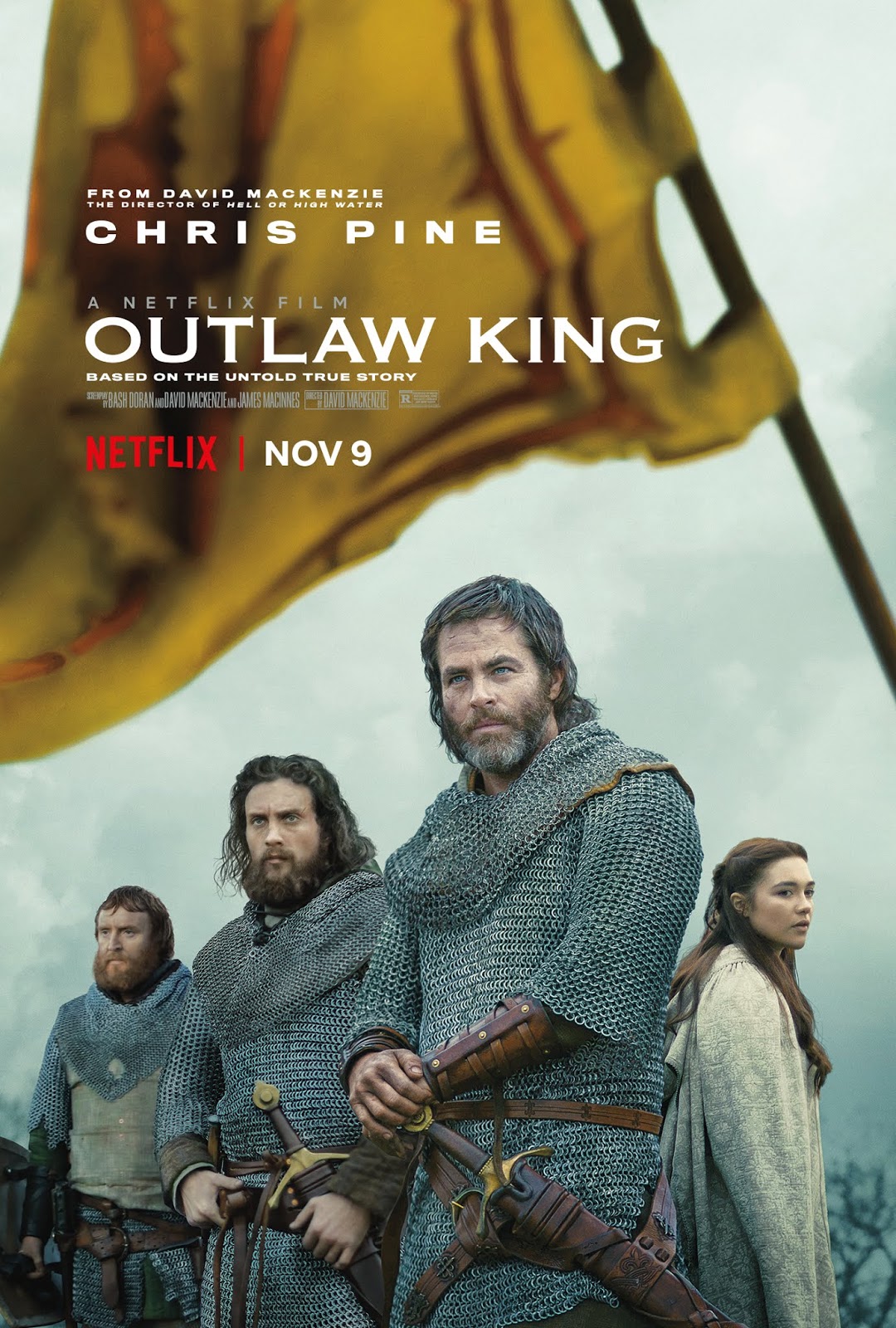
Chris Pine leads Scottish rebellion in Netflix’s Outlaw King

Director: David Mackenzie

Cast: Chris Pine (Robert the Bruce), Aaron Taylor-Johnson (James Douglas), Florence Pugh (Elizabeth de Burgh), Stephen Dillane (Edward I), Billy Howle (Edward II), Tony Curran (Angus Macdonald), Sam Spruell (Aymer de Valence), Lorne Macfadyen (Neil Bruce), Alastair Mackenzie (Lord Atholl), James Cosmo (Robert de Bruce), Callan Mulvey (John Comyn)

In 1995 the world went crazy for Mel Gibson’s Braveheart, which turned William Wallace from a largely forgotten historical rebel into a martyr for independence. Outlaw King is an almost spiritual sequel that follows the life of Robert the Bruce, the eventual winner of Scottish independence. It picks up almost immediately from the death of Wallace and follows the struggle of the Bruce to take the throne. But I’d be surprised if it has the same impact.

Outlaw King is a fairly decent pick-up of events, and it tries to get a balance between drama and history – one it more or less manages until the final act. In the aftermath of a failed Scottish rebellion, Robert the Bruce has the advantage of his father (James Cosmo) being an old friend of Edward I (Stephen Dillane). After renewing his oath of loyalty to Edward, Robert is given land, influence and a marriage to wealthy noblewoman Elizabeth de Burgh (Florence Pugh). However, after his father dies regretting the pact and William Wallace is brutally executed by the English, Robert uses the public outrage as a boost to putting together his own claim to the Scottish throne. Murdering his chief rival in a church, he raises the flag of rebellion against the English and leads an army to take back Scotland. But things swiftly go wrong, and Bruce finds himself on the run and declared a rebel.

Outlaw King gets a lot right. It’s impressively filmed and looks fantastic. The photography by Barry Ackroyd is wonderful, in particular the use of candles for interior scenes which bring a brilliant golden glow to the action. Mackenzie is an ambitious and imaginative director, and he pushes himself to the limit here. The opening nine minutes of the film is one long continuous shot that takes in debate, a sword fight, court room intrigue and the firing of the largest trebuchet you are going to see outside of Warwick Castle. With the camera swaying and bobbing around in this sequence you have to admire the chutzpah – even if I can see that some viewers (my wife included!) might think it showing off. 

Mackenzie gets equal flourish out of the film’s many combat scenes. There is, to tell the truth, probably one too many of these bloody melees, but the camera gets a real sense of the blood, mud and gore that medieval battle involved. With brilliant use of hand-held immersive camerawork, each of these battles really gives you a sense of bloo-spattered chaos. Sometimes things are hard to follow – at least one death in combat is met with fury, but I’m not entirely sure who that guy even was (and it’s never mentioned again). But you’ve got to admire the skill of the film-making.

It’s the story itself where the film sometimes falls a bit flat. It does get a really good sense of the medieval, I will certainly give it that. The design and attitudes of the film are pretty perfect, and the stakes that everyone is clashing for feel very real. But the film encounters problems more and more as the film drifts into fiction and away from history. While the realpolitik of Bruce’s move to have himself declared king has a ruthlessness that feels real, the film’s attempt to build a personal rivalry between Bruce and the future Edward II feels forced from the start. By the time the film’s conclusion attempts to boil the entire campaign for Scottish independence into a mano-a-mano clash between the two on the battlefield (that of course never actually happened) you start to feel it’s getting very silly. Not least as figures who in real life would be invaluable bargaining chips are allowed to walk free from the battle field, to demonstrate the moral superiority of our heroes.

It’s a part of the general drift of the storyline that gets a little less compelling the longer it goes on. Maybe this is because once Bruce has his initial army destroyed and his first campaign to grasp power defeated, the story of him being on the run and carrying out guerrilla hits never feels fresh and original. We’ve seen it before – and the way the film generally avoids developing the supporting characters fully often means your focus starts to shift. After a really strong start, the film becomes more and more generic, Bruce himself becomes more and more a perfect leader rather than the almost Machiavellian character he started as, and the focus turns more and more into making it a conventional goodie-vs-baddie clash. It becomes something more forgettable, more like something you’ve seen before, and turns a campaign that took almost ten years into a rushed “and then they won this battle and everything was fine” ending.

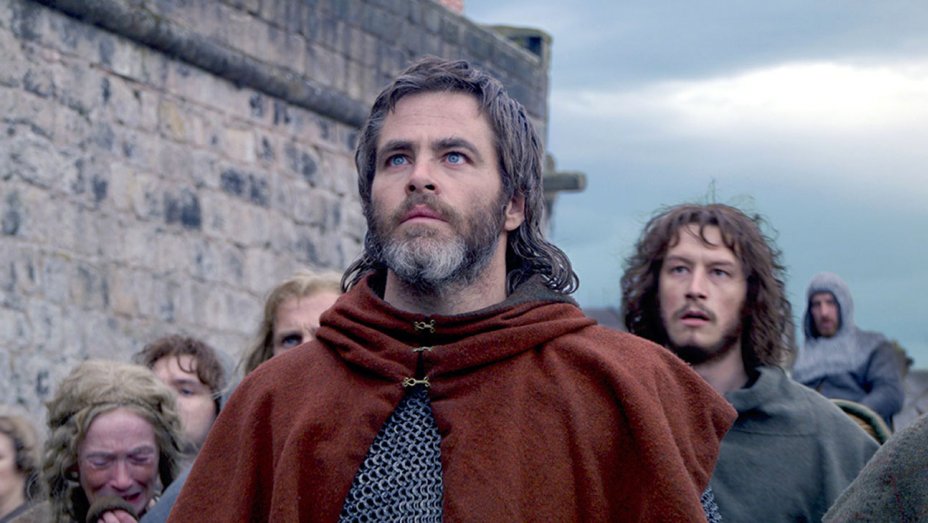
There are many strong moments in there though, not least the generally decent performances from the cast. Chris Pine as Robert the Bruce sounds like the sort of casting decision made in hell, but he actually handles himself very well. His accent is very good, he captures a lot of the complexity of Bruce as a man who wants to be good but must sometimes be ruthless, and he brings a large dollop of charisma to the role so that you never really find yourself questioning whether he is a man others would follow. He doesn’t set the world alight, but does a good job.

The film’s stand-out turn however comes from Florence Pugh, who brings her customary intelligence and charisma to the complex part of the Bruce’s wife. At first positioned into an arranged marriage, she quickly proves both her independence and value, but also her strength of character. Far from being just a hostage – the role history largely assigned her – Pugh’s performance always makes her a character with agency, a woman determined enough to be loyal to the end once she has made her choices. There are other decent performances as well, in particular from Stephen Dillane as an authoritarian hard-ass Edward I, while Billy Howle gets to a play an Edward II who feels true (the film avoids references to his homosexuality, but does allow him to be the fearsome warrior – if hopeless general – he was, as opposed to the homophobic cartoon he was in Braveheart).

Outlaw King,though, just isn’t quite good enough. It’s fine for a decent watch on a Saturday night. In fact Netflix is just about its perfect platform: if you stumbled across this while scrolling through the library, and you were in the mood to click on it, you wouldn’t be disappointed. But even though it’s visually impressive and enjoyable, it’s also increasingly predictable and even a little bit empty. It doesn’t quite come to life as much as it should and eventually settles for being something quite traditional.

The Core (2003)

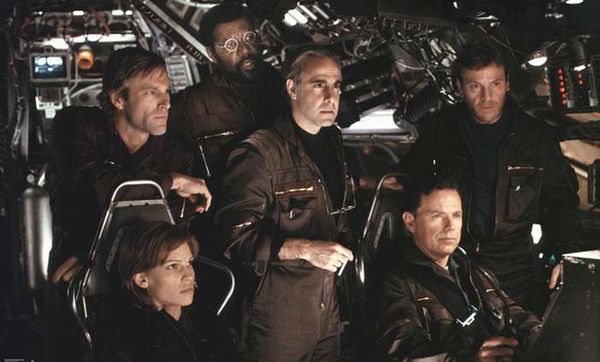
The Only Way is Down for our heroes in super silly Sci-fi disaster The Core

Director: Jon Amiel

Cast: Aaron Eckhart (Dr Josh Keyes), Hilary Swank (Major Rebecca Childs), Delroy Lindo (Dr Edward Brazzleton), Stanley Tucci (Dr Conrad Zimsky), Tchéky Karyo (Dr Serge Leveque), Bruce Greenwood (Commander Robert Iverson), DJ Qualls (“Rat”), Alfre Woodward (Dr Talma Stickley), Richard Jenkins (Lt General Thomas Purcell)

Dr Josh Keyes: “Even if we came up with a brilliant plan to fix the core of the Earth, we just can’t get there”

Dr Conrad Zimsky: “Yes, but – what if we could”

If you have any doubts about the type of film you are going to watch, then that tongue-in-cheek dialogue exchange (and the words can’t capture the playful, I-know-this-is-crap wink that Stanley Tucci tips practically to the camera) should tell you. The core of the Earth has stopped rotating. Which basically means all life on Earth is going to end in the next few months. Unless, of course, we can restart the rotation of the Earth’s core. So time to load up a team of crack scientists into a ship-cum-drill, made of metal that doesn’t buckle under pressure (this metal is, by the way, literally called unobtainium by the characters) so that they can sprinkle nuclear bombs through the centre of the Earth to kickstart the rotation of the planet and blah, blah, blah.

It’s perhaps no surprise that The Core was voted the least scientifically accurate film ever made by a poll of scientists about 10 years ago. Nothing in it makes any real sense whatsoever, and it’s all totally reliant on the sort of handwave mumbo-jumbo where you can tell getting an actual logical explanation was going to be far too much hard work, so better to roll with a bit of technobabble and prayer. Questions of mass, physics, pressure are all shoved aside. The film sort of gets away with it, with a leaning on the fourth-wall cheekiness – no fewer than three times in the film the impossible happens with a “what if we could” breeziness, as a character pulls out a theory or discovery with all the real-world authority of the fag-packet calculation.

But then scientific accuracy is hardly why we watch the movies is it? And this is just a big, dumb B-movie piece of disaster nonsense, which throws in enough death-defying thrills, predictable sacrifices and major landmarks being wiped out topside to keep the viewer entertained. In this film Rome and the Golden Gate Bridge both get taken out by spectacular disasters. Beneath the surface, the characters go through the expected personality clashes and learn the expected lessons.

The script (most of which is bumpkous rubbish) really signposts most of this personal development. Will Zimsky and Brazz rekindle their respect and overcome decades of rivalry? Will Serge, on the mission to save his wife and kids “because it’s too much to think about saving the whole world”, have to pay the ultimate sacrifice? Will Major Childs finally get the courage and determination to take command and make the hard calls? I won’t tease the fate of Mission Commander Bruce Greenwood, but he is called upon so often to reassure Childs that one day she will be ready to take command, alongside other mentoring advice, that the only surprise is that he lasts as long as he does.

So why is hard to not lay into The Core? Because, not that deep down at its core, it knows it’s a silly film. The script has enough awareness of its cliché and scientific silliness that it almost doubles down on it. And the actors play it just about right: for large chunks of it they perfectly hit the beats of sly archness that suggest just enough respect to not take the piss, but enough self-awareness of what they are making. But these are all very, very good actors and when the serious moments come, it’s remarkable how much they can shift gear – with the grisly death of one character (while the others powerlessly try and save him) played with an almost Shakespearean level of tragedy by a distraught Eckhart and Lindo. Later, as three characters juggle over who will go on a suicide mission to keep the mission on track, the bubbling emotions of shame, relief, pride, respect and buried affections are genuinely rather affecting. Its moments like this that makes me kind of love this big, dumb, stupid film.

But it remains stupid. Topside, Alfre Woodard and Richard Jenkins bumble through roles they could play standing on their heads. A hacker – Rat – is as clichéd and full of techno-nonsense as any of the science, which is even more painfully obvious to us now that we’re all so much more tech-savvy than we were in 2003. Events happen because, you know, they can. Discoveries and scientific conclusions are made because the script needs them. But the film knows this, it doubles down on it and it accepts that every problem is just a “But what if we could!” away from being solved. Stupid, but strangely loveable.

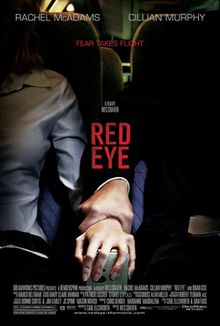
Red Eye (2005)

Rachel McAdams is on the flight to hell with only Cillian Murphy for company in Red Eye

Director: Wes Craven

Cast: Rachel McAdams (Lisa Reisert), Cillian Murphy (Jackson Rippner), Brian Cox (Joe Reiset), Jayma Mays (Cynthia), Jack Scalia (Charles Keefe), Robert Pine (Bob Taylor), Teresa Press-Marx (Marianne Taylor)

Are there any two things in the world we are more unsettled by than plane flights and the possibility that the strangers we meet might turn out to be nutters? Well Red Eye taps into both of those terrors with an effective B-movie of fast-paced brutality, which plays out almost in real time. Lisa Reisert (Rachel McAdams) is catching the red eye flight home to get back to her job managing a five-star hotel in Miami. At the airport bar she meets handsome, charming stranger Jackson (Cillian Murphy), and then finds herself sitting next him to on the plane. Just as things seem to be going well for romance, Jackson reveals he’s a terrorist and he wants Lisa to change the room booking of the Director of Homeland Security so his team can take him out – and if she says no, hitmen will take out her beloved father Joe (Brian Cox). But there may be more to Lisa than Jackson bargained for.

Craven’s film is an extremely efficient, sharp, lean little thriller with a cracking idea at its heart. It’s such a whipper cracker of an idea – the stranger on a plane who turns dangerous – that once the claustrophobia of the flight is removed in the final quarter, the film never quite gets its energy back. It’s Lisa’s mid-flight powerlessness, the self-contained, claustrophobic lack of escape, that makes the first three quarters of the film so compelling. Because as soon as Lisa realises that there is something wrong, there is nothing she can do and nowhere she can go to escape. And Jackson has manoeuvred the situation so she looks like the untrustworthy, awkward one while Jackson seems (outwardly) reasonable and friendly – cutting off any chance of help from fellow passengers.

These sequences in the plane work so well because they are so tightly directed, written, edited and played. Rachel McAdams is very good as a woman who at first seems self-occupied and slightly distant, then weak and vulnerable, before becoming resourceful and courageous. She’s well matched by Cillian Murphy as the smooth, in-control terrorist who begins to crumble as his plans turn against him.

It’s another decent structural twist in the film as it’s Rippner’s own arrogance and pride that eventually proves his undoing, as he drops enough information amongst his hubristic brags and threats for Lisa to work out how she can gain the upper hand. Before that she already shows plenty of invention to try and communicate her situation to the other passengers – and the tension of these cat-and-mouse games of evasion is portrayed perfectly.

It’s not a perfect film. The final quarter too quickly turns Murphy’s character into a psychotic version of his near namesake, Jack the Ripper, while the final cat-and-mouse hunt between these two characters in a new location doesn’t have the same tension as the plane setting. Similarly, the plot hinges on McAdam’s character falling victim to a past sexual assault – and how that event has shaped her later life – that today seems a little uncomfortable in its perfunctory treatment in the story. But these are blemishes – Red Eye is largely a sleek little thriller that makes its points with a nail-biting B-movie meanness. Craven sure knew how to put something like this together.

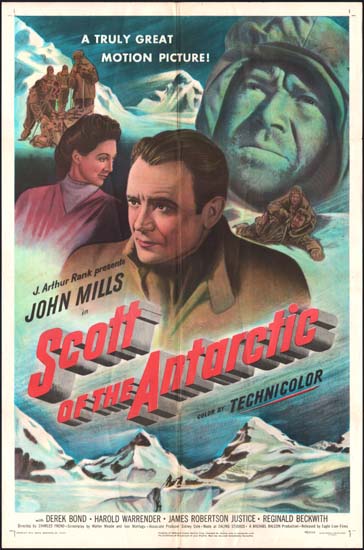
Scott of the Antarctic (1948)

Scott of the Antarctic (1948)

Captain Scott’s tragic end is bought to life with low-key hero worship

Director: Charles Frend

Cast: John Mills (Robert Falcon Scott), Diana Churchill (Kathleen Scott), Harold Warrander (Dr Edward Wilson), Anne Firth (Oriana Wilson), Derek Bond (Captain Laurence Oates), Reginald Beckwith (Lt Bowers), James Robertson Justice (PO “Taff” Evans), Kenneth More (Lt Teddy Evans), Norman Williams (William Lashly), John Gregson (Tom Crean), James McKechnie (Dr Edward Atkinson), Barry Letts (Apsley Cherry-Gerrard), Christopher Lee (Bernard Day), Clive Morton (Herbert Ponting)

There are perhaps few more controversial figures in historical discussion than Robert Falcon Scott. The great polar explorer was, for most of his career, and for a long period after his death in 1912, a national hero, the man who – with stiff-upper-lip bravery – gave his life struggling against the elements to conquer the South Pole. Scott’s reputation only began to be questioned in the late 1970s, with a series of biographies culminating in a near-vicious – but compelling – anti-Scott argument laid out by Roland Huntford in his book Scott and Amundsen. Scott’s many flaws – both personal and in planning – set a new landscape for seeing his achievements as carrying too high a cost, especially in an atmosphere where the extreme sacrifice was seen as something to be avoided if at all possible, rather than an everyday fact of life for post-war generations.

In this context, watching this Ealing Studios 1948 Scott biopic – one of the biggest box-office hits of its year in the UK – is an interesting experience. While the film’s tone and its depiction of Scott are essentially fairly heroic, the film flirts at points with the errors and misjudgements that led to Scott leading himself and his companions into an icy immolation in a tent eleven miles away from a depot that could have given them a chance to survive.

Frend’s film is very well made and beautifully shot – so perfectly does it capture the look and feel of the Antarctic, and the extreme cold, that you overlook the fact that at no point can you see the actors’ breath – and it covers the main points of the expedition very well. It’s in some ways, today, almost hilariously stiff-upper lip, with the expedition members marching dutifully (and with a self-deprecating smile) to certain death, and the ladies at home speaking with such cut-glass primness you have to keep checking that Celia Johnson isn’t in the film.

There are some strong performances, not least from Mills (a very close physical likeness for Scott himself). Mills was the perfect choice for this role –overflowing with a sense of duty, but with a slight edge of idee fixe pride where it’s clear that he’s not willing to budge from anything to do with his mission. Harold Warrander also makes a strong impression as an artistic spirited scientist, Dr Wilson, who quietly hides his premonitions of disaster and later feelings of regret due to a sense of personal loyalty to Scott. Reginald Beckwith, James Robertson Justice and Kenneth More also give decent performances.

But the main appeal is the glorious technicolour look of the film. The film used no fewer than three photographers and brilliantly mixes together painted backdrops, studio locations and some genuine location footage with skilful and glorious aplomb. The technicolour tinge to the shots is wonderful – watching it in high definition, it’s like a series of polar expedition photos brought skilfully to life. The film in fact apes several of the famous photos from the expedition with such beauty that you feel like they could be printed and framed.

The plot however is more concerned with checking off the events of the expedition – from its conception, through its financing and recruitment, initial excursions and the final (futile?) march to the pole and the death march home. Frend’s film is clearly largely intended to be hagiographic – the men are by-and-large totally committed to the journey, there is nary a cross word between them, and the film never really questions the point or purpose of the journey – or if it was worth the lives of five men to achieve it.

However, there are moments where the film leans towards a more interesting criticism of Scott’s planning and leadership. The funding campaign is largely a disaster, bailed out only by a last minute donation. Scott ignores advice from famed explorer Nansen to take dogs (man hauling is of course more noble) and places far too much faith in motor sledges (he is shown ruefully staring at one after it breaks down). Equipment – not least the vital fuel canisters kept at depots – is shown to be inadequate. The dogs perform extremely well – far better than the horses. The film doesn’t avoid the grisly fate of the horses either – I’ve never understood Scott defenders who claim it would have been cruel for Scott to take dogs to the pole, but never question the working to death and shooting of ponies in conditions they were totally unsuited for. 

The film skirts around the moral responsibility Scott bore for the death of the men who entrusted their lives to his planning. It does show – faithfully – the final depot being placed one degree less further south than originally planned (a shortfall that would contribute heavily to dooming the men later on). But as first Evans then Oates pass away, the film focuses on the tragic loss rather than the planning, preparation and “cut to the wire” contingences Scott was working with that contributed to this (not least his last minute decision to expand his polar party to five from the original number of four, sending three men back to base – with all rations and provisions having been packaged for two teams of four). 

The film is less interested in this, more keen on showing the heroic progression of events. It gives us moments, but the main purpose of the film is to sing the praises of Scott. This means, for me, the film becomes more and more deficient as time goes on and the histographical debate around Scott becomes all the richer and more engaging. For all the qualities of the film itself technically, it doesn’t have anything to contribute towards this and just offers up the straight printing of the legend.

For me, by the way, Scott is almost the ultimate expression of Edwardian amateurness, taking on the most challenging environments of the world with a superb confidence in a “special role” for the British in history. While Huntford’s personal dislike for Scott stings too much, there are legitimate points to be made about Scott’s poor planning, his obsessive disregard for learning from his mistakes and his refusal to engage with or embrace the sort of Inuit techniques that Amundsen learnt from. And, at the end of the day, while you could say Scott was unlucky compared to Shackleton, whose equally disastrous expedition at least saw all his men return alive, the fact remains that Scott’s old-school, old-fashioned, Britain-shall-prevail-attitude led not only to his own death but the deaths of four other people in hellishly cold conditions thousands of miles away from their families. Say what you like for his bravery, but don’t forget the price that others also paid for it.

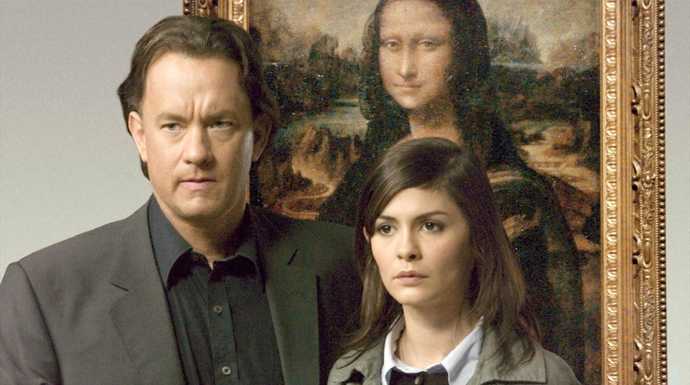
The Da Vinci Code (2006)

Tom Hanks and Audrey Tautou stumble through the dire The Da Vinci Code, possibly one of the dullest films ever made

Director: Ron Howard

Cast: Tom Hanks (Robert Langdon), Audrey Tautou (Sophie Neveu), Ian McKellen (Sir Leigh Teabing), Jean Reno (Captain Bezu Fache), Paul Bettany (Silas), Alfred Molina (Bisoph Aringarosa), Jürgen Prochnow (André Vernet), Étienne Chicot (Lieutenant Jérôme Collet), Jean-Yves Berteloot (Remy Jean), Jean-Pierre Marielle (Jacques Saunière)

In 2003 the world went a little crazy. Maybe it was all the buzz of conspiracy that seemed to be everywhere. Maybe people wanted a bit of escapism from the misery of our post-9/11 world. Or maybe there is just no accounting for taste. But inexplicably, a staggeringly poorly written thriller by a hack author, peddling a tired old conspiracy, became one of the most popular books of all time. Yup, ladies and gentlemen, it was a time of silliness, paranoia and poor taste. It was the time of The Da Vinci Code.

When the curator of the Louvre (Jean-Pierre Marielle) is found dead in the museum, with his body covered with bizarre self-inflicted wounds and symbols, visiting Professor of Symbology from Harvard Robert Langdon (Tom Hanks) is called in to consult. Langdon quickly finds himself the main suspect and on the run, aided only by the victim’s granddaughter Sophie (Audrey Tautou in a truly thankless part of continual question asking, devoid of any agency). Following a trail of bizarre clues, Langdon ends up investigating a conspiracy that leads to the heart of the Catholic Church – could the Church be founded on a lie? Could Jesus Christ have in fact been married to Mary Magdalene? Could she have been his intended heir? Did she have a child? Has a secret society run (at various times) by the Knights Templar, Leonardo Da Vinci and Isaac Newton worked since the dawn of time to protect the secret? Of course they haven’t, but that’s not going to stop the film.

Okay let’s get the main event out of the way. This is a terrible film. But it’s not terrible for the reason you might think. I mean, sure, it’s poorly scripted bobbins, with poorly developed ciphers for characters, and it peddles a conspiracy theory which is total, illogical nonsense from top to bottom. But that’s not the main reason. The main reason this film is terrible is that it is so unbelievably fucking boring.

The film is an utterly faithful, practically scene-by-scene reproduction of Dan Brown’s book. And it immediately reveals how little Brown knows about how to write a good thriller. The film has two or three action “set pieces” or moments of tension – at least, they would be tense, if only there were any stakes to the situation, or the characters’ motivations or the peril they’re in made the slightest bit of sense. They don’t. You’ll barely remember the car chase, or any of the moments where the heroes are held at gunpoint. None of the characters have any definable personalities, other than what they are invested with by the actors playing them. But then that’s no surprise from a novel where the lead character is defined solely by being brainy, having a Mickey Mouse watch (such a character!) and (film rights pleading ahoy) looking like Harrison Ford.

Just like Dan Brown’s turgid original, this film quickly turns into a series of scenes where characters fling exposition at each other to whizz us through a series of sub-par brainteasers and anagrams, which are only solvable with information the characters have but the audience doesn’t (hardly making it a fun thing to play along with). You’ll find yourself wishing for those anagrams back though, once they move on to spunking the novel’s bizarre conspiracy theory into our ears. The low point of this is when Ian McKellen’s polio-suffering billionaire historian (a billionaire historian! Who has a private plane! Of course he does…) tees up a handy PowerPoint presentation he just happened to have sitting around ready, and regurgitates all the mystic mumbo-jumbo that the film tries to pass off as fact.

I’m sure I don’t need to recap the nonsense of this film, but seeing it boiled down from the book is a real reminder that Brown clearly read widely but with no depth. For starters, most of his understanding of everything from the church, to the Templars, to the history of Europe is bogged down in inaccuracy and misinterpretation. By the time the film is claiming that Isaac Newton’s discovery of gravity angered the church you’ll have lost all ability to take anything the film says seriously (for the record, the Catholic church didn’t have a problem with gravity, and even if they did, as an Anglican living in a Protestant country, Newton wouldn’t have given a damn anyway).

None of the film’s (or book’s) ideas are even that original – it was all spewed forth in a book called Holy Blood, Holy Grail (several characters here have names that are anagrams of the writers and editors of these books) in 1982. The idea of Jesus having a whole line of secret descendants is arrant bollocks. The idea of a secret society working to protect this secret is even more stupid (it was revealed after the publication of Holy Blood, Holy Grail to be a total hoax, swallowed whole by that book’s writers). There is not a shred of reality here – rather, it’s typical paranoia and anti-establishment bollocks repackaged as dark reveal.

This is before we even touch on the – heaven help us – “art analysis”. The dark hints of conspiracy in The Last Supper by Da Vinci boil down to: (a) there is no Grail in this painting, (b) the bloke to the left of Jesus looks a bit like a girl so must be Mary Magdelene (“a hint of bosom” McKellen tells us playfully), (c) there is an inverted triangle between Christ and this man/woman – so surely a sign of the female dominance! The fact that the painting shows only 12 disciples and Jesus – meaning that if Mary was there, it should show 14 people not 13 – isn’t considered worth mentioning. But then that’s par for the course for the film’s bullshit clues “discovered” in works of art to support the film’s bullshit, anti-Catholic agenda (the church being staffed in this film exclusively by shadowy, Bond-villain types, with a ruthless agenda for extremist Catholicism and murderous Albino hit-monks they dispatch at will). Give me a break.

But if the film had packaged this all up in a gleefully silly, high energy story, it could still have been an entertaining watch. Unfortunately, it’s completely and utterly boring. It goes on (and on) for almost two and a half hours, and in between unengaging lectures and tedious dialogue scenes it drags like you wouldn’t believe. It’s almost impossible to get engaged in anything at all, and it’s really not helped by the flat, dimly lit, for-the-money direction from Ron Howard. There is no zip or fun about the film whatsoever, as if the book’s massive popularity made the producers worried that if they treated the book like an action adventure yarn, or a fun bit of nonsense, then it might offend people. Instead they treat this nonsense with a deathly reverence usually reserved for Biblical epics that’s fatal for the viewing experience of the entire film. 

It’s supremely dull, very self-important, and for all the hard work of an interesting cast of actors (who do their very best) it’s a complete, yawn-filled, pile of stinking crap. As the man said: “Holy Blood? Holy shit.”

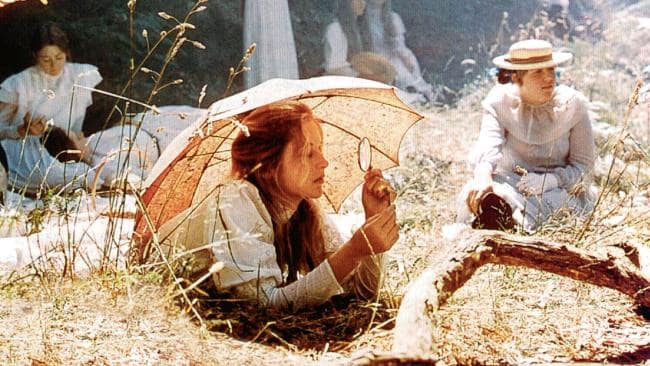
Picnic at Hanging Rock (1975)

Three girls go up a rock and are never seen again in Peter Weir’s masterpiece Picnic at Hanging Rock

Director: Peter Weir

Cast: Rachel Roberts (Mrs Appleyard), Anne-Louise Lambert (Miranda St Clair), Dominic Guard (Michael Fitzhubert), Helen Morse (Mlle de Poitiers), Margaret Nelson (Sara Waybourne), John Jarratt (Albert Crundall), Wyn Roberts (Sgt Bumpher), Karen Robson (Irma Leopold), Christine Schuler (Edith Horton), Jane Vallis (Marion Quade), Vivean Gray (Miss McGraw), Martin Vaughan (Ben Hussey), Kirsty Child (Miss Lumley), Jacki Weaver (Minnie)

Is there any film as haunting and elliptical as Picnic at Hanging Rock? An impenetrable puzzle shrouded in mystery and wrapped in an enigma, it’s the ultimate “mood” film, where everything you understand in the film has be teased out from its sidelines and the unspoken motivations. It’s not going to be for everyone: Peter Weir tells a story on the feature-length Blu-ray documentary (longer than the film) of the response of one US distributor when he saw the film: “[He] threw his coffee cup at the screen at the end of it because he had wasted two hours of his life – a mystery without a goddamn solution!” That’s a fair comment – but accept that this mesmeric film is somewhere between mystery, hynoptic trick and ghost story and you’ll find treasure in it.

Based on Joan Livesey’s novel (which many believed to be true – a fate that also faced the film when it was released), on St Valentine’s Day 1900, a group of girls from a finishing school head to the Hanging Rock in Victoria for a picnic. Three of them (and one of their teachers) walk up to the rock and simply seem to disappear. The subsequent search by the authorities is baffling – and the impact on those left behind is brutal. 

There is barely any real plot in Picnic at Hanging Rock but it’s not a film about that. It’s all about the mood, the creeping sense of menace, and the general uneasy dream nature of the story. Everything follows a woozy dream-like logic – and the atmosphere is built upon by the use of panpipe music and skilful use of classical music. Weir’s film is a masterpiece of ghostly, unsettling spookiness with the rock itself as some unknown mystical source at its centre – the first shot of the film shows it slowly appearing in the mist, as if it has somehow been transported there from some fantasia land outside of the normal.

Weir’s film became the most influential film of Australian cinema, and its tone set many of the key thematic points followed by later films of what became known as the “Australian New Wave”. It explores uneasy balances in Australia between the wildness of the country – and indigenous people’s beliefs and culture – and the social structures from the British residents who had claimed the land. Picnic also explores the beginnings of a split between long-standing Australian residents and those clinging to the upper class Brit lifestyle of the motherland. Weir’s film – with its brilliant photography – lingers on the nature surrounding the rock. Not only the rock itself, with its odd formations and strange structure, but also the animals and the environment about it. There is something unknowable, wild and untamed about these surroundings – something mankind can’t control or understand.

Weir shoots the film with a lush impressionism – everything has a hazy unreality about it – and the dreamy nature of the film is built on with the dark hints of sexual feeling bubbling under the surface. The girls are all on the cusp of discovering their own sexuality – and there are plenty of open suggestions of same-sex crushes, of growing awareness of their sexual natures among the girls. It doesn’t stop with them either – the adults are equally drawn towards unspoken desires (left very much open to interpretation). Weir gets some perfect visual representations of the stonking repression forced on top of all these feelings, not least a wonderful shot which shows several of the girls standing in a line tightly doing up each other’s corsets.

And that perhaps, it’s hinted, is what happens on the rock when the girls disappear. Trance-like, they walk towards a gap in the rock and seem to disappear. What drew them there? Lead girl Marian (a perfect performance of ethereal other-worldliness from Anne-Louise Lambert) even seems dimly aware in the opening scenes that she is bring drawn towards something. The only girl who isn’t drawn towards the mystic is more repressed, dumpy Edith – whatever the force is that calls the other girls, it leaves her panicking and screaming. What’s going on? Something dark, sinister – and you can’t help but think sexual.

And what does that mean for those left behind? A mess. Rachel Roberts (a late casting replacement for Vivien Merchant, and famously awkward around the girls on set) is very good as the distant, draconian headmistress of Appleyard Academy (basically a sort of finishing school for posh girls). The regime she runs at the school is a mixture of oppressive and discriminate, with punishments handed out according to Mrs Appleyard’s personal feelings about the students rather than any reflection of their own behaviour. Part of the film’s story is the fracturing of her own personality that happens as response to the disappearance – her collapse slowly into a sort of paranoid insanity, powered by drink. What dark secrets is she hiding? (The film hints that she has more knowledge than she should have of at least some of the darker events of the story, but never reveals how much or indeed why.) 

But then the whole cast are dealing with problems they scarcely seem to understand. There is a curious – perhaps homosexual bond – between Dominic Guard’s repressed English teen and John Jarrott’s earthy, ultra-Aussie outbacker (a very good performance from Jarrott in a character that could easily have fallen into stereotype). Perhaps that’s why Guard’s character is drawn constantly back to the rock – and also why he too seems to have such an overwhelmed reaction to it.

The sole character in the film who feels most capable of expressing their emotions is the school’s French teacher Mlle de Poitiers. Played exquisitely by Helen Morse – she gives the warmest, most engaging performance in the film – she is the only character who seems able to get in touch with her emotions, unfiltered by too much repression. Perhaps it is no coincidence that as a “double foreigner” (French among the Brits in Australia) she is less affected by the rules around her. Either way, she becomes a perfect audience surrogate, as slowly horrified and confused by the actions she sees around her in the college as the viewer is. Morse is fabulous in these scenes, from a burst of emotion when reunited with a character she thought lost, to quietly watching Mrs Appleyard’s disintegration late in the film.

But the real star is Weir’s masterful direction of the mood of this film. Like that distributor said, there isn’t any plot as such – vital events happen off screen, and there is the distinct feeling that you are only being told half the story – but despite that, the film is compelling. So much is conveyed in the mood, the tensions, the style of the film that you are invited to bring your own interpretation to events. That makes it a continually rewarding piece of cinema – it invites you to make your own answers. 

This juggling of atmosphere to make something so enigmatic is so crucial to the film’s success that the recent mini-series remake effectively continued the trick (with a few extra insights into Mrs Appleyard), and contained arguably even fewer answers over its 5 hours than this did in 2. But Weir’s brilliantly made, beautifully shot, eerily unforgettable film rightly takes its place as (perhaps) the greatest Australian film ever made: it’s a film that is about Australia, and about the tensions, confusions and mysteries of that country. Brilliant.