Author: Alistair Nunn

Network (1976)

Peter Finch rants and raves in media satire masterpiece Network

Director: Sidney Lumet

Cast: Faye Dunaway (Diana Christensen), William Holden (Max Schumacher), Peter Finch (Howard Beale), Robert Duvall (Frank Hackett), Wesley Addy (Nelson Chaney), Ned Beatty (Arthur Jensen), Beatrice Straight (Louise Schumacher), Jordan Charney (Howard Hunter), William Prince (Edward Ruddy), Lane Smith (Robert McDonough), Marlene Warfiedl (Laureen Hobbs)
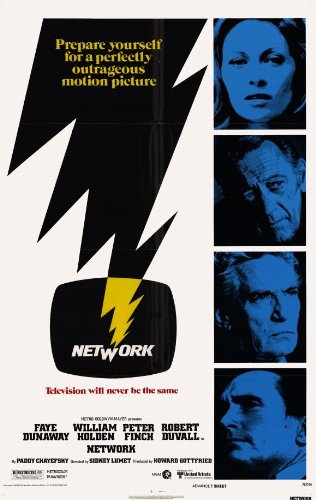
Is there any movie ever made that has been more prescient than Network? So spot-on was its vision of television becoming pushed to extremes by its obsession with ratings that when it was screened a few years ago for a group of teenagers in America, they allegedly didn’t realise it was meant to be a satire. I’m also pretty sure you would have to go a long way to find a better written movie – it’s no surprise that this has been converted into a successful play, it’s basically one already.

In the 1970s, UBS is a struggling TV network trying to find a niche among the giants. Its news show is losing its timeslot in the ratings – which is bad news for its respected anchor Howard Beale (Peter Finch). Informed he will be fired due to falling ratings, Beale goes on air and casually announces he will blow his brains out live on air next week. When this sends the ratings rocketing, the network sends him back on air, encouraging him to speak his mind more rather than just report the facts. When Beale suffers a full blown breakdown, his anti-establishment rants touch a public nerve and Beale becomes a ratings smash – with the news show taken over by ambitious Diana Christensen (Faye Dunaway), Head of Entertainment, who turns it into a bizarre light entertainment show, with the increasingly unhinged Beale the main entertainment. It’s perfect for everyone – so long as the ratings hold…

Network could so easily have become a shrill, OTT satire. Writing down the plot summary there, it even reads like that – a big, stupid, pleased-with-itself film that hits its points hard and where every character is a grotesque caricature. But that’s not the case here. This is a brilliantly written film – Paddy Chayevsky is surely one of the greatest writers in film history – a fiercely intelligent piece of satire, which most importantly crafts its characters with empathy and understanding. Some of them may be larger than life, and some of them may do things that are just this side of heightened reality, but at heart they all feel real. The film is shot through with heart and a sense of realism that underpins the razor sharp satire.

And that satire is all around the world of television. So astonishingly prescient is the film about the rise of reality TV, ratings obsessed and lacking in real soul, that many of its jokes pass by almost unrecognised today. Respected news producer Max Schumacher’s throwaway line about an hour of network TV drama being made up of films of car chases (and crashes) from the police? Done to death already. The idea (again unthinkable in the 1970s) that a news anchor could litter the air with their own opinions on the news and current affairs – half the anchors in America now run their shows like editorial pieces. The concept that the public could be entertained by watching someone clearly not completely normal, throwing crazed statements at the camera – it could only be a fantasy right? A TV network completely in thrall to its corporate masters, following the line from the bosses? Yup surely that could never happen.

What Chayevsky does so well is turn these into masterpieces of rhetoric. Some of the greatest speeches ever written in film appear here, and they work because not only do they showcase some superb writing, but also every moment is crammed with ideas and real genuine feeling. Howard Beale may well be as mad as hell and not going to take it any more – but he articulates his reasons for feeling this with an acute emotional reality. Schumacher’s paens to the changing world of television, and his own lost place in it, are beautifully done. Diana’s ratings obsessed spewing of TV related facts and figures is sharply underpinned by our awareness all the time of the emotional reality of her near-inevitable emotional breakdown (surely only a few years at most down the line).

Given these lines, the acting is extraordinary (it won three of the acting Oscars in 1967). There isn’t a duff beat or performance in this film, and the delivery of the high-blown dialogue is simply outstanding, brilliantly directed by Lumet who was always a highly skilled director of actors. In fact, Lumet is often easy to overlook here, but his understanding of the material, and handling of its message and delivery, is a big reason for why it never becomes overbearing or trying. Away from the leads, he also gets superb performances from Duvall (chilling and on the verge of rage in every scene as the corporate suit who really calls the shots), Beatty (who had basically one speech, worked a day, and got an Oscar nomination) and Straight as Schumacher’s wife (who went one better than Beatty and won the Oscar for her one scene – the shortest Oscar-winning performance ever at just a few minutes).

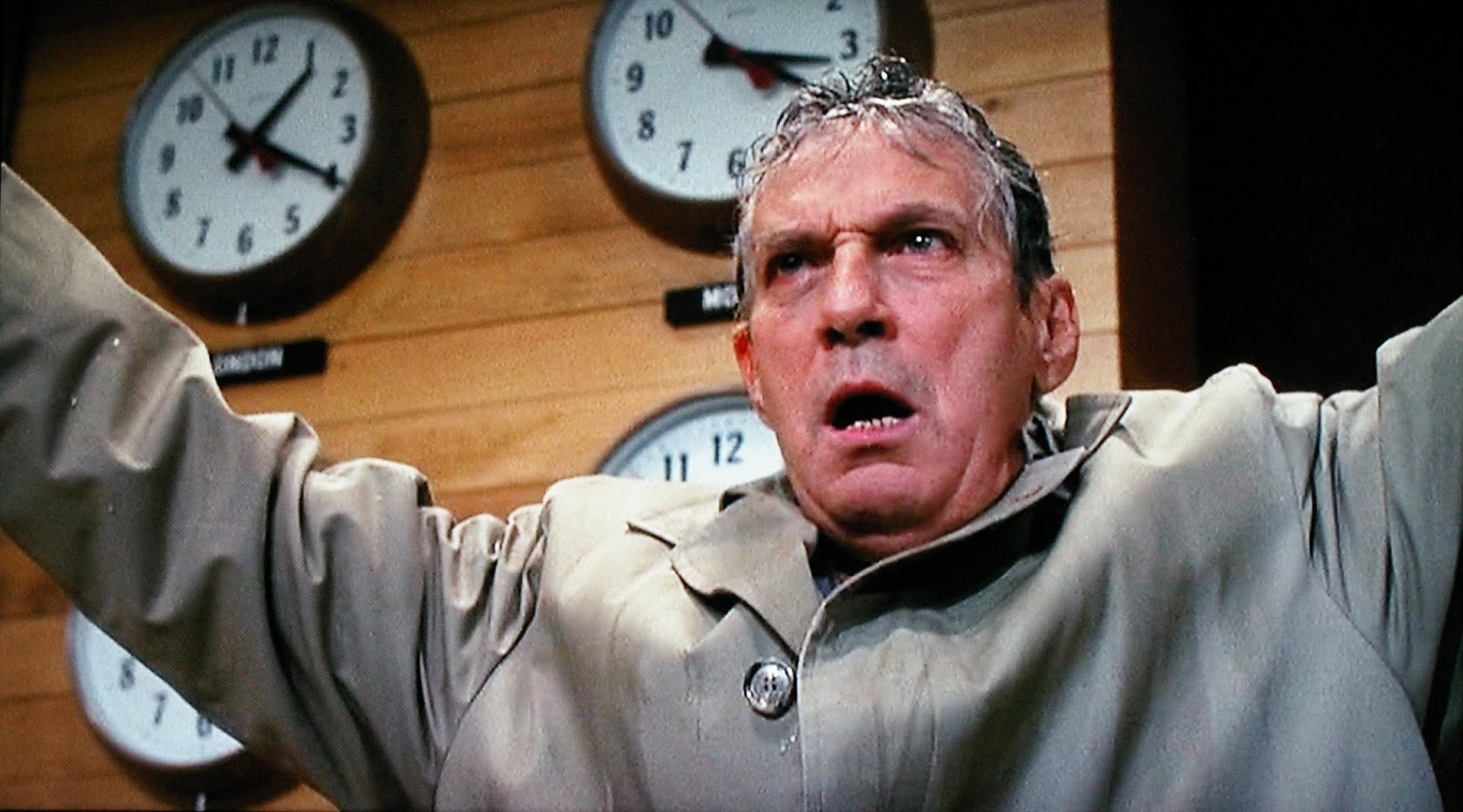
Peter Finch won a posthumous Oscar for his role in this film – ill health restricted his “mad as hell” speech into only two takes (an extraordinary thought when you watch it). Beale is a gift of a part, an intelligent, compelling piece of showmanship – but Finch’s gift is to make the part feel real and human under the genius dialogue. The early scenes showcase Beale clearly struggling with depression, under the smiles, and already starting to crack. I love the way Lumet often frames Finch during these scenes – in group scenes he’s often to the edge of events, and he only slowly comes to the fore to gain a close up. Heck most of his first outburst on television is only seen by us on a viewing monitor in the control room (only the viewer seems to be listening by the way – the technicians are either gossiping or mechanically going through the motions of running the live broadcast, including countdowns to commercials).

Finch basically steals the movie, because you can’t shake from your mind his delivery of scenes like this one:

It’s even harder to believe that so many actors turned down the role – perhaps worried that it would seem like a pantomime role. One of those actors was William Holden – and thank goodness he did, because his grounded, bitter, crumpled, but still idealistic Max Schumacher is one of the film’s highlights. Holden gives one of his greatest performances – often overlooked under the flashy roles of Finch and Dunaway – making Schumacher the still centre of the film and, by its end, something approaching its powerless voice of conscience. 

Faye Dunaway (also Oscar-winning) makes a great deal of the demonic role of Diana Christianson, the representative of the next generation of TV producers, concerned only with ratings over morals. It’s probably the least “real” of the characters, but Dunaway finds the vulnerability and fragility carefully hidden under Diana’s chilly self-confidence and ruthlessness. 

It’s Diana who drives the film, overseeing the transformation of the news hour into a bizarre variety show (including a soothsayer, amongst a host of eccentric magazine feature slots) where Beale is bought on to rant about the emptiness of our world and the horrors of our soulless age like some sort of dancing bear, his inevitable fainting fits greeted by roars of applause. (“What are you?” asks the warm up man of the studio audience “We’re mad as hell and we’re not going to take it anymore!” they delightedly cheer back).

The film runs a particularly dark streak alongside this with Diana’s plan to build a solid hour of entertainment every week from an embedded camera crew following the exploits of a gang of radical Marxist black-pantherist terrorists. The film gets a lot of slightly more obvious satirical material from this – the terrorists quickly lose their Marxist principles in hilarious fights around things like negotiating syndication rights – but its vision of television turning real-life horrors (repackaged) into entertainment for the masses is only a few degrees shy of where many channels have ended up today. 

That’s the whole film – sharply intelligent about where the world is heading, but balancing this with a genuine sense of humanity and emotional intelligence around its characters. If Chayevsky’s screenplay – or Lumet’s direction – hit us over the head with the points the film was trying to make, we’d quickly switch it off. Instead it makes its points with wit and a sense of reality that makes it both horrifying and entertaining. But then it would always have its place in film history with that dialogue and the acting it inspires from the cast. Most of the actors give their best ever work here, and the script is one of the finest around. As for the view of television – well, if we haven’t reached where Network was by now, it’s surely only a few minutes in the future.

The Prince of Egypt (1998)

Animated DeMille epics in the rather brilliant The Prince of Egypt

Director: Brenda Chapman, Steve Hickner, Simon Wells

Cast: Val Kilmer (Moses), Ralph Fiennes (Ramesses II), Michelle Pfeiffer (Tzipporah), Sandra Bullock (Miriam), Jeff Goldblum (Aaron), Danny Glover (Jethro), Patrick Stewart (Pharaoh Seti), Helen Mirren (Queen Tuya), Steve Martin (Hotep), Martin Short (Huy), Ofra Haza (Yocheved)

When Dreamworks Studio was put together by three Hollywood mega hotshots (Katzenberg, Spielberg and David Geffen), Jeffrey Katzenberg, former head of Disney, finally got the chance to make his animated version of The Ten Commandments. The Prince of Egypt was the first project under the Dreamworks animation label – and it was intended to beat Disney at its own game. It succeeded – so well that many people think it actually is a Disney film. Is that a good thing?

Anyway, the story should be familiar. In Ancient Egypt, Moses (Val Kilmer), the child of Jewish slaves, is adopted by Pharaoh (Patrick Stewart) as a baby after being found in the bulrushes. Moses grows up as brother to Ramesses (Ralph Fiennes) the future Pharaoh – until the shock of finding out his heritage leads him to flee Egypt. But an encounter with the burning bush (voiced again by Kilmer) gives him a new mission – back to Egypt to demand of Ramesses “Let My People Go”. Will he succeed? Well: There Can Be Miracles (When You Believe).

It helps you to believe in miracles when a film looks as gorgeous as this one does. The animation is amazing, not just because of its quality and richness, but the imagination of its images. From the framing of Pharaoh and later Rameses around the Egyptian architecture around them, to an extraordinary dynamic shot of Moses throwing his sandals from the room when encountering the burning bush, to the haunting interpretation of the killing of the firstborn, it’s brilliant. 

It doesn’t stop there either, with the final parting of the Red Sea awe-inspiring in its scale. But the film does equally beautiful work with the smaller, more intimate moments: each character feels real and lived in, and the film perfectly captures smaller moments of affection, love and hurt with genuine emotional force. It’s a terrifically well-made film.

And of course it has a classic story – it’s literally stood the test of time. So imaginative are the visuals – and so impressive is its scope and scale – that it almost dwarfs the DeMille style it’s quietly apeing. In fact, I’d worry whether it is a film that will have greater appeal to movie-lovers and parents than perhaps it does to children. There isn’t much in the way of humour – even the film’s nominal comic characters, a pair of cynical Egyptian priests (and near con artists) voiced by Steve Martin and Martin Short, are on the side of the oppressive baddies. There are a few decent songs in there – I rather like the Les Miserables style oomph of “Deliver Us” – and the film makes great use of the beautiful voice of the late Israeli singer Ofra Haza. But there is no getting around that this is a serious piece of film-making, with nary a comic camel in sight.

But this is no bad thing at all, and I think it stands The Prince of Egypt in good stead as it’s a film you’ll like more the older and more mature you are watching it. Not least the wonderfully complex relationship it explores between Moses and Ramesses – these two wild young men start as carefree kids (the first thing we see them do is smash up a temple building site in the film’s most cartoonish sequence, a sort of Wacky Races chariot drag race), and each become dramatically changed by responsibilities. Moses ascends to a higher plane of responsibility and humanity – but Ramesses finds himself forced into defending to the death a system of government he seemed at best disinterested in as a young man.

The film actually carries a great deal of sympathy for Ramesses. It’s in many ways a tragedy of the brother relationship between these two princes of Egypt getting shattered by events. But Ramesses is a lonely, almost needy figure, who needs Moses’ affection and respect. Ralph Fiennes mines a lot of vulnerability for this man struggling to fill his father’s shoes, who just wants Moses to chuck this whole prophet business in and go back to being his only friend. Ramesses becomes a complex, vulnerable and rather sad man – unable to deal with the pressure of his role and desperate to revitalise a lost connection with Moses, the hatred he eventually feels for his former brother born almost exclusively from rejection. 

Moses isn’t quite as interesting a character – he’s more of a waster who becomes a stand-up guy – but the film successfully builds an aura about him. It struggles a bit more with those Old Testament morals: we are meant to condemn Pharaoh’s slaughter of the Jewish firstborn that opens the film, but God’s massacring of the the Egyptian firstborn (for all Moses’ discomfort with it) is presented as being primarily the fault of the Egyptians’ stubbornness.

But then that steers us into theological territory, which no animated epic for kids can really manage to set new ground with. Instead, let’s focus on the many things the film does right. First and foremost that striking visual imagery and beautiful animation, and the depth and shading it gives to the characters. The all-star cast do extremely well – even Jeff Goldblum is fairly restrained – and it’s got some great songs. It deserves to be shown as often as The Ten Commandments on the television.

The Spy Who Loved Me (1977)

Bond finds himself in another pretty pickle in The Spy Who Loved Me

Director: Lewis Gilbert

Cast: Roger Moore (James Bond), Barbara Bach (Anya Amasova), Curd Jürgens (Karl Stromberg), Richard Kiel (Jaws), Caroline Munro (Naomi), Walter Gotell (General Gogol), Bernard Lee (M), Desmond Llewelyn (Q), Lois Maxwell (Miss Moneypenny), Geoffrey Keen (Frederick Gray), Robert Brown (Vice-Admiral Hargreaves), George Baker (Captain Benson), Michael Billington (Sergei Barsov), Vernon Dobtcheff (Max Kalba), Nadim Sawalha (Fekkesh)

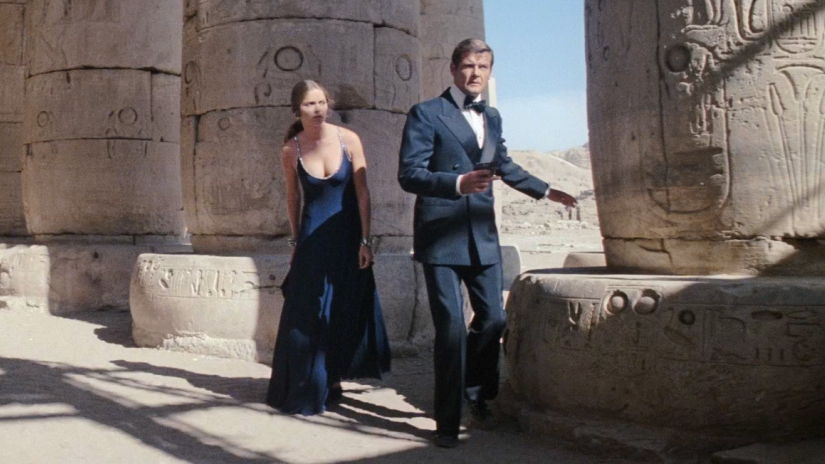
Roger Moore had made two Bond films before he made The Spy Who Loved Me – but this is the one when he finally hit upon the formula that works for him. It’s also probably the moment where the Bond films became – once for all – comedy adventure capers. It was but a few more degrees from here until Bond was telling a tiger to “sit” or racing past a double-taking pigeon in the middle of St Mark’s Square. And the public loved it. For better or worse, Moore’s Bond here helped define the franchise for a whole generation.

Anyway, the story. It’s eerily familiar in many ways to Thunderball and You Only Live Twice: a power-crazed lunatic (Karl Stromberg) running a secret organisation wants to destroy the world. His plan? To capture one American and one Soviet submarine and use them to fire nuclear missiles at the nation’s two capitals, to kickstart a nuclear war, leaving only his underwater kingdom intact. Just as well then that an over-keen Stromberg (Curd Jürgens) first captures a British sub, meaning James Bond (Roger Moore) is called in to investigate. Bond will work with the USSR’s finest agent – Anya Amasova, Triple X (Barbara Bach) – to find out what’s going on and why.

TSWLM is a lot of fun, possibly the ultimate expression of what a lot of people think Bond is. It’s hugely silly, rather exciting and has almost no connection with reality whatsoever. Moore goes through the whole thing with his eyebrow forever arched, tipping the wink at the audience – “You do know, dear boy, this is all dreadfully silly stuff”. Sometimes in Bond this humour gets a bit much – but here it’s pretty much pitched perfectly. And Moore looks like he is having the time of his life.

The film is crammed with action set pieces in striking locations: the Alps! The pyramids! A converted oil tanker base! Nothing is left to the imagination, and everything is thrown at the screen. It gets the sense of excitement right from the pre-credits sequence, with Bond’s high-speed ski chase across the alps from Russian would-be hitmen. Fools – what chance did they have? I don’t know what I like most about this scene: is it the wild ski stunts? The way music and camera action combine so well? The fact that it’s crystal clear Moore probably spent precisely zero days on location for this sequence? What am I talking about, it’s got to be that insane parachute jump at the end – with the camera leaving it just long enough for you to start to think “is Bond going to get out of this one?”. (Spoilers he does.)

That’s almost nothing compared to the famous Lotus-turned-submarine car chase, which pretty much set the standard for all the car-based action (not to mention gadget filled cars) that would follow in the franchise. The idea of a car that turns into a submarine: it’s both brilliant and so overwhelmingly silly that, like Bond at its vibrant best, it seems to transcend class and logic into a higher plane of excitement.

And all this with a plot that is almost staggeringly stupid. Jurgens has a lot of arch, naughty fun as scheming monomaniac (with subtle webbed hands) Stromberg, a pompous arsehole and a great villain. Of course he wasn’t a physical threat – hence the invention of Jaws, surely the most popular henchman ever invented for Bond. Jaws is a lunking, vicious but strangely endearing brute – it’s hard to put your finger on why he’s strangely likeable, maybe it’s just the totally absurd idea of a hitman whose killer tools are metal teeth. Maybe it’s because Richard Kiel has such a dorky sense of humour – and is as good at the glance at the camera as Moore himself is.

Of course it is a dated film – and it’s always the women that show it. If this set a lot of good Bond archetypes, then it also helped to cement a few bad ones. Anya Amasova is (allegedly) the greatest agent Russia has. Not that you would know it, as she stumbles in this film from moments of staggering incompetence and stupidity to victimhood and damsel-in-distress. There is a hint of character development – Bond offs her boyfriend in that alpine chase literally without a backward glance – but that’s soon forgotten by the end under Bond’s charms. The poor woman can’t even drive stick (“That’s reverse, let’s try again shall we” says Bond with smackable smugness) and by the end of the film she’s bikini-clad and being rescued by Bond. It says a lot when the strongest thing about her character is that her name isn’t an innuendo.

But you can let it go, because the rest of the film is such good fun. Everything is nonsense of course, and you could steer a submarine through the plot holes. If Stromberg only needs two submarines to start his evil plan, why on earth does he grab a third one at the start of the final act? (Just as well he does, of course, as otherwise Bond would never get on board his base.) Stromberg is ruthless enough to eliminate three underlings and to set up a nuclear war to wipe out the world – but those captured submarine crews he keeps alive, imprisoned, with a small guard, next to the armoury on his base. Ooops. His plan is almost effortlessly undone with a radio message from Bond. But never mind. It doesn’t matter.

The point is that this is all great fun and basically set the tone for the next ten years of Bond films – until Dalton shifted gears. Moore is really good in it, as a sort of ringmaster of silliness – and he’s clearly enjoying it wildly. The Spy Who Loved Me is his best film – and for all its dumbness, its leaning into cheap humour, its ludicrous plot and sexist attitudes, it’s still up there at the top of the franchise. Because for a lot of people, all those negatives are exactly what they now expect from Bond.

Becket (1964)

Peter O’Toole and Richard Burton make unlikely friends (and then enemies) in Becket

Director: Peter Glenville

Cast: Richard Burton (Thomas Becket), Peter O’Toole (Henry II), John Gielgud (Louis VII of France), Donald Wolfit (Bishop Gilbert Foliot), Martita Hunt (Empress Matilda), Pamela Brown (Eleanor of Aquitaine), David Weston (Brother John), Sian Phillips (Gwendolen), Felix Aylmer (Archbishop of Canterbury), Paolo Stoppa (Pope Alexander III), Gino Cervi (Cardinal Zambelli)

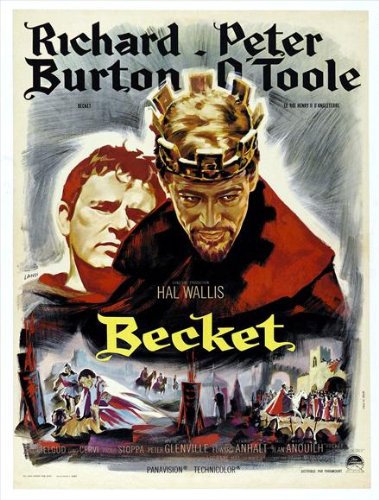
Burton and O’Toole in the same movie? There must have been a few late night benders on that shoot… You suspect actually that the backstage fun might have been just a little more sprightly and engaging than the movie itself, a lavish 1960s Hollywood Prestige film of English history. Based on Jean Anouilh’s semi-satirical play, it translates the clash between Church and State under Henry II into a very personal conflict between two men who each feel the other has let them down. 

Thomas Becket (Richard Burton) is a Saxon who has risen high in the service of Henry II (Peter O’Toole) at a time when all the top jobs are held by Normans. Becket and Henry do everything together: hunting, hawking, whoring, you name it, the two of them are inseparable. But while both are sharply intelligent men, Henry is basically lazy and principally interested in enjoying life, while Becket always has a slight streak of responsibility for his people and their rights. But despite this, the two men both have England’s interests at heart and a strong friendship. So when Henry makes Becket Archbishop of Canterbury, it should work a treat, right? Well wrong, because Becket quickly begins to feel his loyalty is to the Church and God, not to Henry – and soon a debate over the legal rights of the church has blown up into a full scale clash between the two former friends. Will no one rid Henry of this turbulent priest?

Becket is a fairly sharply written, waspish play about the love/hate relationship between two men, but its themes and ideas are basically secondary to the showcasing opportunities it gives to its two lead actors. That’s pretty much what happens with this film: for all the ups and downs of the plot, the thing that really lifts this film are those two performances. Take that away and you essentially have a stately period pace, flatly and unimaginatively filmed with the look-at-the-scenery-and-costumes steadiness of other films of this genre and time. So it’s just as well that both leads are clearly having a whale of time.

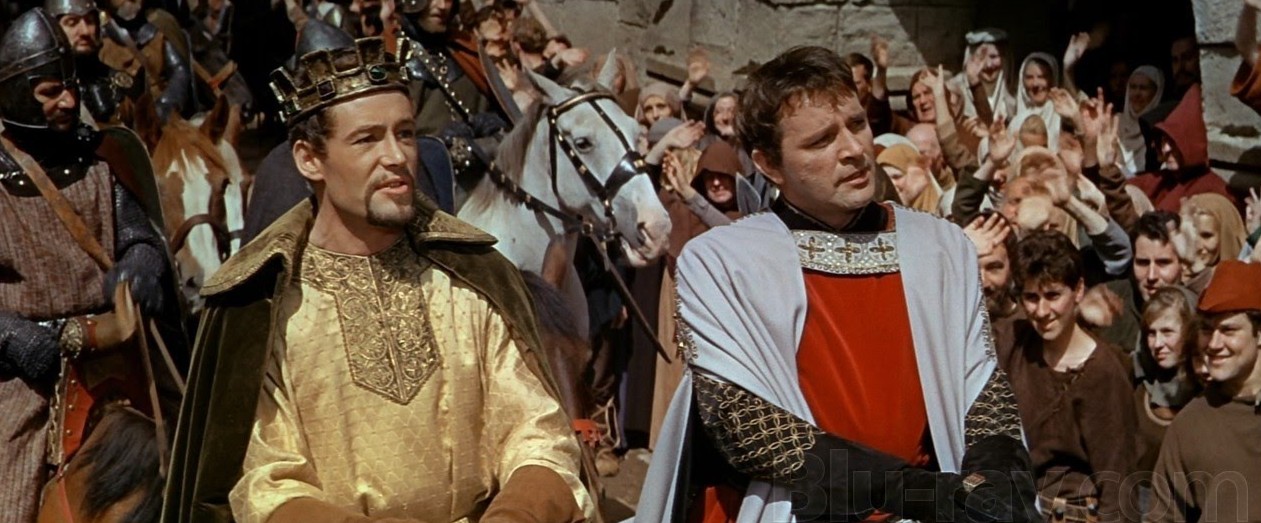
Burton invests Thomas Becket with a quiet authority and a growing sense of something that, if it’s not morality, is at least a sort of moral certitude. Burton’s Becket is not the straightforward good-guy: his stances are always governed at least partly by his own pride and ambition. His defence of the Church is partly motivated by the need to secure his position, and in his career beforehand he constantly shows that he is won’t let doing the right thing damage his position at the court. But there are also touches of genuine faith throughout, and Burton plays the monologues imploring God for guidance with earnest conviction. Alongside this, he plays Becket with a great deal of wry observance and subtle wit that makes this kaleidoscopic character constantly fascinating: you never quite know what he is thinking.

Burton’s restraint also allows O’Toole more room in the more expansive role of Henry II. The powerful king – proud, controlling, intelligent and bombastic – was always a perfect role for O’Toole: indeed he would play it again four years later in another play adaptation, The Lion in Winter (becoming one of the few actors to get two Oscar nominations for the same character). O’Toole roars through the film, bringing immense energy and humour to Henry’s many scenes of intense speechifying. But what O’Toole does so well is balance this with a genuine sense of vulnerability, a genuine pain at losing Becket’s friendship. For all the power and control, O’Toole understands that Henry is essentially a very lonely man with only one man anywhere near his equal. O’Toole’s sharply intelligent, dynamic performance is a real treat.

And it feeds into the underlying theme of the film: this sense of unrequited love between the two men. Henry, for all his egotism, is clearly in love on some level with Becket: a fact that Becket seems aware of, but doesn’t quite return with the same intensity. And in fact, to double Henry’s pain, it feels like the friendship is one partly driven by Henry’s position rather than something genuine between the two men – Becket is always more guarded and more critical as a companion. Though of course that is fair enough: Henry is, however good-naturedly, a supreme ruler who cares little for the welfare of the Saxons under his rule, happy to help himself to attractive women from the peasantry if he wants them. But then perhaps it’s Becket’s very distance, his certain level of speaking truth to power, that makes him so appealing to Henry: when Becket is around, Henry has competition for smartest guy in the room.

There is a lot going on between the two leads, so it’s not surprising that much of the rest of the film doesn’t get a look in. For the other performers, John Gielgud landed an Oscar nomination for his two scenes (barely five minutes) as an arch and manipulative King of France, while Donald Wolfit is all puffed-up pomposity as Becket’s church rival. But the film is only focused on the two men and their political rivalry, so the context is always sketched in quickly, and the energy drops out of the film noticeably when they are apart. The film wants to frame the rivalry so much as a personal one that it doesn’t develop another interest in the political issues – so when scenes are obliged to focus on this, you feel the film starting to drag.

But that might also be because Anouilh’s play is famously historically inaccurate. For starters, Becket wasn’t Saxon, so his early lack of social standing makes no sense. The Constitutions of Clarendon (historically the reason for the falling-out in the first place) don’t merit a mention. Henry’s wife Eleanor of Aquitaine is presented as a shrew rather than one of the most intelligent women of the era, while Henry is also shown to be on poor terms with his mother, again contrary to the truth. 

But that stuff all stems from the play, and in the end it hardly matters as the film is positioning itself as the tale of a friendship turned sour between two men. O’Toole and Burton are sublime, and if the direction and film-making around them is pretty pedestrian (although the film looks great and has an impressive score) it doesn’t really matter in an actors’ piece like this. Most of what is good from the play is carried over to the film, and the dialogue and speeches are often very strong. It’s a very stately and rather overlong play that doesn’t really keep the momentum up. But it’s still enjoyable, still has plenty to admire and even if it’s overlong and dry, it gives you performances that really sing.

The Guernsey Literary and Potato Peel Pie Society (2018)

Will Lily James and Michiel Huisman find true love in The Guernsey Literary and Potato Peel Pie Society? You have one guess.

Director: Mike Newell

Cast: Lily James (Juliet Ashton), Michiel Huisman (Dawsey Adams), Glen Powell (Mark Reynolds), Jessica Brown Findlay (Elizabeth McKenna), Katherine Parkinson (Isola Pribby), Matthew Goode (Sidney Stark), Tom Courtenay (Eben Ramsey), Penelope Wilton (Amelia Maugery)

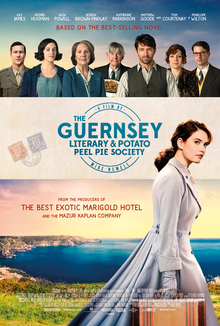
Every so often I get challenged to write a really short review. The Guernsey Literary and Potato Peel Pie Society is the sort of film where I could almost write a review that was shorter than the film’s title. Look at the poster – everything you are now expecting from this movie, it completely delivers. It’s as warm, unthreatening, comfortable and familiar as Sunday dinner at your Gran’s.

In 1948, novelist Juliet Ashton (Lily James – so winning you overlook the fact that she’s clearly too young for the part) receives a chance letter from Dawsey Adams (Michiel Huisman), a farmer in Guernsey. Adams tells her about the book club that sprang up between himself and other islanders during Guernsey’s occupation by the Nazis, where reading books gave them a chance to escape the horrors of the occupation. Leaving her slightly put-out American fiancée (Mark Reynolds) in London (one guess as to what romantic pairing we’ll end the film with, by the way) she heads to Guernsey to meet the group and write an article about them – and finds herself swept up in a mystery around missing member of the club Elizabeth McKenna (Jessica Brown Findley). 

It’s a film that virtually writes itself, the sort of predictable Sunday-afternoon, British film where the 1940s look impossibly glamourous and everything turns out wonderfully happily in the end. You won’t be challenged by anything in it, you can simply sit back and enjoy it. Everyone involved in the film does clearly understand what they are making here though: it’s light, fluffy and unchallenging but it’s professionally made and everyone gives it their all.

Perhaps it’s a sign of how much the film is pitching for the Downton Abbey audience that it has no fewer than four actors from that show in key roles. Lily James is radiant and charismatic as Juliet – sweetly earnest and also with a determination to wrestle out a truth once she senses a story. It doesn’t take a genius to guess that she is going to be won away from her dull Yankee pilot (Glen Powell in a totally thankless role of blandness) by the earthy, romantic, caring and intellectually stimulating charm of Game of Thrones’ Dario Naaheris, Michiel Huisman (the sort of role an actor can play standing on his head but he’s still very good).

Penelope Wilton does some good work as a widow clinging to happier memories that she can’t bear to see affected by harsher truths. Jessica Brown Findley has little to do, but to be honest it’s not a problem as the part is such a straight re-tread of her Lady Sybil role from Downton she could probably do it in her sleep. The last Downton alumnus, Matthew Goode, is rather funny as Juliet’s sweet but good-naturedly exasperated publisher. For the rest of the cast, Katherine Parkinson oscillates between comic timidity and soulful sensitivity and Tom Courtenay gives a playful old man performance which can’t have stretched him.

Not being stretched is what the film is all about. Even the mystery at the film’s centre isn’t particularly gripping or – even when the truth is revealed – something that really has much impact on anything. And it’s hardly the focus anyway. It’s really a film that wants you to enjoy the photography and landscapes, and to root for the two leads to fall in love with each other. It wants you to feel little else, and carefully avoids getting you to invest your emotions in other aspects of the story so you can’t get upset. It’s the sort of film that you could call “lovely”, that passes an hour or two perfectly well, and at the end of it you’ll tell people it was fine. Then you’ll never think about it again. Ever.

The Untouchables (1987)

The Untouchables (1987)

Super stylish cops and robbers thriller, as Costner and Connery take on Capone

Director: Brian de Palma

Cast: Kevin Costner (Eliot Ness), Sean Connery (Jimmy Malone), Andy Garcia (George Stone), Robert De Niro (Al Capone), Charles Martin Smith (Oscar Wallace), Patricia Clarkson (Catherine Ness), Billy Drago (Frank Nitti), Richard Bradford (Chief Mike Dorsett), Jack Kehoe (Walter Payne)

“What are you prepared to do!”

It’s the motto of this electric law-enforcement film, one of those all-time classics that provides endlessly quotable lines and moments you can’t forget. It’s crammed with iconic moments, from its brilliantly quotable dialogue from David Mamet, via its wonderful music score, to its artful film literacy and iconic performances. If there is an untouchable film, this one is pretty close. I love it.

It’s 1930, prohibition is in full force and Chicago is ruled by gangland kingpin Al Capone (Robert De Niro). Young Federal Officer Elliot Ness (Kevin Costner) is thrown into Chicago to end Capone’s reign and stamp out the illegal liquor business. Not surprisingly, it’s hard to know who to trust in a town as stinking as this one, until a chance meeting with disillusioned beat cop Jimmy Malone (Sean Connery) helps him find a group of people he can trust – “Untouchables” who aren’t going to go on Capone’s payroll. But to bring Capone down he’s going to have to embrace the “Chicago way” and start to bend his strict moral code. 

Listening to Brian de Palma talk about the making of the movie, you can’t help but suspect he felt he was doing one for the suits rather than one from the heart. Well perhaps he should do that more often, because The Untouchables is a lean, mean, hugely entertaining action-adventure, that plays with genuine ideas and but also nails every single moment. Every scene is shot with a confident, compelling swagger – the sort of thing that reminds you what a conneseur of high-class pulp de Palma can be. The Untouchables plays out like a super-brainy graphic novel adaptation, and every scene sings. There is barely a duff moment in there.

A lot of this comes straight from David Mamet’s brilliant script. Really, with lines like this, moments as well-crafted as this, characters as clearly, brilliantly defined as the ones on show here, you can’t go wrong. Quotable lines fall from the actors’ lips like the gifts they are: “He brings a knife, you bring a gun. He sends one of yours to the hospital, you send one of his to the morgue. That’s the Chicago Way!” It’s dialogue like this that just has ageless appeal, the sort of stuff you find yourself trying to work into day-to-day conversation.

But Mamet’s script is also sharply clever. It swiftly lays out at the start Ness’ moral compass, his code – and then, as the film progresses, it cleverly shows the whys and wherefores for Ness compromising these. Needless to say, the man at the end of the film is totally different from the bright-eyed naïve agent we met at the start. Mamet also brilliantly works shades of grey into all our heroes, while scripting some compelling moments of grandstanding bastardy that an actor as marvellous as De Niro is just waiting to send to the back of the net.

De Niro was of course the inevitable choice as Capone. Bob Hoskins was contracted just in case De Niro said no (when told De Niro would be taking the job but he would get a $20k pay-out for his time, Hoskins told de Palma he’d be thrilled to hear about any other movies de Palma didn’t want him to be in), but it had to be Bobby. The film drops Capone in at key moments: the film opens with the swaggering bully delighted at holding court with English newspapers while being shaved (de Palma’s camera draws down from an overhead shot, like a spider descending from the ceiling, to reveal him in the barber’s chair) – a flash of danger emerges when the barber slips and cuts Capone’s face (de Niro’s flash of fury, followed by his decision to pardon – combined with the barber’s terror – is perfect). Later Capone rages at Ness, hosts a very messy dinner party with a baseball bat, and weeps at the theatre while a key character bleeds to death at his home (a brilliant example of de Palma’s mastery of B-movie cost cutting). He’s the perfect dark heart.

And opposite him you need a white knight – even if it a white knight who is set to be sullied. I’m not sure Kevin Costner ever topped his performance here, in the film that made him a superstar overnight. Looking like the perfect boy scout – his fresh faced earnestness is one of his finest qualities – Costner also has a WASPish hardness under the surface. The burning determination he has to destroy Capone, his disgust at the murder and chaos Capone deals in, is never in doubt – just as his initial naïveté about how to end Capone is all too clear. Costner masterfully shows how each event pushes Ness a step or two further in bending his rules, to fight Capone’s ruthlessness with ruthlessness of his own. “What are you prepared to do!” Malone asks him, and the film is about Ness working out how far his moral compass can stretch. I can’t think of many films that so completely and successfully have the lead character change as much as Costner does here without it feeling rushed or forced. It’s a wonderful performance.

But the film is stolen – and it’s no surprise, as he has the showiest part, most of the best lines, and of course the movie-star cool – by Connery. It’s easy to mock Connery’s blatantly Scottish Irish cop – he gives the accent a go for his first scene, but promptly drops it. What Connery’s performance is really all about is an old dog who never got a chance to do the right thing, finally being given the licence, the support and the inspiration from the younger man to clean up this filthy city. And Connery rages in the film, a force of nature, the perfect mentor, the cop who against all initial expectations is prepared to go through any and all risks to get Capone. He’s the samurai beat cop, and Connery (Oscar-winning) growls through Mamet’s dialogue with all the love of the seasoned pro letting rip. It’s an iconic performance – and led to a five year purple patch of great films and roles for Connery.

But the film works partly because of these great performances and the script, but also because of de Palma’s direction. The pacing is absolutely spot-on, the camera full of moments of flash and invention. Every action sequence has its own distinct tone, from the horse riding hi-jinks of a Canadian border interception of a booze truck, to the dark slaughter late at night of one of the film’s main characters (a masterful, Hitchcockian piece of genius by the way that uses the POV shot to exceptional effect). A late roof chase sizzles with a ruthless energy.

But the real highpoint of the action is of course that famous train-station shoot out. Allegedly the original plans on the day had to be ditched due to budgetary reasons – so cinephile de Palma pulled a sublime Battleship Potemkin homage out of his locker. Shot in near silence, save for gunshots, the bounce of a pram falling down the station stairs (baby on board) and a spare score from Morricone, the sequence is true bravura cinema, both hugely exciting and strangely endearing for all those who know anything about the history of cinema. 

De Palma and Mamet keep the story focused, clear and every scene has a clear purpose and goal. There isn’t a single superfluous character or moment. Everything is perfectly assembled to serve the overall impact of the film. It’s gripping, entertaining and compelling: the sort of film where if you catch it at the right age it has you for life. Ennio Morricone’s operatic score is perfect for the film, underlining and emphasising every moment and effectively sweeping you up. Costner and Connery are superb, De Niro is perfect, the film is a gift that has something new to give every time you see it.

The Full Monty (1997)

Steelworkers from Sheffield have no options but to turn their hand to stripping, in British phenomenon The Full Monty

Director: Peter Cattaneo

Cast: Robert Carlyle (Gaz), Mark Addy (Dave), Tom Wilkinson (Gerald), Lesley Sharp (Jean), Emily Woof (Mandy), William Snape (Nathan), Steve Huisan (Lomper), Paul Barber (Horse), Hugo Speer (Guy)

In the summer of 1997, Britain was a depressed place. The country was in the middle of an intense mourning for the death of Princess Diana. Perhaps that’s why a film all about overcoming despair and to turn it into heart-warming triumph suddenly gripped the whole nation and emerged from nowhere to become the most successful British film of all time. No one expected a film about Sheffield strippers to do that.

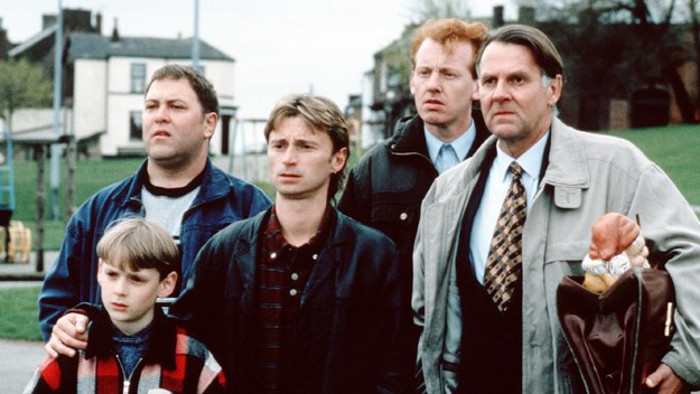
The economy has dropped out of the Sheffield steel market, and hundreds of people are out of work and desperate. Gaz (Robert Carlyle), a genial waster, needs £700 to pay his child maintenance and not lose access to his son Nathan (William Snape). Dave (Mark Addy) has serious self-image problems, his disgust at his own weight is leading him to push away Jean (Lesley Sharp), the wife he can’t believe loves him. Gerald (Tom Wilkinson), their ex-foreman, is so ashamed of losing his job he hasn’t told his wife that he’s been unemployed for six months and is facing financial ruin. Together with three other men with no other options, they decide one way to get money quick is to follow the example of the sell-out male-strippers at the local working club – with the unique selling point that they will go “the full monty”.

It’s been nearly a decade since I saw The Full Monty. Over-exposure made it an easy film to feel a bit sniffy and dismissive about, like it was a happy accident that the film came from nowhere to achieve staggering success. But that’s hugely unfair. Watching it back now, it’s amazing how much it’s a comedic film grounded in a sense of desperation and pain, and then how brilliantly it uses this to create empathy for its characters, and how wonderfully this helps you to share their joy and triumph when they are finally taking control of their own destinies.

The Full Monty emerged from a troubled production history. It was hugely difficult to find funding for the film. It took years to get the filming sorted, and casting was difficult – in a parallel universe Nicholas Lyndhurst and Russ Abbott played the lead roles. Robert Carlyle has described the making of the film as being totally chaotic (he further claimed he was convinced the film was “pish” and heading for disaster). The first cut was met with such negativity from the distributors that it nearly ended up direct-to-video, until the producers begged for one more shot at editing the film. But then it emerged as one of the most widely loved UK films of the 1990s, eventually being nominated for four Oscars (Picture, Director, Screenplay and a win for Best Score). That’s what I call a turnaround!

It’s also strangely fitting for the film itself. The opening footage showing a prosperous and bustling Sheffield in the 1960s is a perfect set-up for the Sheffield of the 1990s with unemployment rampant, and our characters confined to endless days of drifting around the city and failing to gain any benefits from a workshop at the unemployment office. Every frame of Cattaneo’s well shot film stresses the relative bleakness of the environment, the run-down world the characters inhabit, and that sense that all promise is missing from the future of this city.

In the middle of this, the film doesn’t shy away from looking at – with plenty of jokes – plenty of themes which are hardly your default expectations for a comedy movie. We’ve got depression, self-loathing, body-image, fathers’ rights and suicide: if that’s not a comic gold on paper I don’t know what is!  However, what is so perfect about the film is how well it judges the tone when dealing with these themes. Simon Beaufoy’s script is warm, humane and above all immensely empathetic. Never – not once – are any of these characters the butt of the humour. While we may see the dark comedy that can occur, we never laugh at the characters.

The script gets a perfect balance between all this desperation and pain and well-worked, down-to-earth, honest and affecting humour. It’s also genuinely funny, with several stand-out gags. As an interesting side note, perhaps the film’s most famous comic moment – the boys standing in the dole queue, involuntarily practicing their routine when Hot Stuff starts playing in the radio – nearly didn’t make the film, as the producers felt it was unrealistic. Just as well they left it in, as it perfectly captures the mood of the movie.

On top of which, the film taps into the human bonds that can grow in adversity. One of the film’s principal delights is seeing this odd bunch slowly begin to come together like a family. We see them confide in each other, listen to each other’s problems, accept each other for what they are. It’s a film about the triumph of the human spirit and the rewards that can come from opening your heart to other people when all seems lost.

It further helps that Simon Beaufoy’s script draws such terrific performances from the actors. Carlyle (for all his doubts about the film) plays Gaz with a perfect, low-key, commitment and empathy. Carlyle in many ways makes the film work as well as it does because he plays the truth of each scene and is willing to be the film’s loadstone. He plays every moment truthfully and is as effective showing Gaz’s chancer wasterness as he is at allowing the real pain and fear Gaz feels at the prospect of losing his son.

The film also changed the careers of Addy and Wilkinson, turning the two into character actor superstars. Addy is fabulous as the self-loathing Dave: having had problems myself with being concerned about my own image, seeing the psychological damage Dave inflicts on himself through his own inadequacies is very moving, and perfectly played by Addy – who also brings a great deal of comic mastery to the film. Wilkinson is perhaps the pick of the bunch as the seemingly proud and haughty Gerald, who hides intense fragility and pain under the surface. He has a truly affecting breakdown scene after a job interview gone wrong – and the reaction acting to this from Carlyle and Addy is also by the way marvellous. It’s a terrific (BAFTA winning) performance.

And then you hit the final stripping scene – and all that empathy the film has been building pays off, because the triumphal dance and strip down is hugely heart-warming. After seeing the men go through such difficulty and despair it’s really affecting and joyful to see them finally take control of their own destinies. How could you not be wrapped up in it? How could a whole nation not take the whole thing to their hearts? Put out of your mind all those thoughts that this can’t be that good, or that we were all mistaken in 1997: this is genuinely very good, thought-provoking and hilarious stuff.

Star Trek VI: The Undiscovered Country (1991)

Kirk has to overcome a lifelong prejudice against Klingons in the marvellous, best-in-series film Star Trek VI: The Undiscovered Country

Director: Nicholas Meyer

Cast: William Shatner (Captain James T Kirk), Leonard Nimoy (Captain Spock), DeForest Kelley (Dr Leonard ‘Bones’ McCoy), James Doohan (Scotty), Walter Koenig (Commander Pavel Chekov), Nichelle Nichols (Commander Uhuru), George Takei (Captain Hikaru Sulu), Christopher Plummer (General Chang), Mark Lenard (Ambassador Sarek), David Warner (Chancellor Gorkon), Kim Cattrell (Lt Valeris), Rosana DeSoto (Azetbur), Kurtwood Smith (Federation President), Brock Peters (Admiral Cartwright), Michael Dorn (Colonel Worf), John Shuck (Klingon Ambassador), Iman (Martia)

This will sound ridiculous, but there are few films that have had such an impact on me as Star Trek VI: The Undiscovered Country. How bizarre is that? But not only can I trace my love of all things Trek to this film, but it was also my basic introduction to Shakespeare, whose plays in various shapes and forms have been a big part of my life ever since. Throw into the mix that it sparked an interest in the Cold War and you’ve got quite a coup for this sixth film in (I’ll be honest!) a hit-and-miss franchise.

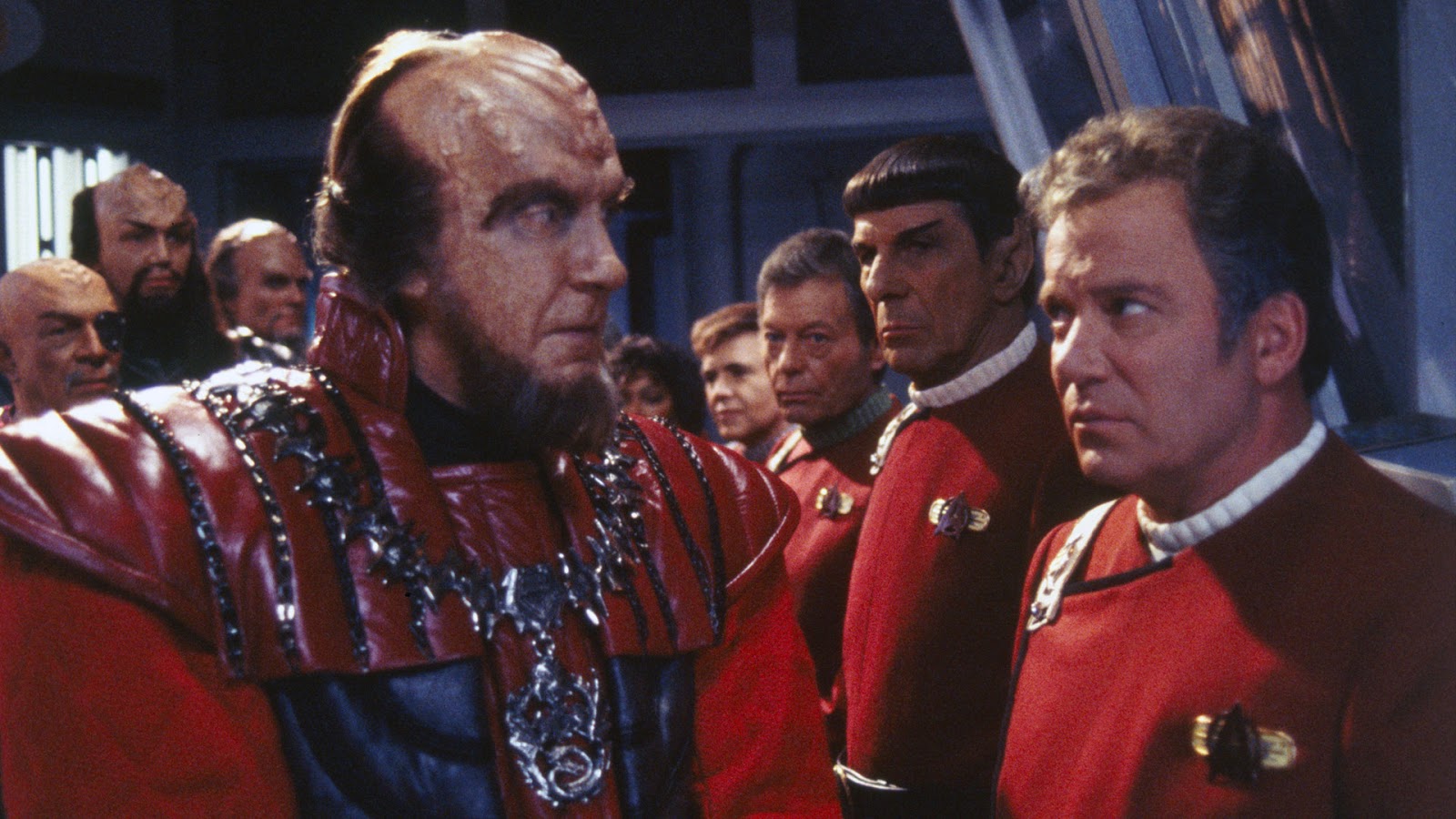
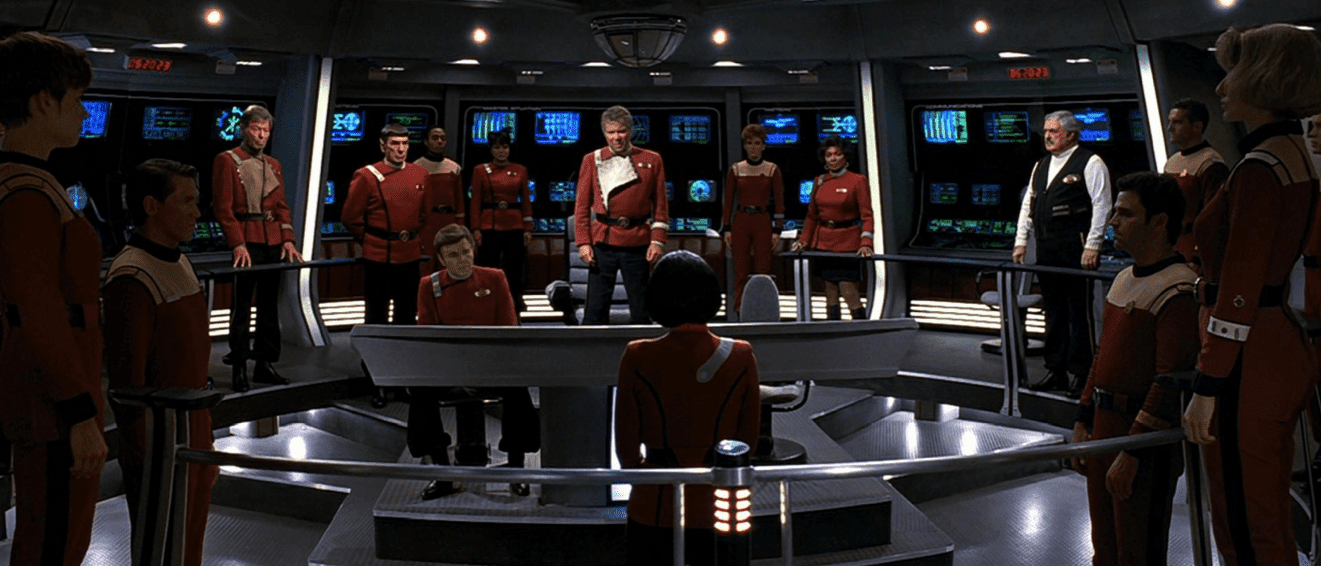
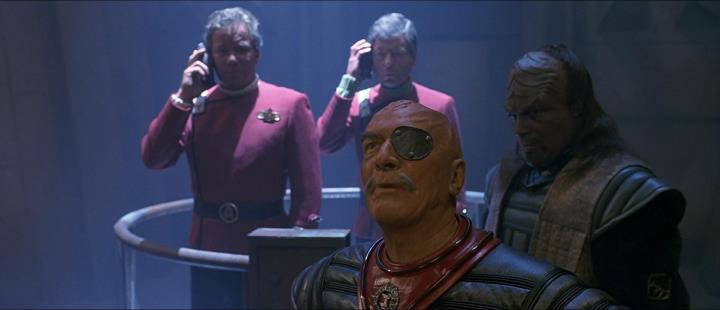
This film follows the final mission of Kirk (William Shatner) and company. There has been a disaster on the Klingon moon Praxis, which has devastated the Klingon economy and left them with no choice but to enter peace negotiation with the Federation, to try and end the Cold War that has existed for generations between the two powers. Sound familiar? While Spock (Leonard Nimoy) has been one of the leading negotiators with Klingon Chancellor Gorkon (David Warner), Kirk is reluctantly roped in to provide an escort for the Klingons to a peace conference. Kirk, and many of his crew, are weighed down with decades of prejudice and suspicion of Klingons (attitudes that erupt in a tense dinner between the Enterprisecrew and many of the equally suspicious Klingons). Kirk and McCoy (DeForest Kelley) however find themselves in trouble when Gorkon is assassinated and the two men are arrested and put on trial by the Klingons. Will Spock save them? Can they save the peace talks? Time for one last adventure.

Star Trek VI very nearly didn’t happen. The previous film, written and directed by Shatner, was a disaster, a messy, strange, flat-footed, cheap-looking adventure that was a huge flop, won several Razzies and nearly killed the series off. So it’s great that the cast got a chance to have one final swan-song in their parts – and that this basically turned into the most intelligent film they had made since Star Trek II. No surprise that Nicholas Meyer, an articulate, literate and intelligent novelist turned film-maker, was the common link between them. Not weighed down by Star Trek lore, nor the breezy “I’m above this” contempt that other directors in the series have had, Meyer understands what makes good Trek – a strong story, compelling character arcs, intelligent writing and a good balance between adventure and themes that resound with contemporary depth.

Star Trek VI was written as the Berlin Wall fell, and it’s a neat commentary on the sort of attitudes you would have seen in America and Russia at the time. Gorkon’s name even echoed Gorbachev (and Lincoln as well). But this isn’t just a historical parallel with the modern world. Instead Meyer also uses this to explore the attitudes of his characters. Like Star Trek II, this works into a neat deconstruction of Kirk’s persona. Kirk has to confront not age here (as in that film) but instead his own out-of-step anger, prejudices and refusal to change. At the same time, the film also explores Kirk as a man who can overcome his instinctive hostility, to make himself a better man. It’s such rich complexity that it’s no wonder I got sucked into a life-long love for Star Trek.

All this makes a fabulous framework for the strongest, most high-stakes entry in the franchise. Meyer’s direction is spot on: simmering with tension in the first half, investing every scene with a creeping intensity and rumbling sense of disagreement. He also works brilliantly with the regular cast, who turn in some of their best performances in this film: Shatner in particular reins in (mostly) the ham for a thoughtful and intelligence performance, while Kelley mixes deadpan snarks with a world-weary resignation. Nimoy also goes further than he has for a long time with Spock, who struggles under the surface with a host of emotions, from hope, pride, guilt and fury all bubbling away under that cool Vulcan façade. The rest of the cast also get moments to shine. 

This is a film that barely puts a foot wrong in its entire first act. From the opening explosion of Praxis – with a hugely exciting sense of danger as Sulu’s Excelsior starship gets caught up in the shockwave – through to the trial of Kirk and Bones, this film is tonally spot on. We understand completely the hostility and distrust Kirk feels towards the Klingons, just as we appreciate on a deeper level his desire to make the peace talks work. The awkward encounters with the Klingons simmer with an unspoken racism from the Federation characters (many of the cast reported being uncomfortable with the imperialist and superior tone their characters had to take), and a hostile resentment from the Klingons. The eventual assassination attempt has a grim inevitability about it, but is expertly shot and edited (a zero-gravity assault by two assassins on Gorkon’s disabled ship). The show-trial itself is like a nightmare of injustice. It’s scintillating and compelling stuff.

While the pace does slacken slightly when Kirk and McCoy find themselves in a Klingon prison camp – we are, by the way, introduced to the prison camp via a speech from the commandant eerily reminiscent of the greetings handed out in Bridge on the River Kwai – it never loses the audience’s attention. And it powers back up for a brilliant all-action, at first totally one-sided, fight between the Enterprise and a Klingon ship en route to the peace conference. A large measure of the film’s atmospheric success should also be given to the extraordinary score by Cliff Eidelman, a brilliant combination of familiar themes and fast-paced orchestral work, one of my favourite film scores.

And Shakespeare? Where does he come into it? Largely through Christopher Plummer, playing General Chang, the man who emerges as principal antagonist. Plummer’s exuberant performance is perfect for this larger-than-life warrior – a man who loves nothing more than reading Shakespeare “in the original Klingon” (one of many examples of the film’s wit). Plummer lets rip throughout the film, quoting endlessly from virtually every Shakespeare play you could imagine, just this side of ham. Plummer is also, for my money, the best villain this series had. But how could you not love a film where the villain rotates round in his command chair shrieking gleefully “Cry havoc and let loose the dogs of war!” Or says farewell to Kirk early on with a cheeky “we have heard the chimes at midnight…”. It’s possibly the best introduction to how great Shakespeare is that you can have.

But then that’s just part of Meyer’s witty, literate script, which throws in quotes from Conan Doyle and JM Barrie to Adlai Stevenson and Neville Chamberlain, and has Spock tells Kirk he’s the perfect choice for a mission to the Klingons as “there is an old Vulcan saying: only Nixon can go to China”. With stuff like that how can you not enjoy the film? It also understands the warmth between the main cast, their sense of character. The whole film combines an elegiac tone with a triumphant final mission, the passing of an era – with the final moments of the film capturing this, from its Peter Pan quote (“First star to the left and straight on until morning”), to the signatures of the cast appearing on the screen, literally signing off on their Star Trek careers.

The whole film is perfectly pitched like this. Every moment works from the off, and the action and adventure is balanced by some wonderful comic moments and beats of high tension and drama. The film’s use of the Cold War in Space as a backdrop works really well, and sheds a new light on attitudes in the franchise that have never really been touched before. It’s well acted, directed with flair and skill (the final space battle is brilliantly assembled), and the score is fantastic. There is a reason why I inflicted this film on my best man and ushers the morning before my wedding: it’s got a special place in my heart and it always will.

Ship of Fools (1965)

Simeone Signoret and Oskar Werner are just part of the kaleidoscope of humanity in Ship of Fools

Director: Stanley Kramer

Cast: Vivien Leigh (Mary Treadwell), Simeone Signoret (La Condesa), José Ferrer (Siegfried Rieber), Lee Marvin (Bill Tenny), Oskar Werner (Dr Wilhelm Schumann), Elizabeth Ashley (Jenny Brown), George Segal (David Scott), José Greco (Pepe), Michael Dunn (Carl Glocken), Charles Korvin (Captain Thiele), Heinz Rühmann (Julius Lowenthal), Lilia Skala (Frau Hutten), Barbara Luna (Amparo), Christiane Schmidtmer (Lizzi Spokenkieker), Alf Kjellin (Freytag), Werner Klemperer (Lt Huebner)

Stanley Kramer was the man who went his own way in Hollywood. Struggling to find work after returning from the Second World War, he set up his own production company which quickly specialised in critically acclaimed “message” films. It’s the sort of film making that hasn’t always aged well. Kramer’s style hasn’t often either – even at the time he was seen as achingly earnest and worthy. Ship of Fools was the sort of perfect project for him: a massive best-selling novel about a huge subject, humanity itself. It was about big themes and it felt really important. It was perfect Kramer material.

In 1933, a ship sails from Mexico back to a newly Nazified Germany. On board, the passengers and crew blithely continue their own personal dramas and obsessions – it really is literally a “ship of fools”, as we are informed in the film’s opening by wry observant German dwarf Carl Glocken (Michael Dunn) who serves as an occasional chorus. On board: a faded Southern Belle (Vivien Leigh) desperate to recapture her youth; a failed baseball player (Lee Marvin) bitter that his career never took off; a young artist (George Segal) intent on only drawing serious subjects to the frustration of his girlfriend (Elizabeth Ashley); a bigoted, bullying Nazi (JoséFerrer) trying to start an affair with an attractive younger blonde (Christiane Schmidtmer); a Jewish jeweller (Heinz Rühmann) who thinks the Nazi party can’t be that dangerous; and ship’s doctor Willi Schumann (Oskar Werner) who finds himself increasingly fascinated with La Condesa (Simeone Signoret), a drug addict and a social campaigner being transported to prison in Spain. Truly, the whole world is on board this boat! (Or so you can imagine the poster saying).

The success of the individual moments in Ship of Fools rise and fall depending on the level of engagement you feel in each of these stories. It’s a curious mixture of tales, some of them dancing around deeper meanings, some playing like dark farce, some plain self-important rubbish. What’s abundantly clear is Kramer feels this is all leading towards meaning something, though whether he gets anywhere near expressing what this something is really isn’t clear. In fact the only real categorical message I could take about this is that humanity has a tendency to fiddle whole Rome burns – and that of course the Nazis are bad. 

There is an attempt to suggest a world in microcosm – and some have argued that the smorgasbord of characters are basically like facets of one person’s personality – but really what many of these stories are deep down are soapy pot-boilers, brought to life by good writing and fine acting. Kramer marshals all these events with a professional smoothness: there is something quite admirable about the fact he clearly sees the director’s role as more like a producer’s, someone there to service the story and actors more than to cover the film with flash. It might not make for something compellingly visual, but it is refreshing.

What Kramer is less successful with is the heavy-handed importance the film gives its serious moments. Most infamous is a moment when Glocken and Jewish trader Julius Lowenthal are sitting on the veranda, listening to the band while chatting about current affairs in Germany. “There are nearly a million Jews in Germany. What are they going to do? Kill all of us?” Julius jovially states – the band music obviously ends the second he stops speaking, filling the screen with a chilling silence. It’s the sort of moment that is supposed to make us feel the chill of the oncoming storm – but instead feels manipulative and portentous. Every moment like that lands in the same way – the film is delighted with its exploration of these shallow people, very pleased with knowing the Nazi destruction is on the way. 

This self-important bombast dates the picture more than anything else in it. Nothing dates as badly as pretension. It’s a film that feels like it’s been made very consciously to make you think, and which wears its attempt to capture every level of society – from poor Spanish workers to rich Nazis – very heavily. It also makes obvious points: naturally the only true act of self-sacrifice comes from a poor Spanish worker, while the rich passengers can scarcely look past their own concerns. 

When it isn’t being self-important, the film too often finds itself mired in soapy rubbish. The plotline featuring George Segal as a failing artist and Elizabeth Ashley as a frustrated girlfriend is tedious beyond belief, a slog through the worst kind of coupley drama that adds very little to the film. A further plotline around the companion of a wheelchair-bound intellectual, obsessed with an exotic dancer on the ship, could sit just as easily in Coronation Street as it could in a highbrow drama like this.

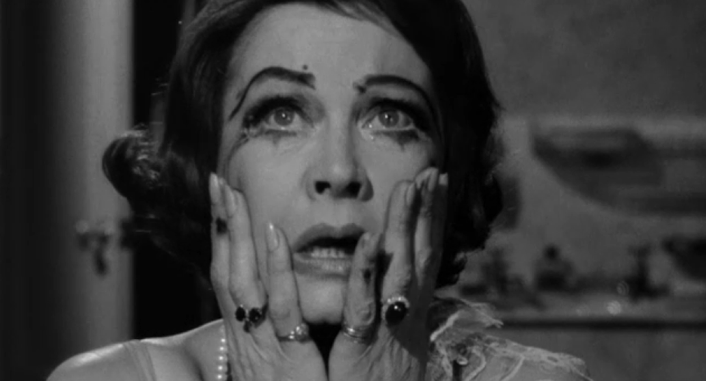
Despite all this, I have to say much of the acting is very strong – even if many of the actors are cast very much to type. Vivien Leigh, in her last performance, struggled with immense psychological difficulties during shooting, but brings a heartfelt realism to divorced Southern belle Mary Treadwell (an even more heartfelt version of her Blanche DuBois than in Streetcar). Kramer also allows her one of the film’s few moments of imaginative spontaneity when she suddenly bursts into a Charleston before stumbling back to her hotel room. 

Carrying a lot of the film’s emotional weight are Oskar Werner and Simeone Signoret (both Oscar nominated) as an unlikely romantic coupling. Werner brings great depth and sadness to the world-weary doctor who finds himself irresistibly drawn to Simeone Signoret’s Countess. Signoret channels her distant, fragile imperiousness from Les Diabloques and Room at the Top to marvellous effect as a woman struggling with an indolent drug addiction but who feels a genuine responsibility to the world. The quiet scenes between these two are the closest the film gets to touching some distant meaning, even if it never quite gets there – and again the points deep down are fairly straight forward.

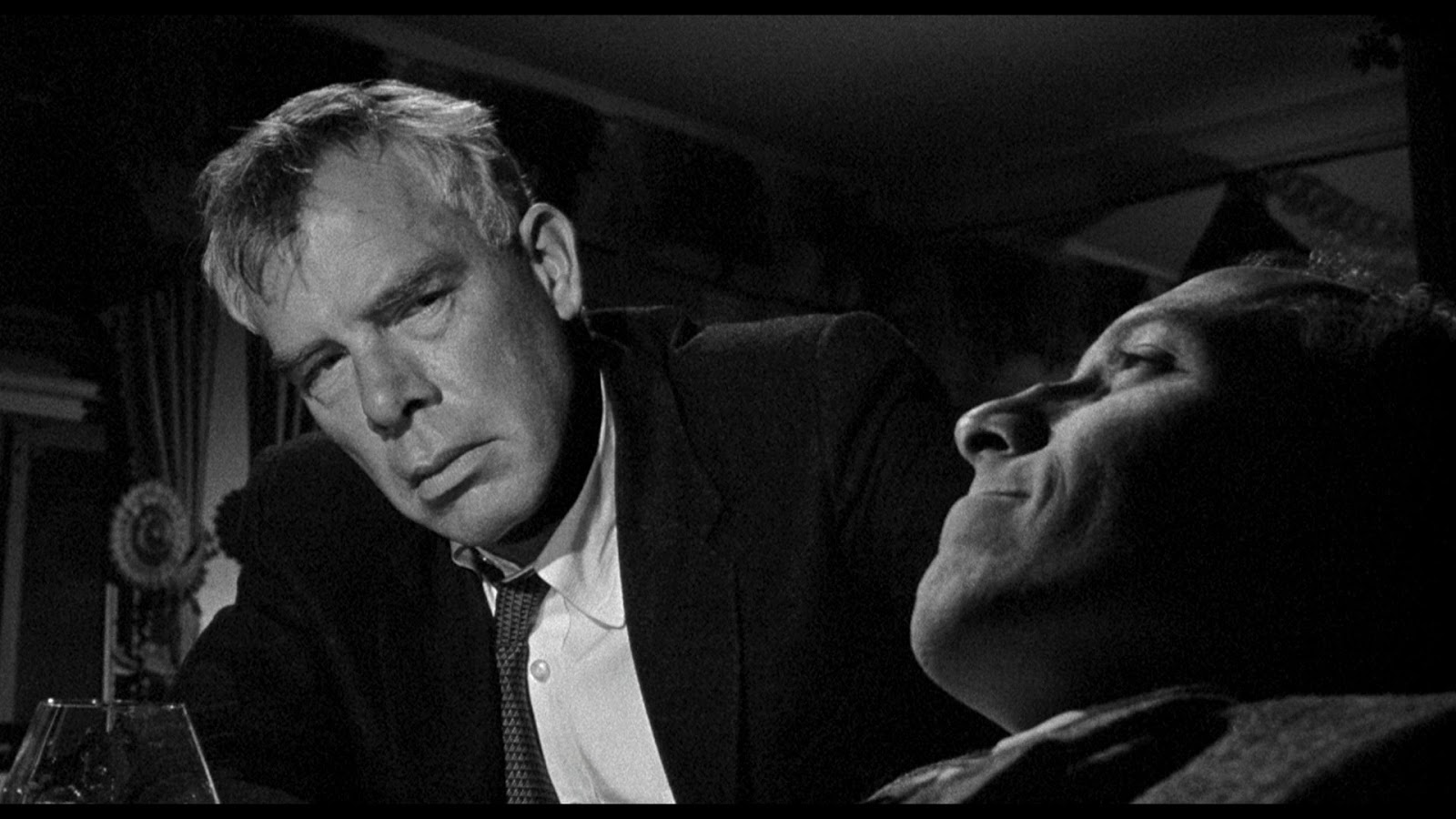
For the rest of the cast, there is hardly a weak link. Heinz Rühmann, in his only English-speaking role, campaigned heavily for the role of Jewish trader Julius and he is magnificent. José Ferrer swaggers convincingly as bullying Nazi Siegfried, even if he is saddled with the most obvious, poorly written, character. Michael Dunn (also Oscar nominated) makes a lot of his role as charming chorus and commentator. Lee Marvin is terrific as the frustrated and bitter baseball player. Charles Korvin gives a lot of depth to the thoughtful and compassionate captain.

Ship of Fools has plenty of moments of enjoyment. But as a whole it’s always a little self-consciously important, too determined to push you to be aware of the messages it wants you to take home. As the final shot sees a camera crane inexorably down onto a swastika you feel smacked around the face with the film wanting you to know that the darkness was just around the corner. The dread of Nazism should hang over the film like a shroud but instead it feels so repeatedly stressed to us that it loses all impact. The film wants us to know that we know more than the characters, and goes out of its way to remind us so that we can pat ourselves on the back when we spot the irony. Despite much of the quality of acting and dialogue, it gets wearing after a while.

Creed (2015)

Sylvester Stallone and Michael B Jordan keep the flag flying in Rocky relaunch Creed

Director: Ryan Coogler

Cast: Michael B Jordan (Adonis Creed), Sylvester Stallone (Rocky Balboa), Tessa Thompson (Bianca), Phylicia Rashad (Mary Anne Creed), Graham McTavish (Tommy Holiday), Wood Harris (Tony “Little Duke” Evans), Ritchie Coster (Pete Sporino), Anthony Bellow (“Pretty” Ricky Conlan)

Remember Rocky IV? It’s a bizarre film that opens with the plot twist of Apollo Creed, Rocky’s rival-turned-friend, slain in the ring by a Russian fighting monstrosity. Well that film, for all its rubbishness, partly redeems itself by being the jumping-off point for this spirited and well-made re-launch of the series. (Strange as it is for a film as grounded as this one to bounce off from such a bizarre piece of 1980s nonsense as Rocky IV.)

Adonis Creed (Michael B Jordan) is the son of Apollo  Creed from an extramarital affair. Adopted as a young boy by Creed’s widow Mary Anne (Phylicia Rashad), Creed grows up to be a man who yearns to fight as a boxer – although whether this is motivated by a desire to get closer to his father or to try and outdo him the film subtly plays around with as a major theme. He approaches Rocky Balboa (Sylvester Stallone) to train him, who eventually reluctantly agrees, inspired by seeing something of himself in the young man. When Creed unexpectantly lands a title shot – while Rocky deals with increasing ill health – both men have to come together to fight for their pride and future. 

Creed is a film that captures what works about this franchise, and repackages basically a very familiar story (this is almost point-for-point a Rocky remake) with a great deal of dynamism. Coogler, a talented and original director, brings imagination and intelligence to essentially pulpy material and makes something old seem new again. It does this while still homaging the previous films (even the rubbish ones!) at several points, from small stills on the walls of Rocky’s restaurant, to bit-part characters, to the marvellously beguiling score that gently riffs on the familiar motifs from the series.

It’s also helped by a fine performance from Michael B Jordan with a pretty much spot-on re-interpretation of the Rocky character in a new form. Jordan’s Creed is impulsive and quick-tempered, but also kind and charming. In fact it’s refreshing to have such a clean-living and well-brought up hero centring a film! Jordan gets some intelligent and subtle character work over Creed’s mixed feelings for his father: both resentful of never knowing him and also desperate to gain a sort of posthumous approval. It’s a basic daddy-problems story line but it’s done with a lot of subtlety.

Stallone’s performance as the ageing, slightly world-weary, lonely Rocky is another stand-out. This film’s Rocky is punched out, weighted down by life and unable to get over the sadness of his wife’s death; he sees young Creed as both a chance to find a new family and a reminder of his guilt over Apollo’s death. It’s a fine performance he gives here, detailed, moving and pretty much perfectly judged, with real moments of humour among the pathos. There is also an extraordinarily subtle make-up job on Stallone to make him appear far weaker and vulnerable than he actually is. It’s probably his best performance since the original film.

Coogler’s direction is spot-on, the pacing of the film is pretty much perfect. He shoots the fight scenes with particular freshness, the camera darting in and around the fighters as they beat each other in the ring. This immediacy adds a lot to these sequences – although the heavily choreographed fights, while great cinema, barely resemble a real boxing match! The film also balances really well both the training montages (many of which affectionately homage similar sequences from the early films) with a sensitive and well-constructed romance plotline between Creed and singer Bianca (well played by Tessa Thompson, who makes a lot of what is on paper quite an underwritten part).

It’s not perfect, don’t get me wrong. The decision to cast actual boxers in pivotal roles doesn’t always pan out, not least Anthony Bellow as Creed’s title rival (surely it’s easier to train up an actor than try to teach a boxer to act). For the English viewers it’s hard not to feel a few sniggers at the slightly strange sight of a title fight taking place at Goodison Park of all places (surely this film is the closest any Everton fan has got to seeing major silverware). 

But its affectionate reworking of the tropes of the series works really well, it’s extremely well-acted, it has intelligent character work for both Creed and Balboa who become fully rounded and intriguing characters, and it’s very well directed. It becomes a film about the importance of family as much as it is about legacy, about the two lead characters having to come to terms with the loss of their loved ones and build a new family. For all that the events in the film are pretty close to a straight re-tread of Rocky, this is such a lovely, heartfelt film it’s hard not to like it a lot.