Author: Alistair Nunn

The Testament of Dr Mabuse (1933)

The Testament of Dr Mabuse (1933)

Lang’s masterful mix of gangster thriller and supernatural psychological drama is superb

Director: Fritz Lang

Cast: Rudolf Klein-Rogge (Dr Mabuse), Otto Wernicke (Inspector Lohmann), Oskar Beregi Snr (Professor Baum), Gustav Diessl (Thomas Kent), Wera Liessem (Lilli), Karl Meixner (Hofmeister), AE Licho (Dr Hauser), Theo Lingen (Karetzky), Klaus Pohl (Muller), Theodor Loos (Dr Kraum)

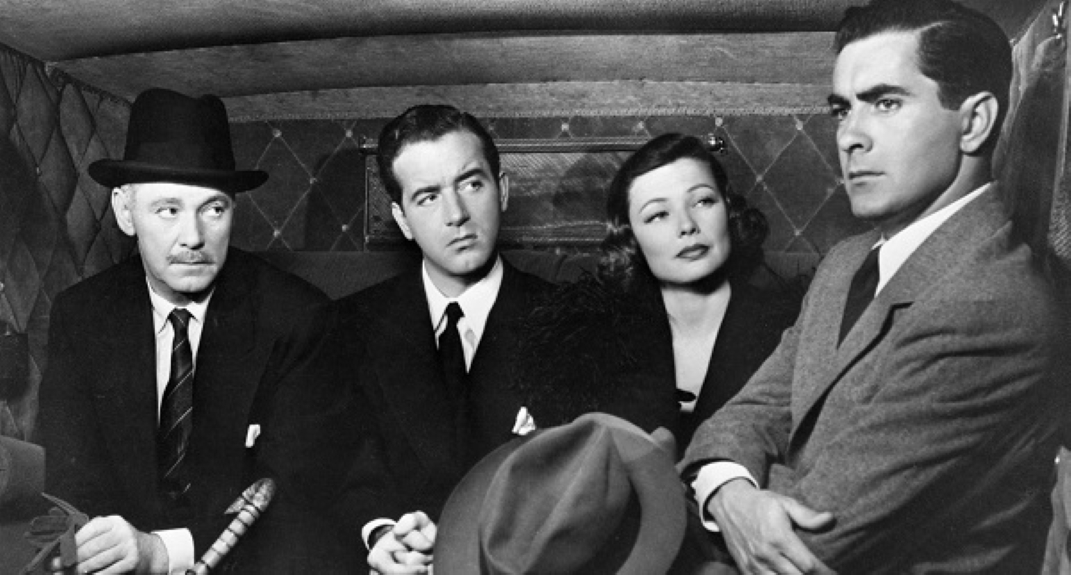
Did Fritz Lang invent the concept of the cinematic universe? Or after completing M, did he just wonder what it would be like if his detective Lohmann (Otto Wernicke) took on the dastardly criminal mastermind Dr Mabuse (Rudolf Klein-Rogge) from his earlier epic crime drama. Either way, the hero and the villain from those two very different films face-off in The Testament of Dr Mabuse, a pacey crime melodrama spliced with a spooky ghost story, that rattles its way through a scintillating story tinged with the whiff of the dread of Nazism.

It’s eleven years after Mabuse’s reign of terror ended with him catatonic and under arrest. In a psychiatric hospital under Professor Baum (Oskar Beregi Snr), who sees him as a fascinating case study of deluded genius, Mabuse has not spoken in years instead filling his days with endlessly scribbling a series of blueprints and schemes for the criminal underworld, focused on destabilising the country and corrupting the currency. But, despite being under lock and key, a secret society of criminals is carrying out Mabuse’s scribbles, seemingly under the guidance of the man himself. Can death, when it comes, really take Mabuse? Or are Lohmann’s suspicions that the dread hand of the Great Unknown still controls events, even from beyond the grave, correct?

Lang’s gangster film throws together some of the best elements of all his German films. This is a pulpy gangster thriller, full of action, shoot-outs and explosions mixed with the unsettling double exposure appearance of ghosts and shady, unknown powers manipulating events. It’s Scarface meets A Christmas Carol, with Mabuse as a dreadful Marley’s Ghost causing devastation and chaos even after death. The Testament of Dr Mabuse sees realism meet thriller meet supernatural powers, but brilliantly combines all three up into a propulsive thriller.

And it’s a film, more than any of Lang’s others, about the malign influence of Fascism. For what is Mabuse’s dogmatic lust for chaos and destruction, but a terrible prophecy of the horrors Hitler would unleash. Mabuse, like the Fuhrer, is interested only in destruction wanting to pull the world down to rule over the ashes, to reforge the remains into his ideal vision of reality. His paranoid ramblings – and the spectral, transparent (brilliant use of double exposure at the technical possibilities of cinema, as always from Lang) presence he becomes parroting the same mantra of the nobility of destruction – are about leading the country into a morass of destruction. No wonder The Testament of Dr Mabuse was almost immediately spiked by Goebbels. Hitler’s magnetic powers of persuasion and control were surely the real-world apotheosis of Mabuse’s skills.

Mabuse’s powers are so great that even death can’t slow him down. Today it doesn’t take long to figure out exactly who the real mastermind – or after-death puppet of Mabuse’s – might be. As wardens in the hospital say, even in silence the fixed, controlling glare of Mabuse is enough to bend minds to his will. The rantings of his testament – Mabuse’s Mein Kampf – merely add to the force of his stare. Even the echo of Mabuse’s name will turn former police detective Hofmeister into a gibbering wreck. His power is absolute.

No wonder he appears after death, disfigured post-autopsy, his eyes bulging, to continue to direct his puppets, his ghostly form directing their actions. It’s a wonderful visual expression of the hypnotic control Mabuse had over his victims, that they continue to see his controlling, ranting form – across a desk or guiding them down corridors – even after they’ve gone. Mabuse’s ghostly form will literally emerge out of the body of his underling, crossing to sit opposite him and pour more instructions in his ear.

Ordering his underlings from behind a curtain that hides his true face, Mabuse’s commands are absolute and its threats always delivered. The gang, each a series of cells who work together only when instructed, are nearly all brain-washed fanatics, accepting orders without question. Much like Hitler, Mabuse’s followers cover a vast range, not just common criminals, or trigger-happy loons but also the middle-class and professional, in thrall to the words of a mad man promising a new dawn (sound familiar?) Much like in Mabuse’s hey-day, any deviation from absolute loyalty is met with swift, fatal punishment. What chance does Thomas Kent (Gustav Diessl – a spitting image for the young George Sanders) have when he decides the gang life is too risky for his girlfriend?

Up against this, Lang places his hero from M and his accustomed detailed fascination with the mechanics of investigation. The Testament of Dr Mabuse mixes this analysis of things like the forensic translation of scratches on a windowpane, with this outré pulpy set-up of Wizard of Oz-like criminal masterminds. The world of Lohmann is one of order and methodical investigation, grounded in realism and detail. It’s an adjustment for Lohmann who, in M, was more the jovial face of a failing institution – here he’s the last bastion of reasonable authority.

The Testament of Dr Mabuse is full of shrewd political observations – but it’s also a supremely entertaining film. Few directors were as good at crime drama set-ups than Lang. The film’s opening sequence, showing Hofmeister tracking the gang through a warehouse, is a masterclass of the tension of imminent discovery, then of explosive (literally) violence during a chase. A gorgeously inventive bomb sequence – where a flooded room is the best chance of safety – is another masterpiece of slow burn tension, while the insidious threat of Mabuse’s voice creates a miasma of terror.

That sequence plays beautifully into Lang’s increasing comfort with, and mastery of, sound. The film opens with a pounding heart-beat on the soundtrack as freelance investigator Hofmeister hides in the factory where Mabuse’s men assemble their latest schemes, capturing the fear as he constantly ducks and hides to (unsuccessfully) avoid detection. The sound of machinery grows to overwhelm the film and, as Hofmeister flees, his barracked by the sounds of engines and rolling oil-filled barrels that burst into flames. Sound skilfully stresses mood and bridges scenes, controlling mood and atmosphere and adding to the air of distrust and disturbance.

The technique shines out of several stunning set-pieces. A traffic light assassination – another masterpiece of sound – is a brilliant piece of gangster-ish business, the gangsters using a crescendo of car horns to cover a fatal shot. Watching its slow build-up and the carefully paced release of information to the audience (the presence of the killers, the gun, the tension of the wait) you can see why Lang often felt Hitchcock got a lot of credit for things he had invented.

Fast-paced and thrilling, it’s a perfect extension of both Lang’s previous films, a brilliantly unsettling and disturbing drama wrapped up in a gangster package. It’s supernatural touches are just the right side of psychological drama, a portrait of obsession and a fractured mind. A perfect expression of Lang’s mastery of mixing the high and low brow into an engaging, thought-provoking and thrilling package.

Hello Dolly! (1969)

Hello Dolly! (1969)

Bloated, miscast and over-produced musical that nearly sank the genre and studio

Director: Gene Kelly

Cast: Barbra Streisand (Dolly Levi), Walter Matthau (Horace Vandergelder), Michael Crawford (Cornelius Hackl), Marianne McAndrew (Irene Molloy), EJ Peaker (Minnie Fay), Danny Lockin (Barnaby Tucker), Joyce Ames (Ermengarde Vandergelder), Tommy Tune (Ambrose Kemper), Judy Knaiz (Gussie Grander), David Hurst (Rudolph Reisenweber), Louis Armstrong (Band leader)

The old-fashioned musical had always been a winner for Hollywood. So, I guess it made perfect sense to pump $25 million (just over $200 million in today’s money) into Hello Dolly!. Reality didn’t agree though. Hello Dolly! was a massive box-office bomb which, despite its seven Oscar nominations (including Best Picture, due to intense studio lobbying) pretty much killed the traditional, Freed-style musical stone-dead. After this, musicals would have drama at their heart (like Fiddler on the Roof or Cabaret) and scale down the production numbers.

It also didn’t help that the mega-budget, colossal production values across its bum-numbing two-and-a-half hour run time ruthlessly exposed Hello Dolly! as a perilously slight story, in a way its years playing on Broadway hadn’t. Dolly Levi (Barbra Streisand) is a widowed matchmaker, hired by grumpy “half-a-millionaire” Horace Vandergelder (Walter Matthau) to find him a wife. However, Dolly rather fancies getting back into the game with Horace herself. Around them other parties flirt, such as Horace’s niece Ermengarde (Joyce Ames) with artist Ambrose Kemper (Tommy Tune) and his clerks Corenlius Hackl (Michael Crawford) and Barnaby Tucker (Danny Luckin) with fashion store owner Irene Molloy (Marianne McAndrew) and her assistant Minnie Fay (EJ Peaker).

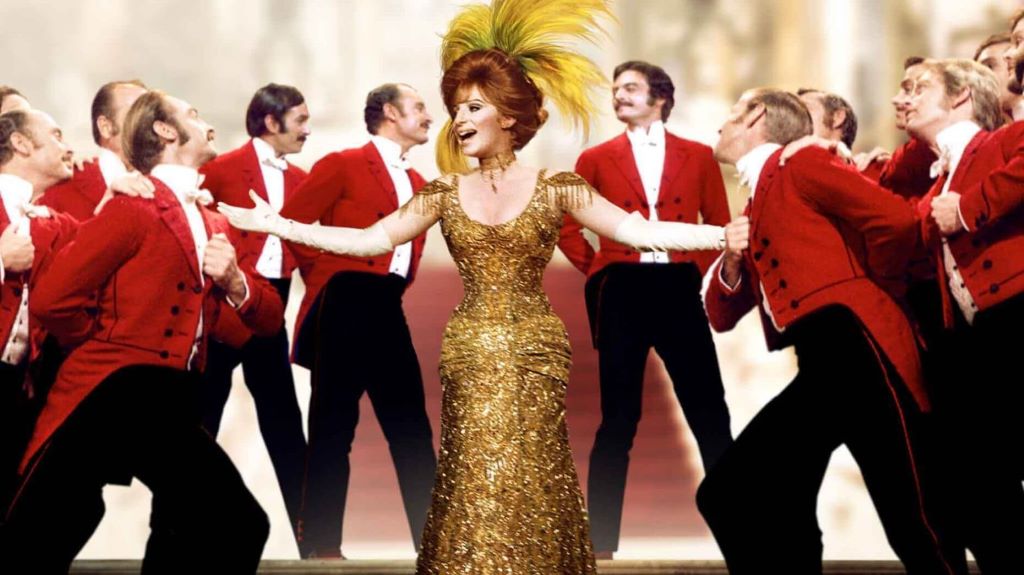
I’ll grant the scale and sets are impressive. Whole streets and parks were built. Grand, elaborate costumes (some of Streisand’s costumes cost thousands and thousands of dollars by themselves) add wow factor. If you believe “more is more” Hello Dolly! is for you, it’s Oscar for set design well deserved. But as you watch Streisand hit a high note in long shot while an entire parade of thousands takes place around her, you start to realise you’ve not formed a bond with the characters. When we finally get them all in one place (a crowded restaurant in New York) the best part of thirty minutes is taken up with three massive numbers (Dancing waiters! Streisand’s entrance number! Comedy foot-tapping from Crawford! Louis Armstrong cameo!) that piles so much stuff on, that you almost forget what the scene was meant to be about in the first place.

What this probably needed to be is a tighter, American in Paris style romantic comedy, the sort of stuff Arthur Freed would have run out in 100 minutes with a few set pieces. Instead, it’s a bloated mega-production with colossal sets, 12,000 extras, widescreen soaking up the action and vast, never-ending dance numbers that fail to progress either story or emotion. After being bludgeoned by balletic leaps, you suddenly realise not only has nothing much happened, but you are being asked to invest in the future happiness of characters you barely know and often hardly even like.

It’s not helped by the chronic miscasting of the leads. Barbra Streisand was the hottest star in town – the studio was (correctly) convinced mega-stardom was inevitable after watching the rushes of Funny Girl – but she is wrong on almost every level for Dolly Levi. A part intended for a slightly-over-the-hill widower in her late 40s, was barely retrofitted for a glamourous diva aged 26. Streisand, clearly painfully aware she was wrong for the part, struggles to work out how to play it. Sometimes she’s coquetteish, other times she goes for a mother-in-law largeness, most of the time she ends up channelling Mae West sauciness. While her singing is (of course) outstanding, she never looks comfortable. Equally out-of-place is Walter Matthau, whose grouchy comedy style never meshes with the tone of the film (although he has a great bit of business with a walking stick which he hammers down onto a table with such irritated force it almost rebounds and hits him in the face).

It also doesn’t help that Matthau and Streisand all-too-clearly can’t stand each other (their closing kiss is hilariously awkward – try replicating their physical positions to see how unnatural and unromantic it is). On set Matthau felt Streisand was too big for her newcomer boots while Streisand saw him as envious of her star quality. The two frequently fell into heated rows: this at least meant they fitted in naturally on a set where almost no-one got on. Streisand and Kelly’s working styles (both being demanding perfectionists) proved incompatible, Kelly stopped speaking to the official choreographer who also stopped speaking to the costume designer.

With the leads struggling, most of the film’s charm actually relies on its secondary leads. Hello Dolly! is, actually, an effective showcase for Michael Crawford’s physical dexterity (some would say recklessness) and his sweet romance with Marianne McAndrew’s charming Irene Molloy is the film’s emotional heart. It’s a shame both their film careers effectively ended here (though Crawford would go on to greater things on stage). Their dance number Elegance is one of the film’s most engaging while their duet It Only Takes a Moment is the simplest filmed and most moving moment in the film.

Bloat and bombast overwhelms the rest. Although Kelly knows how to shoot dancing – effective camera moves and having the dancers move towards the camera, increasing their dynamism is very well done – he’s far less suited to the character moments which Stanley Donen and Vincente Minnelli excelled at. The gags very rarely land, either because the timing is off or the camera is so focused on getting the mammoth sets in that the bits of business look like minor irrelevances.

Fundamentally, Hello Dolly! bet the house on throwing all the budget on the screen to wow audiences the way something like The Great Ziegfeld had over thirty years ago. But audiences needed an emotional connection with what they were watching. Hello Dolly spectacularly fails to deliver on this. What we were left with is a very slight story about matchmaking, basically a chamber piece with about six characters, transposed onto the sort of epic backdrop that makes Gone with the Wind look humble. The mismatch never works and the entire enterprise eventually collapses under its own gravitational pull. A box office dud that nearly sank the studio, the musical would never be the same again.

Nyad (2023)

Nyad (2023)

Swimming biopic relies on strong performances as it delivers expected strokes

Director: Elizabeth Chair Vasarhelyi, Jimmy Chin

Cast: Annette Bening (Diana Nyad), Jodie Foster (Bonnie Stoll), Rhys Ifans (John Bartlett), Karly Rothenberg (Dee Brady), Jeena Yi (Angel Yanagihara), Luke Cosgrove (Luke Tipple), Eric T Miller (Jack Nelson)

Diana Nyad was a champion endurance swimmer in the 1970s, but one major achievement eluded her: the 110-mile swim from Cuba to the tip of Florida at Key West. Estimated to take about 60 hours, it involves wild currents, difficult weather conditions and wild sea creatures with a support crew who can do nothing to help other than advise, keep her on course and provide food. The swim must be completed unassisted and without rest. A failed attempt in 1978 aged 28 was one of her last swimming feats for almost 30 years. Turning 60, Diana decides to dive back into the water and attempt it once again.

Nyad brings this story to the screen, refashioned into a comfortably feel-good sports biopic that presents Diana’s story within the expected framework of the cliches of the genre. There is almost nothing in Nyad that you haven’t seen before. Lessons are learned, people walk from the swimming campaign only to return for “one more adventure”, we discover there is no I in team and no solitary athlete ever truly works alone. Settle down for seeing the same sort of material you’ve seen in many other films before, and you won’t be disappointed.

The thing that makes Nyad different is the performances at its heart. Annette Bening (Oscar-nominated) trained for a year in preparation for this role, large chunks of which are spent watching Nyad charge forward through choppy open waters. On land, Bening skilfully balances Nyad’s prickly self-obsession with a vulnerability and fear of defeat. A demanding perfectionist who accepts no compromise, Nyad frequently rubs her team up the wrong way, but Bening never makes her unsympathetic. She’s a woman keen to prove something to the world and to herself, not least that age doesn’t define our horizons.

Our warmth to the tunnel-focused Nyad largely comes from the delightful chemistry between Nyad and her coach, ex-girlfriend and best friend Bonnie Stoll, delightfully played by the Oscar-nominated Jodie Foster. This is some of Foster’s finest work in years, an exuberant, playful, incredibly natural performance of a woman who is, in her way, as driven as Nyad, determined to protect her charge. It’s Bonnie who frequently needs to salve the wounds left by Nyad, hold the team together and make the difficult calls to continue or abort Nyad’s attempts. Foster’s performance is a burst of life in the film, providing its real heart.

The two dominate much of the film, although there is a room for a fine performance of curmudgeonly decency from Rhys Ifans as late navigator John Bartlett. But this is film that works best when focused on the two leads, be it Bonnie surprising Nyad with a birthday party, the two unashamedly celebrating watching a competitor’s attempt fail on television, Bonnie tending Nyad’s injuries, or the two arguing with the honesty that platonic life partners have. All of the film’s most memorable moments feature Foster and Bening bouncing off each other on land.

So, it’s a bit of a shame that a large part of the film takes place in the water. One of Nyad’s major failings is that it never really finds a way to make the act of swimming either truly dramatic of visually interesting. It is a tough challenge – after all, marathon solo swimming is (by its very nature) silent, monotonous, and in long stretches not exactly compelling to watch. But Nyad falls back too often into sequences that feel either artificial – look out there are sharks in the water! – or reliant on Life of Pi style visuals (no coincidence surely that film’s Claudio Miranda also shoots this one) to try and bring to life the hallucinations long-distance swimmers can suffer from after over 50 hours of non-stop physical effort. We get Bening swimming through magical light shows and an underwater Taj Mahal, but this feels like an attempt to give us something to look at rather than a flourish that gives insight into theme or character.

It’s a common theme of the film. Nyad often has watery-framed flashbacks to her younger self, pushed to achieve great things at an early age and suffering sexual abuse from her coach as a teenager. But, again, these revelations feel unconnected with the drama we are watching, making the repeated flashbacks to it feel unnecessary. The only time the subject comes up in the main plot line, Nyad brusquely closes the conversation down, insisting she has not been made into a victim and briskly moving on.  The film concurs in wanting to avoid defining Nyad in any way by this abuse. But it does leave you wondering why in that case the film so frequently returns to the issue.

At times it feels like Nyad has struggled to turn the act of someone swimming into drama. Instead, it relies on those standard sporting movie events. The initial success, the struggle, the break-up, the lessons, the heart-warming triumph. Nyad doesn’t find any time to explore the on-going debate around Nyad’s achievement (her poor record-keeping led to Guinness Book of Records refusing to recognise it) but that would get in the way of the triumphant ending. It’s a middlebrow film that relies pretty much exclusively on its actors for spark: fortunately, especially in Foster’s case, they provide it.

Distant Voices, Still Lives (1988)

Distant Voices, Still Lives (1988)

Davies beautiful memory piece is quite unlike any other film in its poetic virtuosity

Director: Terence Davies

Cast: Pete Postlethwaite (Father), Freda Dowie (Mother), Lorraine Ashbourne (Maisie Davies), Angela Walsh (Eileen Davies), Dean Williams (Tony Davies), Jean Both (Aunty Nell), Michael Starke (Les), Debi Jons (Micky), Chris Darwin (Red), Pauline Quirke (Doreen)

When we study the past and our memories, we see an assortment of recollections of events and motionless snapshots of moments in time. The past can feel both distant and still, a long-ago series of happenings that our mind constantly shuffles and reinterprets depending on circumstance and situation. That vibe lies at the heart of Terence Davies’ poetic dive into that foreign land of memories, where events, people and snatched moments combine, shift and contrast in a visual attempt to reproduce our own sifting of our past lives.

Distant Voices, Still Lives follows the post-war lives of a working-class Liverpudlian family. Father (Pete Postlethwaite) is a depressive tyrant, who oscillates between moments of tenderness and acts of extreme violence. Mother (Freda Dowie) is a saint-like victim, who tries her best for her children. Maisie (Lorraine Ashbourne), Eileen (Angela Walsh) and Dean (Tony Davies) grow up, marry and forge their own lives in the community, sometimes repeating the mistakes of their parents, all in largely warm and welcoming working-class community.

Terence Davies based much of Distant Voices, Still Lives on his own upbringing and memories of his family (a framed photo on the wall is of Davies’ own father). Shot with a rich, slightly sepia-toned classicism, the entire film replicates both the random workings of memory and watching a carefully constructed slide show. Events frequently are only tangentially connected to those preceding and following them: a memory of a marriage in the family, activates memories of the now-absent father at both his best and worst, a Christmas when he was affection itself, another when he overturned the dining room table in a sudden fury and demanded it cleaned up. It continues throughout the film, the narrative sliding from pre- to post-war, dictated more by tone and mood than by narrative.

It requires that you pay close attention to Davies’ film, to sift yourself through its moods and subtle shifts in tone. It opens with a carefully managed tracking shot that takes us inside the family house at an unspecified time, then fixes on a still shot on the staircase, while we hear conversation all around us. Is this happening at the same time? Or are we merely hearing the echoes of conversations past? In this film the past is both all around us and tantalisingly out of reach. Distant Voices, Still Lives is made up of frequent stationary, carefully assembled shots that resemble Mitchell and Kenyon photos that suddenly spring into movement (the image of the family preparing the wedding looks so like a photo, it’s a shock when all four actors suddenly walk out of frame). It’s a reminder that, to many of us, the past is a series of still lives, frozen in time.

Around everything, in a Dennis Potterish touch, is wrapped a musical backdrop of songs from the 40s and 50s. These tunes bring people together, knit together memories and (perhaps) even cover over and confuse events. Music is crucial in unity, the family and their friends frequently breaking into extended sing-alongs to popular tunes in the pub. It provides moments of warmth, closeness and intimacy – moments of mutual joy – which perhaps covers and balances the complex relations and struggles at home. It also makes the film often feel like an odd musical, like a sort of living slide show of images scored by the classics of yesteryear.

Distant Voices, Still Lives can be seen as a sort of poetic art installation, with its balance of still images bought to life and its poetic rhyming of events and persons. But it manages to involve the viewer, because it’s a very human film. There is real warmth and compassion in these memories and reflections. The love of a family, pulling together to survive trauma at home. Those moments of release in singing. The joy and delight – and tears – of coming together to watch a film at the cinema, swept up in the big screen emotion and imagination. Davies also finds a simple, pure beauty in the everyday: watching mother carefully tend and clean the house takes on a strange, natural beauty and power in the care and tenderness that lies behind it.

That’s particularly striking, considering the unflinching horror at home. Pete Postlethwaite is extraordinarily terrifying as a deeply unhappy and depressed man, who can process his complex feelings (and even, bizarre as it seems, his love for his family) only through anger and violence. He viciously beats his children and (in one terrible scene) his wife. He is charming and sweet with their friends. He oscillates between affection and fury. His children – particularly his son – are torn between despising the old man and wanting something – anything – from him in the way of affection. (Eileen will later bemoan his absence – due to death – at her wedding, to the disbelief and anger of her brother who often bore the brunt of his beatings). Davies’ film carries real power in its opening half, dominated by Postlethwaite’s tragic dark-heart, the ruler and gate-keeper of his home until his health collapses and he reverts to vulnerability.

The terrible impact on mother – beautifully played by Freda Dowie, in an extraordinary performance that feels like it’s been pulled direct from Davies’ memory of his own mother – dominates the emotional thread of the film. It also adds a dread to the possibility that Eileen’s own husband shows traces of jealousy and violence. But then the world is one of danger: the war could have ended the lives of the whole family (there is a striking sequence where they run trying to find their parents during an air raid warning, before finally finding the shelter and being greeted with relief and inevitable anger by their father). An accident nearly cripples Dean and Maisie’s husband – it’s echoes recurring throughout the film. Echoes touch nearly every moment of Davies film, flashes of memories activated by memories pulling together the film into an engrossing and heartfelt tapestry.

But the film’s real impact comes from the humanity that grounds it. It perfectly captures a moment of time, the bonds and interdependence of a working-class community in a film extraordinarily textured into something like a fictional documentary. The film is crammed with small moments of joyful intimacy, among the trouble and strife: friends laughing together, joy in music and film, laughing faces at shared jokes. All of this is shot with an exactitude that never manages to squash the tenderness at its heart. It’s a uniquely artistic, inventive and warm exploration of memory and time, with very few films even remotely like it – and rewatching it is a reminder of what a loss to cinema Terence Davies, a truly unique film-maker, is.

Dungeons and Dragons: Honour Among Thieves (2023)

Dungeons and Dragons: Honour Among Thieves (2023)

Delightful fantasy action-adventure, well-made fun that leaves you with a warm glow inside

Director: Jonathan Goldstein, John Francis Daley

Cast: Chris Pine (Edgin Darvis), Michelle Rodriguez (Holga Kilgore), Regé-Jean Page (Xenk Yendar), Justice Smith (Simon Aumar), Sophia Lillis (Doric), Hugh Grant (Forge Fitzwilliam), Chloe Coleman (Kira Davis), Daisy Head (Sofina), Jason Wong (Dralas), Bradley Cooper (Marlamin)

I can’t be the only person who had low expectations heading into Dungeons and Dragons: Honour Among Thieves. A swords-and-spells epic based on a game that is a by-word for geeky sadness? No wonder quite a few people said “count me out”. Well, they were wrong. D&D: HAT is a left-field treat, a bouncy adventure that is both loads of fun and also true to the spirit of the original game, full of content for fans while welcoming newcomers with open arms. This is the sort of treat that years from now people will remember as one of the best adventure films of its era.

Set in the world of Dungeons and Dragons – and don’t worry about the overwhelming backstory and cultures of this sprawling role play game, they only intrude when essential to the plot – our heroes are crooks-with-hearts-of-gold: former-Harper (a sort of heroic knight) turned thief Edgin Darvis (Chris Pine) and his best friend, barbarian warrior Holga (Michelle Rodriguez). They’ve been banged up in an arctic prison after a job-gone-wrong, escaping only to discover they were betrayed by oily conman Forge (Hugh Grant), who has used their incarceration to turn Darvis’ daughter Kira (Chloe Coleman) against them. To win her back – and find an amulet that could bring Edgin’s late wife back from the dead – they assemble a team for a dangerous quest. One that could become even more dangerous, since Forge is in league with evil red witch Sofina (Daisy Head).

Perhaps the best thing about D&D: HAT is that it never takes itself too seriously, but also never laughs at or looks down on its source material. It sounds easier than it is: pulling off this sort of trick is extremely hard. Lean too far one way, and the jokes can suggest the cast and crew feel contemptuous about what they doing; go too serious, and the po-faced treatment of a parade of silly names and gobbledegook backstories practically invites the viewer to laugh at it. D&D: HAT though is bouncy entertainment that knows exactly when to ease off the gags for moments of drama, danger and emotion to really land. If you’d told me I’d get a bit choked up watching the end of a role-play game adaptation, I’d have said you were mad.

Pretty much every scene provides a little piece of comic business that delights, almost all of them perfectly executed by a director and cast whose affection for the original material shines out. Watching D&D: HAT you get the impression it must have been fun to make – and to successfully make that sense of fun be shared by the viewing audience is a real challenge to pull-off (take a look at the horrific Thor: Love and Thunder). But there is a real charm here that means emotional plots about loss of a partner, father-daughter divides, broken marriages, traumatised children and persecuted victims carry real impact because we invest in the characters.

That’s in large part due to some knock-out performances of comedy vigour. Chris Pine is the perfect lead for material like this: charming and fun to be around, witty without ever trying too hard (he’s the master here of the throwaway pun) but skilled enough to make us see the heart and yearning below the surface of a fast-talking trickster with a line for everything. He sparks wonderfully off the gruff Michelle Rodriguez, whose surliness hides depths. Fellow gang members Justice Smith and Sophia Lillis (both Americans juggling, it has to be said, very good accents) match them perfectly, turning potentially one-note characters into heartfelt heroes.

D&D: HAT also manages to be true to the spirit of playing games like this. Goldstein and Daley wisely avoided the obvious idea for a film of D&D (“people playing the game in the real world are sucked inside it!”) to instead create the wild, improvisational tone of the game where your decisions guide the narrative. Like gamers, our heroes are a disparate collection of people and species, all with different skills that complement and conflict, given a loosely-defined mission and responding to unexpected curveballs thrown at them by the invisible game runner (the scriptwriters and directors) that keeps them on their toes.

It also captures the way best laid plans in the game can go awry (a portal in a picture, foiled by a picture falling face down onto a stone floor) or how a sudden unlucky movement (or random dice roll) can lead to disaster – a moment perfectly captured where a laboriously detailed series of instructions about crossing a bridge are rendered moot when a character absent-mindedly places a rogue foot on the first stone and instantly collapses it. The characters have a constant feeling of flying by the seat of the pants, much like D&D players often do, and D&D: HAT wonderfully captures this improvisational wildness on screen.

It’s also a very entertaining spells-and-swords romp. There are some great set-pieces, not least a sequence in a sort of lava-filled mine (with the inevitable dragon – both dungeons and dragons make several appearances throughout) and a wild and crazy chase through a death-filled maze arena. The film throws in some inventive Ocean’s Eleven style trickery to get out of difficult situations. In all these moments the cast’s energy, likeability and blend of wit and heart makes each development sing and ensures even routine plots (Can wizard Simon overcome his self-doubt? Can persecuted animagus Doric learn to trust?  Can Holga learn to be honest to the people she loves? Can Edgrin learn to put other people’s needs first?) become tender and engrossing plotlines.

It bounces along perfectly, all hugely entertainingly and with a real winning charm. It spices things up just right with some brilliantly engaging comic turns: no one does slimy insincerity better than Hugh Grant (hysterical), while Regé-Jean Page is a revelation as a hilariously earnest super-powered knight, the only character who really speaks like you sort-of-expect a po-faced D&D character to. Above all, it’s huge fun with a lot of heart. I’ve seen it twice and it knocks spots off almost every other blockbuster for the last couple of years, being purely enjoyable, clever, funny and sweet.

L’Argent (1983)

L’Argent (1983)

Bresson’s final film: challenging, cold, hard to watch, definitely leaves you thinking

Director: Robert Bresson

Cast: Christian Patey (Yvon Targe), Vincent Ricterucci (Lucien), Caroline Lang (Elise), Sylvie van den Elsen (Grey haired woman), Michel Briguet (Grey haired woman’s father), Beatrice Tabourin (Ka photographe), Didier Baussy (Le photographe)

Robert Bresson is today so widely acclaimed as one of the patron saints of cinema, it’s odd to think that in 1983 at Cannes he was furiously booed when he won the director prize for L’Argent. But Bresson’s style had always been divisive – before the vindication of history – and L’Argent, his final picture, is one of the purest, most uncompromising slices of Bressonism you are likely to see, not to mention an uncomfortable and deeply challenging work of art. Uncompromising in almost every sense, it is a film that climbs under your skin and troubles your mind for days after watching.

Based on a short story by Leo Tolstoy, L’Argent’s theme is the corrupting influence of money. Two rich kids, troubled by the small allowance from their parents, forge a 500 Franc note and exchange it for change in a photography shop. The owner, keen to get rid of the offending note, instructs his assistant Lucien (Vincent Ricterucci) to pay working-class Yvon Tonge (Christian Patey) with it. When Yvon uses it in a café, he is arrested and charged, his pleas of innocence ignored. Losing his job, with a wife and child to support, Yvon slides down a slippery slope encompassing theft, jail time, tragic bereavement and murder leaving him a brutal shell of the man he was before.

Bresson’s film deals with the inexorable inevitability of fate, once it is prodded in a certain direction by the destructive forces that govern our world. Those forces are themselves governed by cold, hard mammon and the selfishness and casual cruelty of those who have it or want it. Bresson’s film is littered with shots of hands at work – nearly always that work involves the passing of bank notes from one place to another. Money is what makes the world go around – it dictates power and privilege and it fundamentally decides who is believed and who is punished.

Yvon can plead in vain he is innocent of passing fake notes, because no one is going to listen to a working class joe with scarcely a penny to his name rather than the vouched-for employee of a respectable middle-class businessman. Yvon even ends his first court case by being rebuked for bringing into disrepute the names of such thoroughly respectable people. By contrast, when concerned her son might get caught up in the whole filthy affair, the mother of one of the original forgers simply hands over a wedge of cash to the cheated shop-owner to make the problem go away. Money talks.

And it has cast its verdict on Yvon, deciding he should be chewed up by the system and spat out a very different man. From the moment we first see Yvon arrested for the false note, we know he is doomed. Just as we know, from seeing Yvon’s first reaction to being accused (a violent shove that sends a waiter tumbling and glass smashing on the ground) that there is a capacity for violent revenge in him. Later, like a dim echo of this first moment, glass will shatter again on another floor, dropped by a grey-haired old woman hiding the fugitive Yvon. It’s a salutary reminder (one the film delivers on, with chilling impact, a few minutes later) that Yvon has a darkness that can harm others.

It’s a hardness sharpened by time in prison. Returning to the fertile ground of A Man Escaped, Bresson offers a chilling indictment of the prison system. Formal, cold and uncaring, it is a breeding ground for resentment and rage. The authorities read all incoming mail, but in no way think about its contents and the impact it will have on the receiver (the mail reading room is a voyeur’s paradise, the chance to observe the secret goings on of everyone before they even know it themselves). Incoming mail discovers Yvon’s sick daughter has died and his wife is leaving him for good. No attempt is made to support Yvon who quickly succumbs to rage (looking to strike a mocking fellow inmate with a metal serving spoon), punishment by isolation and a suicide attempt through stockpiling chill-pills (much easier to shut inmates up rather than help them).

Throughout Bresson shows the onslaught of cruel events on Yvon with his characteristic spare style (no music, well drilled actors, perfectly timed shots, composed to convey information in the most economical style possible). But L’Argent is also a film strikingly devoid of moral judgement. It’s very much left open to us when, how and why we may or may not lose sympathy with Yvon. After all we truly see him suffer, after trying his very best to play by all the rules (reporting where he got the fake note from, telling the truth in court) only for him to lose everything.

Is there a chance for redemption for Yvon? He discovers money talks and the world is fundamentally uncaring (after all it took his freedom, child, wife and a large part of his mental health). Photography shop assistant Lucien reaches the same conclusion: he’s been fleecing his crooked boss for weeks (‘I thought crooks looked after each other’ he tells his boss) but decides on one last theft to redistribute the wealth to the needy. Same conclusions, different methods to punish the world.

Yvon however decides to no longer restrain the dark impulses within him. He murders senselessly twice, grabs a few notes from a hotel cash desk and then finds himself protected be a selfless older woman (who he encounters initially eyeing up for theft). Staying in her home, her family in the same house, what will he do with this woman who does good things and expects nothing in return?

L’Argent is far from an optimistic film, with a hard-working family man turned into a family-free convict. In this uncompromising film, the final sequence is almost unwatchable in its bleak, terrible power as Yvon commits his final, inevitable, sins with a passion-free fixity of purpose almost impossibly horrible to watch. Bresson’s perfectly constructed film, full of detailed, clockwork precision has been slowly building to this horrific end, a natural one for a film highlighting the uncaring cruelty of the modern world.

Because money also doesn’t care about the damage it leaves, the collateral deaths or the cost on those on the margins. Was it this hopeless, systemic, inevitability the viewers at Cannes found so worthy of boos? The progress of events, one connected to another (and L’Argent, despite its structured formalism, is full of events of the least-Bressonist you can imagine, including a car chase) that forms a terrible, unsettling and unreassuring picture? Bresson leaves our judgement of Yvon entirely up to us: Tolstoy’s novella looked at the journey of redemption for its lead character. Bresson shows us the crimes and nothing else. If there is to be redemption or forgiveness we must ask ourselves if we can do it.

Serpico (1973)

Serpico (1973)

Pacino is sensational in this sensational and gripping anti corruption thriller

Director: Sidney Lumet

Cast: Al Pacino (Frank Serpico), John Randolph (Captain Sidney Green), Jack Kehoe (Tom Keough), Biff McGuire (Captain McClain), Barbara Ede-Young (Laurie), Cornelia Sharpe (Leslie), Tony Roberts (Detective Bob Blair), John Medici (Pasquale), Allan Rich (DA Tauber)

Frank Serpico (Al Pacino) is a newly graduated cop in the NYPD. Passionate about changing the world, Serpico wants to clean up the streets – but not at any cost. The aggressive tactics and jobsworth disinterest of many of his colleagues infuriate him while his bohemian style and view that the way to be really effective as an undercover cop is to look like the people he investigates alienates other cops. As Serpico’s experience grows, he discovers the NYPD is overflowing with corruption and on-the-take cops, hoovering up cash and protection money and turning blind eyes. But when Serpico decides to do something about it, he puts himself in the firing line. Literally.

Serpico captures the anti-authoritarian fury of 70s cinema. Who can you trust when your suspicions of those who are supposed to enforce the law are right – they are as dirty, if not more so, than the criminals? Serpico mixes police thriller with paranoid conspiracy thriller, rotoscope filming placing everything in chilling focus, the grimy streets of New York a world where injustice is rampant and the powers-that-be will do anything to maintain the corrupt status quo.

Pacino grips the role of Serpico with the sort of fire-breathing force that made him a phenomenon in the 70s. Pacino transformed himself for the part, prowling the roughest neighbourhoods of New York for research and burying himself under a mountain of shaggy hair. Serpico was shot in reverse, so Pacino could progressively shave off parts of his mountain of hair, starting his work with the jaded, disillusioned Serpico and stripping back into the fresh-faced rookie (there is a neat joke in the fact that the naïve young Serpico looks the spitting image of Michael Corleone).

It’s a performance of bubbling, dizzying intensity, that dominates the film (Pacino is in nearly every scene), with Pacino slowly more and more coiling up with wild, frustrated tension. Edgy, fidgety but searingly naturalistic, Pacino gives this larger-than-life figure a searing sense of moral certainty and rigid principles, a man who slowly realises the world is not what he thought and increasingly furious at its essential shittiness. What Pacino understands is that Serpico doesn’t want to be a crusading whistle blower – he just wants to be a cop, but won’t sit back and watch his colleagues laughing with crooks. It’s a stunning, passionate, technically and emotional superb performance, from an actor at the pinnacle of his powers.

Serpico is a chilling exploration of police corruption. It’s casual, everyday and all evasive. From the free sandwiches handed out by café owners (“If I pay can I get what I want?” Serpico asks and is promptly told to shut up) to the casual brutality handed out to suspects. For a man like Serpico who wants to change the world, it’s a nightmare, even before a stuffed brown envelope is dropped into his hand and he’s urged to take it and shut up. It sits alongside crippling indifference: he can’t even arrest two rapists he spots on the street because the detective running the case is on leave (“They’re here now!” he screams down the phone before taking matters into his own hands.)

All this and more makes Serpico stick out to other cops. In an NYPD still overwhelmingly made-up of white, middle-class besuited guys (the collection of potential undercover cops in a training lecture are hilariously uniform in more ways than one) he’s a bohemian. Interested in the arts, reading books, listening to classical music and watching ballet. In his spare time he dates actresses and hangs out with arty types. He’s a world away from the cops, who view him with mistrust and a potential threat in more ways than one (a fellow cop, disgusted at overhearing Serpico talk ballet, accuses him of soliciting in the department bathroom and won’t be shaken in his belief).

So, he’s in huge danger when he eventually decides he can’t close his eyes to his army of colleagues on the take, but must do something about it. He’s already been warned that the answer “I don’t know” to the question if he would always vouch for any cop is the wrong answer. In a world where Lumet makes clear cops see as sharply divided between themselves and everyone else, where taking some extra payments is a perk of the job, someone like Serpico won’t be tolerated.

Inevitably the system turns on the whistle-blower. Serpico’s fellow cops close ranks, his superiors fob him off or treat him with suspicion. His colleagues move swiftly from offering to hold his cut in trust, to asking why he just doesn’t donate it to charity to finally loathing him. Eventually he’s an isolated, despised figure, padded down for wires, routinely ignored in the precinct and unable to trust anyone (rightly so, since the film opens at the end with Serpico shot after a raid, possibly by a cop, before flashing back to his graduation). And the ‘outside bodies’ he brings in? They move like slugs and Serpico’s disgust at their focus on scalps and not systemic change just re-enforces his isolation.

Serpico was shot quick and dirty on the streets of New York (Lumet shot in 51 days with editor Dede Allen editing each scene as it was finished). Lumet’s immersive camera throws the viewer straight into the gritty world of New York in the 70s, and the city has rarely ever felt more like a wretched hive of scum and villainy. It’s dirty and filthy with danger on every corner. There is virtually no sense of community or public duty and everyone, cops and robbers, are solely out for what they can get. It’s a brutal, terrifying world where injustice and violence are just part of the rations.

Wonderfully directed by Lumet, it’s powered by a tour-de-force performance of sheer, dynamite genius from Pacino in one of his greatest (and most overlooked) roles. Serpico is a searing indictment of a world that creates a friendly atmosphere for corruption and wickedness and where doing the right thing leaves you victimised, isolated and in a hospital bed with a bullet in your cheek.

Separate Tables (1958)

Separate Tables (1958)

Guilt and shame under the politeness in this stagy and almost-very-brave Rattigan adaptation

Director: Delbert Mann

Cast: Rita Hayworth (Anne Shankland), Deborah Kerr (Sibyl Railton-Bell), David Niven (Major David Angus Pollock), Burt Lancaster (John Malcolm), Wendy Hiller (Pat Cooper), Gladys Cooper (Mrs Maud Railton-Bell), Cathleen Nesbitt (Lady Gladys Matheson), Felix Aylmer (Mr Fowler), Rod Taylor (Charles), Audrey Dalton (Jean), May Hallett (Miss Meacham), Priscilla Morgan (Doreen)

Bournemouth’s Hotel Beauregard offers comfortable rooms and separate tables for dining. No wonder it’s popular with a host of regulars and out-of-town guests. But at each of those separate tables, drama lurks. Unflappable Pat Cooper (Wendy Hiller) manages the hotel and is secretly engaged to John Malcolm (Burt Lancaster), a down-on-his luck writer a little too fond of a pint in The Feathers. Their secret relationship is thrown into jeopardy when John’s ex-wife Anne (Rita Hayworth) arrives from New York, keen to get John back. Meanwhile, Major Pollock (David Niven) hides a secret behind his “hail-fellow-well-met” exterior, one which will threaten his place in the hotel and friendship with mousey Sibyl (Deborah Kerr) – a woman firmly under the thumb of her domineering mother (and resident bully) Mrs Railton-Bell (Gladys Cooper).

Delbert Mann’s film merges two Terence Rattigan one-act plays into a single, respectable piece of middle-brow Masterpiece Theatre viewing, which Mann subsequently effectively disowned (even after its seven Oscar nominations) after losing control of both editing and scoring to producer Lancaster. (Mann, quite rightly, loathed the hilariously out-of-place Vic Damone crooner number “Separate Tables” that opened the film.) Mann had already replaced Laurence Olivier, who dropped out after Lancaster’s company felt the film needed two American stars to make it box-office (handily they chose Lancaster himself and his business partner’s fiancée Rita Hayworth).

Lancaster and Hayworth are incidentally the weak points in the cast, their Americanness hopelessly out of step with Rattigan’s extremely English style and setting. Both actors are all too clearly straining to “stretch themselves” in unlikely roles, giving the film a slight air of self-indulgence. (Hillier later archly stated her best scene from the original was handed to Hayworth, while Lancaster recut the film to move up his first entrance.) The will-they-won’t-they tug-of-war between the two of them is Separate Tables’ least interesting beat and it’s to the film’s detriment that it, and these two awkwardly miscast actors, dominate so much of the film’s middle section.

They were already playing the dullest half of Rattigan’s double bill. Rattigan’s passion, and by far the film’s most electric moments – even if they only really constitute just under a half the runtime – revolve around the scandal of Major Pollock. Pollock, it is swiftly revealed, is not only prone to exaggerate his class, schooling and military career (his knowledge of alleged alma mata Sandhurst and the classics is revealed to be sketchy at best) but also carries a secret criminal conviction for harassing young women in a cinema.

While such harassment is of course recognised as beyond the pale today, it’s very clear in Separate Tables that Pollock’s misdeeds are standing in for a crime that literally “dare not speak its name”. Rattigan was one of Britain’s most prominent closeted homosexuals and his original intention had been for the Major’s crime to be fumbled cottaging. In the 50s it was unspeakable for the lead to be a sympathetic frightened homosexual so, in what looks bizarre today, it was far more acceptable to make him a timid sexual molester. However, the subtext is very clear, unspoken but obvious. One only has to hear the tragic Major sadly say “I’m made in a certain way and I can’t change it” and talk about his shame and loneliness to hear all too clearly what’s really being talked about here. Isn’t the Major’s pretence about being “the Major” just another expression of the double life a gay man had to lead in 1950s Britain?

This sensitive and daring plot is blessed with a wonderfully judged, Oscar-winning performance by David Niven (dominating the film, despite being on screen for a little over 20 minutes – the shortest Best Actor winning performance on record). Niven had made a career of playing the sort of suave, debonair military-types Pollock dreams of being – so there might not have been an actor alive more ready to puncture that persona. Recognising a role tailor-made for him, Niven peels away the Major’s layers to reveal a shy, sensitive, frightened man, desperate for friendship and acceptance. His heart-breaking confession scene (clearly a coded coming out) is beautifully played, while the closing scene with its hope of acceptance gains hugely from Niven’s stiff-upper-lip trembling with concealed emotion.

Niven’s performance – (Oscar-in-hand he rarely felt the need to stretch himself as an actor again) – centres the film’s most dramatic and engaging content. The campaign against the Major is led by Mrs Railton-Bell, superbly played by Gladys Cooper as the sort of moral-crusader who needs to cast out others to maintain her own ram-rod self-perception of virtue. Cooper uses icy contempt and overwhelming moral conviction to browbeat the rest of the guests in a sort of kangaroo court into blackballing the Major, a neat encapsulation not only of the power of the loudest voice but how readily decent people reluctantly acquiesce to it to avoid trouble.

Her control has also crushed her daughter’s spirit. Deborah Kerr’s performance is a little mannered: Kerr works very hard to embody a mousey, dumpy, frumpy spinster and make sure we can see she’s doing it. But she works beautifully with Niven and her meekness means there is real impact when the mouse finally (inevitably) roars. The rest of the guests are a fine parade of reliable British character actors: Felix Aylmer reassuringly fair and May Hallett particularly delightful as a no-nonsense woman who doesn’t give a damn what people think and trusts her own judgement.

Linking all plots together, Wendy Hiller won the film’s other Oscar as the hotel manager. Hiller was born to play decent matrons, bastions of respectable fair play who reluctantly but stoically bear personal sacrifices as their own crosses. She’s a natural with Rattigan’s dialogue and brings the best out of Lancaster, as well as providing all the drama (and sympathy) in the film’s other plotline as a surprisingly noble “other woman”.

Separate Tables is a middle-brow slice of theatre filmed with assurance. But when it focuses on Major Pollock it touches on something far more daring and much more moving than anything else it reaches for. Here is true low-key, English tragedy: under a clear subtext, we see the horror of a man who pretends all his life to be something he is not and the terrible judgements from others when he is exposed. It’s that which gives Separate Tables its true impact.

The Trial (1962)

The Trial (1962)

Welles exploration of paranoia and guilt is an easier film to admire than like (or enjoy)

Director: Orson Welles

Cast: Anthony Perkins (Josef K), Jeanne Moreau (Marika Burstner), Romy Schneider (Leni), Elsa Martinelli (Hilda), Suzanne Flon (Miss Pittl), Orson Welles (The Advocate), Akim Tamiroff (Bloch), Madeline Robinson (Mrs Grubach), Paolo Mori (Court archivist), Michael Lonsdale (Priest), Arnoldo Foa (Inspector A), Fernard Ledoux (Chief Clerk of the Court)

It had never happened to Welles before: in 1960 producer Alexander Salkind shoved a series of literary works at him and said “make one of these into a film! Money no object and complete creative control!”. Welles wasn’t going to say no. It hardly mattered that he’d barely even let Kafka cross his mind before: he could see a way to do The Trial and, by God, he wasn’t going to pass up this chance. To purists, The Trial is one of the few “pure Welles” flicks – the one Welles shepherded from start to finish and more-or-less ended up with what he wanted at the end of it (no wonder he called it “his best picture” – although he said that about all his pictures at one time or another).

The Trial adapts, fairly faithfully, Kafka’s surrealist novel. Josef K (Anthony Perkins), a middle-management pen-pusher, is accused of a terrible crime without being told what it is. He stumbles from encounter to encounter, law court to law court, never given the ability to defend himself, spiralling down the rabbit hole with no sunlight. Welles’ The Trial captures this by turning Kafka’s work into a fever dream. Scenes link together with all the structural logic of a dream – locations seem randomly connected, with Josef turning corners and finding himself in courtrooms or opening cupboards to find surrealist sequences like his prosecutors being whipped by an angry functionary.

Welles shot much of the film on location in a single abandoned Parisian railway station, with the abandoned, decaying rooms redressed into a series of locations from the Advocate’s rooms, to a church to a law court. This was mixed with sequences shot in Zagreb industrial estates and a factory set made up of 850 extras banging typewriters in unison and all rising to end their working day at the same time. There is a horrible un-reality reality to The Trial, a deeply unsettling realisation you are watching something both set in a world real and impossible.

In fact, The Trial may be one of the most uncomfortable films to watch ever made in its innate understanding of the domineering terror of paranoia. Welles used a series of low angles and wide lenses to stress the oppressiveness nearness of walls and ceilings. Rooms always seem to loom in and crush the characters, with K himself frequently framed hemmed in by objects, walls and people. There is a sense of being “watched” in every scene – either from the oppressive bodies that surround K, or the prowling tracking cameras that follow him from location to location.

The Trial is a sort of paranoid’s wet-dream, a nightmare world where logic is gone, our lead character has no control over his movements or destiny and the entire world seems to be constantly bearing down on him and us. Who better to play the twitch-laden centre of this than Anthony Perkins. Awkward, uncomfortable and never anything-less than tense, Perkins features in almost every scene but always feels buffeted by events rather than controlling them. He makes K hugely uncomfortable with others – the many women who throw themselves at K he treats with suspicion mixed with terror. His self-loathing bubbles up whenever confronted with mirror images (such as Akim Tamiroff’s timorous Bloch), invariably reacting with barely disguised contempt.

What’s also interesting in The Trial is the possible insight into Welles’ character. The easy interpretation is to see K as Welles, the court standing in for the Hollywood machine that had shoved Welles from pillar to post and never given him a chance. But, if so, why did Welles urge Perkins to play the role as shiftily and uncomfortably as he does? There is an air of guilt around K throughout – as if The Trial was his nightmare about getting caught for whatever he did. Is this how Welles saw himself? How fascinating that this artistic behemoth read The Trial and seemed to see it as the paranoia of a guilty man. Did the film speak to a deep self-loathing in Welles himself? Did he, in the dark when the demons come, think he’d inflicted his destruction on himself?

It’s a fascinating idea and makes it even more interesting that Welles is all over the film. He plays the corpulent, arrogant advocate, meeting supplicants whole luxuriating in bed with his accustomed bombast. But he also speaks the film’s woodcut-illustrated opening parable (a story of a man waiting at a gate, that he moved from the books Priest to his faceless narrator). Welles’ tones are heard coming from a range of mouths as he overdubbed many of his Euro actors. He even speaks the credits. Everywhere you turn you see and hear Welles and it’s hard not to start to feel perhaps we are stumbling inside his own terrible fantasies. Perhaps The Trial is what Welles’ dreams (or nightmares) were like?

The feel of a nightmare often makes The Trial an uncomfortable and, if I’m honest, less than enjoyable watch for all the undoubted panache it’s made with. In fact, since the panache is partly designed to illicit that response, it’s almost a tribute to the film’s success. The Trial is masterful, but in its unsettling sense of paranoia also uncomfortable, although it’s fascinating to see Welles layering some (perhaps inner) guilt on top of Kafka’s tale of an innocent crushed in the system. Either way, there is plenty to admire if not love about The Trial.

Maestro (2023)

Maestro (2023)

Well filmed and acted Bernstein biopic, that doesn’t really get to the heart of its subject

Director: Bradley Cooper

Cast: Carey Mulligan (Felicia Montealegre), Bradley Cooper (Leonard Bernstein), Sarah Silverman (Shirley Bernstein), Gideon Glick (Tommy Cothran), Maya Hawke (Jamie Bernstein), Matt Bomer (David Oppenheim), Vincenzo Amato (Bruco Zirato), Michael Urie (Jerry Robbins), Brian Klugman (Aaron Copland), Zachary Booth (Mendy Wager)

You can’t fault his ambition. In bringing the family life of legendary composer, conductor and cultural icon Leonard Bernstein to the screen, Bradley Cooper pulls out all the stops in a medley of inventive staging mixed with single shot trust in actors. Maestro is, in many ways, a perfect capturing of Bernstein: dazzling, giddy film-making that never lets you really peek into its subject’s soul. It’s a hugely impressive sophomore effort, but not quite fully satisfying as a film.

It opens with the life-changing night in 1943 when a 25-year-old Leonard Bernstein (Bradley Cooper) stands in (with no rehearsal) to conduct the New York Philharmonic at Carnegie Hall for a packed crowd and millions listening on the radio. From there, Bernstein never stops his ascent, becoming one of the world’s leading conductors and a composer who triumphs in every genre. He also marries successful actress Felicia Montealegre (Carey Mulligan), in a marriage full of mutual love and support. But Bernstein is the epicentre of his own fame, whose primary sexual attraction is to men. Over the decades, his marriage bends, fractures and reforms as Bernstein’s numerous affairs and party-filled lifestyle increasingly alienate the loyal Felicia.

Maestro is shot with all the zest and energy Bernstein himself was full of. Cooper keeps the pace the brisk and frequently transitions between scenes with a bravura trust that we can keep up. We see Bernstein receive the phone call for that fateful stand-in performance in his apartment: jubilant, he runs out the door (stopping only to playfully slap the bottom of his lover David en route), the camera taking an angle above to watch the pyjama-clad Bernstein run through a series of halls and emerge into the auditorium of Carnegie Hall.

It’s one of several transitions that mix reality and fantasy. Felicia will turn around from Leonard, during a flirty date in an empty theatre, to stride forward to applause from a packed audience. Felicia and Leonard run from a snobby garden party straight into a theatre (again with an overhead shot tracking them in a single smooth cut) where dancers from On the Town pirouette on stage as a visual representation of Bernstein explaining his work, the dancers eventually luring Leonard, Felicia and several other characters into an impromptu ballet. It’s a playful mix of reality and fantasy. At other times, the film skips years in seconds, successes dizzyingly referenced in throwaway lines.

The film’s focus is Leonard and Felicia’s complex, multi-layered marriage. Two people, in many ways soulmates, deeply stress-tested by Leonard’s frequent selfishness. Cooper, in a remarkable physical transformation (his capturing of Bernstein’s voice, mannerisms and conducting style is faultless) makes the composer a force of nature, high on his own genius: garrulously charming, a man who can focus all his attention on one person as easily as he can absent-mindedly drop another. The sort of man who excitedly introduces his fiancée to his lover David (a sensitive Matt Bomer) and then abashedly apologises immediately after for springing the news on him.

It’s part of the message of that On the Town ballet: living with Bernstein is a never-ending, dizzying pile of social engagements that doesn’t stop ever. Felicia feels she is ready for that: but the drift of Bernstein’s primary emotional commitment away from her and towards protégé Timothy Cothran (Gideon Glick) deeply hurts her. It’s part of Bernstein’s increasing lack of care to at least pretend to keep his promiscuity under semi-wraps, including awkwardly dismissing unspecified “rumours” that have distressed his daughter Jamie (Maya Hawke, very good) as nothing more than “jealousies”.

As Felicia, Carey Mulligan delivers what might just be a career best performance. Luminous, she makes Felicia savvy, loving but realistic about the “sacrifices” loving Bernstein involves. It’s a marriage where she is often in Bernstein’s shadow – at one point literally so, a shot showing Bernstein’s giant conducting shadow dwarfing Felicia in the wings. Mulligan’s performance mines deep emotional depths, Cooper frequently showcasing these in long, still takes. Most strikingly, a dynamite argument in New York after the opening of Bernstein’s Mass plays out in one visceral shot as Mulligan conveys the release of years of tension, in angry home truths. She is also heart-breaking during the film’s affecting chronicle of Felicia’s cancer, another striking single-shot scene showcasing Mulligan’s skill at letting all pain play behind her eyes while talking to visiting friends.

Maestro is about the underlying strength between these two who always turn to each other at hours of need or emotional triumph. Felicia’s successes on stage are shared with Bernstein, while it’s she who accompanies him (after their unofficial split) to his ground-breaking Mahler concert in Ely (another virtuoso sequence, directed and acted by Cooper with aplomb). Bernstein abandons his career – and all other relationships – to nurse Felicia, their bond finally something that could not be shaken by his thoughtlessness.

However, Maestro fails at times to really show how this relationship buckled. The giddying speed with which it moves through events means the middle act and, in particular, the sense of Bernstein’s numerous affairs gets lost. When Felicia finally does erupt, it’s easy to think it’s due to one late night and Bernstein holding his lover’s hand during the Mass premiere, rather than years of slow emotional distancing. It’s one time when a montage, stressing the repetitive nature of Bernstein’s self-obsession, would have really made a positive impact.

It’s also a film that focuses so much on the relationship, it leaves Bernstein himself a curious enigma. Strangely, despite sampling Bernstein compositions throughout the film, its almost as dismissive of his musical theatre work as it implies Bernstein himself was. West Side Story gets barely a passing mention, On the Waterfront is bundled up with “film scores” and almost nothing of the rest of his work is placed in any form of context. The epic Mahler concert in Ely is brilliantly restaged, but its artistic importance never explained and it’s easy to come out of the film not really appreciating either Bernstein’s cultural or musical impact.

Instead, Bernstein remains somewhat of an enigma, a charismatic figure who, for all the excellence of Cooper’s performance, remains a showman we never get to really know, someone capable of great care and intimacy (he’s extraordinarily tactile) for people, but also keeps them (and us) at a distance. The affairs have a veil tastefully drawn over them. There is very little overtly gay content in Maestro, which feels a conservative choice.

It’s hard not to think at times Cooper is more focused in Maestro on demonstrating his own directorial invention and pushing himself to never go for the obvious shot. Maestro is a dazzling dive into the playbox of film technique – it changes in aspect ratio and colour stock to reflect the cinematic era (though an odd decision for a film about a composer, that never explores his connection to cinema) and offers a host of interesting visual compositions and daring long-takes. Cooper and especially Mulligan are superb, but it’s a film that perhaps leaves more questions in the mind. A dazzling piece of film-making, but not always a dazzling piece of story-telling.